


More news on this day
A rapidly intensifying Thanksgiving nor’easter tracking up the Eastern Seaboard on Thursday, November 26, 2026, has severely disrupted one of the busiest travel days of the year, with hundreds of flights canceled, thousands more delayed and knock‑on impacts spreading across airports, highways and key rail corridors from Washington, DC, to Boston.
Get the latest news straight to your inbox!
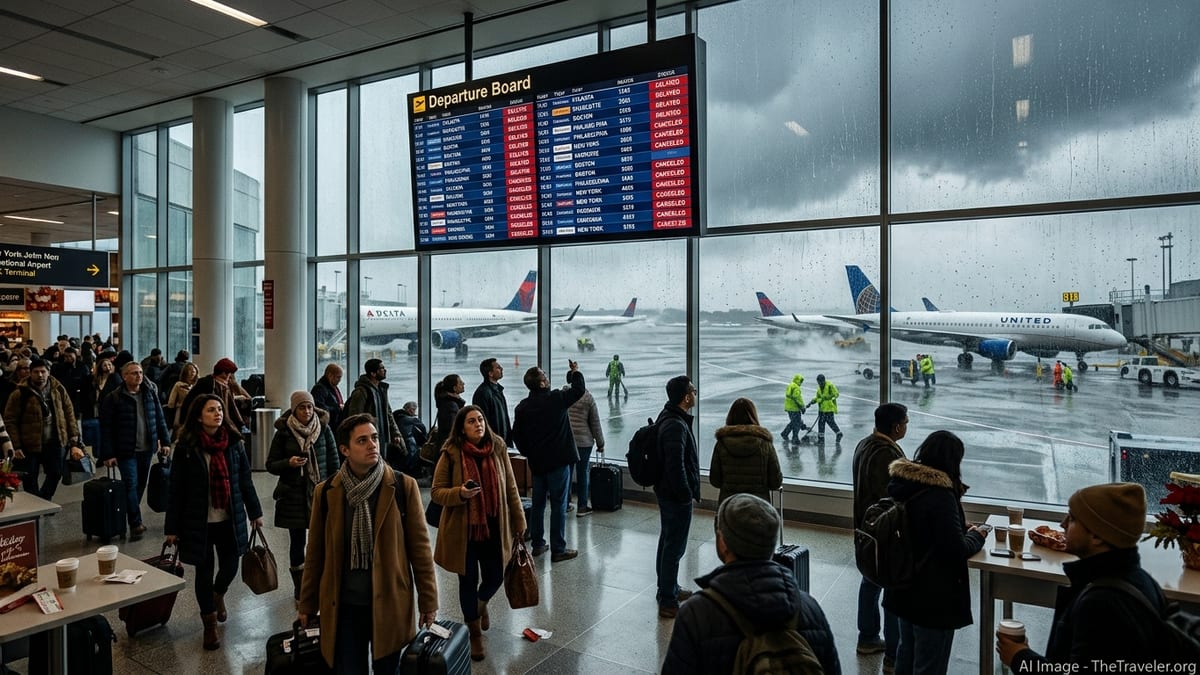
Flight disruption concentrations and how the numbers are changing
By Thursday evening on November 26, live counts from flight-tracking services showed that weather-related disruption had moved well beyond forecasts into active systemwide interference, with several hundred U.S. flights canceled and well over a thousand delayed as the coastal storm intensified along the East Coast. Figures have been fluctuating through the day as airlines adjust schedules, but patterns are consistent: the most pronounced operational problems are clustered at major hubs directly under the rain and wind shield, while secondary delays are appearing at inland and West Coast airports as late-arriving aircraft ripple through the network.
New York’s John F. Kennedy and LaGuardia, Newark Liberty International, Boston Logan and Philadelphia International have reported some of the highest volumes of Thanksgiving Day delays, according to airport status boards and national delay summaries. At various points on Thursday, these airports have faced a combination of arrival metering, lengthened taxi queues and low visibility approaches that reduce the number of aircraft controllers can safely land each hour. Baltimore/Washington International Thurgood Marshall has seen an especially high share of schedule disruption relative to its daily program, with roughly a quarter of flights canceled and around one in five delayed at one point on Thursday, underscoring how smaller hubs can be disproportionately affected when there is little slack in holiday timetables.
The Federal Aviation Administration has periodically imposed traffic management initiatives on the most heavily affected airfields, including delay programs and temporary ground stops at New York City, Philadelphia, Baltimore and Washington-area airports, as conditions have warranted. These controls do not always show up in headline cancellation totals but materially slow passenger journeys. Even where flights have ultimately departed, longer-than-normal waits at the gate, in departure queues and in airborne holding patterns have translated into missed connections and same-day rebookings, particularly on eastbound transatlantic services and dense domestic corridors that rely on tight turnarounds.
Storm dynamics and where conditions are most challenging
The disruption stems from a vigorous coastal low that organized into a nor’easter along the Eastern Seaboard during the 24 to 36 hours leading into Thanksgiving Day. Forecast discussions from the National Weather Service and the Weather Prediction Center on Thursday have highlighted a swath of wind-driven rain from coastal Virginia through New Jersey, Long Island and southern New England, with frequent gusts above 40 miles per hour and pockets of heavier squalls near the immediate coast. Coastal flood warnings and advisories have been in effect from parts of North Carolina northward, as the storm’s low pressure, strong onshore flow and seasonal high tides combine to raise water levels in vulnerable bays and inlets.
For aviation, the combination of strong low-level winds, low cloud ceilings and episodes of poor visibility has been especially complex around the tightly packed airports of the Northeast corridor. While the majority of conditions have remained within legal thresholds for instrument operations, controllers have had to reduce arrival and departure rates for safety, most notably at busy parallel-runway airports such as JFK, Newark and Boston. Reduced throughput has triggered formal arrival metering programs, intermittent ground stops and holding stacks in terminal airspace that all contribute to longer overall travel times for passengers even when their flights are not formally marked as canceled.
On the ground, the same nor’easter has produced flooding on some coastal and low-lying roads that feed major airports around New York, New Jersey and parts of New England, complicating access for passengers and staff. National and local outlets have reported scattered road closures and hazardous driving conditions in parts of the mid-Atlantic and Northeast, along with significant power outages in some states as heavy rain and strong winds bring down trees and power lines. For travelers, that has meant that even when flights are departing, reaching the airport in time has often required greater leeway than usual, particularly in regions under coastal flood alerts.
Pressure on a system already tested by recent technical failures
The Thanksgiving nor’easter is arriving on top of a strained aviation system that has already been tested repeatedly in November by technology-related disruptions. Earlier in the month, a nationwide ground stop linked to an issue in an artificial intelligence based air traffic management tool forced delays and cancellations across multiple days, according to federal and industry summaries. In the weeks that followed, both Delta Air Lines and United Airlines reported separate outages affecting internal operational software, temporarily halting departures and generating hundreds of additional delays at hubs including Atlanta and Denver.
By the start of Thanksgiving week, those technical issues had largely been resolved from a systems perspective, but the operational effects had not fully dissipated. Aircraft and crews were still in the process of returning to normal rotations, and some routes were operating with limited spare capacity or tighter-than-planned ground times. Against that backdrop, Thursday’s weather-related cancellations and long delays are landing on an already taut operation, reducing airlines’ ability to absorb new shocks and limiting the availability of spare seats for travelers whose original flights are scrubbed.
Holiday demand in 2026 has kept that margin thin. Forecasts heading into the week, drawing on AAA and airline trade group projections, anticipated that more than 80 million people would travel at least 50 miles from home between Tuesday, November 24, and the Monday after Thanksgiving, with just under 6 million expected to fly over the broader period. While those totals are slightly down on some previous records, passenger screening data from the Transportation Security Administration indicate that volumes remain near or above pre-pandemic levels on the busiest days. In that context, even a modest national cancellation rate on Thanksgiving Day translates into hundreds of thousands of passengers facing missed connections, re-routings or, for some, the loss of their holiday trip.
Airline waivers, rail adjustments and limited alternatives
Major U.S. airlines began issuing weather waivers for parts of the mid-Atlantic and Northeast several days before the storm’s arrival, expanding coverage as forecast confidence increased. These waivers, which vary by carrier, typically allow customers booked through specified airports to change flights once without incurring change fees, provided new travel takes place within a defined rebooking window and retains the same origin and destination. At least one large network airline has publicly confirmed that passengers using airports including Boston, Baltimore, New York’s JFK and LaGuardia, Newark, Philadelphia, Washington Dulles, Reagan National and Westchester County may rebook travel through at least Saturday, November 28, with fare differences waived on many itineraries that keep to comparable cabins and routing.
Several low-cost and ultra-low-cost carriers with strong East Coast footprints have also highlighted more flexible same-day change options on selected routes. These arrangements have generally included reduced or waived same-day confirmed change fees and, in some markets, the ability to stand by at no extra cost for earlier or later departures where seats remain available. Because eligibility rules and blackout dates differ not only between airlines but also by city pair and fare type, operators and travel advisers continue to urge passengers to check the latest waiver bulletins and conditions directly with their airline before changing plans.
On the rails, intercity operators have adjusted timetables and train formations along sections of the Northeast Corridor to reflect speed restrictions, local flooding and heavier-than-normal demand from travelers seeking alternatives to flying. In some cases, this has meant modest frequency reductions at the height of the storm over concerns about water near track and electrical infrastructure. In others, additional carriages have been attached where infrastructure has permitted, particularly on peak departures between Washington, Philadelphia, New York and Boston. However, advance reservations for the busiest Thanksgiving trains were already tight before the nor’easter developed, and day-of alternative rail options have remained limited on many popular city pairs. Regional commuter rail systems have also reported weather-related delays and isolated service suspensions, although detailed impacts have varied by operator and line.
What travelers should expect through the weekend
Forecasts from the National Weather Service indicate that the nor’easter will begin to lift away from the coast late Thursday night and into Friday, November 27, with steady rain gradually tapering along much of the Interstate 95 corridor and inland winds easing. Coastal flooding concerns may linger into subsequent high-tide cycles, especially along exposed stretches of New Jersey, Long Island and southern New England, and rough surf is likely to remain a hazard along some beaches even as rainfall intensity declines. As the low tracks northeastward into the open Atlantic, the zones of heaviest rain and strongest winds along the U.S. coastline should contract, which in turn should reduce the need for the strictest air traffic flow restrictions at affected airports.
For air travelers, that improving meteorological picture does not mean an immediate return to normal operations. Aircraft and crews that ended Thanksgiving Day out of position will need time to be reintegrated into regular rotations, and connecting hubs in the Midwest, Southeast and on the West Coast are already experiencing some secondary delays as they work through aircraft arriving behind schedule from the East. Passengers flying on Friday and, to a lesser extent, Saturday should therefore anticipate an elevated risk of schedule changes, including rolling delays and isolated cancellations, even if local weather has largely cleared.
Travelers scheduled to fly in the next 24 to 48 hours are being advised by airlines and regulators to begin closely monitoring flight status at least a day before departure, using carrier apps, text alerts and official websites. Given the pace of schedule adjustments on Thursday, relying solely on printed boarding passes or earlier confirmation emails risks missing updated departure times, gate changes or aircraft swaps that can alter seat assignments. Airports and airlines are also recommending that passengers allow additional time when traveling to the airport and for check-in and security, particularly during morning and late afternoon peaks, to accommodate potential traffic delays, longer security lines and congestion at counters handling rebookings.
Rights, practical steps and planning for the rest of the season
For passengers whose flights are canceled or heavily delayed, the specific remedies available depend on both U.S. regulations and individual airline policies. Under federal rules, when a flight that a passenger no longer wishes to take is canceled, or significantly changed by the airline, travelers are generally entitled to a refund of the unused portion of their ticket to their original form of payment, regardless of the reason for the disruption. When customers still want to complete their trip, most carriers will attempt to rebook them on the next available departure at no additional cost. During Thanksgiving week, however, limited spare capacity on many routes means that same-day alternatives may be scarce, particularly on heavily booked nonstops into major hubs inside the storm zone.
Accommodation, meal vouchers and other on-the-ground assistance for stranded passengers remain largely at the discretion of the airline during weather-related events, which are considered outside carriers’ direct control under current U.S. rules. Some airlines have indicated in public guidance that they may provide hotel or meal assistance in gateway cities when overnight delays occur and rooms are available, but such support is not guaranteed. With many hotels near major hubs already busy with holiday guests and disrupted travelers, passengers who learn they will need to overnight are generally advised to secure accommodation as soon as a substantial delay or cancellation is confirmed, whether through airline channels or directly with hotels.
Looking beyond this particular nor’easter, outlooks from federal meteorological agencies for the 2026–27 winter season point to an elevated likelihood of strong coastal storms affecting parts of the eastern United States. While such seasonal guidance is probabilistic rather than predictive of individual events, it suggests that travelers with important trips later in the winter may benefit from allowing larger buffers for connections, preferring earlier departures in the day where possible and having clear contingency plans for journeys that cannot easily be rescheduled. For the remainder of the Thanksgiving travel period, the most practical steps remain concrete: verify flight and rail status repeatedly in the hours before departure, keep contact details current with airlines and booking platforms so disruption notifications are received promptly, and be prepared for lingering delays on Friday and into the weekend as the aviation and rail systems work through the backlog generated on Thanksgiving Day.