


More news on this day
Flight disruption across the United States began to ease on Friday, November 27, 2026, after a week of severe Thanksgiving weather and a rare nationwide Federal Aviation Administration ground stop, yet flight-tracking data still showed hundreds of delays and scores of cancellations as airlines worked to reposition aircraft, restore crew rosters and return schedules to something closer to normal.
Get the latest news straight to your inbox!
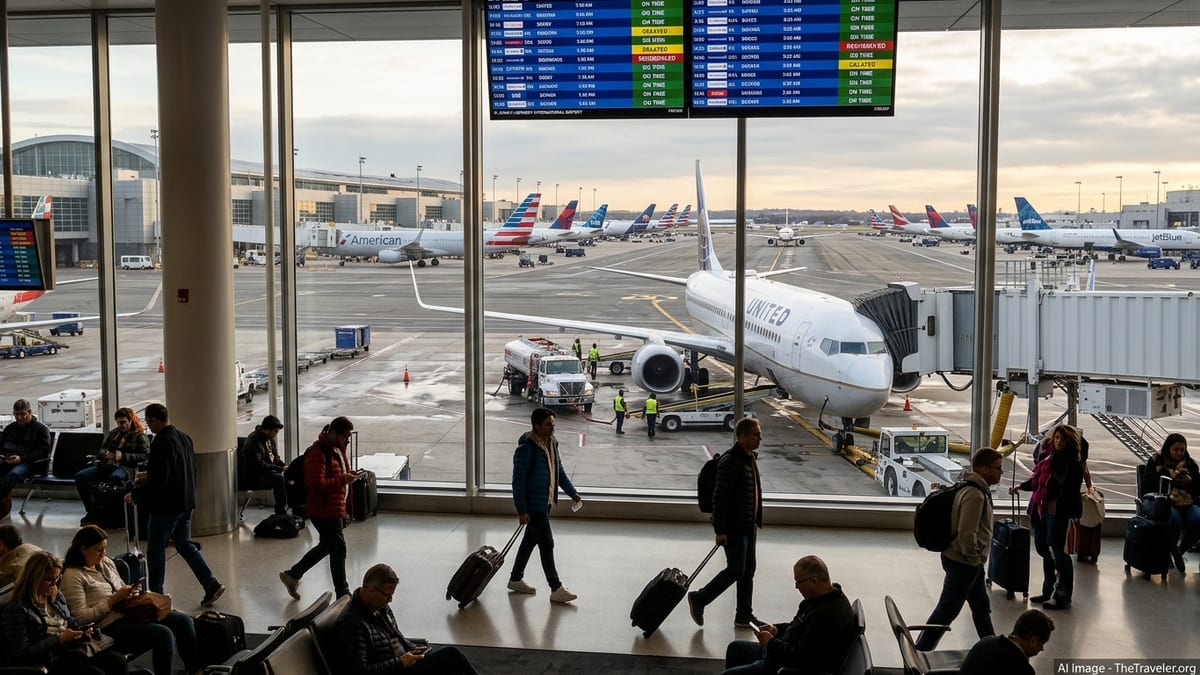
Schedules stabilise on November 27 but remain fragile
By early morning on Friday, November 27, data from flight-tracking services indicated that the number of disrupted flights within, into or out of the United States had fallen sharply compared with Thanksgiving Day. Figures from FlightAware and other trackers pointed to several hundred delays and under 100 cancellations nationwide in the first part of the day, far below the levels seen on Thursday, November 26, when more than 2,200 flights were delayed and over 400 were canceled as the East Coast storm peaked. Although Friday’s totals were still higher than on a routine autumn Friday, they suggested that recovery was under way rather than deteriorating further.
The disruption on November 27 was widely distributed across the network rather than concentrated at a single hub, reflecting how the lingering effects of the storm and earlier system issues were still rippling through airline operations. Major gateways that had been under the heaviest weather restrictions a day earlier reported a marked improvement. At New York’s John F. Kennedy International Airport and LaGuardia Airport, early data showed a modest number of delayed arrivals and departures and relatively few cancellations compared with Thursday, when roughly 10% of scheduled flights at each airport were canceled as winds, low clouds and saturated runways constrained operations.
Conditions also improved at other key East Coast airports exposed to the nor’easter, including Newark Liberty International, Baltimore/Washington International Thurgood Marshall and Boston Logan. While each continued to log weather-related and knock-on delays, there was no repeat of Thursday’s intense concentration of disruption. In the Washington area, Ronald Reagan Washington National and Washington Dulles International both reported manageable queues at security and check-in on Friday morning, in contrast to the longer lines seen just before the holiday, when the Transportation Security Administration had prepared for daily passenger volumes above 3 million at the peak of the Thanksgiving rush.
The ongoing challenge on November 27 was the fragility of schedules rather than the severity of any single constraint. With many aircraft and crews still out of position after days of rolling problems, some passengers continued to face missed connections and rebooked itineraries even where local weather had improved. Airlines were using spare aircraft where possible and drawing on reserve crews to plug gaps, but duty-time limits and overnight curfews at some airports restricted how quickly all operations could be restored.
What the November 13 nationwide ground stop changed
The Thanksgiving week difficulties came less than a fortnight after one of the most disruptive single events in recent U.S. aviation history: the nationwide FAA ground stop on Friday, November 13, 2026. According to a question-and-answer document published by the FAA and briefings from the U.S. Department of Transportation, instability in a critical telecommunications network used for communications and radar data began affecting multiple Air Route Traffic Control Centers in the afternoon Eastern Time. As anomalies spread to 17 of the FAA’s 22 centers and several terminal radar approach facilities, officials issued a nationwide halt to most departures out of what they described as an abundance of caution.
The order took effect in mid-afternoon and remained in place for approximately 4 hours and 45 minutes before being lifted once engineers confirmed that core systems were stable and sufficient redundancy had been restored. During that window, airlines canceled roughly 12,500 flights, including more than 9,000 cancellations by major carriers, according to figures released by transportation officials. Thousands more flights operated late as aircraft and crews waited out the pause on the ground.
Because so many flights were either canceled outright or landed far from their planned positions, the operational impact extended well beyond the hours of the ground stop itself. On Saturday, November 14, carriers were still canceling and delaying large numbers of flights as they attempted to reposition aircraft, move reserve crews into place and rebuild rotations within federal duty-time limits. Federal emergency management summaries and congressional research material describe the incident as one of the most extensive nationwide aviation disruptions since the airspace shutdown following the attacks of September 11, 2001, though the underlying causes were very different.
In the days after the outage, the FAA and the Department of Transportation reiterated that preliminary investigations had found no evidence of a cyberattack. Instead, they linked the event to a failure and subsequent instability within telecommunications infrastructure provided by external vendors, which in turn affected legacy equipment inside the FAA’s network. Technical summaries point to a flood of connection attempts that overwhelmed parts of the network and produced inconsistent radar and communications data for controllers. While the FAA has promised a detailed, public post-incident review, members of Congress have already requested joint technical briefings involving the agency and its contractors and have raised questions about whether the episode indicates that air traffic control modernization and communications redundancy have lagged behind current needs.
Thanksgiving storms compound existing strain on the system
The late November storms arrived while airlines and regulators were still working through the residual effects of the nationwide halt. Forecasts issued earlier in the week had highlighted the potential for a strong coastal low to develop along the Eastern Seaboard, and by Thanksgiving Day those warnings were borne out. National Weather Service alerts on Thursday, November 26, described heavy rain, strong winds and coastal flooding affecting an area from the Mid-Atlantic through southern New England, with gusts exceeding 40 miles per hour in exposed locations, periods of reduced visibility and waterlogged ground conditions at major airports.
Those conditions intersected directly with some of the busiest travel days of the year. By Thursday evening, outage-tracking services estimated that close to a million customers across multiple East Coast states had lost power as trees and power lines came down, while transport operators reported flooded roads and localized closures. In New York City, organizers of the 100th Macy’s Thanksgiving Day Parade confirmed on November 25 that the event would be postponed to Saturday, November 28, marking the first time in its century-long history that the parade had been delayed rather than held on Thanksgiving Day itself. City advisories cited concerns about high winds and heavy rain along the parade route.
On the aviation side, trackers such as FlightAware reported more than 2,200 delays and over 400 cancellations on Thanksgiving Day for flights to, from or within the United States. Many of the hardest-hit airports were those directly in the path of the storm. Baltimore/Washington International, New York’s LaGuardia and John F. Kennedy airports, Newark Liberty and Boston Logan all experienced elevated cancellation and delay rates as crosswinds, low cloud ceilings and standing water reduced arrival and departure rates. In several cases the FAA implemented temporary, airport-specific ground stops or ground delay programs, holding some departing flights at origin airports while arrival conditions improved.
Separate weather systems added complexity away from the coast. Parts of the Midwest and interior Northeast saw early-season snow and wintry mix during the same period, affecting hubs such as Chicago O’Hare and Detroit Metropolitan Wayne County on different days of the week. While those events were not as extreme as the coastal storm, they contributed to additional runway de-icing requirements, slower ground handling and occasional visibility restrictions, all of which interacted with an already stretched system. As operations resumed after each local weather event, airlines were still dealing with aircraft and crews displaced by the November 13 ground stop, so knock-on delays appeared even in regions where the skies were relatively clear.
What federal data reveal about on-time performance and bottlenecks
The severity of the past fortnight’s events stands out in daily disruption figures, but federal statistics suggest that they occurred within a system that already operates with limited margin for error during peak periods. The Department of Transportation’s latest Air Travel Consumer Report, released in November 2026 and covering performance through September, shows that around one in five domestic flights arrived at least 15 minutes late in recent months, using the standard federal definition of an on-time arrival. At some large airports, on-time performance was weaker still, particularly during late afternoon and evening peaks.
The same report attributes a substantial share of total delay minutes to so-called national aviation system factors. This category includes air traffic control initiatives, airport capacity constraints and certain forms of non-extreme weather, alongside separate tallies for carrier-caused delays and delays linked to more severe storms. In practical terms it means that even on days without headline-grabbing events, a mix of routine congestion, modest weather and late-arriving aircraft already consumes much of the system’s flexibility.
That background helps explain why both the telecommunications outage and the Thanksgiving nor’easter had effects that extended well beyond the hours when the most intense problems occurred. When a nationwide ground stop halts departures from hundreds of airports simultaneously, or a coastal storm sharply reduces arrival capacity into slot-constrained hubs, there are few unused aircraft, spare gates or reserve crews left to absorb the shock. Schedules built around tight aircraft turns and back-to-back crew duties can unwind quickly, leaving airlines to choose between canceling flights in advance to create recovery space or attempting to operate full programs and accepting the risk of rolling delays.
Regulators have responded with a mixture of operational adjustments and consumer-focused initiatives. The FAA has continued to use ground delay programs and miles-in-trail spacing requirements to meter traffic into the busiest airspace when capacity is reduced, and has encouraged airlines to pare back schedules on the most congested routes and time bands. In periods of extended disruption, the agency has also granted temporary slot waivers or schedule relief at slot-controlled and slot-facilitated airports, allowing carriers to cancel or retime flights without losing valuable long-term access.
The Department of Transportation, for its part, maintains an online dashboard that compares the customer service commitments of U.S. airlines in specific scenarios, such as controllable cancellations or long delays. The latest version highlights which carriers promise meal vouchers, hotel accommodation or complimentary rebooking when disruptions are within their control, and clarifies that assistance is more limited when weather or air traffic control restrictions are the primary cause. Officials have pointed to the dashboard as a way for travelers to understand what they can expect when problems arise, although it does not itself prevent delays or mandate compensation.
What passengers should check for the rest of the holiday period
For travelers flying on Friday, November 27, and across the remainder of the Thanksgiving weekend, the latest data suggest that most scheduled flights will operate, but that conditions remain sensitive to further weather changes or local operational issues. Airlines and airports continue to advise passengers to monitor their flight status closely via official carrier apps or websites, which typically reflect schedule adjustments and gate changes more quickly than airport departure boards or third-party tools. Given the recent pattern of rolling delays, travelers with tight connections, especially through East Coast and Midwest hubs that experienced heavy disruption this week, may wish to allow additional time between flights where their bookings permit.
Passengers whose flights are significantly delayed or canceled during this period should review their airline’s published policies and, where relevant, the Department of Transportation’s customer service dashboard to understand their options. When a disruption is within an airline’s control, such as those caused by crew or maintenance problems, many U.S. carriers commit to rebooking customers at no extra fare and may provide meal vouchers or hotel accommodation if an overnight stay becomes necessary. When the primary cause is weather or an FAA-directed traffic management initiative, airlines generally still rebook passengers on the next available flight but are less likely to cover incidental expenses, although practices vary by carrier. Keeping detailed receipts and documenting the circumstances can help when seeking reimbursement in cases where written policies allow it.
Looking into the coming week, National Weather Service outlooks indicate that the coastal storm responsible for the worst of Thursday’s disruption is moving away, but further unsettled conditions are possible as November shifts into December, including the risk of additional frontal systems and early-season snow in northern states. Travelers with time-sensitive onward connections, such as cruises or long-distance rail departures, may wish to build in extra margin or consider flexible ticketing options where available. Those planning trips through major U.S. hubs over the next several days should keep an eye on both local forecasts for their departure and arrival points and any further operational updates from the FAA on the status of its telecommunications systems as the wider winter travel season begins.