


More news on this day
Europe’s peak summer travel season is once again colliding with mounting operational strains, as new data show the Netherlands joining Austria, France, Portugal, Germany, Finland, Belgium, Spain and Italy among the countries experiencing a sharp rise in flight delays and cancellations across major aviation hubs.
Get the latest news straight to your inbox!
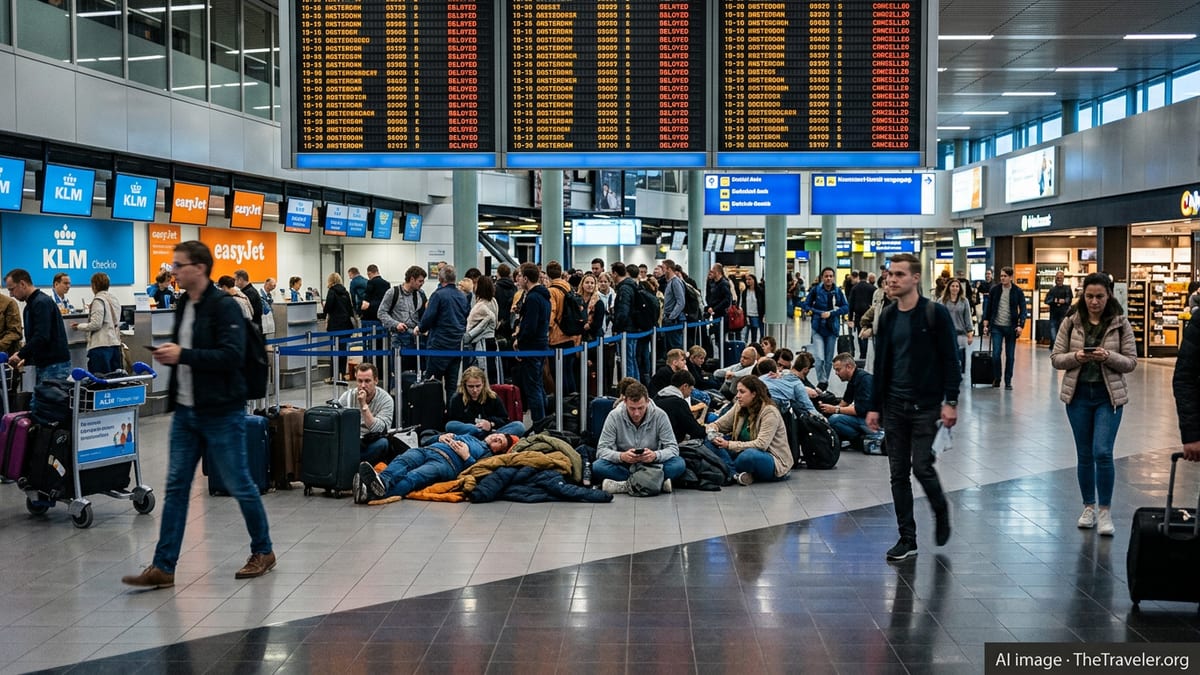
Netherlands Added to Growing Map of Disruption
Recent operational data and route-level analyses indicate that the Netherlands has now clearly joined the ranks of European countries facing sustained flight disruption as the summer season intensifies. Amsterdam Schiphol, one of the continent’s busiest transfer hubs, has featured prominently in delay statistics and case studies tracking hour‑plus holdups and late arrivals across the region.
Independent punctuality and passenger-rights platforms report that routes to and from Schiphol are now regularly appearing among Europe’s most delay-prone city pairs, even on days when overall European traffic is described as stable. In some rankings of airports with the highest share of 60 minute or longer delays, connections involving Amsterdam appear repeatedly, underlining the pressure on a hub that plays a critical role in north European connectivity.
The Netherlands’ inclusion alongside Austria, France, Portugal, Germany, Finland, Belgium, Spain and Italy reflects a broader pattern in which individual local issues, from tight turnaround schedules to weather and air traffic control constraints, are magnified by the complexity of Europe’s interconnected hub network. As a result, relatively small pockets of disruption can quickly cascade into missed connections and rolling delays for passengers transiting through Amsterdam and other major nodes.
Earlier in the year, Schiphol also experienced acute strain during severe winter weather, when hundreds of flights were cancelled over several days as snow and de-icing bottlenecks reduced runway capacity. That episode has left airlines and airport planners wary of renewed pressure as schedules ramp up to peak summer levels.
From France to Finland, Network Bottlenecks Deepen
Across the wider European network, publicly available operational briefings show that traffic is nudging above last year’s levels while delays remain elevated compared with pre-crisis norms. Eurocontrol’s latest summer updates describe a system running close to capacity, with total flights forecast to grow by around 2 percent on average compared with summer 2025 and potentially exceeding that rate in peak weeks.
France and Spain continue to generate a significant share of en route air traffic flow management delays, with control centers in Reims, Marseille, Brest, Barcelona, Seville and Madrid repeatedly cited for capacity and staffing constraints in combination with strong traffic growth. Reports also highlight persistent pressure in parts of southern Europe, including Greece and Portugal, where demand from both intra-European and long haul markets has rebounded strongly.
Germany remains a focal point of disruption as well, with consumer-claims data signaling that a large proportion of recent cancellations can be traced to a handful of major German airports and a small number of carriers with concentrated hub operations. Finland, Austria and Belgium, while handling lower absolute volumes, have nonetheless seen rising instances of knock-on delays when weather, staffing or technical issues collide with tightly timed summer schedules.
Despite modest week-on-week improvements in some metrics, the broader picture is of a system operating with limited margin for error. When localized storms, staffing shortfalls or technical outages occur in one country, the impact is often felt hours later in another, particularly where connecting flights feed long haul departures to North America, Africa and Asia.
New Border Checks and Structural Pressures Add To Queues
Operational challenges this summer are not limited to the airspace itself. The phased rollout of the European Union’s Entry/Exit System, which records biometric data for many non-EU arrivals, is contributing to longer processing times at border control points in popular destinations such as Spain, Portugal, Italy and France. Airline and airport bodies have warned that persistent bottlenecks at these checkpoints can lead to missed connections even when flights operate according to schedule.
Industry representatives have cautioned that in a worst-case scenario, queues of several hours could develop at some peak-time arrivals, particularly at leisure-focused airports where staffing and infrastructure are already under strain. Travel media and passenger advocacy groups are advising visitors to allow extra time for border formalities and to build longer buffers between connecting flights that require passport control.
At the same time, elevated jet fuel prices linked to wider geopolitical tensions, along with concerns over potential supply disruptions, are exerting additional pressure on airline operating models. Analyses from aviation consultancies and trade publications suggest that higher fuel costs, combined with airport capacity constraints, are encouraging some airlines to trim frequencies, consolidate flights and maintain tight control over spare capacity, leaving less room to recover after operational shocks.
Regional airports across Europe have been flagged as particularly vulnerable if demand softens or fuel costs spike further, raising the risk of additional cancellations or route withdrawals that could force travellers onto already busy services via major hubs like Amsterdam, Frankfurt, Paris and Madrid.
Passenger Rights and Compensation Rules Under Spotlight
The latest wave of disruption is sharpening focus on Europe’s extensive passenger-protection framework. Under the long-standing EU rules commonly referred to as EU261, travellers whose flights are heavily delayed or cancelled may be entitled to fixed-sum compensation and assistance, depending on the length of the delay, the distance flown and the cause of the disruption.
In mid-June, European lawmakers backed updated language clarifying compensation thresholds for long-haul routes while affirming core protections for passengers caught up in cancellations and extended delays. The agreed text reiterates that airlines can be liable for payouts of several hundred euros per person when disruption is within their control and meets defined delay criteria, while also confirming that free cabin baggage remains a basic right across the single market.
Consumer groups note that as cancellations and long delays accumulate in countries such as the Netherlands, Germany, France, Spain, Italy, Portugal, Belgium, Austria and Finland, awareness of these rights becomes increasingly important. Passenger claims services report heightened interest in tools that automatically check past itineraries for missed compensation opportunities, sometimes going back several years.
However, experts also emphasize that not all disruption will qualify for financial redress. Weather events, air traffic control restrictions and other circumstances considered beyond an airline’s control can limit eligibility, even where the practical impact on travellers is significant.
What Travellers Can Expect Through Peak Season
With traffic levels rising and multiple structural pressures in play, aviation forecasts and operational briefings suggest that Europe’s flight network is likely to remain fragile throughout the core summer months. While not every day will see severe disruption, the combination of tight schedules, airspace inefficiencies, volatile fuel markets and evolving border-control procedures is expected to keep delay and cancellation risk elevated, particularly at congested hubs.
Travel coverage and advisory columns are recommending that passengers build additional resilience into their plans, such as opting for earlier departures where possible, avoiding very tight connections and keeping essential items in carry-on bags in case of overnight disruption. Many commentators also highlight the value of airline apps and independent flight-tracking tools to monitor inbound aircraft and emerging patterns of delay before airport departure boards are updated.
For the Netherlands and its fellow hotspot countries across western and southern Europe, the coming weeks will test whether operational adjustments and traffic-management measures can prevent localised strains from escalating into a repeat of previous summers’ headline-grabbing meltdowns. For now, the data point to a landscape where even a small number of cancellations or missed rotation windows at a single major hub can ripple rapidly through the rest of the continent.