


More news on this day
Passengers booked on Frontier Airlines flight FFT4117 faced unexpected travel turmoil this weekend after the Airbus A320 operating the route diverted to Raleigh-Durham, abruptly severing a key low-cost link to Myrtle Beach and leaving budget travelers scrambling for alternatives along the Carolina coast.
Get the latest news straight to your inbox!
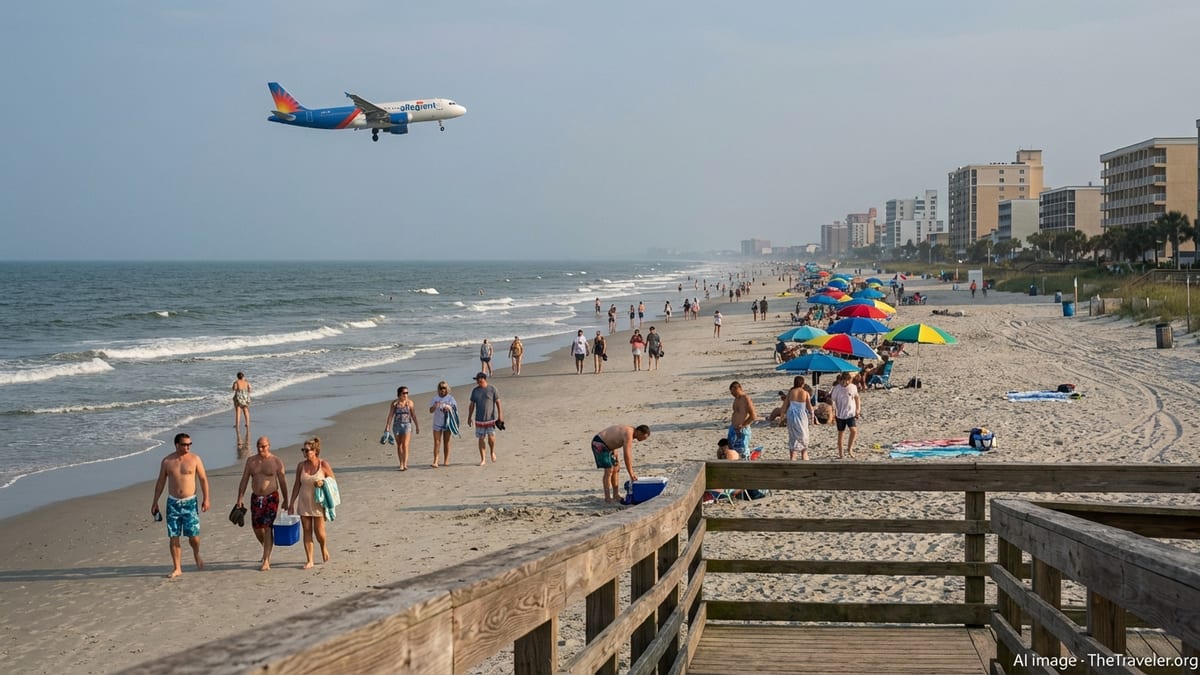
Sudden Diversion Upends Plans for Coastal Travelers
Flight tracking data and publicly available schedules indicate that Frontier Airlines flight FFT4117 is scheduled as a short-hop Airbus A320 service connecting Raleigh-Durham International Airport and Myrtle Beach International Airport, a high-demand leisure route for beach-bound travelers. Instead of operating as planned, the flight diverted into Raleigh-Durham, effectively cutting the nonstop connection and forcing passengers to replan their journeys at short notice.
The A320 aircraft involved is part of Frontier’s all-Airbus single-aisle fleet, which the carrier uses extensively on dense leisure routes with tight turnaround times. When a single round-trip is disrupted on a point-to-point route with limited weekly frequencies, the impact on passengers can be disproportionately large compared with hub-based airlines that offer more options for rebooking.
Public flight-status boards show that the FFT4117 numbering is associated with the Raleigh-Durham to Myrtle Beach pairing, highlighting how any disruption on this sequence reverberates through both airports. For travelers timing arrivals to match resort check-in windows, golf tee times, and vacation rentals, the unexpected diversion translated directly into missed reservations, extra ground transport costs, and last-minute itinerary changes.
Limited Frequencies Magnify Impact on Myrtle Beach Access
Unlike major hub routes that see multiple departures each day across several airlines, the Frontier Airlines link between Raleigh-Durham and Myrtle Beach typically operates at low weekly frequencies. Schedules published by independent flight-tracking services show a pattern of once-weekly service, which leaves passengers with few same-day alternatives when something goes wrong with a particular flight number.
Because the Myrtle Beach market is highly seasonal and heavily leisure-driven, many travelers build trips around ultra-low fares tied to specific departure dates. When an aircraft diverts and a rotation like FFT4117 cannot be completed as expected, passengers often must choose between expensive last-minute alternatives on other carriers or overland travel that can add several hours to the journey.
Reports from past disruptions on similar point-to-point routes suggest that travelers in these situations frequently resort to rental cars or rideshare services to bridge the gap between their intended destination and the diversion airport. For Myrtle Beach visitors, that can mean an unplanned highway trek from Raleigh-Durham, turning what was marketed as a sub-one-hour hop into a multi-hour door-to-door odyssey.
Ultra-Low-Cost Model Leaves Little Buffer in Irregular Operations
Industry data and corporate filings show that Frontier Airlines operates one of the largest Airbus A320neo-family fleets in the United States, with a business model built around dense seating configurations and high daily utilization of each aircraft. This approach allows the airline to advertise very low base fares, but it also leaves limited slack in the system when an aircraft is pulled off its planned rotation by a diversion.
With aircraft scheduled tightly across multiple city pairs in a single day, a diversion on a short leg such as FFT4117 can cascade into subsequent delays and cancellations. The airline must then decide whether to protect longer or more profitable routes with its available fleet, a choice that can leave low-frequency leisure routes such as Myrtle Beach particularly vulnerable to extended disruption.
Publicly available customer accounts across the industry show that when ultra-low-cost carriers face irregular operations, passengers can experience longer waits for reaccommodation and fewer options for same-day rebooking. Fees for seat assignments, carry-on bags, and checked luggage are also generally nonrefundable under standard fare rules, adding to frustration when a key flight segment is lost due to a diversion.
Raleigh-Durham’s Growing Role as a Diversion and Relief Hub
Raleigh-Durham International Airport has emerged in recent years as one of the fastest-growing midsize airports in the United States, served by a mix of legacy, low-cost, and ultra-low-cost carriers. Its location along the U.S. East Coast and its dual-runway layout make it a logical diversion point for flights transiting the Mid-Atlantic and Southeast, particularly in periods of convective weather or congestion further down the coast.
Frontier’s expanding footprint at Raleigh-Durham, paired with its use of the Airbus A320 family, has increased the number of short-haul spokes radiating from the airport to leisure destinations such as Myrtle Beach. When an operation such as FFT4117 diverts into Raleigh-Durham and does not continue as planned, the airport effectively becomes an unintended final stop for passengers who expected it to be only a departure or overflight point.
Available scheduling information shows that Raleigh-Durham is connected to a wide range of domestic destinations, but nonstop service to Myrtle Beach remains comparatively limited. As a result, when a dedicated low-cost segment is disrupted, passengers who are unfamiliar with the region’s geography can find themselves relying on rental cars, intercity buses, or ad hoc ride arrangements to salvage their travel plans.
Passengers Face Complex Rebooking and Compensation Landscape
The diversion of FFT4117 has once again drawn attention to the patchwork of passenger-rights protections in the United States. Consumer-advocacy material notes that when diversions are attributed to weather or air-traffic constraints, airlines generally are not required to provide hotel rooms, meal vouchers, or ground transportation to the original destination, even when customers are left far from where they intended to land.
For a route such as Raleigh-Durham to Myrtle Beach, this can mean that travelers whose flight terminates early at the diversion point must shoulder the cost of getting themselves to the coast if the carrier is unable or unwilling to operate a later segment. Ultra-low-cost carriers that depend heavily on ancillary fees may be reluctant to offer voluntary refunds or credits beyond what is stated in their contracts of carriage.
Publicly available guidance from airline and government sources encourages affected passengers to document all additional expenses, including hotels, meals, and replacement transportation, in case partial reimbursement is later offered as a gesture of goodwill. However, past cases involving diversions across the industry show that compensation outcomes vary widely and can take weeks or months to resolve, especially when weather or air-traffic-control issues are cited as contributing factors.
With the summer travel season approaching and Myrtle Beach preparing for another influx of visitors, the disruption around Frontier’s FFT4117 service illustrates how a single Airbus A320 diversion can ripple across an entire leisure corridor. For travelers, it is a reminder that the cheapest ticket on a thinly served route can come with added risk when irregular operations suddenly sever a critical link in the journey.