


More news on this day
A fast-moving line of severe thunderstorms forced a ground stop at Baltimore/Washington International Thurgood Marshall Airport, triggering 189 flight delays and 26 cancellations and disrupting schedules for Southwest, Delta, United, Icelandair and other carriers across the United States, Canada, Mexico, Jamaica, Iceland and the wider Caribbean region.
Get the latest news straight to your inbox!
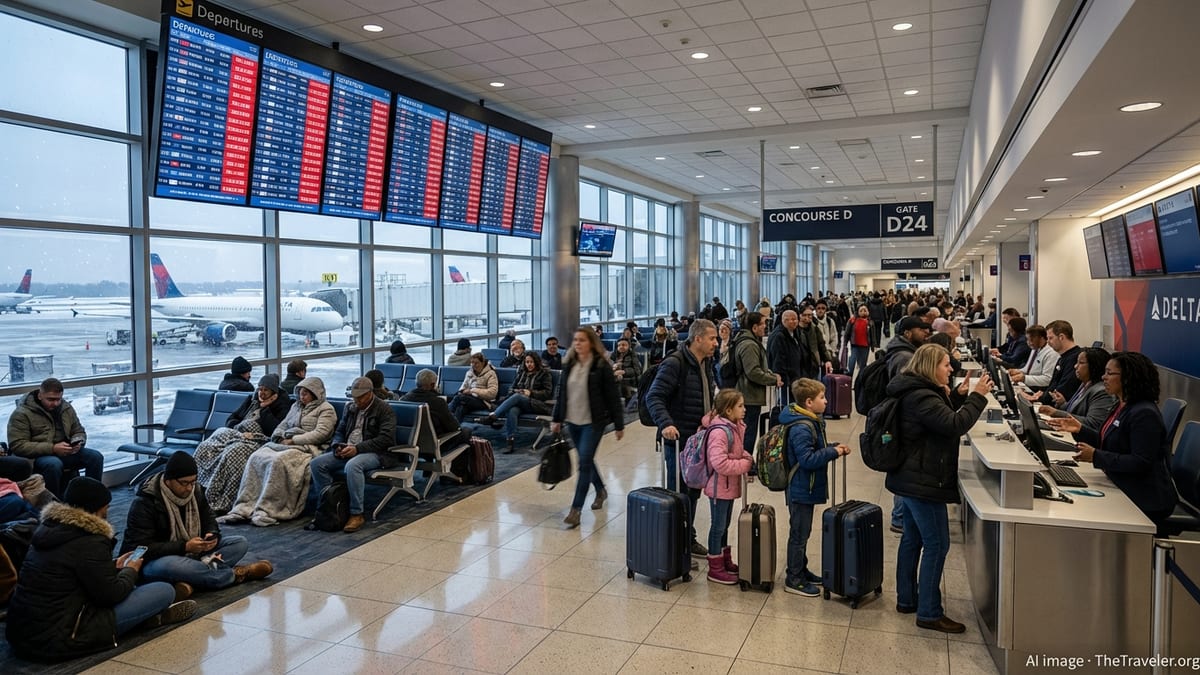
Thunderstorms Halt Departures at Key Mid-Atlantic Hub
The ground stop at Baltimore/Washington International Thurgood Marshall Airport temporarily paused most departures as air traffic managers responded to intense thunderstorm cells moving through central Maryland and the broader Mid-Atlantic corridor. Publicly available aviation data indicates that the restriction was imposed to manage safety around lightning, low visibility and rapidly shifting wind conditions in the terminal area.
Operational data and live flight tracking platforms show that BWI, a major base for Southwest Airlines and an important station for Delta Air Lines, United Airlines, Icelandair and several leisure carriers, experienced a sharp spike in late-afternoon and evening disruptions. Departures were held at gates, aircraft on approach were placed in holding patterns or diverted, and turnaround times for arriving flights lengthened as crews waited for ramp conditions to improve.
The delay count climbed to 189 flights as thunderstorms lingered over the region, with 26 flights ultimately canceled when the operating window for crews and aircraft narrowed. The pattern reflected a typical severe-weather disruption in which early, short holds compound over several hours into missed connections, aircraft and crew imbalances and ultimately canceled rotations.
Once the strongest storm cells moved east of the airport, traffic managers gradually lifted the most restrictive measures, but residual congestion persisted as airlines worked through the backlog of aircraft waiting for departure slots and arriving flights queued for available gates.
Southwest, Delta, United and Icelandair Among Most Affected
BWI’s role as one of Southwest Airlines’ largest bases meant that the carrier absorbed a significant share of the delays and cancellations. Publicly available schedule data shows that Southwest operates a dense web of point-to-point routes from BWI to major U.S. cities and popular leisure destinations, making its network particularly vulnerable when thunderstorms stall operations at the airport.
Delta Air Lines and United Airlines, both of which use BWI as a spoke station feeding their hubs, also saw disruption as inbound and outbound flights fell behind schedule. When departures from BWI are held for weather, aircraft and crews that should feed into evening bank operations at larger hubs often arrive late, putting pressure on tightly timed domestic and international connections.
Icelandair, which links BWI to Reykjavík and onward to Europe, was also drawn into the disruption. Weather-related delays on transatlantic services can create additional challenges because long-haul rotations typically operate once daily, leaving fewer opportunities to re-accommodate passengers on later flights if a cancellation becomes necessary.
Other carriers serving BWI, including U.S. mainline, low-cost and leisure airlines, recorded shorter but still significant delays as they sequenced departures into the available departure window once the most restrictive elements of the ground stop were eased.
Ripple Effects Across the United States, Canada and the Caribbean
Because BWI connects to dozens of destinations across North America and the Caribbean, the local weather event quickly evolved into a wider network disruption. Flights linking Baltimore to cities across the United States experienced rolling delays, including services to major hubs in the Northeast, Midwest, South and West, as well as to secondary and leisure markets.
Connections to Canada, including key markets such as Toronto, and to resort destinations in Mexico and the Caribbean experienced knock-on impacts as aircraft arriving late into BWI were unable to depart on time. Data from flight-tracking and airport-status platforms shows outbound services to popular sun destinations facing extended boarding holds, schedule pushes and in some cases aircraft swaps as airlines sought to preserve the most time-sensitive long-haul operations.
Links to Jamaica and other Caribbean destinations, which often operate in narrow scheduling windows to meet onward hotel check-in and cruise departure times, were particularly exposed. Travelers on these routes reported extended gate holds and late-night arrivals as airlines attempted to complete as many rotations as possible within crew duty limits.
International connections involving Iceland were also affected, with any significant delay on the Baltimore to Reykjavík leg risking missed onward connections in Europe and complicating aircraft positioning for the following day’s schedule.
How Ground Stops Cascade Through Airline Networks
Ground stops are a standard tool used by air traffic managers to regulate the flow of aircraft into and out of an airport when weather or other operational constraints temporarily exceed capacity. Rather than allowing congestion to build in the air and on taxiways, flights are held at their departure points until conditions improve and a manageable flow can be re-established.
At an airport like BWI, where a single carrier accounts for a large share of departures and multiple airlines operate tightly timed schedules, even a relatively short ground stop can generate disproportionate disruption. Aircraft that are held at gates or on remote stands cannot operate their next scheduled sectors, causing delays that propagate through the network. Crews may reach duty time limits, aircraft may miss maintenance windows, and connection banks at other hubs may be weakened.
Published aviation guidance notes that summer thunderstorms in particular can create highly variable and localized conditions, which complicates forecasting and often leads to conservative spacing between aircraft for safety reasons. As a result, airlines must carefully prioritize which flights to operate once restrictions ease, often focusing first on long-haul services, aircraft repositioning needs and routes with few daily frequencies.
The BWI event also illustrates how delays at a single airport can spread quickly to distant cities. Aircraft and crews scheduled to operate routes in the western United States, Canada, Mexico or the Caribbean may originate in Baltimore, meaning that a local storm can eventually slow operations as far away as the Pacific coast or Central America.
Travelers Face Missed Connections and Rebooking Challenges
For passengers, the thunderstorms and resulting ground stop translated into missed connections, unexpected overnight stays and extended time in terminals across several countries. According to real-time airport and airline operations data, many travelers with connections through BWI found that their onward flights departed late or were canceled entirely as the disruption unfolded.
Those bound for international holidays in Mexico, Jamaica and other Caribbean islands encountered particular challenges because many of these routes operate once per day or a few times per week. When a flight is canceled on such a route, rebooking options can involve long waits for the next available seat or complex rerouting through different hubs.
Airlines encouraged passengers to monitor mobile applications and departure boards for rapid schedule changes and, in some cases, implemented flexible travel policies allowing customers to switch to alternate flights or dates without change fees. However, as aircraft and crews remained out of position for much of the evening, open seats became scarce on several routes, extending the disruption into subsequent days.
Travel industry analysts note that such events highlight the importance for passengers of allowing extra connection time during peak thunderstorm season, particularly when traveling through busy East Coast airports. They also suggest that travelers heading to cruise departures or time-sensitive events consider arriving at their embarkation city a day early when feasible, especially during periods of unsettled summer weather.