


Two of Poland’s most atmospheric cities offer very different winter experiences. Baltic Gdańsk mixes dockside cranes and Solidarity history with Gothic facades along the Motława River, while inland Kraków revolves around its medieval Rynek Główny and royal Wawel Hill. Both have strong museum scenes, lively Christmas markets and good air links, but the feel on a cold December weekend can be quite different. This comparison focuses on December to February, using recent flight, ticket and price data where available, to help you choose the right winter city break for your style and budget.
Get the latest updates straight to your inbox!
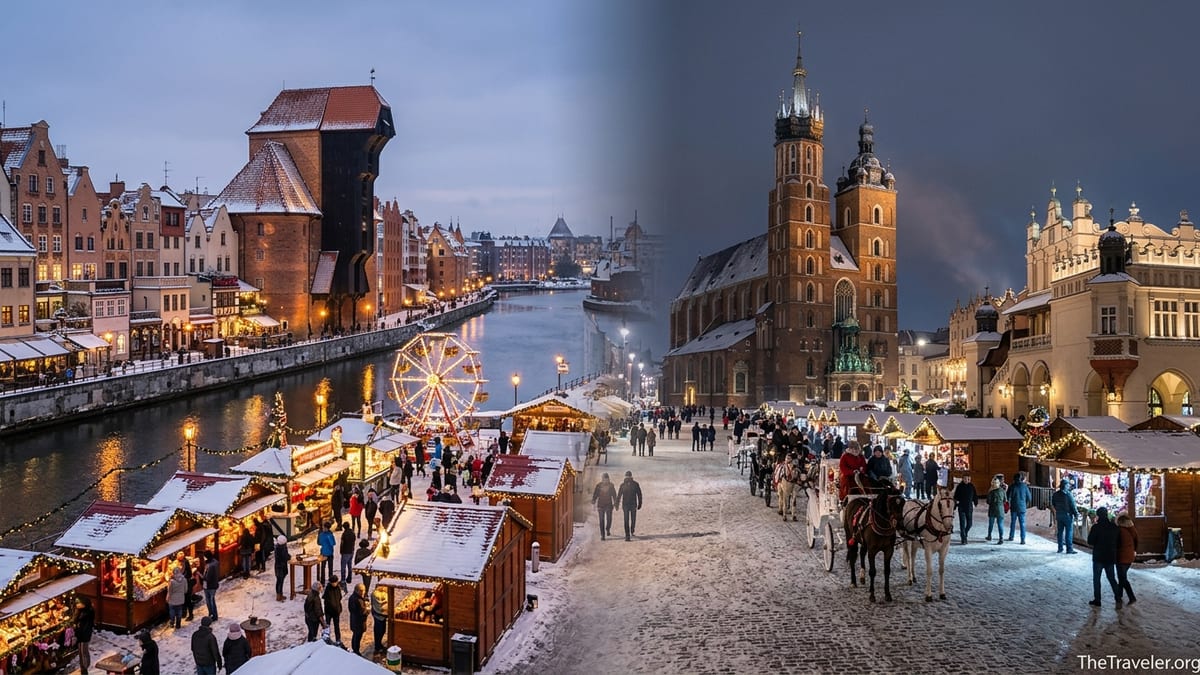
Gdańsk and Kraków in winter: atmosphere and first impressions
Gdańsk’s identity is inseparable from the Baltic. Arriving in winter, you step into a waterfront city of shipyard cranes, frozen quays and rebuilt Hanseatic townhouses reflected in the Motława River. Around the Long Market and the Main Town Hall, tall, narrow facades glow in soft light, while just west the former Lenin Shipyard anchors the story of the Solidarity movement and the fall of communism. The result is a compact center where maritime, wartime and 1980s protest history are all within walking distance.
Kraków feels older and more traditional. The city’s heart is Rynek Główny, one of Europe’s largest medieval squares, ringed by townhouses and dominated by the Cloth Hall and the twin towers of St Mary’s Basilica. Wawel Castle rises on a low hill above the Vistula, underlining Kraków’s centuries as Poland’s royal capital. South of the center, the Kazimierz district combines Jewish heritage, synagogues and candlelit restaurants in former workshops, which in winter can feel especially atmospheric after dark.
In winter, Gdańsk tends to feel quieter and more local once you step beyond the waterfront streets. The city’s big museums soak up visitors, and away from the Christmas period the Old Town can be surprisingly uncrowded on weekday evenings. Kraków, by contrast, sees visitors year round. Even in January you are likely to share Rynek Główny with tour groups and school trips, and key sites such as Wawel and Schindler’s Factory are busy enough that advance tickets are strongly advised.
For a short winter stay, the choice often comes down to mood. If you like dockside views, postwar reconstruction stories and modern museums, Gdańsk may appeal more. If you want a dense concentration of Gothic churches, royal halls and classic squares lit by Christmas lights and horse carriages, Kraków is the obvious pick.
Museums and historic sights: Solidarity vs royal splendor
Gdańsk’s headline sights cluster just north and east of the Main Town. The Museum of the Second World War, in a striking tilted building near the river, covers the conflict from both a Polish and international perspective with immersive exhibits. According to the museum’s official information, winter opening hours usually run from morning to late afternoon, with one weekly closure day most often on Monday and last admission several hours before closing. Tickets for the main exhibition are in the rough range of 40 to 60 złoty for adults, with discounts for students and seniors, and timed entry is used on busier days, so it is worth reserving online, especially in December.
A short walk away, the European Solidarity Centre sits beside the former shipyard gates. The permanent exhibition, devoted to the Solidarity trade union and the end of communist rule, is housed in a rust colored building that echoes the hulls of ships. Current information indicates it generally opens daily except selected holidays, with an adult ticket for the permanent exhibition and viewing terrace in the region of 30 to 40 złoty. Audio guides are widely used, and same day tickets are usually available outside peak holiday weekends.
Within the historic core, the Amber Museum and the Main Town Hall focus more on Gdańsk’s merchant wealth and craft traditions. They are part of the municipal museum network, which usually closes some branches on Mondays. Entry to individual branches is usually under 25 złoty per adult, and combined tickets are sometimes offered. In December and January these smaller museums are rarely crowded, with tickets available on arrival, though opening hours can be slightly shorter than in summer.
Kraków’s main set piece is Wawel Castle, which is organized into separate ticketed routes. The official Wawel site shows that most interiors operate with timed entry and limited capacity, particularly the Royal Private Apartments and State Rooms. Winter schedules often see some outdoor or seasonal exhibits closed, but core routes stay open from morning to mid afternoon, with the complex itself typically closed on some Mondays or with reduced access. Individual route tickets often cost in the region of 35 to 55 złoty per adult, and there is also a combined pass for multiple interiors at a higher price point. Advance reservation is strongly recommended, particularly in December and on weekends.
In the Old Town, St Mary’s Basilica on the main square has separate visiting times for tourists outside of services. The basilica charges a modest entry fee, generally under 20 złoty, with a different ticket if you wish to climb the tower in seasons when it is open. South across the Planty, the Oskar Schindler Enamel Factory, part of the Museum of Krakow, houses a major exhibition on Nazi occupation and the story popularized by the film “Schindler’s List.” Museum documents show that visiting uses time slot tickets, last entry is around 90 minutes before closing, and that numbers are capped, with adult tickets currently a little over 30 złoty. Online reservations, often released in batches, are strongly advised even for winter weekends.
Finally, Kazimierz is best seen as a living historic quarter rather than a single site. Synagogues such as the Old Synagogue and Remuh have separate entry fees, usually in the 15 to 25 złoty range, and winter hours can be shorter. Together with Rynek Główny and Wawel, this cluster of sites gives Kraków a denser run of historic attractions than Gdańsk, which balances that with its contemporary wartime and Solidarity institutions.
Christmas markets, winter calendar and crowd patterns
Both cities host major Christmas markets that shape the feel of a December visit. In Gdańsk, the 2024 Christmas Market ran on Targ Węglowy and nearby streets roughly from late November to just before Christmas, with official city and organizer information giving concrete dates of 22 November to 23 December. The market offers wooden stalls, a small ferris wheel, food and drink chalets and an “Amber Corner” themed area. It is busy on December weekends and during Polish school holidays, but weekdays in early December feel far more relaxed.
Kraków’s Christmas Market on Rynek Główny traditionally runs longer. City information for the 2023 to 2024 season lists dates from 24 November to 1 January, with stalls still open through New Year’s celebrations. This means that early January visitors can still enjoy lights, food stalls and mulled wine around the Cloth Hall, even after Christmas week. Additional smaller markets and nativity exhibitions extend the festive feel around the Old Town and at the Krzysztofory Palace into late January or February.
The calendar matters for pricing and crowd levels. From late November through New Year, both cities see higher hotel rates, with peak nights around the first three weekends of December and New Year’s Eve in Kraków. By contrast, weekends in mid January or early February often see noticeably lower rates and thinner crowds, especially in Gdańsk where the market has already closed. If you want markets plus space to move, an early December midweek stay is ideal, while travelers focused on museums and value might prefer a late January weekend.
During Christmas week itself, many museums and attractions operate reduced hours or close on 24 and 25 December and on 1 January. Both cities usually maintain some limited visiting hours on 26 December and around New Year. Travelers planning a festive break should check individual museum calendars for the exact winter opening patterns of the year they travel, and avoid planning flagship museum visits on Mondays and major public holidays when closures are common.
Weather, daylight and winter walking comfort
Weather is one of the biggest differences between Gdańsk and Kraków in winter. Climate comparison services show that from December to February, average daytime highs in Gdańsk hover around 1 to 3 degrees Celsius, with nighttime lows a few degrees below freezing. Kraków, further inland, can be slightly colder on average, with more pronounced frosts and occasional drops well below minus 10 degrees in colder spells. In practice, both cities see spells of snow, thaw and grey drizzle across the season.
Despite similar temperatures on paper, coastal Gdańsk often feels colder because of wind chill coming in from the Baltic. Along the Motława waterfront and on the walk out towards the shipyards, wind can make a zero degree day feel significantly below freezing, particularly in the late afternoon. Waterproof shoes, a windproof outer layer, hat and gloves are essential if you plan to explore on foot for several hours.
Kraków’s Old Town is more sheltered and compact. Many of its main sights cluster around Rynek Główny and Wawel, so you can move between heated interiors without long exposed walks. However, temperature inversions can trap smog on still, cold days, which some winter visitors notice as haze and a slight smell in the air. Snow cover can be patchy, but when it does settle it tends to linger in parks and on the banks of the Vistula more than in traffic heavy streets.
Daylight is limited in both cities, with mid December sunsets around mid afternoon. This makes it sensible to schedule outdoor walking tours and day trips in the late morning and early afternoon, then focus on museum interiors after dark. Historic cobbles can be slippery when wet or icy, especially around Gdańsk’s Long Market and Kraków’s side streets in Kazimierz, so footwear with decent grip is more important here than in summer.
Flights, airport transfers and local transport
Both cities have international airports with a broad spread of winter flights. In the 2024 to 2025 winter season, low cost carriers schedule frequent direct flights from London area airports, Scandinavian capitals and several German cities to both Gdańsk Lech Wałęsa Airport and Kraków John Paul II Airport. For example, recent schedules show multiple weekly flights from London and Stockholm to each city operated by low cost European airlines, along with connections to hubs such as Frankfurt or Amsterdam on legacy carriers. Frequencies are generally higher to Kraków, which serves as a gateway to southern Poland and the mountains, but Gdańsk is well connected across the Baltic region.
From Gdańsk airport, you can reach the center by suburban train or city bus. The PKM train connects the terminal to Gdańsk Wrzeszcz and Gdańsk Główny with tickets reported by local travelers in mid 2024 at under 10 złoty one way. Bus 210 links the airport to Gdańsk Główny in roughly 35 to 50 minutes, with a standard single ticket in the order of 4.8 złoty. Ride hailing services and taxis cost substantially more, but can still be reasonable for couples with luggage, especially at night.
In Kraków, an airport rail link runs from a station beside the terminal to Kraków Główny in the center. Official airport information notes that tickets can be purchased on board from machines and that the line is adapted for passengers with disabilities. Travelers in 2024 report a one way fare of around 17 złoty and a journey time of roughly 20 minutes. Several city bus routes also serve the airport at a lower cost but with longer journey times, and taxis and app based rides are readily available outside arrivals.
Both cities have integrated tram and bus networks in their urban cores. In Gdańsk, single urban tickets typically cost under 5 złoty, with time based options available. In Kraków, single tickets for trams and buses in the city zone are usually around 6 to 8 złoty depending on duration, with 24 hour and longer tourist passes offered. For a three day winter break, most visitors will use public transport for airport transfers and day trips, then walk in the historic centers where possible.
Day trips: Sopot from Gdańsk and Wieliczka from Kraków
From Gdańsk, the easiest independent day trip is to Sopot, the seaside resort that completes the Tricity area together with Gdańsk and Gdynia. SKM suburban trains run frequently along this corridor, with recent fare tables indicating a single ticket between Gdańsk and Sopot in the rough range of 7 to 10 złoty depending on the exact ticket type and operator. Journey times are about 15 to 20 minutes. Even in winter, Sopot’s pier, beach and Monte Cassino pedestrian street make for a pleasant half day or full day outing, although strong winds off the sea can make conditions feel very cold.
In Kraków, the classic winter day trip is to the Wieliczka Salt Mine. You can reach Wieliczka Rynek or Wieliczka Park railway stations by suburban train in roughly 20 to 30 minutes, or take a suburban bus route in a similar time. Local transport tickets cost only a few złoty each way. Visiting the mine itself is more expensive: current official price lists and local agencies give a standard adult guided tour ticket in foreign languages at well over 100 złoty, commonly around 130 to 150 złoty, while Polish language tours are a little cheaper. There are also extra charges for photography in some routes.
Allow half a day to a full day for Wieliczka. Tours of the classic tourist route usually last around 2 to 3 hours underground. Factoring in transport, ticket collection, queuing and possible waiting times for your language group, a realistic schedule from Kraków city center is about 5 hours door to door. In winter, entrance paths and the surrounding town can be icy, but underground temperatures remain relatively stable, around single digit degrees Celsius, so a warm layer and comfortable shoes are sufficient.
Compared with Sopot, Wieliczka requires more planning and a larger budget but offers a unique UNESCO listed experience of chapels and chambers carved from salt. For a short weekend in Gdańsk, Sopot is an easy add on. For a winter stay in Kraków, Wieliczka is very often the main side trip, with Auschwitz-Birkenau further away and requiring a longer, emotionally demanding day that many travelers prefer to keep separate from a short festive break.
Winter costs: accommodation, food and two sample budgets
Hotel prices vary by exact date and offer, but recent December and January weekend searches suggest that Gdańsk often prices slightly below Kraków for comparable properties. In Gdańsk, centrally located three star hotels near the Main Town or the waterfront can often be found in mid winter from around 250 to 350 złoty per night for a double room booked a few weeks in advance, rising closer to or above 400 złoty during Christmas market weekends. In Kraków, similar three star hotels within easy walking distance of Rynek Główny may run from roughly 300 to 450 złoty per night in January, with higher rates again around the market and New Year period.
Food costs are broadly similar in both cities. In a traditional Polish restaurant near the main sights, a hearty main dish such as pierogi, bigos or pork cutlet often costs in the range of 35 to 60 złoty, soups like żurek or barszcz around 20 to 30 złoty, and desserts and coffee from 15 to 25 złoty. A beer in a central bar is usually around 15 to 20 złoty, and mulled wine at Christmas market stalls is often in a similar range. Value improves slightly away from the central squares in both cities.
For a budget minded couple visiting for two nights in low season January, a realistic Gdańsk budget might include approximately 550 to 700 złoty for two nights in a modest but well reviewed hotel or apartment, 150 to 250 złoty per day for food if mostly eating in mid range spots with one cheaper meal, 100 to 150 złoty total for local transport and airport transfers, and around 250 to 350 złoty for two or three major museum entries for two people. That yields a ballpark of 1,250 to 1,600 złoty for the couple excluding flights and shopping.
A comparable budget weekend for two in Kraków in January is likely to come out slightly higher, perhaps around 1,400 to 1,800 złoty, once you factor in a slightly pricier hotel, tickets to Wawel interiors, Schindler’s Factory and possibly a half day visit to Wieliczka, which on its own can add upwards of 300 złoty for two including tickets and local transport. Travelers staying during the Christmas market period should expect nightly accommodation rates to be significantly higher, especially around Saturdays and holiday dates.
Three day winter itineraries for different styles
For a budget couple in Gdańsk outside the peak festive period, a three day, two night plan could look like this. Day one: arrival, inexpensive airport bus or train into town, evening stroll along Długi Targ and the waterfront, with a simple dinner in a milk bar style cafeteria or casual pierogi spot. Day two: morning at the Museum of the Second World War, afternoon exploring the Main Town and Amber Museum, then an early evening visit to the European Solidarity Centre while it is still open, followed by a cheap bar food dinner in the Wrzeszcz district and tram back. Day three: half day trip to Sopot by SKM train if the weather is kind, or a slower morning cafe hop in the Old Town before heading back to the airport.
For midrange travelers in Gdańsk during the Christmas market, you could upgrade accommodation to a well located boutique hotel near the Motława, enjoy sit down dinners with regional dishes and craft beer, and add paid extras such as a viewing terrace in the Solidarity Centre or a small group walking tour of the Old Town. The overall structure of the days can be similar, but with more time for lingering in cafes and perhaps a sauna or spa session in the evening to warm up.
In Kraków, a budget couple outside the peak season might spend day one exploring Rynek Główny, St Mary’s Basilica during visitor hours and walking up to Wawel Hill, then dining in a simple restaurant just outside the most touristy streets. Day two could focus on a morning visit to Schindler’s Factory (booked ahead) followed by an afternoon wandering Kazimierz and visiting one or two synagogues. Day three could be a half day excursion to Wieliczka Salt Mine using public transport, returning in time for a budget friendly early dinner before traveling back to the airport.
Midrange visitors might choose a hotel right on or just off the main square, book guided tours for Wawel and Wieliczka, and enjoy slightly more upscale dining in Kazimierz or in cellars around the Old Town. They could also add extras such as a classical concert in a church or historic hall on one evening. The core winter pattern remains a mix of indoor museums during the coldest hours, short walks between tightly clustered sights and one larger excursion beyond the city limits.
Practicalities: walking conditions, accessibility and when to go
Both cities are walkable but require care in winter. Gdańsk’s Old Town streets are paved with cobblestones and large stone slabs that can become slick in rain or slush. The walk from the center to the Museum of the Second World War runs along open quaysides where wind and occasional icy patches can be challenging for those with limited mobility. The big museums themselves are modern and equipped with lifts, but older houses converted into smaller museums may have narrow stairs.
Kraków’s historic core is relatively flat, with the exception of Wawel Hill, which has a steady but manageable incline and some uneven surfaces. Many museums and major sites have introduced accessibility adaptations, including ramps and lifts, although very old buildings and basements may remain challenging. Winter crowds are lower than in summer, which can help visitors who prefer quieter spaces, but Christmas market weeks do pack Rynek Główny and surrounding streets, especially in the evenings.
Museum crowding patterns differ slightly between the two cities. In Gdańsk, outside the main festive weeks, even flagship sites tend to have space, and weekday afternoons in January can feel particularly calm. In Kraków, Wawel, Schindler’s Factory and the more famous Old Town churches attract a steady flow of visitors year round, though winter mornings and late afternoons are still quieter than midday. Mondays remain problematic in both destinations, as many museums either close fully or operate reduced hours.
Holiday weekends, notably around Christmas, New Year and some Polish winter school holiday dates in January and February, push prices up and reduce availability of popular time slots. If your dates are fixed over a festive period and you choose Kraków, you should secure accommodation and tickets for Wawel and Schindler’s Factory well ahead of time. For Gdańsk, advance booking is useful around the Christmas market weekends, though the pressure is often lower than in Kraków.
Which city for which traveler?
For history enthusiasts, Gdańsk excels in modern history. The Museum of the Second World War and the European Solidarity Centre together provide a deep look at twentieth century conflict and the fall of communism, all within walking distance of the rebuilt Hanseatic Main Town. Kraków’s strength lies in medieval and early modern heritage, with Wawel Castle, Rynek Główny and layer upon layer of church and Jewish district history, plus Schindler’s Factory for twentieth century context. If your interests are mostly post 1900, Gdańsk has the edge. If you want the feel of an old royal capital, choose Kraków.
Couples looking for a romantic winter break may lean towards Kraków. Snow dusted Rynek Główny, horse drawn carriages and vaulted cellar restaurants create a classic European city break ambiance, and the Christmas market runs into early January for extended festive charm. Gdańsk, however, offers quiet evening walks along the Motława, intimate cafes near Długi Targ and the option of a windswept walk in Sopot, which some couples will find equally appealing, especially if they prefer a slightly less touristed feel.
For dedicated Christmas market visitors, Kraków offers the longest season and the largest, most central market, right on the main square and usually open through New Year’s Day. Gdańsk’s market is particularly atmospheric in its own right and has earned international praise, but it typically ends around 23 December, so those visiting between Christmas and Epiphany will find the stalls gone, even if the decorations remain.
Museum lovers who want to spend many hours indoors might find Kraków has the broader overall offer, with Wawel’s multiple routes, numerous churches, the National Museum branches and the Schindler and Kazimierz sites. Yet Gdańsk’s flagship museums are among the most modern in Poland and lend themselves very well to a winter visit. In terms of winter value, Gdańsk usually comes out slightly cheaper for accommodation and feels less crowded, especially after New Year, which makes it an attractive choice for travelers on a tighter budget. Kraków delivers more of a classic “city break” roster of sights and markets, but very short festive trips can be pricier and busier.
Ultimately, both cities work extremely well as winter destinations. If you imagine evening walks through a huge medieval square under Christmas lights and days packed with royal chambers and Jewish heritage, Kraków is the stronger match. If you picture a Baltic waterfront, cutting edge museums on war and freedom, and a slightly quieter, better value weekend with the option of a bracing seaside excursion, Gdańsk may be the better winter bet.