


More news on this day
Flights between Asia and Saudi Arabia remain heavily disrupted in mid November 2026, as regulators warn of heightened risks in Saudi airspace and multiple Asian and Gulf carriers extend suspensions or deep cuts on routes to Jeddah, Riyadh and Dammam, forcing many travelers to reroute via alternative hubs or postpone trips altogether.
Get the latest news straight to your inbox!
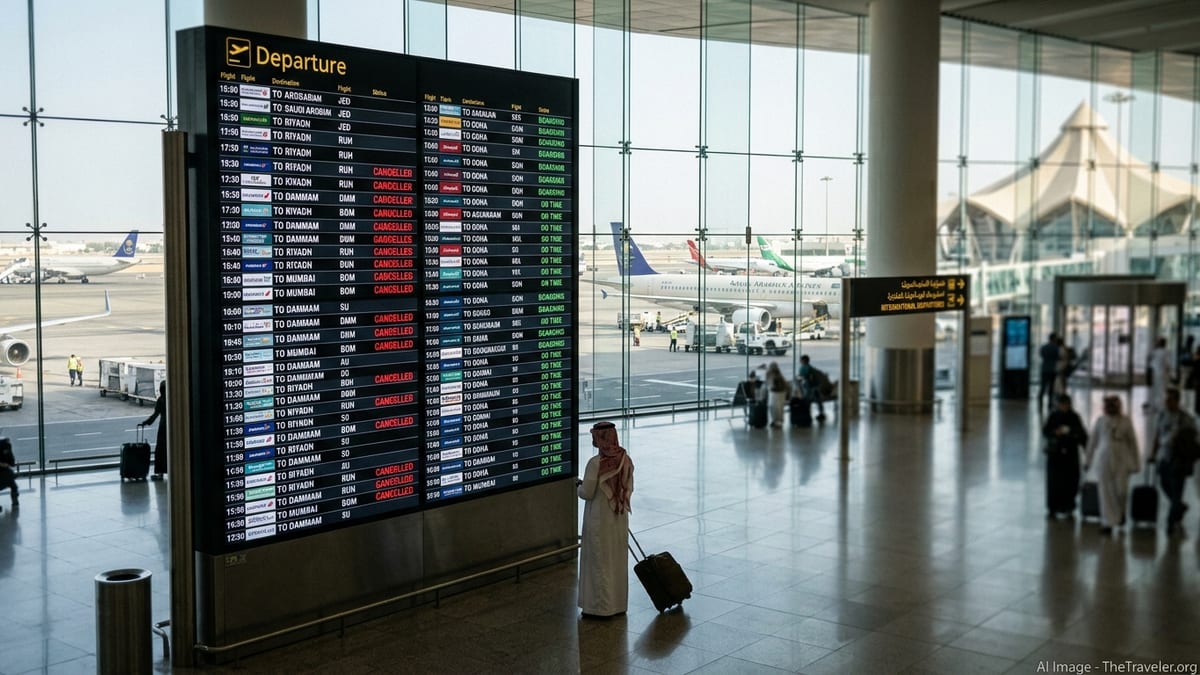
Conflict-zone advisory keeps Saudi airspace under enhanced security
The European Union Aviation Safety Agency has renewed and extended its conflict-zone warning for Saudi airspace, keeping the current level of caution in place through the end of January. Its Conflict Zone Information Bulletin CZIB-2026-09-R2, updated on 16 November 2026, notes a “medium risk” environment for operations in the Saudi Flight Information Region and formally advises European operators to conduct thorough risk assessments before flying in the area rather than avoiding it outright.
Saudi airspace and the country’s main hubs remain technically open, but security-focused operational bulletins issued to airlines and cargo operators describe an “enhanced security” posture, with tactical rerouting and altitude constraints around sensitive areas. These measures are contributing to congestion and irregular operations, particularly for flights touching Jeddah, Riyadh and Dammam, even when services have not been formally suspended.
Importantly for travelers, the presence of an active conflict-zone bulletin does not mean that all flights to Saudi Arabia are grounded. Live departure boards and schedule data show that Jeddah’s King Abdulaziz International Airport continues to handle the majority of its scheduled flights, although with a modest proportion of cancellations and delays, while Riyadh and Dammam have borne a larger share of outright route suspensions by foreign carriers.
Indian and Asian carriers extend Saudi route suspensions
Indian airlines have implemented some of the most far-reaching Saudi cancellations affecting Asia–Saudi traffic this month. IndiGo has announced that all of its flights to and from Jeddah, Madinah, Riyadh and Dammam are cancelled until 30 November 2026, citing the prevailing security situation in the kingdom and telling affected passengers to use its customer channels for rebooking or refunds. This suspension covers both outbound services from India and the return legs from Saudi Arabia, limiting nonstop options for leisure, business and religious travelers alike.
Other Indian operators have followed with similar measures. Air India and Air India Express advisories indicate that services on selected Saudi routes, particularly to Riyadh and Dammam, will remain suspended until at least 30 November, with passengers offered the choice of full refunds or rebooking on alternative dates where capacity allows. Budget carrier Akasa Air has also pushed back its planned resumption of flights to Jeddah and Riyadh until late November, further reducing lower-cost options for Umrah-bound travelers from India and neighboring countries.
Beyond India, regional networks remain patchy rather than entirely halted. Qatar Airways has restored daily flights from Doha to Riyadh and Dammam in mid November, creating an additional one-stop option for some Asian itineraries, while maintaining services to Jeddah. By contrast, several other Asian and European airlines, including KLM and certain Gulf-based carriers, have extended their own Riyadh and Dammam suspensions into late November or beyond, leading to a complex mix of operating and non-operating routes that can vary by carrier and city pair.
Gulf carriers trim Saudi schedules but keep partial links open
For travelers connecting through the Gulf, the situation differs by airline and destination. Etihad Airways has cancelled all passenger and cargo flights between Abu Dhabi and the Saudi cities of Riyadh and Dammam through 30 November 2026, according to notices on its flight-status pages and recent public statements. At the same time, Etihad has resumed and maintained services to Jeddah, meaning that Saudi-bound passengers on the airline may need to adjust their final destination or onward ground transport rather than abandon trips entirely.
In Dubai, local reporting and airline advisories indicate that flydubai has extended suspensions on its Riyadh services while continuing to operate selected flights to Dammam and some Jeddah and Madinah rotations. Emirates and other UAE-based carriers are operating a reduced but still active schedule to parts of Saudi Arabia, with cancellations concentrated on particular cities and dates rather than applied uniformly across all Saudi routes.
This patchwork approach means that travelers may find very different levels of disruption depending on their chosen hub. A route that is suspended on one Gulf carrier may still be available via another, or on a different Saudi gateway. However, high demand on the remaining flights, coupled with last-minute operational changes as airlines respond to security updates, is pushing some passengers onto longer routings via Doha, Bahrain, Muscat or even more distant hubs in Europe and Africa.
What this means for Umrah and other Asia–Saudi trips
The greatest impact is being felt among Umrah pilgrims and other religious travelers from South and Southeast Asia who typically rely on competitive nonstop or one-stop fares into Jeddah and Madinah. With IndiGo, Akasa Air and several full-service Indian carriers suspending or curtailing Saudi operations until at least 30 November, many itineraries now require rebooking via alternate hubs such as Doha, Dubai, Abu Dhabi, Bahrain or Muscat, often at higher fares and with longer total travel times.
Most affected airlines have put temporary flexibility policies in place, though the details vary. IndiGo is allowing one-time free date changes or full refunds for tickets to Saudi destinations issued before its latest advisory, provided travel falls within the current suspension window through 30 November. Etihad is offering rebooking onto later dates or alternative destinations in its network for passengers ticketed on its cancelled Abu Dhabi–Riyadh and Abu Dhabi–Dammam services, while maintaining normal conditions on routes that continue to operate, such as Abu Dhabi–Jeddah.
Travelers should also account for changing government safety advice. The United States currently maintains a Level 3 “Reconsider Travel” advisory for Saudi Arabia and in late October ordered non-emergency U.S. government personnel and eligible family members to depart the country, while several European governments continue to highlight the risks of missile and drone attacks and potential disruptions to civil aviation. These advisories do not automatically halt commercial flights but can influence airline risk assessments and insurance conditions, contributing to the pattern of selective route suspensions.
Planning ahead: what travelers should monitor next
Given the rapidly evolving situation, travelers with plans to fly to or through Saudi Arabia over the coming weeks should pay close attention to both airline and regulatory updates. The current EASA conflict-zone bulletin for Saudi airspace is valid through 31 January 2027, suggesting that heightened operational caution will remain in place well beyond the end-of-November airline suspension dates now being publicized, even if specific routes reopen sooner.
Before departing for the airport, passengers are advised to check their booking directly in the airline’s manage-booking or flight-status tools, rather than relying solely on earlier email notices or third-party travel agents. In recent weeks, some carriers have adjusted Saudi schedules multiple times, extending or shortening suspension periods and, in certain cases, restoring flights earlier than expected on particular dates or routes.
Prospective visitors, especially those planning Umrah or time-sensitive business travel, may wish to build additional flexibility into their itineraries by considering fully refundable or changeable tickets, monitoring alternative routings via Qatar, the UAE, Bahrain or Oman, and reviewing their home government’s latest travel advisories for Saudi Arabia. For now, the disruption is concentrated on specific Saudi routes and hubs rather than across all of Asia’s air network, but continued security concerns mean that last-minute changes to flight plans remain a realistic possibility.