


More news on this day
Plans by Italian high speed operator Italo to launch long distance services in Germany from 2028 are prompting passenger groups to call for clear rules that protect regional connectivity, ticket prices and service quality.
Get the latest news straight to your inbox!
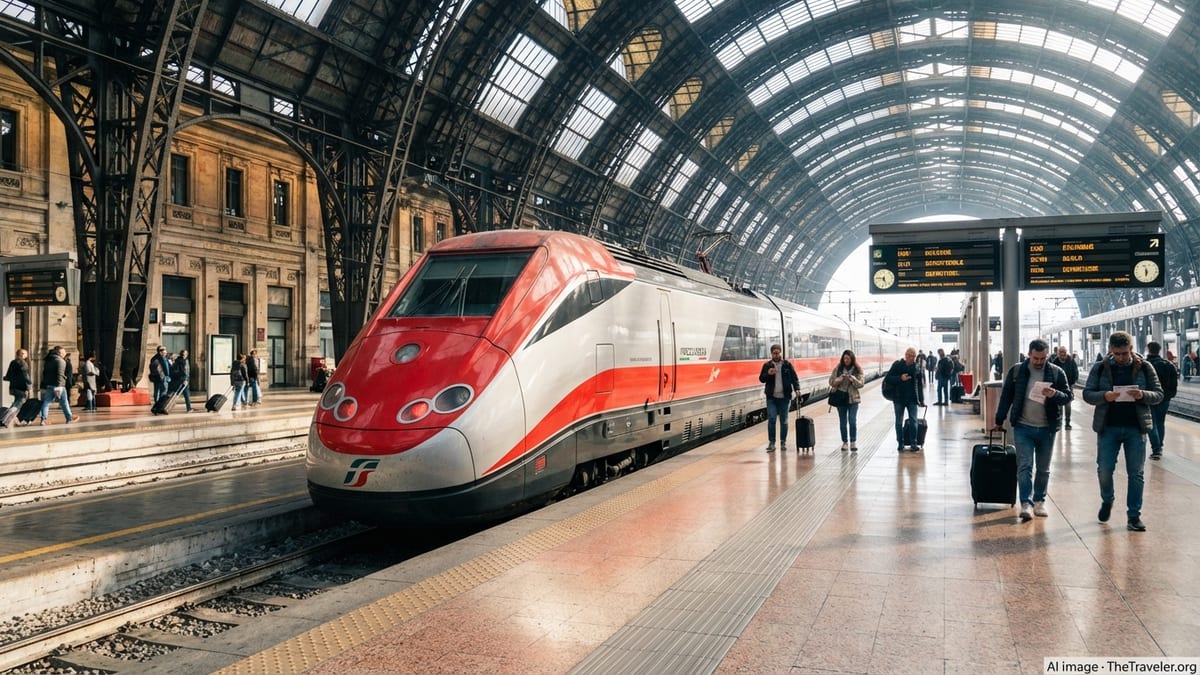
Competition arrives on Germany’s busiest rail corridors
Italo, a private high speed rail operator that has grown rapidly in Italy over the past decade, is preparing its first venture outside its home market with an ambitious expansion into Germany. Publicly available information indicates that the company has set up a German subsidiary and is in talks to acquire a new fleet of Siemens Velaro trains, with operations targeted to begin around 2028 on some of the country’s busiest north south corridors.
Current plans focus on the high demand axes linking Munich with Frankfurt, Cologne and Dortmund, as well as a separate corridor from Munich via Berlin to Hamburg. These routes are among the most profitable long distance lines in the country and are already heavily served by Deutsche Bahn’s ICE network. Italo is reported to be considering an intensive timetable with roughly hourly or two hourly patterns on these main lines.
Industry reports suggest that the operator is seeking around 25 to 30 high speed trainsets and eyeing up to 50 trains per day over a network of roughly 1,300 kilometres serving around 18 major cities. Advocates of rail liberalisation argue that this could increase capacity, give passengers more choice and apply price pressure on existing services, repeating patterns seen in Italy where competition between Italo and state operator Trenitalia has been linked to higher frequencies and strong passenger growth.
For German travellers, the prospect of a new competitor in long distance rail comes at a time of frustration over delays, disruptions and crowded trains on much of the existing network. Against that backdrop, passenger and consumer groups broadly welcome the idea of more operators and more seats, but they are increasingly vocal that the benefits should not be concentrated only on already well served main lines.
Passenger groups: competition must not abandon smaller cities
German passenger association Pro Bahn has publicly backed greater competition in long distance rail in principle, arguing that additional operators can lower prices, raise quality and expand services if the framework is designed carefully. At the same time, both Pro Bahn and the railway and transport union EVG have warned that unregulated competition focused purely on the most profitable routes risks cutting off medium sized cities from the national long distance network.
The concern stems from the way Deutsche Bahn currently finances its long distance network. Profits from dense, lucrative city pairs help support ICE and IC stops in less profitable locations and enable a wider network than market forces alone would deliver. If a private competitor such as Italo concentrates on the strongest corridors, EVG and passenger advocates fear that Deutsche Bahn could lose revenue there, undermining its ability to maintain or expand services to smaller hubs.
Recent public statements from EVG cite at least 16 cities that could face reduced or discontinued long distance services if new operators secure the most attractive train paths on core routes and Deutsche Bahn responds by cutting back elsewhere. Passenger representatives are therefore asking federal and regional policymakers, as well as the infrastructure manager, to ensure that new open access competition does not lead to a thinning out of services away from the main corridors.
For travellers in those regions, the stakes are high. In many parts of Germany, long distance rail remains a lifeline for commuting, business travel and tourism. A reduction in ICE or IC stops can mean longer journey times, more changes or a shift to less sustainable modes such as car and air travel. Passenger groups argue that a fair competitive framework should actively protect this wider network function while still allowing new entrants to compete on quality and price.
Calls for clear track access rules and planning security
The emerging debate is focusing on how Germany manages access to its heavily used rail infrastructure. Italo has made clear in public comments that it requires reliable, long term clarity about the train paths it can obtain from infrastructure manager DB Infrago in order to commit to multibillion euro train orders and maintenance contracts. Passenger representatives similarly say that transparent criteria for path allocation are essential to avoid ad hoc decisions that might favour one operator or weaken the coherence of the national timetable.
Germany’s high speed and main line network is already close to capacity on some stretches, with mixed traffic from long distance, regional and freight services competing for limited slots. Without clear rules, passenger organisations fear that commercially attractive express services could be prioritised at the expense of slightly slower or more regionally oriented trains that provide important connectivity. They argue that any entry by Italo should be embedded in a broader strategy that balances competition with a stable, integrated timetable.
Consumer advocates are also stressing the need for planning security from the passenger perspective. Travellers often book long distance journeys months in advance and rely on regular, predictable patterns of service. If the arrival of new competitors led to frequent timetable shifts, rerouted trains or the loss of traditional connections, the perceived benefits of competition could quickly erode. For that reason, organisations representing passengers are urging regulators and policymakers to publish clear, long term guidelines on how new operators will be incorporated into the existing network.
The debate feeds into ongoing European level discussions about open access competition, non discriminatory infrastructure access and public service obligations. Germany is under pressure both to modernise its rail system and to increase rail’s share in climate friendly transport. Passenger groups argue that clear, passenger centred rules for newcomers like Italo are a necessary piece of that wider policy puzzle.
Pricing, ticketing and passenger rights under scrutiny
Beyond network coverage and track access, German passengers are also paying close attention to how additional operators might affect fares, ticketing and passenger rights. Experience in other liberalised markets suggests that competition can lead to attractive promotional fares on key routes, which is welcomed by many travellers. At the same time, fragmented ticketing systems and differing conditions of carriage can make journeys more complex, particularly when trips involve multiple operators.
Consumer organisations are therefore urging that any entry by Italo be accompanied by progress on integrated ticketing and clear information about rights in case of delays, cancellations or missed connections. Publicly available documents from Deutsche Bahn and other rail bodies show that the European Union has already strengthened rail passenger rights in recent years, but practical implementation often remains complicated for travellers who must navigate different websites, apps and conditions.
Passenger advocates see an opportunity to use the arrival of Italo as leverage to improve this situation. They argue that regulators should promote easy to use, multimodal booking and compensation systems that treat passengers consistently regardless of which company operates the train. This includes transparent rules for through tickets, rebooking and assistance if a disruption on one operator’s service affects a connection with another.
Many German travellers have voiced frustration over perceived gaps between formal rights and real world experience when claiming compensation or resolving problems on long journeys. As a result, calls are growing for clearer, more enforceable standards across all long distance rail operators, so that competition is felt in better service rather than shifting responsibilities when things go wrong.
Government stays cautious as debate intensifies
The federal government has so far taken a cautious stance on the brewing rail contest between Deutsche Bahn and Italo. Recent statements from Berlin indicate that the authorities do not intend to intervene directly in commercial decisions about routes and frequencies, instead pointing to independent regulators and existing European rules on market access.
At the same time, the political debate around rail reliability, investment backlogs and climate targets is intensifying. New management at Deutsche Bahn has highlighted the need for massive infrastructure renewal and warned that uncoordinated competition could complicate efforts to stabilise the national timetable. Regional leaders and municipal representatives are also watching closely, concerned about the future of long distance stops in their areas if revenue shifts away from the state owned incumbent.
Passenger and consumer groups are seeking to position themselves in this discussion as the voice of everyday travellers. While few dispute that Germany’s long distance rail market can benefit from fresh investment and new service concepts, these organisations insist that clear rules and transparent planning are essential to ensure that competition delivers tangible improvements for passengers across the whole country, not just on the flagship high speed corridors.
As Italo continues negotiations over train orders and track access, the coming months are likely to see more detailed proposals from both policymakers and regulators on how to structure the new competitive landscape. For German passengers, the outcome will shape not only ticket prices and train choices on major routes, but also the long term coherence and reach of the national rail network.