


Lower Manhattan is often reduced to stock tickers and skyscrapers, but step a few blocks away from Wall Street and One World Trade Center and you discover a remarkably walkable district where the city’s history, harbor, and diverse neighborhoods collide. From cobblestoned piers and car-free islands to dim sum halls, speakeasy-style bars, and unexpected green spaces, this compact corner of New York rewards anyone willing to wander beyond the financial landmarks.
Get the latest updates straight to your inbox!
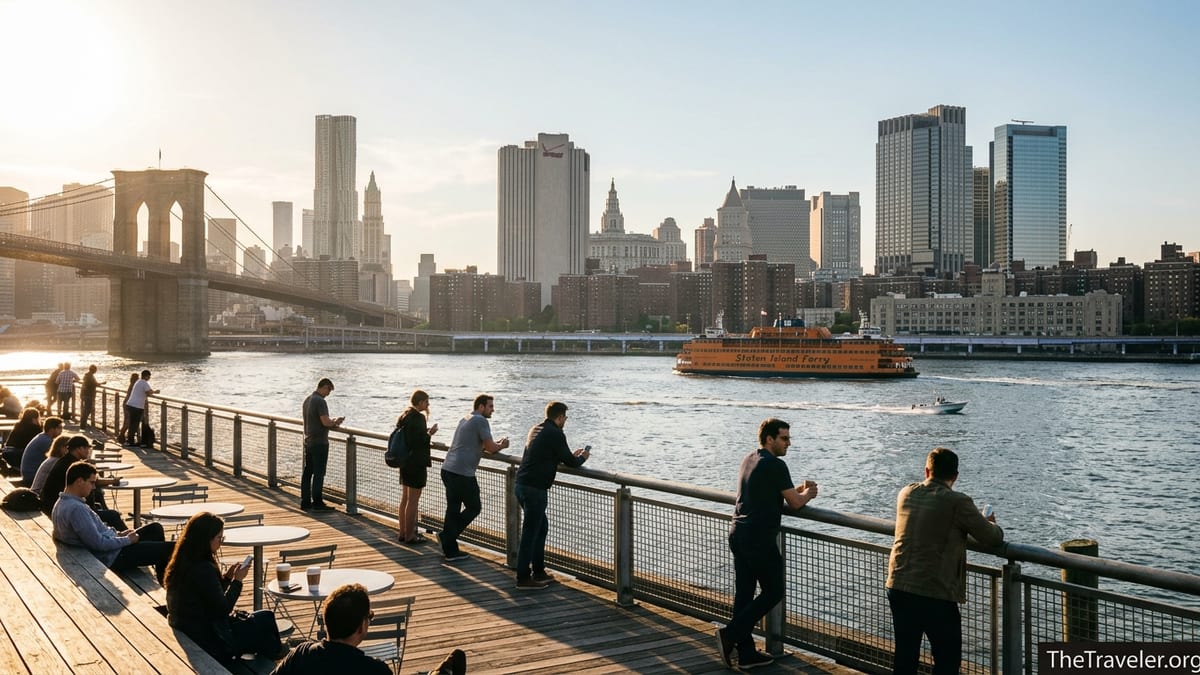
Harbor Views and Free Ferries: Experiencing the Waterfront
Lower Manhattan is surrounded on three sides by water, and some of its most memorable experiences are found along the harbor rather than in the canyons of office towers. Start at the southern tip in Battery Park, where lawns, gardens, and public art open directly onto views of the Statue of Liberty and Ellis Island. On a clear morning you can watch commuter ferries and cargo ships glide past while office workers cut through the park with coffee from nearby carts and cafes. Benches along the waterfront promenade are ideal if you want a quiet moment before jumping back into the city.
From just east of Battery Park, the Whitehall Terminal is where the Staten Island Ferry departs, offering one of New York’s classic free experiences. The bright orange ferries run regularly, typically every 20 to 30 minutes during the day, and the ride across New York Harbor takes about 25 minutes each way. There is no ticket barrier for foot passengers, and locals routinely ride over and back purely for the skyline and up-close views of the Statue of Liberty. On the upper outdoor decks you can feel the wind, hear the gulls, and watch Lower Manhattan recede into a postcard-perfect panorama.
Next door, the green-topped Battery Maritime Building is the Manhattan base for the Governors Island ferry. Year-round, a short ride of under ten minutes whisks you to this former military outpost turned public park, with frequent departures during the day and generally modest ticket prices that are far lower than most harbor cruises. Boarding here feels less like joining a tour group and more like stepping into a local routine, with families pushing strollers, cyclists rolling on with their bikes, and city workers commuting to offices on the island.
Even if you never leave Manhattan, lingering at these terminals reveals how closely New York’s identity is tied to the water. Inside Whitehall, huge glass walls frame the harbor and Statue of Liberty, making the terminal itself a viewing platform. Just outside, pathways connect back toward Battery Park City and the Hudson River Greenway, so you can make a loop along the west side waterfront and return through the narrow, historic streets of the Financial District.
Governors Island: A Car-Free Escape Minutes from Downtown
Governors Island feels worlds away from Lower Manhattan, yet on a map it sits just off the southern tip, easily visible from Battery Park. Once you disembark from the ferry at Soissons Landing, the city noise fades immediately. The island is car-free for visitors, and the main loop road around the perimeter is roughly two miles, making it manageable on foot and particularly fun by bike. Rental outfits such as Blazing Saddles operate near the ferry landing, offering hourly or day rentals for standard bikes and surreys; prices change seasonally but are generally comparable to other city bike rentals and often drop during weekday promotions.
The island’s topography is surprisingly varied. The artificial Hills on the south side climb to about 70 feet above sea level, high enough to give you sweeping views of the Lower Manhattan skyline, Brooklyn waterfront, and the Statue of Liberty. A series of slides on Slide Hill make this an easy sell for families, while Outlook Hill offers a more contemplative vantage point. Many visitors simply bring a picnic picked up in Lower Manhattan and spread out on the lawns, though there are also seasonal food vendors in converted shipping containers and historic buildings near the main green, serving everything from tacos and ice cream to coffee and craft beer.
Governors Island has also become a hub for culture and wellness. Historic brick officer housing now hosts artist residencies and rotating exhibitions that open their doors on weekends, allowing you to wander through porches and parlors that date back more than a century. On the western side, a waterfront spa complex offers outdoor thermal pools, relaxation rooms, and harbor views; reservations are recommended and prices are comparable to upscale day spas in Manhattan, but the setting on an island makes it feel like a short vacation. In summer and early fall, the island’s calendar fills with festivals, outdoor concerts, and niche events ranging from vintage-style dance parties to food markets, many of them free or low-cost with only the ferry fare to pay.
Because the island is open daily, including in cooler months, it is worth checking the latest hours before you go, as closing times can vary between winter and summer and some amenities are seasonal. Even in the off-season, strolling the perimeter promenade with a hot drink and watching the sun sink behind the Statue of Liberty is one of the most quietly beautiful experiences you can have after a busy day in Lower Manhattan.
South Street Seaport and Pier 17: Historic Streets Meet Modern Nightlife
On the East River side of Lower Manhattan, the South Street Seaport district preserves a rare slice of the city’s 19th-century maritime past. Cobblestone streets, low red-brick warehouses, and restored sailing ships tied up along the pier give the area a distinctly different feel from the nearby glass towers. Walking along South Street in the late afternoon, you can peer into galleries and boutiques occupying old mercantile buildings and duck into long-running taverns that trace their history back more than a century.
At the center of the neighborhood, Pier 17 projects out over the East River as a contemporary complement to the historic streets behind it. The pier’s multi-level complex houses restaurants with floor-to-ceiling windows, casual eateries, and bars that open onto terraces with direct views of the Brooklyn Bridge and the Brooklyn skyline. Prices for a sit-down meal here are comparable to mid-range Manhattan dining, but many travelers opt for a drink or shared plates to enjoy the setting without committing to a full dinner. On warm evenings, office workers and visitors mix on the decks, sharing tables, snapping photos of the bridge, and listening to music filtering out from the venues.
On the roof of Pier 17, a large open-air space functions as an event venue and seasonal hangout. Summer concerts, outdoor films, and pop-up experiences draw crowds, and in cooler months the rooftop has hosted winter-themed installations that transform the skyline into a dramatic backdrop. Even on nights without a major event, wandering the perimeter of the rooftop offers some of the best elevated views of the East River bridges without paying for an observation deck. Sunset is particularly striking as the light hits the stone towers of the Brooklyn Bridge and the windows of the Financial District’s skyscrapers behind you.
A visit to the Seaport pairs naturally with a walk across or onto the Brooklyn Bridge, whose Manhattan approach is just a short stroll away. Many travelers choose to explore the neighborhood by day, visiting the small maritime museum spaces and shops, then return in the evening when Pier 17 lights glow over the water and the district shifts into a dining and nightlife hub. Either way, it is a reminder that Lower Manhattan was a working port long before it was a financial center.
Hidden History: Colonial Streets, Churches, and Quiet Museums
Away from the waterfront, Lower Manhattan’s narrow, irregular streets preserve the original colonial-era street plan in a way few other parts of New York do. Wandering without a set route between Bowling Green and City Hall can feel like time travel. Stone-fronted buildings, hidden courtyards, and modest brick row houses appear between banks and office towers, especially around streets like Stone, Pearl, and William. In the early morning or on weekends, when fewer workers are around, these lanes can be surprisingly peaceful.
Several small but memorable historical sites give depth to a walk through this area. Near the southern end of Broadway, a fenced patch of lawn known as Bowling Green is the city’s oldest public park, ringed by 18th-century townhouses and the stately old U.S. Custom House. A few blocks north, Trinity Church sits at the intersection of Broadway and Wall Street, its Gothic spire still a striking sight among glass towers. The churchyard holds the graves of figures such as Alexander Hamilton, and is open during the day for quiet reflection. Services and concerts are free to attend, and stepping inside the stone interior can be a welcome respite from summer heat or winter cold.
Just beyond the skyscrapers, New York City Hall anchors a complex that includes the neoclassical City Hall building and adjacent park. Guided tours are offered on select days with advance reservations, giving visitors a look at ornate interiors and council chambers that rarely appear in typical tourist itineraries. Nearby, smaller museums explore specific aspects of the city’s early life, from finance to the press and civic government. Entrance fees are often a fraction of what you might pay at major Midtown institutions, and some offer suggested donations rather than fixed prices, making them a good choice for budget-conscious travelers who still want cultural depth.
Because many of these attractions sit in the heart of the working Financial District, their opening hours can tilt toward weekdays and office hours, so it is worth checking schedules ahead of time. Even when buildings are closed, though, simply standing in front of ornate facades, reading historical plaques, and tracing the outline of old New Amsterdam walls in the pavement offers a chance to imagine the trading post that once occupied the same ground as modern Lower Manhattan.
Chinatown and Little Italy: Eating Your Way Through Downtown
North of the courthouses and federal buildings around Foley Square, Lower Manhattan spills into Chinatown and what remains of historic Little Italy, two neighborhoods that still anchor many visitors’ culinary explorations. In Chinatown, storefronts cluster along streets like Mott, Bayard, and Canal, offering everything from traditional dim sum halls to bubble tea shops and bakeries. Stepping into a busy dumpling spot at lunchtime, you might share a round table with local families, office workers, and visitors, passing bamboo steamers stacked with shrimp har gow and pork siu mai that typically cost far less than comparable dishes in trendier parts of the city.
Bakeries are another everyday pleasure here. Glass cases display egg tarts, pineapple buns, and sesame balls for prices that often hover only a few dollars per item. Many stay open late, so you can grab a hot bun after an evening walk or on your way back to the subway. Produce markets spill onto sidewalks with seasonal fruit and vegetables, and fishmongers lay out their catch on ice, adding to the sensory rush of the streets. While some restaurants now accept card payments, it is still wise to carry some cash, as smaller spots and snack counters may remain cash-preferred.
Just west of Chinatown, the core of Little Italy centers on Mulberry Street, where trattorias line the sidewalks and red, white, and green decorations hang overhead. The area is smaller than in decades past and catered more to visitors than locals, but it can still be a festive place to linger over a plate of pasta or a cannoli. Outdoor hosts will often call out to passersby with menus, especially in the evening, so if you prefer a quieter experience, consider stepping one or two blocks off Mulberry to find less aggressively marketed cafes and restaurants. Prices here are typically higher than in Chinatown, reflecting the tourist demand, but set lunch specials and shared antipasti can keep costs reasonable.
Combining these neighborhoods makes for an ideal half-day beyond the office towers of Lower Manhattan. You might start with dim sum late in the morning, wander through Columbus Park to watch older residents play cards and practice tai chi, then cross into Little Italy for espresso and pastries. From there, it is an easy walk back downtown via Lafayette or Centre Street, where the scenery shifts from tenement-era brick to the civic architecture surrounding City Hall and the Brooklyn Bridge approaches.
Battery Park City and the Hudson River Promenade
On the west side of Lower Manhattan, the master-planned neighborhood of Battery Park City offers a greener, calmer counterpoint to the Financial District. Built on landfill from the construction of the World Trade Center, it is now a mix of residential towers, schools, and landscaped parks connected by a continuous waterfront promenade. Starting near the North Cove Marina, you can walk or cycle north along the Hudson River, passing sailboats, outdoor public art, and small playgrounds where local children climb and run.
The atmosphere here is more neighborhood than tourist site. Cafes and grocery markets cater primarily to residents, which means you are more likely to see people walking dogs, jogging, or coming home with shopping bags than snapping selfies. Yet the views are spectacular: across the river, the New Jersey skyline rises behind the water, and to the south you can glimpse the Statue of Liberty aligned with the harbor. Benches and lawns along the Esplanade invite you to sit with a coffee or picnic and watch ferries and water taxis move up and down the river.
Battery Park City also contains a handful of notable cultural and memorial sites. Close to the water, a stepped grass amphitheater frames views across the harbor, while tucked among the high-rises are contemplative spaces dedicated to events from recent history. These are generally free to visit and open to the public, blending into the surrounding parks in a way that encourages quiet reflection rather than formal tours. Because the area is compact, you can easily combine a stroll here with time in nearby Tribeca or with an evening ferry ride, using the piers along the Hudson as informal observation decks for sunset.
While retail is more limited than in Midtown, there are a few shopping and dining clusters where you can sit indoors with a river view, including casual food halls and higher-end restaurants. Prices range from quick-service counters appropriate for a simple lunch to white-tablecloth establishments better suited to special occasions, giving you flexibility depending on how much you want to spend in this part of Lower Manhattan.
Nightlife Beyond the Financial District: Rooftops, Jazz, and Speakeasy Vibes
When the trading day ends, the heart of the Financial District can feel quiet compared with Midtown or Brooklyn, but nightlife in and around Lower Manhattan has quietly diversified. One option is to simply stay along the waterfront. Rooftop venues at Pier 17 and nearby hotels regularly host DJ nights, live bands, and seasonal pop-ups, attracting a mix of locals and visitors who come as much for the skyline as for the music. Drink prices are in line with other Manhattan rooftop bars, so expect to pay a premium for the views, but many spots allow you to wander the perimeter with a glass in hand, making a single drink last while you soak in the atmosphere.
In the streets closer to Broadway and Stone Street, older taverns and newer cocktail bars coexist. Historic pubs with wood-paneled interiors and low ceilings offer hearty food and a rotating list of beers, drawing after-work crowds on weeknights who spill out onto pedestrianized cobblestone lanes in good weather. Tucked into basements and behind unmarked doors, contemporary cocktail bars channel speakeasy aesthetics, serving carefully mixed drinks in intimate rooms. Reservations are recommended at many of these smaller venues, especially on Thursdays and Fridays, and prices per drink match craft-cocktail standards found across downtown Manhattan.
If live music is a priority, it is worth scouting out small jazz rooms and performance spaces scattered around the southern part of the island. Some are housed in hotels or multi-use buildings, where a modest cover charge or drink minimum gains you access to sets by local musicians. Since lineups change frequently, checking the week’s schedule helps you catch emerging artists without the high ticket prices of larger Midtown clubs. For something more laid-back, many bars throughout Chinatown and the fringes of the Lower East Side host informal performances, karaoke, or late-night dining that can easily follow an earlier evening spent on the piers or ferries.
Because public transportation is dense in this part of Manhattan, getting back to your accommodation after a night out is usually straightforward. Multiple subway lines converge at major hubs such as Fulton Street, Brooklyn Bridge–City Hall, and Chambers Street, and yellow cabs or app-based rides are readily available around main avenues and bridges, making it easy to end your evening on the waterfront or in a tucked-away side street bar without worrying about a long journey home.
The Takeaway
Lower Manhattan is far more than a financial district and a skyline punctuated by a single tower. Its waterfront parks, ferry terminals, and nearby car-free islands offer some of the most accessible and memorable harbor experiences in the city, many of them either free or relatively low-cost. Historic lanes, churches, and small museums add depth to any walk, while neighborhoods like Chinatown and the remnants of Little Italy keep the area grounded in everyday life through food and street culture.
By dividing your time between the harbor, the historic core, and the surrounding residential and culinary pockets, you can easily spend a full day or more here without setting foot on Wall Street or paying for a traditional observation deck. Whether you are watching sunset from a pier, tasting dumplings on a side street, or biking around Governors Island, exploring Lower Manhattan beyond its most famous landmarks reveals a district that feels at once deeply rooted in history and constantly reinventing itself.
FAQ
Q1. How much time should I plan to spend in Lower Manhattan beyond Wall Street and One World Trade Center?
Most visitors can comfortably fill a full day exploring the waterfront, Governors Island, the Seaport, Chinatown, and Battery Park City without rushing. If you want to include multiple museums, long meals, or evening entertainment, consider spreading your visit over two days so you can slow down and enjoy each area.
Q2. Is it worth visiting Governors Island if I only have a few hours?
Yes, even a short visit can be rewarding. With about three hours, you can ride the ferry, rent a bike or walk part of the loop, climb the Hills for skyline views, and grab a snack from seasonal food vendors. If you have more time, you can add art installations, picnics, or a visit to the spa.
Q3. Are the Staten Island Ferry and Governors Island ferry the same thing?
No, they are separate services. The Staten Island Ferry is a free commuter route between Lower Manhattan and Staten Island, while the Governors Island ferry is a short paid service from the Battery Maritime Building that specifically serves Governors Island. Both depart from the southern tip of Manhattan but use different terminals and schedules.
Q4. What is the best way to combine Chinatown and Little Italy with Lower Manhattan sights?
A practical route is to start downtown in Battery Park or the Seaport, walk north through the Financial District and around City Hall, then continue into Chinatown for lunch. After exploring the markets and bakeries, you can cross into Little Italy for coffee or dessert before heading back south via Broadway or Centre Street, seeing historic buildings along the way.
Q5. Are there budget-friendly things to do in Lower Manhattan besides walking around?
Yes. The Staten Island Ferry is free and offers harbor and Statue of Liberty views, while many churches, small galleries, and certain museums operate on a suggested-donation basis. Public parks like Battery Park, the Hudson River promenade in Battery Park City, and the open spaces on Governors Island offer low-cost or free ways to enjoy the area, especially if you bring your own snacks or picnic.
Q6. When is the best time of day to visit South Street Seaport and Pier 17?
Late afternoon into early evening works well for most visitors. You can explore the historic streets and maritime atmosphere in daylight, then move toward Pier 17 as the sun sets to see the Brooklyn Bridge and skyline light up. Evening is also when many rooftop and waterfront venues become livelier with music and events.
Q7. Is Lower Manhattan walkable, or do I need to use the subway between sights?
Lower Manhattan is highly walkable. Distances between major areas like Battery Park, the Seaport, City Hall, Chinatown, and Battery Park City are relatively short, often 10 to 20 minutes on foot. The subway is useful if you are arriving from or returning to other parts of the city, but within the district itself most travelers rely on walking.
Q8. What should I know about eating in Chinatown and Little Italy as a visitor?
In Chinatown, many casual spots are informal and busy, so be prepared to share tables and order by pointing at menu photos if needed. Prices are generally lower than in many other parts of the city. In Little Italy, restaurants along the main stretch can be more tourist-oriented, with staff inviting you in from the street, so it can help to glance at menus and step slightly off the busiest blocks if you prefer a quieter or more local-feeling experience.
Q9. Are there good options in Lower Manhattan for travelers who prefer quieter evenings?
Yes. Battery Park City’s waterfront, the promenades around the Seaport, and the parks near the ferry terminals all offer calm places to watch the harbor without loud crowds. Many hotel lounges and smaller neighborhood restaurants in the area provide relaxed settings for dinner or a drink, especially earlier in the evening or on weeknights.
Q10. How safe is Lower Manhattan at night for walking between neighborhoods?
Lower Manhattan is generally considered safe for visitors, with regular foot traffic, residential buildings, and office towers that keep the area active beyond business hours. Standard city precautions apply: stick to well-lit streets, be aware of your surroundings, and use main routes when walking between neighborhoods. Public transportation and taxis are plentiful if you prefer not to walk late at night.