


I booked a ticket to Philadelphia with a mental checklist of historic landmarks: Independence Hall, the Liberty Bell, Ben Franklin’s haunts. I left talking about roast pork sandwiches, Filipino barbecue, Cambodian num pang, and a Reading Terminal Market lunch that turned into a three-hour progressive feast. In a city long known for its history, it was the food that stole the show.
Get the latest updates straight to your inbox!
From Independence Hall to a City Ranked Among America’s Top Food Destinations
Walking through Old City on my first morning, I passed brick townhouses and Revolutionary-era churches and expected the day to be all about plaques and tour guides. Instead, a different piece of local pride kept popping up in conversation. Philadelphians talked about their restaurants with the same intensity they reserve for the Founding Fathers and the Eagles. It is not just hometown bias. Recent rankings from national outlets place Philadelphia among the top food cities in the United States, crediting its immigrant communities and relatively accessible dining scene for the variety you can find in a single day.
That variety hits quickly. Within a 10-minute walk of the Liberty Bell, you can move from a century-old Jewish deli to a sleek natural wine bar, then on to a modern Israeli restaurant or a tiny BYOB serving refined French plates. Even on a short visit, you feel the city’s culinary evolution layered on top of its historic grid. The streets where delegates once argued over the Constitution now host arguments over the best roast pork, the most authentic birria, or which neighborhood makes the strongest Ethiopian coffee.
What surprised me most was how casual it all felt. This is not a food scene built only on special-occasion dining. Yes, there are tasting menus and white tablecloths, but many of the city’s best meals are eaten at counters, on plastic stools, or at picnic tables on reclaimed asphalt. For a traveler, that means you can eat exceptionally well without booking months ahead or spending half your vacation budget on one dinner.
Reading Terminal Market: The Moment History Met Hunger
If there is one place where Philadelphia’s past and present converge on a plate, it is Reading Terminal Market. Opened in the 1890s under an old train shed, it still anchors Center City as a working market and a tourist magnet. Today more than 70 to 80 vendors crowd the aisles, and recent strategic plans call for upgrades to seating and public areas to handle millions of annual visitors, a sign of how central the market has become to the city’s food identity.
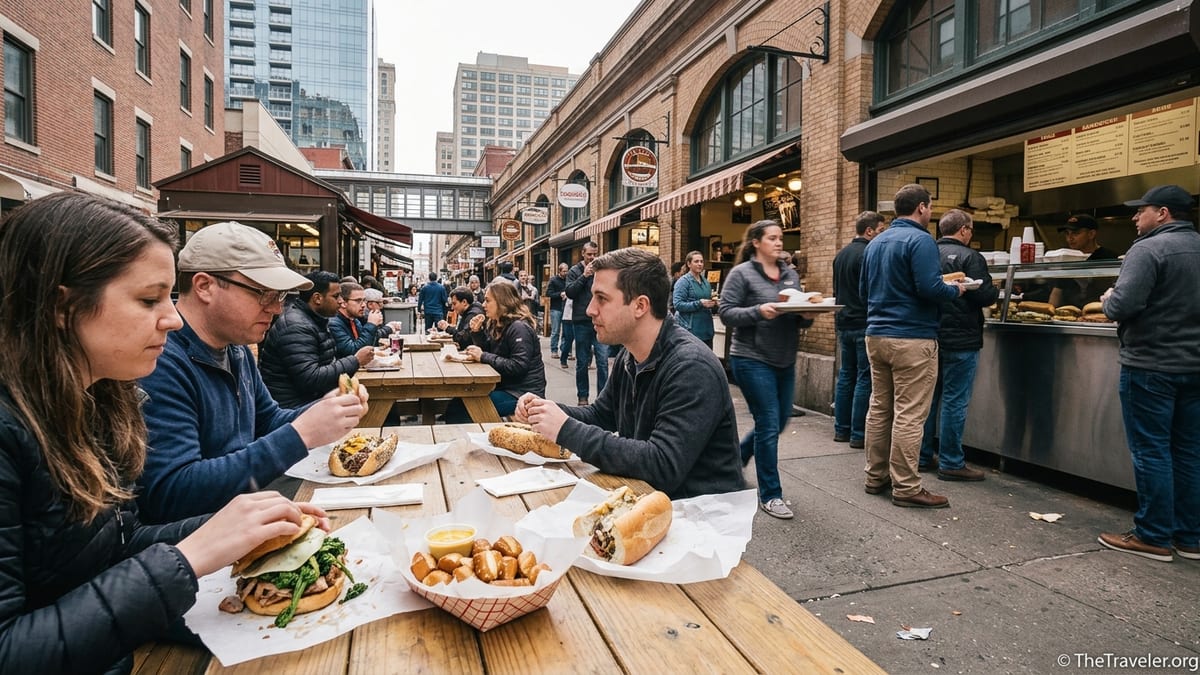
I arrived just before lunch and immediately understood why locals warn you to come hungry. One corner is all sizzling griddles and sandwich boards. DiNic’s draws a steady line for its famous roast pork, sliced thin, soaked in jus, and packed into a seeded roll with sharp provolone and garlicky broccoli rabe. A sandwich runs roughly 12 to 15 dollars and comfortably feeds two light eaters. A few steps away, Fox & Son serves corn dogs and fried treats, while Kamal’s Middle Eastern offers falafel and hummus plates that can hold their own against full-service restaurants.
Turn another corner and the market shifts to sweet comfort. Bassetts Ice Cream, in business since the 19th century, scoops densely creamy ice cream in classic flavors. Beiler’s Donuts piles its glass cases high with hand-rolled, Lancaster-style donuts that regularly sell out on weekends, and Famous 4th Street Cookies offers thick, chewy chocolate chip cookies that many visitors start “saving for later” and then devour on the spot. It is entirely possible to spend 25 to 30 dollars here and string together a progressive meal of roast pork, pretzels, coffee, and dessert without ever sitting down for a formal service.
Even on a weekday, the energy is intense. Office workers angle for a seat in the central seating area, visitors wander with maps and dripping sandwiches, and local regulars weave between them with the efficiency of people who know exactly which stall has the best chicken and waffles or Filipino barbecue skewer that day. The market is touristy, but it is also deeply used by the city itself, which keeps the food quality high and the atmosphere distinctly Philadelphian rather than theme-park polished.
Beyond Cheesesteaks: The Real Sandwich Education
Arriving in Philadelphia, I had the usual outsider’s confidence that I knew what to order: a cheesesteak, maybe a hoagie. Locals quickly corrected me. Yes, you have to try a cheesesteak at least once, but the city’s true sandwich culture is broader and more fiercely debated. The classic trio is the cheesesteak, the hoagie, and the Italian roast pork, and arguments over which shop does each best are practically a local sport.
On one afternoon, I took the Broad Street Line south and joined the crowd at John’s Roast Pork, a no-frills spot near the river that has been around since the 1930s. Their namesake sandwich layers slow-roasted pork, sharp provolone, and bitter greens into a crusty roll that soaks up the juices without collapsing. Many food writers and visiting chefs quietly name this as the city’s best sandwich, and at around 12 to 14 dollars it feels like a bargain compared with many big-city “must-eats.” The cheesesteak here is excellent too, proving that you do not have to stand in the neon glare of the most famous corners to find greatness.
Elsewhere in the city, hoagie specialists offer their own education. At legacy South Philly shops and neighborhood delis in places like Fishtown or East Passyunk, you will see long counters stacked with cured meats and provolone, crusty local rolls, and big tubs of marinated long hot peppers. A proper Italian hoagie often costs in the 10 to 13 dollar range and can easily be split. For travelers, this is one of the most budget-friendly ways to eat like a local. Pick up a hoagie, walk a few blocks to a nearby park like Washington Square or the Rail Park, and you have a lunch that feels fully Philadelphian without requiring a reservation.
What struck me is how these sandwiches reflect the city’s immigrant roots. The roast pork and sharp provolone speak to Italian heritage. Soft pretzels and pork roll hint at regional Mid-Atlantic traditions. Newcomer communities are adding their own signatures, from Vietnamese hoagies on Kensington Avenue to Caribbean-influenced cheesesteaks in North Philly. Philadelphia’s sandwich culture is no longer just about one iconic item. It is a living collection of stories in a roll.
Neighborhoods Where the Food Story Gets Personal
Leaving Center City is where Philadelphia’s food scene really starts to feel like an insider secret. In South Philadelphia, streets that once held almost exclusively Italian red-sauce joints now share space with some of the country’s most talked-about Southeast Asian and Mexican restaurants. On a single block, you might find a classic family-run Italian dining room next door to a bold Thai kitchen known for blisteringly spicy curries and modern takes on street food.
West Philadelphia tells a different story. Here, Ethiopian cafes line stretches of Baltimore Avenue, their injera platters feeding tables of students and families for around 15 to 25 dollars. Nearby, halal food trucks and small South Asian restaurants cater to long-time residents and university communities alike. Menus might list slow-cooked lamb stews, lentil dishes scented with berbere or turmeric, and thick mango lassis served in simple plastic cups. The dining rooms are often unfussy, but the flavors are vivid and, for many visitors, unlike anything they will find in more tourist-oriented parts of the city.
Up in North Philly and the River Wards, the picture shifts again. Old industrial blocks have filled with taquerias, Puerto Rican cafes, and creative bakeries that keep late hours for service workers. A plate of al pastor tacos or pernil with rice and beans can cost under 15 dollars, and many spots remain cash-friendly and relaxed about reservations. These neighborhoods underscore something important about eating in Philadelphia: some of the best food experiences happen far from guidebook routes, in places where menus are photocopied, decor is improvised, and the welcome is unmistakably warm.
High-End Dining Without the Big-City Attitude
Though much of Philadelphia’s culinary charm lies in casual, affordable spots, the city also punches above its weight in fine dining. What feels different here is the attitude. Many of the most acclaimed restaurants are chef-driven, relatively small, and deliberately approachable. They lean into the city’s BYOB culture or pair serious cooking with comfortable service instead of the stiff formality often found in larger coastal cities.
In Center City and Rittenhouse Square, you will find tasting menu restaurants that focus on seasonal Mid-Atlantic produce and sustainably sourced seafood. A multicourse dinner with wine pairings will not be cheap, but it often costs less than comparable experiences in New York or San Francisco. Nearby, modern bistros reinterpret French, Italian, or Mediterranean flavors with local ingredients: house-baked sourdough, Jersey tomatoes in season, Pennsylvania mushrooms, and cheeses from regional creameries.
What makes this tier of dining attractive to travelers is the balance between ambition and accessibility. It is not unusual to see diners in jeans at the bar working through a small plates menu for under 60 dollars per person, while other tables around them celebrate anniversaries with longer, more elaborate meals. Many restaurants have adapted to changing dining habits with robust bar menus, outdoor seating, and flexible reservations, making it easy to slot a special dinner into a sightseeing-heavy itinerary without rearranging your entire day.
Street Food, Night Markets, and Outdoor Dining
Philadelphia’s restaurant culture extends out onto the sidewalks. The city’s long tradition of food trucks near universities and hospitals has evolved into a vibrant curbside scene. Around Temple University, the University of Pennsylvania, and Drexel University, you will find trucks selling everything from halal platters and Korean bibimbap to vegan wraps and bubble tea. A filling lunch can run 10 to 14 dollars, and service is usually fast enough to fit between museum visits or walking tours.
In warm weather, entire streets transform into open-air dining rooms. Outdoor seating lines corridors like 13th Street in Midtown Village, East Passyunk Avenue, and parts of Fishtown and Northern Liberties. After the pandemic, Philadelphia formalized a “streetery” program that allows restaurants to create semi-permanent outdoor structures, so you will see wooden platforms, planters, and string lights turned into inviting sidewalk patios. This makes dining feel communal and spontaneous: you can walk until something smells or looks right, then grab a table and settle in.
Seasonal night markets and street festivals amplify this feeling. Depending on when you visit, you might stumble into a block party organized by a neighborhood association or a larger market featuring dozens of local vendors. The setup is usually simple: long lines, paper boats, and plastic cups, but the payoff can include everything from Lao grilled chicken to small-batch ice cream and craft beer from regional breweries. For travelers who want to sample as much as possible in a short time, these events are an efficient and festive way to taste the city.
Practical Tips: Eating Your Way Through Philly in a Long Weekend
For a long weekend in Philadelphia, you can easily structure your days around both history and food without sacrificing either. One simple approach is to anchor each day in a different neighborhood. Start in Old City and Society Hill for the classic historic sites, then walk west toward Reading Terminal Market for lunch. In the afternoon, tour the museums along the Benjamin Franklin Parkway and finish with dinner in Rittenhouse or Midtown Village, where you can choose between small-plate wine bars, upscale taverns, and contemporary American dining rooms.
On day two, focus on South Philadelphia. Visit the Italian Market area in the morning for coffee and pastries, then wander the produce stalls and butcher shops that have served the neighborhood for generations. Grab a hoagie or roast pork sandwich for lunch, then spend the afternoon exploring East Passyunk’s boutiques. Return in the evening for dinner at one of the many acclaimed spots along the avenue, whether that means inventive Thai, modern Mexican, or a classic red-sauce Italian restaurant with white tablecloths and big, shareable portions.
Day three is your chance to explore West Philly or Fishtown. In West Philadelphia, you could build a food crawl along Baltimore Avenue, stopping for Ethiopian coffee, a shared vegetarian platter, and dessert at a neighborhood bakery. In Fishtown and nearby Kensington, coffee roasters, natural wine bars, and inventive bakeries mix with long-standing Polish and Latin American establishments. Traveling mostly by subway and bus, you can keep transportation costs low and funnel your budget into experiences on the plate.
Across all three days, a realistic food budget might range from 50 to 90 dollars per person per day, depending on how often you opt for higher-end dinners. Splitting sandwiches, taking advantage of generous lunch portions, and balancing restaurant meals with market snacks will stretch your dollars further. Making at least a few reservations, especially for dinner on Friday and Saturday nights, will save you from long waits and let you focus on enjoying what arrives at the table.
The Takeaway
When I first stood in line for security at Independence Hall, I expected the highlight of my trip to be hearing a ranger recite stories about 1776. Those moments were memorable, but when I think back on Philadelphia now, the scenes that surface involve food: tearing into a dripping roast pork sandwich under the vaulted ceiling of an old train shed, watching a line of neighbors joke with the staff at a tiny Ethiopian cafe, and eating donuts on a bench while church bells rang in the distance.
Philadelphia’s history gives it gravitas, but its food scene gives it heart. The city’s sandwich shops, markets, food trucks, and chef-driven restaurants tell a story that is still being written, one where new immigrant communities leave just as strong a mark as the Italian grandmothers and deli owners who came before. For travelers, that means a visit here can be both a lesson in American history and an immersion in one of the country’s most exciting, accessible food cultures.
I came to Philadelphia for the history, but I left with a new understanding of the city: this is a place where the past is preserved in brick and parchment, and the present is best understood in a bite of something messy, flavorful, and proudly local.
FAQ
Q1. Do I need restaurant reservations in Philadelphia?
Reservations are recommended for popular dinner spots, especially on weekends, but many markets, sandwich shops, and neighborhood places remain walk-in friendly.
Q2. How much should I budget per day for food in Philadelphia?
A reasonable daily food budget is roughly 50 to 90 dollars per person, depending on how often you choose higher-end restaurants over markets and casual spots.
Q3. Where should first-time visitors stay to enjoy both history and food?
Staying in Center City or Old City offers easy access to historic sites, Reading Terminal Market, and transit connections to neighborhoods with strong dining scenes.
Q4. Is Reading Terminal Market too touristy to be worth it?
It is popular with visitors, but locals also shop and eat there, and standout vendors make it a genuinely worthwhile stop for a first-timer’s lunch or snack crawl.
Q5. Are cheesesteaks really a must, or are there better local dishes?
Cheesesteaks are worth trying once, but many locals will nudge you toward hoagies and roast pork sandwiches, which showcase the city’s sandwich culture just as well.
Q6. Can vegetarians and vegans eat well in Philadelphia?
Yes. Many markets and restaurants offer strong vegetarian and vegan options, from falafel and Middle Eastern spreads to dedicated plant-based cafes and bakeries.
Q7. What is the best way to get between food neighborhoods without a car?
Philadelphia’s subway, trolleys, and buses are usually enough for visitors, and pairing transit with walking or short ride-hail trips works well for reaching most dining areas.
Q8. Are tips expected in Philadelphia restaurants and markets?
Yes. In sit-down restaurants, tipping around 18 to 20 percent is customary, while a dollar or two per drink or counter order is common in more casual settings.
Q9. Is it safe to explore food spots outside the main tourist areas?
Many neighborhoods with great food are comfortable to visit, but as in any city, it is smart to stay aware, follow local advice, and stick to well-traveled streets, especially at night.
Q10. What local foods should I prioritize if I only have one day?
Focus on a roast pork or hoagie sandwich, a soft pretzel or local pastry, and a visit to Reading Terminal Market, then add a neighborhood dinner that reflects the city’s diversity.