


More news on this day
Germany has formally identified a sudden hillside slide as the cause of a fatal regional train derailment near Riedlingen in July 2025, bringing clarity to an accident that killed three people and intensified questions about how climate-driven weather extremes are testing European rail networks.
Get the latest news straight to your inbox!
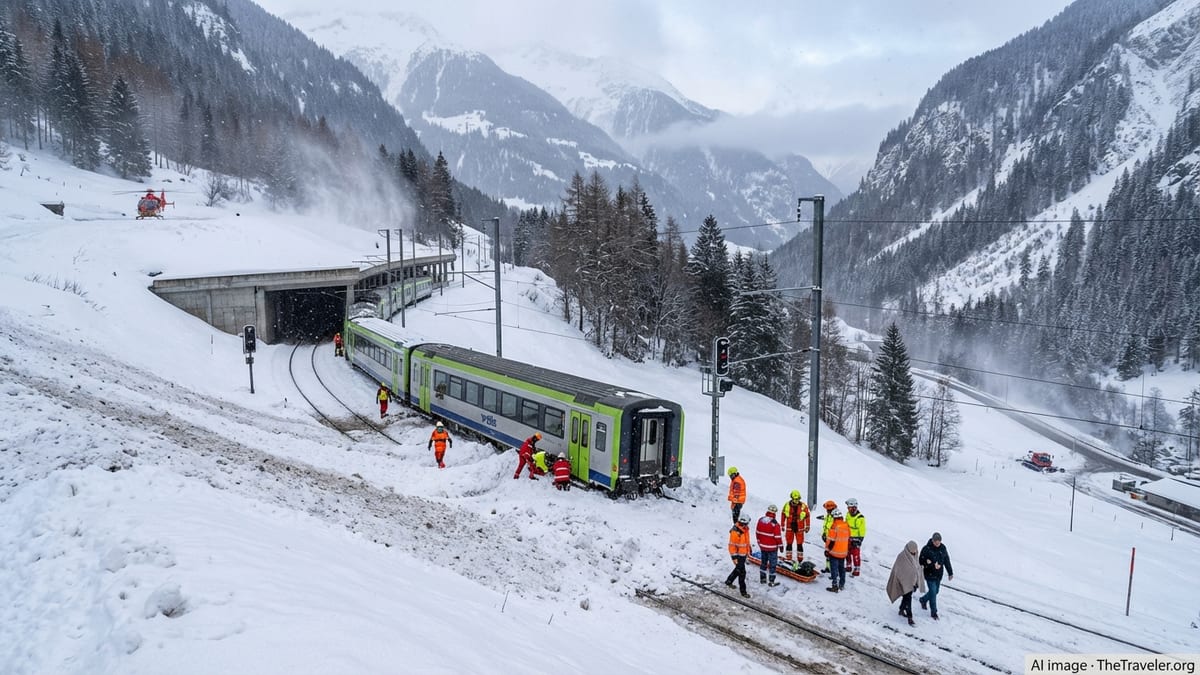
Investigation Concludes Hillside Movement Triggered Crash
According to newly published findings from Germany’s Federal Authority for Railway Accident Investigation, a rapid slope failure beside the single-track line between Sigmaringen and Ulm caused the Regional Express to derail near Zell-Bechingen, a district of Riedlingen, on 27 July 2025. Reports indicate that the moving hillside pushed debris and material toward the track bed, destabilising the rails shortly before the four-car train passed the site.
Coverage by German public broadcasters describes how three of the train’s coaches left the tracks, overturning and sliding along the ballast. The train driver, a rail trainee and a 70‑year‑old passenger died in the crash, while dozens of other travellers sustained injuries of varying severity. Emergency services faced difficult conditions on the rural stretch of line, where access routes are narrow and the surrounding terrain is uneven.
The final report rules out technical defects on the train and signalling system as primary causes, focusing instead on the interaction between the unstable slope and the railway embankment. Investigators reconstructed weather patterns, soil conditions and drainage behaviour in the months leading up to the accident, concluding that a localized ground movement, rather than a sudden track failure alone, set the derailment sequence in motion.
Publicly available information also notes that the affected line, which runs along the Danube valley and passes close to steep forested slopes and agricultural land, had not previously been classified as a critical geotechnical risk point to the same degree as certain alpine corridors. The new findings suggest that risk maps and monitoring regimes in such transition zones may need to be revisited.
From Sewage Spill Hypothesis to Geotechnical Focus
Early in the investigation, regional police and media reports highlighted a possible link between the derailment and an overflowing sewer near the tracks. That initial hypothesis pointed to water undermining the embankment or washing away supporting material beneath the sleepers. For months, public debate centred on whether infrastructure failures in local drainage networks had indirectly contributed to the crash.
The final assessment shifts the emphasis from a single piece of infrastructure to the broader behaviour of the hillside above the line. Published coverage indicates that heavy and persistent rainfall saturated the soil, increasing pore water pressure and weakening the slope until a section gave way. This process, often described in geotechnical literature as a shallow landslide or slope slide, can be difficult to predict with standard inspection routines.
Investigators examined sewer installations, culverts and ditches in the area and incorporated hydrological modelling to understand how surface and groundwater moved through the slope. While excess water from man‑made structures may have influenced local conditions, the report describes the derailment’s root cause as a natural hillside movement that redistributed loads on the track foundation at a critical moment.
The updated conclusion illustrates how complex interactions between civil infrastructure and natural terrain can complicate early explanations after a crash. It also underscores the challenge for rail operators and local authorities in communicating evolving findings to communities seeking swift answers.
Implications for Rail Safety and Climate Resilience
The Riedlingen case adds to a series of European rail incidents in recent years where landslides, rockfalls or erosion during periods of intense rainfall have played a central role. Safety specialists interviewed in German and international media have increasingly warned that climate change is likely to bring more frequent short, heavy downpours that can destabilise slopes close to rail corridors, particularly on older lines built along river valleys.
Publicly available information on German infrastructure planning shows that operators are already expanding programmes to map geotechnical risks and deploy sensors that can detect slow ground movement or increased water levels near vulnerable cuttings and embankments. The Riedlingen findings are expected to feed into ongoing reviews of where additional monitoring, drainage upgrades or physical barriers are necessary.
For travellers, the investigation highlights how some of the most picturesque regional routes, often prized for their views of steep hillsides and riverbanks, may require more frequent maintenance closures and speed restrictions after heavy rain. Rail companies and regional transport authorities have been exploring ways to improve real‑time communication with passengers when sudden weather‑related disruptions occur.
Sector observers note that the final report may also influence European discussions around common standards for climate resilience in rail infrastructure. As cross‑border passenger and freight traffic grows, policymakers are considering how to align risk assessment methods so that routes linking multiple countries can be evaluated under comparable geotechnical criteria.
Germany’s Broader Rail Safety Context
The determination of the cause of the Riedlingen derailment comes as Germany continues to scrutinise rail safety in the wake of several serious incidents. A separate internal investigation into the 2022 Garmisch-Partenkirchen derailment found that a combination of track component issues and procedural shortcomings contributed to that crash, prompting nationwide inspections of concrete sleepers and track geometry.
Deutsche Bahn’s public reporting indicates that the company has expanded inspection and renewal programmes for key infrastructure elements, including bridges, tunnels and embankments, and is investing in digital monitoring systems intended to identify anomalies before they lead to incidents. The Riedlingen findings add an additional layer of complexity by emphasising that infrastructure must also be understood as part of a changing natural environment.
Rail unions and passenger advocacy groups have used recent accidents to press for more resources and clearer accountability structures. Commentary in German media often contrasts the ambition of shifting more freight and passengers from road to rail with the perceived backlog of maintenance and modernisation projects on existing lines, particularly in rural regions.
At the same time, comparative safety statistics continue to show that rail travel remains one of the safest modes of long‑distance transport in Europe. Analysts argue that high‑profile investigations such as the Riedlingen report, while rooted in tragic circumstances, play a vital role in refining safety practices and improving public understanding of the complex systems that underpin everyday mobility.
What the Findings Mean for Travellers
For domestic and international travellers using Germany’s regional and long‑distance network, the Riedlingen investigation is likely to translate into more targeted maintenance work and occasional temporary closures on lines deemed vulnerable to slope movements. Transport planners have signalled in public forums that such interruptions are a necessary part of adapting long‑standing infrastructure to evolving environmental conditions.
Passengers may increasingly encounter reduced speeds in areas identified as geotechnical risk points during or after heavy rainfall, particularly on scenic rural routes. While such measures can lengthen journey times, safety experts emphasise in published commentary that speed restrictions remain one of the most effective tools for reducing derailment risk when track conditions are uncertain.
Travel industry observers suggest that clear communication will be critical. Tourism boards and rail operators are being encouraged to provide multilingual updates and user‑friendly journey planners so that visitors can rebook connections or choose alternative routes when weather‑related disruptions occur. Better integration between regional trains, long‑distance services and local buses can help ensure that safety‑driven closures do not leave communities temporarily isolated.
Ultimately, the formal identification of a hillside slide as the cause of the Riedlingen derailment underscores how rail safety in Germany is increasingly tied to environmental monitoring and climate resilience. For travellers planning journeys across the country, the case serves as a reminder that the risks being addressed extend beyond rolling stock and signalling to the very landscapes through which Europe’s railways run.