


Germany remains one of the world’s most institutionally stable destinations, yet its risk profile has shifted in recent years. Slower economic growth, rising security concerns, climate related flooding and heatwaves, and visible political polarization all affect the risk calculus for individuals and organizations considering relocation. This dashboard summarizes the main structural and emerging risks that could influence medium to long term relocation decisions to Germany as of early 2026.
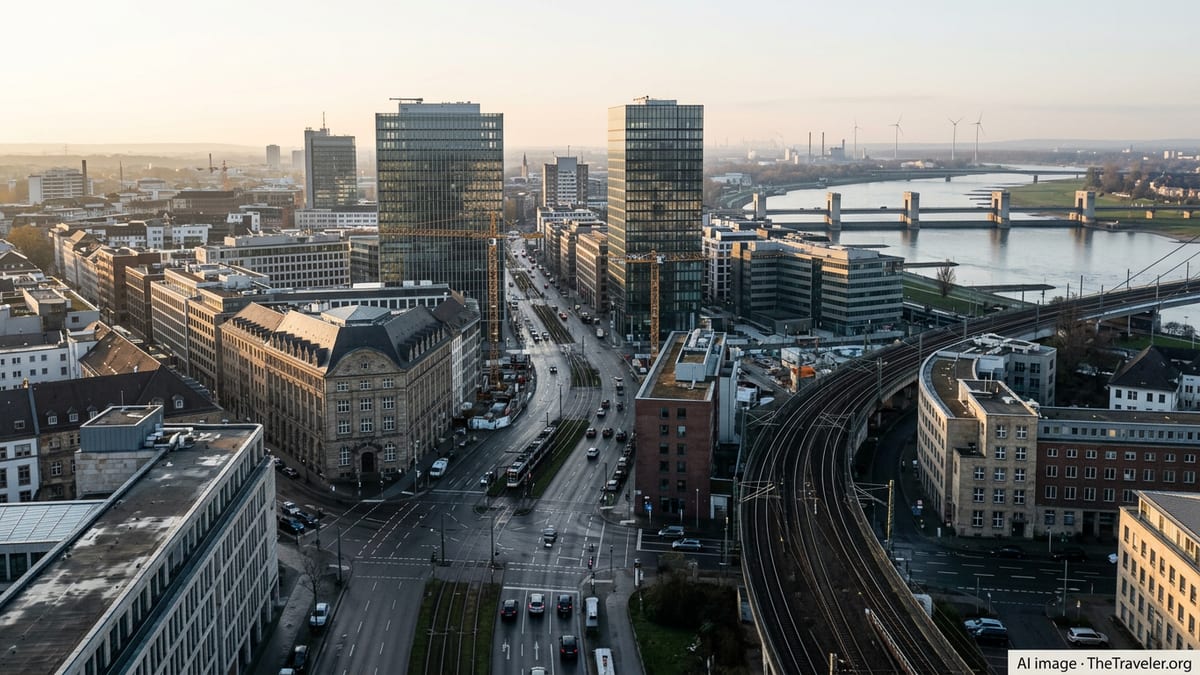
Germany Relocation Risk Dashboard Overview
Germany is generally regarded as a low to moderate risk destination in global comparison, with strong institutions, mature infrastructure and a diversified economy. International composite indices that combine governance quality, climate vulnerability and economic readiness typically place Germany within the top 20 worldwide, indicating high overall resilience but also growing exposure to shocks. In governance readiness rankings derived from the Worldwide Governance Indicators, Germany scores around 0.77 on a 0 to 1 scale and ranks near 15th globally, reflecting robust rule of law and regulatory quality combined with some political fragmentation risk.
At the same time, Germany has faced a prolonged economic slowdown since 2022 and has been described in several economic analyses as one of the more vulnerable major advanced economies under adverse Euro Area scenarios. Forecasts for real GDP growth between 2024 and 2027 generally lie around 0.5 to 1.5 percent per year, substantially below its historical average. This combination of institutional strength with economic underperformance and rising security concerns produces a nuanced, sector specific risk environment that relocation decision makers need to understand in detail.
From a relocation perspective, the central questions are whether Germany’s institutional capacity can continue to offset its structural challenges, and how specific risks such as crime trends, climate hazards and infrastructure bottlenecks may affect daily life, operational continuity and medium term planning. The following sections break down the key risk dimensions most relevant to individual and corporate relocations.
Political and Governance Stability Risk
Germany’s political system is built on a federal parliamentary structure with proportional representation, coalition governments and a strong constitutional court. Over several decades this architecture has delivered high levels of predictability, respect for civil liberties and continuity of core policies. Sovereign credit ratings from major agencies remain at the highest levels, with AAA assessments and stable outlooks, indicating extremely low perceived default and governance risk.
However, the political landscape has fragmented significantly since the mid 2010s. Support for traditional centrist parties has declined while smaller parties and populist movements have gained share, resulting in more complex coalition negotiations and occasional legislative gridlock. Since 2022 Germany has also experienced heated public debate around energy transition, migration and fiscal policy, sometimes accompanied by large demonstrations. While institutions have coped, the tone of politics has become more confrontational and the risk of policy reversals or delays has increased compared with earlier decades.
For relocation planning, this implies that core democratic stability risk remains very low, but policy volatility risk is higher than in the pre 2010 period. Changes to climate, industrial and digital policies can be slower or more incremental than initially announced, and large scale reforms may face legal or coalition related delays. Individuals and organizations relocating to Germany can assume a high degree of legal continuity and contract enforcement, but should anticipate occasional abrupt changes in regulatory detail or timelines, especially in areas touching on energy, environmental regulation and digital infrastructure.
Macroeconomic and Labor Market Risk
Germany entered a period of economic weakness from 2022 onward, with real GDP contracting around 0.9 percent in 2023 and roughly 0.5 percent in 2024 according to several international assessments. By early 2026, government and multilateral forecasts broadly expect a return to modest growth, with estimates around 0.3 to 1 percent in 2025 and about 1 to 1.3 percent in 2026 and 2027. This suggests a slow recovery rather than a rapid rebound, leaving the economy vulnerable to external shocks in energy prices, global trade or Euro Area demand.
Structural challenges include high energy costs relative to pre 2022 levels, slow adoption of digital technologies, an aging population and a shortage of skilled workers in many sectors. Some analytical work on Euro Area growth vulnerability identifies Germany as more exposed to adverse common shocks than most peers, given its export reliance and industrial composition. At the same time, fiscal capacity remains significant, debt ratios are manageable, and major public investment programs in infrastructure and defense are being rolled out over a multi year horizon.
For relocation risk assessment, this environment translates into a mixed macro picture. Systemic crisis risk such as severe currency or banking disruption appears very low, but medium term economic underperformance risk is meaningful. Job markets for highly skilled professionals in engineering, IT, healthcare and research remain relatively tight, whereas more cyclical manufacturing segments and energy intensive industries face restructuring pressure. Individuals relocating for employment should pay close attention to sector specific outlooks, while organizations establishing operations should factor slower domestic demand growth and potential policy shifts into their planning.
Public Security, Crime and Social Cohesion Risk
Germany is generally perceived as a relatively safe high income country, with overall crime rates that declined from the early 2000s to a low point around 2020 and 2021. Police crime statistics show that this trend reversed after the pandemic. By 2023 the number of recorded offences had returned to levels similar to 2017, and several reports characterized 2023 as having the highest number of recorded crimes in roughly a decade. Violent crime indicators, including serious assaults and robberies, reached their highest levels in around 15 years according to national overviews.
Data released in 2024 and provisional information for 2025 point to a stabilization or slight decline in total recorded offences, but violent crime remains elevated compared with the late 2010s. Official statistics also document a steady rise in politically motivated offences over the last decade, with annual totals more than doubling since the early 2010s. This reflects a combination of far right, far left and extremist ideologies, as well as tensions linked to international conflicts. Large cities tend to record higher crime rates than smaller towns, a pattern that has remained stable.
From a relocation risk standpoint, the absolute levels of crime in Germany remain low by global standards, but the direction of travel for violence related categories is unfavorable. Residential burglary and property crime risks are moderate and generally manageable through standard precautions, while the primary emerging concern is the slow upward drift in violent incidents and extremist motivated attacks. Social cohesion is under strain in some regions, with polarized discourse around migration and identity, but there is still strong institutional and civil society capacity to respond to these challenges.
Climate, Environmental and Natural Hazard Risk
Climate and environmental risk has become one of the most dynamic components of Germany’s relocation risk profile. The country is not highly exposed to earthquakes or tropical cyclones, but it faces rising threats from heatwaves, river flooding, heavy rainfall and local hail or windstorm events. Major flood events in the last decade, including severe river floods in western Germany, caused substantial economic losses and highlighted vulnerabilities in land use planning and critical infrastructure.
Studies of natural hazard losses in Europe between 1980 and 2023 estimate total economic damage in the European Union at several hundred billion euros, with Germany among the larger contributors due to its size and industrial concentration. Recent research focusing on southwestern Germany shows increasing clustering of multiple meteorological hazards such as windstorms, convective gusts, hail and different types of flooding, implying that compound events can affect the same region within relatively short timeframes. This raises the risk of disruption to transport, utilities and housing, especially in river valleys and urban areas with limited drainage capacity.
Heatwaves have also intensified, with several recent summers recording prolonged periods of high temperatures that stress public health and infrastructure. Germany’s climate policy framework aims to mitigate long term risks through decarbonization and adaptation investments, but near to medium term exposure to extreme rainfall and flood events remains a salient risk factor for relocation decisions. Risk levels are highly location specific: low lying river basins, floodplains and densely built areas with older drainage systems carry higher hazard exposure than elevated or less densely developed regions.
Infrastructure Reliability and Systems Resilience Risk
Germany’s core infrastructure backbone for transport, energy and digital connectivity remains extensive, but age, underinvestment and recent shocks have exposed reliability issues. Several national assessments point to a significant backlog in the maintenance and modernization of roads, bridges and rail networks, with some key corridors subject to recurring disruptions. Rail punctuality deteriorated notably in the early to mid 2020s, and large scale renovation programs now underway are expected to cause intermittent construction related disturbances even as they improve long term resilience.
The energy system underwent substantial stress after 2022 due to the rapid reduction in Russian gas imports and higher global prices. Emergency measures, diversification of supply and expansion of renewables avoided systemic shortages, but industrial users in particular face structurally higher electricity and gas costs compared with the pre crisis period. Policy initiatives to subsidize energy for heavy industry and accelerate grid expansion are being implemented, but these will take several years to fully materialize.
Digital infrastructure is mixed. Urban centers typically have reliable high speed connectivity, while some rural areas still lag behind leading peers in terms of broadband coverage and mobile network quality. For relocation risk analysis, this means that Germany offers robust infrastructure in aggregate, but with greater regional variance and more frequent short term disruptions than its reputation as an engineering powerhouse might suggest. Organizations with time critical operations should examine local track records for transport and energy reliability, especially in industrial and logistics hubs.
Regulatory and Legal Predictability Risk
One of Germany’s principal strengths in relocation risk terms is its highly developed legal and regulatory system. The rule of law is consistently rated as strong by international governance indicators, and courts are generally independent and professional. Contract enforcement, property rights and administrative review processes are reliable, which significantly reduces legal uncertainty for long term relocation and investment.
The main risk factor in this domain is not arbitrary state action, but rather complexity and the potential for regulatory delays or reversals. Germany’s multi level federal system, combined with detailed regulations and frequent court challenges, can prolong permitting and planning processes. High profile examples, particularly in energy and infrastructure projects, illustrate how legal appeals and constitutional constraints on fiscal measures can alter timelines or financing structures, even when political support exists.
For individuals and corporations relocating to Germany, this means that once legal decisions are finalized they are highly secure, but the process to reach those decisions may be lengthy. Compliance obligations in areas such as data protection, labor law and environmental standards are comprehensive and can be administratively demanding. This raises operational complexity risk rather than fundamental legal security risk, and should be factored into relocation planning, especially for activities requiring permits or regulatory approvals.
The Takeaway
Germany’s relocation risk profile in early 2026 is characterized by strong institutional resilience combined with elevated medium term challenges. Political and legal stability remain high, and systemic breakdown risks are very low. However, prolonged economic underperformance, an uptick in violent and politically motivated crime, visible climate related hazards and infrastructure strains add layers of complexity for relocation assessments.
For individuals, Germany continues to offer a relatively safe and predictable environment by global standards, but expectations should be calibrated to recognize that crime and climate risks are no longer negligible and may vary meaningfully by region and city. For organizations, the key considerations are sector specific economic prospects, exposure to energy costs, vulnerability of local infrastructure to disruption and the administrative demands of operating in a highly regulated environment.
In decision grade terms, Germany remains a viable and often attractive relocation destination, particularly for knowledge intensive activities and highly skilled professionals. The core recommendation is to complement the generally positive country level profile with careful regional and sectoral due diligence, focusing on climate exposure, local security trends, infrastructure reliability and the practical implications of regulatory complexity in the intended area of relocation.
FAQ
Q1. How stable is Germany politically for long term relocation?
Germany’s political system is highly stable, with strong institutions and low risk of abrupt regime change, although coalition politics can create policy delays and volatility in specific areas.
Q2. Is Germany currently in an economic crisis?
Germany experienced recession in 2023 and 2024 and is now in a slow recovery phase. Forecasts point to modest growth rather than deep crisis, but structural challenges remain.
Q3. How serious is crime risk in Germany for residents?
Overall crime is moderate by international standards, but recorded offences and violent crime have risen from pandemic lows. Large cities have higher risk than smaller towns, so local conditions matter.
Q4. Are extremist or politically motivated crimes a concern for newcomers?
Politically motivated offences have increased over the last decade. While absolute numbers remain limited relative to population, they indicate a more polarized environment that newcomers should be aware of.
Q5. What are the main climate related risks affecting relocation to Germany?
The primary climate risks are river flooding, heavy rainfall, hail and increasingly frequent heatwaves. Hazard levels vary strongly by region, with floodplains and some urban areas more exposed.
Q6. How reliable is infrastructure such as transport and energy in Germany?
Infrastructure is extensive and generally reliable, but aging assets and renovation backlogs lead to more frequent disruptions than in the past, particularly on some rail corridors and road networks.
Q7. Does Germany face energy security risks that could affect daily life?
Energy supply has stabilized after the 2022 shock, and widespread outages are unlikely. The main residual risk is structurally higher prices and potential localized constraints for energy intensive users.
Q8. How predictable is the legal and regulatory environment for residents and businesses?
Legal security and rule of law are strong, but regulations can be complex and procedures lengthy. Once decisions are made they are highly reliable, but reaching them may take time.
Q9. Are there significant regional differences in relocation risk within Germany?
Yes. Large metropolitan areas tend to have higher crime but better services, while some regions face greater climate or infrastructure stress. Risk assessments should always be location specific.
Q10. What is the overall relocation risk rating for Germany compared with other countries?
In global comparison Germany rates as low to moderate risk for relocation, with strong institutions offsetting economic and security challenges. It is generally less risky than most countries worldwide but no longer risk free.