


Germany and Portugal have become two of Europe’s most discussed bases for remote workers and freelancers. Both combine EU stability with strong connectivity, but they differ significantly in digital infrastructure maturity, work environments, and the practical realities of running a remote or freelance career. This briefing compares Germany and Portugal strictly from the perspective of remote work and freelance operability, providing decision‑grade insights for individuals considering a relocation to either country.
Overall Attractiveness for Remote Work and Freelance Activity
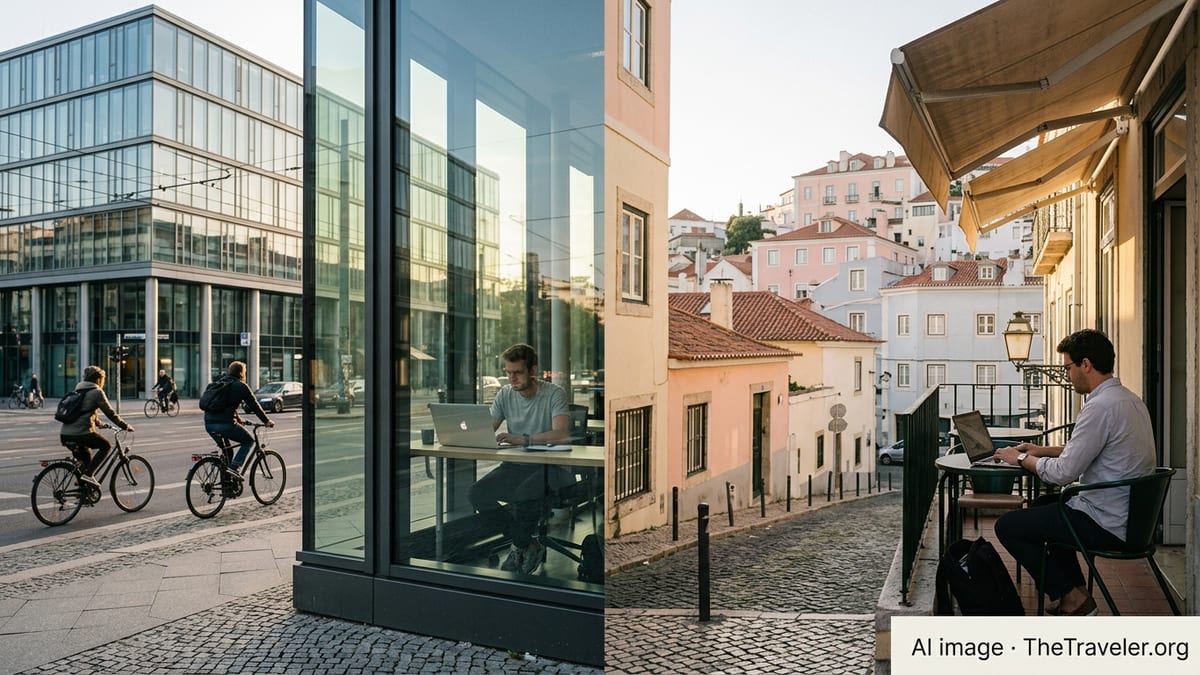
Germany and Portugal are both established hubs for remote workers and freelancers, but they occupy different positions in the European work ecosystem. Germany functions as a high‑productivity, enterprise‑oriented environment with deep corporate networks and a large domestic client base, particularly in technology, engineering, and professional services. Portugal operates more as a lifestyle and community‑oriented hub, with a strong concentration of international remote workers serving foreign employers or clients.
For remote employees with demanding connectivity and collaboration requirements, Germany’s mature corporate infrastructure, extensive business services, and time zone alignment with the rest of Europe provide a structurally reliable base. For global freelancers and digital nomads prioritizing community, flexibility, and lower operating costs, Portugal’s remote‑work ecosystems in Lisbon, Porto, and coastal regions offer a dense network of coworking spaces and peer support.
Both countries align with Central European time for much of the year, which is advantageous for collaboration with European and parts of African and Middle Eastern markets. For workers primarily serving North American clients, evening overlap exists in both locations, but Portugal’s slightly more westerly position provides marginally better alignment with US time zones, which may matter for client calls and real‑time support roles.
Internet Quality, Connectivity, and Reliability
Both Germany and Portugal provide sufficient internet quality for most remote work tasks, but there are notable differences in consistency and infrastructure maturity between regions and urban versus rural areas. In major German cities, high‑speed fixed broadband and 5G coverage are widespread, with advertised residential speeds commonly reaching several hundred megabits per second. Urban infrastructure in cities such as Berlin, Munich, Hamburg, Frankfurt, and Cologne offers redundant connectivity options, frequent fiber availability, and robust mobile networks suitable for video conferencing and cloud‑heavy workloads.
Portugal has made significant investments in fiber and mobile networks, particularly in Lisbon, Porto, and key coastal areas. In these hubs, fiber‑to‑the‑home and 4G or 5G coverage are standard, supporting video calls and data‑intensive work. However, in smaller inland towns and less populated regions, speeds and reliability can be more variable, and workers may need to rely more heavily on mobile data or specific accommodation with confirmed high‑speed connections.
For remote workers who travel frequently within the country, Germany’s extensive rail and road networks provide broad but not uniform mobile coverage. Dead zones still appear on certain intercity rail routes, which can limit the ability to work effectively while in transit. Portugal’s smaller geographic size generally makes connectivity across major corridors more manageable, but coverage along some rural or coastal stretches may still be intermittent. In both countries, serious remote professionals typically rely on a combination of fixed broadband at home or in coworking spaces plus a high‑data mobile plan as backup.
Coworking Landscapes and Third‑Space Work Options
Coworking availability and pricing differ notably. In Germany, coworking ecosystems are densest in Berlin, Munich, Hamburg, Frankfurt, and Cologne. Typical monthly hot‑desk memberships in central Berlin are often in the approximate range of 150 to 300 euros, with premium or very flexible offers higher, while some discounted or limited‑access memberships can be obtained below that range. In top‑tier business cities like Munich, desk rates can be significantly higher, often positioning coworking as a mid‑to‑high overhead line item in a freelancer’s budget.
Portugal’s coworking market, while smaller in absolute size, is strongly oriented toward remote workers and international freelancers. In Lisbon and Porto, recent surveys and operator price lists indicate that monthly hot‑desk memberships commonly fall in an approximate band of 100 to 200 euros, with dedicated desks often around 150 to 300 euros, depending on location and amenities. Smaller cities and coastal towns may offer even lower prices or more flexible day‑pass structures that appeal to mobile remote workers.
In Germany, coworking spaces are frequently embedded in startup and corporate ecosystems, with strong links to local investment, accelerators, and enterprise clients. This can be advantageous for freelancers seeking local corporate contracts or partnerships. In Portugal, coworking spaces tend to emphasize community, social programming, and international networking over direct access to large domestic corporate buyers, which suits remote employees with foreign employers and freelancers with global client portfolios.
Client Markets, Professional Ecosystems, and Networking
For freelancers who depend on local or regional clients, Germany offers a much deeper business market. As one of Europe’s largest economies with a broad industrial and services base, it presents extensive opportunities in sectors such as software development, engineering, consulting, marketing, and creative services. Remote‑capable roles and hybrid arrangements are now mainstream in many large German companies, which increases the range of potential engagements for locally established professionals.
Portugal’s domestic client market is smaller and more concentrated in a few metropolitan centers and certain export‑oriented sectors such as IT services, tourism‑related businesses, and outsourced back‑office functions. Many freelancers residing in Portugal continue to serve clients located in northern and western Europe or North America. For independent professionals who already have foreign clients or full‑time remote contracts with overseas firms, this is not a limitation, but those hoping to build a client base predominantly in the country may find a narrower opportunity set compared to Germany.
In terms of networking, Germany provides dense professional events, industry meetups, and sector‑specific conferences, particularly in Berlin and Munich, which can be highly valuable for higher‑value B2B freelancers. Portugal has a strong community focus around remote work, especially in Lisbon and certain coastal hubs, with frequent meetups, community‑driven events, and informal collaboration spaces appealing to solo professionals and early‑stage freelancers. The choice between the two environments often depends on whether an individual values corporate proximity and industry specialization or cross‑national and lifestyle‑oriented communities.
Language, Business Operations, and Daily Workflows
For day‑to‑day remote work, English suffices in many professional contexts in both countries, especially within international companies and coworking spaces. However, the operating language of bureaucracy, many domestic clients, and a large share of business services in Germany remains German. For freelancers targeting local German clients or integrating deeply into domestic professional networks, functional German is a strong advantage and often a de facto requirement at higher levels of responsibility.
Portugal’s professional environments in tech and international services frequently operate in English, and there is widespread English usage in startups and coworking communities. Local administration and many small businesses continue to function primarily in Portuguese, but non‑Portuguese speakers often find it somewhat easier to navigate work‑related interactions in English compared with equivalent situations in Germany, particularly in internationalized urban neighborhoods.
From a workflow perspective, Germany’s business culture is often characterized by structured scheduling, detailed contracts, and longer decision cycles, which can benefit freelancers looking for stability and predictable engagements. Portugal’s work culture, especially within remote and startup circles, may feel comparatively informal and flexible, which can be attractive to certain remote workers but may also require more proactive communication and self‑management to maintain clear expectations with clients and partners.
Time Zones, Work Hours, and Collaboration Patterns
Germany operates on Central European Time, while Portugal uses Western European Time, which is typically one hour behind. For teams primarily located in continental Europe, Germany’s time zone alignment simplifies synchronized working hours and meeting coordination. Remote employees embedded in European organizations may find that Germany’s schedule results in more standard overlapping workdays with colleagues across the bloc.
For remote workers heavily engaged with clients or employers in the United States, Portugal’s one‑hour shift west can meaningfully shift the working window. Evening calls with US East Coast clients start slightly earlier, which may improve work‑life balance for some roles. For US West Coast engagements, both Germany and Portugal generally require late‑evening or night‑time meetings, so the practical difference is smaller, but Portugal still offers a marginally more favorable offset.
Freelancers managing global client portfolios should also consider that Germany’s larger corporate ecosystem tends to anchor around more formal working hours, whereas Portugal’s remote work communities often exhibit more flexible timing and asynchronous collaboration. Individuals who need consistent, conventional office hours with European firms may align more naturally with Germany, while those comfortable with asynchronous communication bands and variable daily schedules may find Portugal’s patterns equally workable.
Community, Professional Support, and Work Sustainability
Community structure affects long‑term sustainability for remote workers. Germany’s professional communities are strong but often segmented by sector and city, with a greater emphasis on formal professional associations, industry groups, and company‑driven networks. For freelancers seeking mentorship and structured professional development, especially in technical or regulated fields, these networks can be valuable but may require time and language skills to access fully.
Portugal has become a prominent destination for globally mobile remote workers, and this is reflected in the density of peer communities, online groups, and in‑person meetups in Lisbon, Porto, and certain coastal areas. These communities can offer rapid social integration, peer learning on remote work best practices, and informal support on operational topics like choosing coworking spaces or managing cross‑border payment platforms. For solo freelancers and early‑career remote workers who rely on peer networks for leads and knowledge sharing, this can be a significant advantage.
At the same time, the concentration of remote workers in certain Portuguese neighborhoods has contributed to rising local demand for workspace and services, which can gradually increase costs over time. In Germany, the scale of the economy distributes remote workers across a larger set of cities and sectors, reducing the sense of concentrated “remote work clusters” in some areas but potentially offering a more stable long‑term environment for those building multi‑year careers in a single city.
The Takeaway
For remote workers and freelancers, Germany represents a structurally robust, business‑dense environment with high infrastructure reliability, extensive coworking networks in major cities, and access to a large domestic market of potential clients and employers. It favors professionals seeking long‑term career development within European corporate ecosystems, particularly those willing to operate in German and invest in integration with local industry networks.
Portugal, by contrast, functions as a highly attractive base for internationally oriented remote workers and freelancers who earn primarily from foreign clients or employers. It provides widely available fiber and mobile connectivity in main urban centers, comparatively accessible coworking prices, and dense international remote‑work communities. It is particularly suitable for solo professionals and teams that prioritize flexibility, community, and slightly more favorable time zone overlaps with North America.
When choosing between Germany and Portugal as a base for remote work or freelance activity, the decisive variables are less about the existence of connectivity or coworking options, which both countries provide, and more about professional orientation. Individuals seeking deep integration into a large, structured European business environment with strong local demand may be better served in Germany. Those prioritizing an internationally focused, community‑driven remote work context with lower operational thresholds may find Portugal more aligned with their long‑term working style.
FAQ
Q1. Which country offers more reliable internet for remote work, Germany or Portugal?
Both provide adequate connectivity in major cities, but Germany’s infrastructure is generally more mature and consistent nationwide, while Portugal offers excellent service in hubs but more variability in smaller or rural areas.
Q2. Are coworking spaces generally cheaper in Germany or Portugal?
Coworking is typically more affordable in Portugal, where common hot‑desk memberships in major cities often fall around the low‑to‑mid hundreds of euros, compared with generally higher average prices in top German cities.
Q3. Which country is better if I depend on local clients for freelance work?
Germany is usually stronger for locally sourced clients due to its large, diversified economy and extensive corporate and SME base, particularly in technology, engineering, and professional services.
Q4. Is English enough to work effectively as a remote professional in Germany and Portugal?
English is sufficient in many international companies and coworking spaces in both countries, but operating with domestic clients and public administration is easier with German in Germany and Portuguese in Portugal.
Q5. Where will I find a stronger community of international remote workers?
Portugal, especially Lisbon, Porto, and some coastal towns, hosts highly visible international remote‑work communities, frequent meetups, and coworking‑centered networks that are oriented toward foreign remote workers.
Q6. Which location aligns better with European corporate working hours?
Germany aligns directly with the core Central European working day, making it slightly better suited for remote roles tied closely to European corporate schedules and real‑time collaboration.
Q7. Is Portugal or Germany more suitable for working mainly with North American clients?
Portugal’s time zone, typically one hour behind Germany, offers marginally better overlap with North American business hours, especially for East Coast clients, reducing the need for very late‑night calls.
Q8. How do coworking communities differ between the two countries?
German coworking spaces often integrate into startup and corporate ecosystems, while Portuguese spaces tend to focus on international remote workers, social events, and peer community building.
Q9. Which country is better for long‑term career building as a remote professional?
For those seeking long‑term integration into European industries and potential hybrid or in‑person roles, Germany is typically stronger. Portugal is highly attractive for sustaining location‑independent, globally oriented remote careers.
Q10. If I already have stable foreign clients, does Germany or Portugal offer a more practical base?
If client acquisition is not tied to the local market, Portugal’s lower coworking costs in many cases, strong remote‑work communities, and flexible environment can provide a practical and supportive base, while Germany remains compelling for those valuing stronger ties to European corporate ecosystems.