


Germany and Spain are both prominent European destinations for internationally mobile professionals, yet they offer distinctly different work-life balance environments. Evaluating actual working hours, time off, workplace flexibility and cultural expectations is crucial for anyone considering relocation. This briefing compares Germany and Spain on those specific dimensions to support decision-making for employees and employers planning cross-border moves.
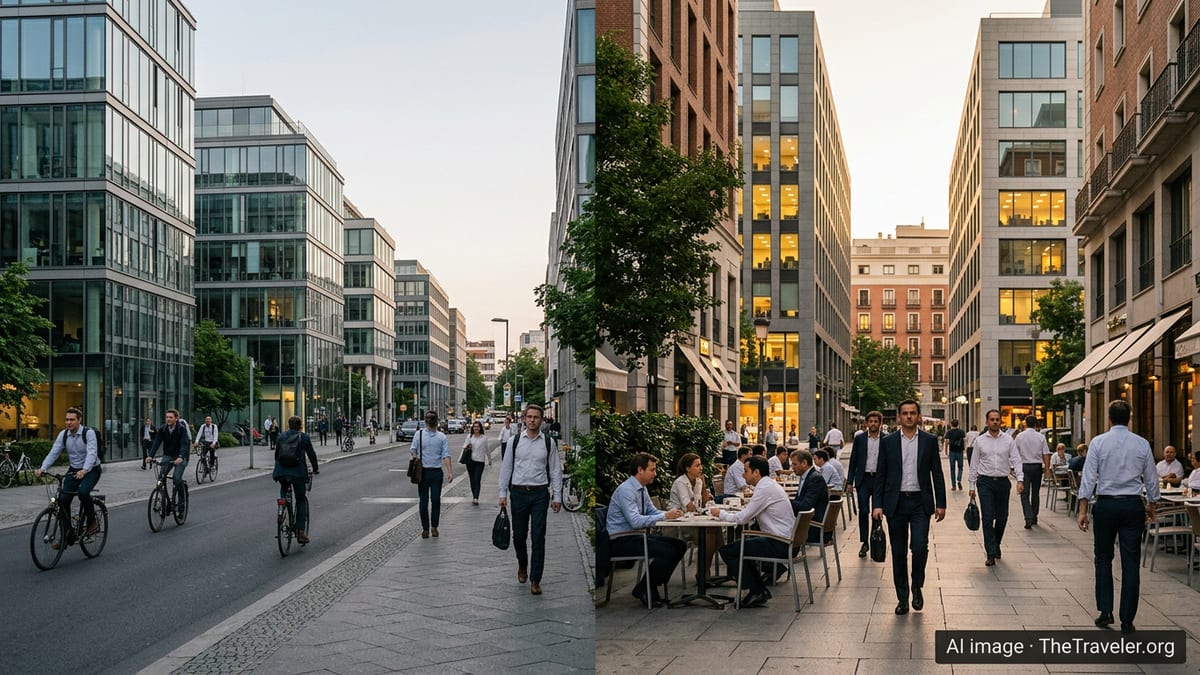
Work-Life Balance Overview: Germany vs Spain
Across Europe, actual working time has been trending downward, with the European Union average at roughly 36 hours per week for workers aged 20 to 64 in 2024. Germany sits well below this average, at about 33.9 to 34 hours per week, while Spain is slightly above it at around 36.4 hours. This gap provides an initial indication that Germany generally offers shorter working weeks than Spain.
Over a full year, Germany also records among the lowest annual hours worked across advanced economies, at roughly 1,330 to 1,350 hours per worker, whereas Spain’s annual hours are higher and closer to the OECD average. For a relocating professional, this typically translates into more non-working time over the year in Germany, whether for personal projects, family life or rest.
However, work-life balance is not determined by hours alone. The structure of the day, predictability of schedules, access to part-time options, and cultural norms around availability outside office hours differ significantly between Germany and Spain. Spain’s traditional longer daytime span, with late finishes in some sectors, contrasts with Germany’s emphasis on earlier finishing times and clearer separation between work and personal life.
Both countries are actively debating the future of work, including experiments with reduced working time and more flexible arrangements. Yet, current practice still reflects established patterns: Germany is perceived as more protective of non-work time through regulations and norms, while Spain has been making incremental reforms to shift away from historically long and fragmented workdays.
Legal Working Time Frameworks and Typical Weekly Hours
Legally, both Germany and Spain are aligned with European Union rules that cap working time at a maximum of 48 hours per week on average, including overtime, over reference periods. In practice, typical contracts in Germany specify standard full-time working weeks of around 38 to 40 hours, whereas in Spain standard full-time contracts are typically set at or close to 40 hours.
Actual average hours are lower than contractual hours, especially in Germany. Recent European statistics indicate that workers in Germany average about 33.9 to 34 actual hours per week, while Spanish workers average around 36.4 hours. Germany’s high share of part-time employment, roughly one third of the workforce, is a significant driver of this lower average, offering many employees a structural route to improved work-life balance.
Spain’s workforce still skews more strongly toward full-time roles with longer actual hours. Although part-time work exists, it is less prevalent and often associated with lower-paid or less secure roles. For professionals, this usually means that work-life balance relies more on employer-level flexibility and sector-specific norms rather than systematic reduced working hours.
Both countries also regulate daily working time. In Germany, legislation and collective agreements commonly operationalize an 8-hour workday, averaged over time, with strict rest-period requirements. Spain’s regulations also define daily maximums, but enforcement and day-to-day practice may leave more room for extended days in some sectors, such as retail, hospitality, and certain services, where evening work remains common.
Daily Rhythms, Breaks and Evening Time
The structure of the working day is a key qualitative difference for work-life balance. In Germany, a typical office day starts relatively early and ends mid to late afternoon, often between 16:00 and 18:00. Longer midday breaks are less common, and lunch is usually short, which helps keep the overall span of the day compact and leaves evenings largely free.
Spain has been moving away from the classic long midday break and very late evening working pattern, but remnants of this structure are still visible, especially outside the largest internationalized cities. In many sectors, the working day can extend into the early evening as standard, and professionals may experience a longer daily time window during which they are expected to be available, even if total hours are broadly comparable.
From a work-life balance perspective, the German pattern generally favors earlier and more predictable finish times, which can benefit families with school-age children or professionals who prioritize regular evening activities. In Spain, the longer daily span can complicate scheduling of personal commitments, although it may also support a more gradual pace of the day and social interactions around work.
Break rules also differ in practice. Germany enforces statutory rest breaks based on shift length and is relatively strict about minimum rest periods between working days. Spain also mandates breaks and rest periods, but practical enforcement may vary more by employer and region. For relocation decisions, this affects how reliably non-working time can be planned and protected.
Paid Leave, Public Holidays and Time Off Culture
Paid annual leave is a central component of work-life balance. Germany guarantees a statutory minimum of 20 working days of paid leave for a five-day week, but collective agreements and company policies often raise this to around 25 to 30 days for full-time employees. Combined with public holidays, this leads to a substantial volume of protected non-working days.
Spain also provides a statutory minimum of 30 calendar days of paid annual leave, which typically equates to about 22 working days for a standard five-day schedule, plus a relatively high number of public holidays. In raw numerical terms, both countries offer competitive levels of time off by international standards, with Spain slightly ahead on statutory minimums and Germany often matching or exceeding this in practice through collective bargaining.
The key difference lies in how leave is taken and supported. In Germany, there is a strong expectation that annual leave is used and that employees are genuinely offline, supported by workplace cultures that often discourage contacting staff during their vacation. Spain is evolving in this direction, and legal protections for digital disconnection have been strengthened, but in some organizations informal expectations of connectivity may still persist during non-working periods.
Both jurisdictions have legal frameworks around maternity, paternity and parental leave that are more generous than global averages, supporting care-related work-life balance. Germany is widely viewed as having particularly extensive parental leave options, while Spain has increased the duration and equality of leave entitlements in recent years, aligning more closely with northern European standards.
Flexibility, Remote Work and Part-Time Options
Flexible working time arrangements are now central to work-life balance evaluations. In Germany, widespread use of flexitime models, working-time accounts and part-time arrangements allows many professionals to adapt hours to personal needs within collectively agreed frameworks. Remote work and hybrid models expanded significantly from 2020 and remain commonplace in knowledge-intensive sectors, although there is currently some policy pressure to increase on-site presence.
Spain has also seen a marked expansion of remote work, particularly in large cities and service sectors. Recent legislation clarifying remote work rights has formalized conditions such as cost coverage and equipment. Nonetheless, remote work penetration remains uneven, with higher adoption in multinational firms and lower rates in smaller, domestically focused companies.
Part-time work is structurally embedded in the German labor market. Approximately one third of employees work part-time, including many highly skilled professionals who balance work with caregiving or other commitments. This institutionalized part-time culture supports long-term, sustainable work-life balance, although it can sometimes correlate with slower career progression and gender disparities.
In Spain, part-time roles are less prevalent and often concentrated in lower-wage or temporary positions. Professionals seeking reduced hours may find fewer high-quality part-time opportunities, particularly outside major metropolitan areas. As a result, achieving better balance often depends on negotiating individual flexibility rather than accessing standard reduced-hours roles.
Work Culture, Boundaries and Expectations
Formal rules interact with workplace culture to shape real-world work-life balance. German work culture is characterized by a strong separation between working time and personal time. The concept of being fully present and productive during defined hours, then disconnecting afterward, is widely accepted. Overtime is generally recorded and either compensated or taken as time off, particularly in organizations covered by collective agreements.
Spain’s work culture is more heterogeneous. In some modern sectors and international companies, there is an increasing emphasis on boundaries and predictable hours. However, in many traditional businesses, expectations of staying later, informal overtime and socializing around work can blur the line between professional and personal time. While this may enhance workplace relationships, it can pose challenges for those seeking clear time boundaries.
Public debates in both countries reflect shifting attitudes. In Germany, there is an ongoing discussion about whether work-life balance has gone too far in the direction of reduced hours, with some political voices calling for longer working lives and more hours to support economic performance. In Spain, debates focus more on how to shorten excessively long or fragmented days and align work hours with broader European norms while preserving productivity.
For relocating professionals, personal fit with these cultural expectations is critical. Individuals who value strict boundaries, early evenings and structured time off may find Germany more aligned with their preferences. Those who are comfortable with later schedules and a more fluid integration of work and social life may adapt well to Spain, especially in sectors already modernizing their time practices.
Sector Differences and Occupational Patterns
Sectoral patterns can significantly modify the national picture. In Germany, manufacturing and engineering roles may still involve shifts and occasional overtime, but are often governed by robust collective agreements that regulate working time and provide compensatory rest. Professional services, finance and technology have adopted hybrid models where office presence is balanced with home working, supporting flexible time management.
In Spain, hospitality, tourism, retail and certain services maintain longer or irregular hours, often extending into evenings and weekends, directly impacting work-life balance. Professionals in these sectors may face more pronounced challenges than their peers in Germany. On the other hand, Spanish public sector and large corporate roles can offer relatively strong protections around time off and leave, narrowing the gap with German conditions.
Highly mobile professionals should therefore evaluate work-life balance conditions at sector and employer level rather than relying solely on national averages. A technology role in a major Spanish city with a progressive time policy can offer superior balance compared with a shift-based role in German industry, despite the overall national trend favoring shorter hours in Germany.
Regional variation exists in both countries. In Germany, differences between federal states are relatively modest on working time norms, although major cities may provide more remote work and flexible options. In Spain, divergence between large urban centers and smaller towns can be more pronounced, with big-city employers more likely to adopt international norms on working hours and flexibility.
The Takeaway
From a strictly work-life balance standpoint, comparative data suggests that Germany currently offers a more favorable baseline than Spain in terms of shorter average working weeks, extensive part-time opportunities and a strong culture of separating work and personal time. Over a year, professionals in Germany can expect fewer hours worked and more predictably protected evenings and vacations.
Spain is, however, narrowing the gap through reforms that promote digital disconnection, regulate remote work and encourage more rational working hours. For many professionals, especially in international companies and knowledge-intensive sectors, Spanish work-life balance can be competitive, although longer daily spans and sector-specific practices still weigh on overall conditions.
Relocation decisions should therefore weigh national averages against sector realities and personal preferences. Individuals prioritizing shorter hours, part-time options and clear temporal boundaries will often find Germany better aligned with their goals. Those who value a more fluid integration of work and social life and are employed in modernized sectors may find Spain acceptable or even attractive, provided they negotiate explicit expectations about working time and availability.
Ultimately, both countries are high-income European economies where work-life balance is an active policy and public debate topic. Germany presently has the structural advantage in reduced working hours and institutionalized flexibility. Spain presents a more mixed picture, combining relatively long hours in some sectors with rapid progress toward more balanced and predictable working patterns.
FAQ
Q1. Which country generally has shorter working hours, Germany or Spain?
On average, Germany has shorter actual weekly working hours, around the mid 30 hour range, while Spain’s averages are closer to the mid 30s but above the European Union mean.
Q2. Where is it easier to find high-quality part-time work for professionals?
Germany offers more high-quality part-time options across many sectors due to its long-established part-time culture, whereas in Spain part-time roles are less common in professional positions.
Q3. Do employees in Germany or Spain get more annual leave?
Both provide generous leave by international standards. Spain has a slightly higher statutory minimum, while German employees often receive comparable or higher days through collective agreements.
Q4. In which country are evenings more likely to be protected from work?
Germany generally offers more predictable early finishes and clearer boundaries around evening time, whereas in Spain later working days are still common in many sectors.
Q5. How do remote work opportunities compare between Germany and Spain?
Remote and hybrid work are established in both countries for knowledge roles. Germany’s adoption is broad, while Spain’s is growing but more concentrated in large cities and international firms.
Q6. Is overtime more regulated in Germany or Spain?
Overtime is legally regulated in both, but Germany typically has stricter tracking and compensation via collective agreements, resulting in more systematic time-off-in-lieu or pay.
Q7. Which country is better for parents seeking work-life balance?
Germany usually offers stronger structural support through part-time options and extensive parental leave, though Spain has significantly improved its parental leave framework in recent years.
Q8. Are workdays more predictable in Germany or Spain?
Workdays in Germany tend to be more predictable, with consistent start and end times. In Spain, predictability varies more by sector and employer, particularly where evening work remains common.
Q9. How important is sector choice for work-life balance in each country?
Sector choice is critical in both. In Spain, the contrast between hospitality or retail and corporate or public sector roles is particularly marked in terms of hours and schedule regularity.
Q10. Overall, which destination is stronger for work-life balance for most professionals?
For most professionals, Germany currently offers a more consistently favorable work-life balance environment. Spain can be competitive in modern sectors but still presents greater variability and, on average, longer working time.