


Anchorage is a practical hub for independent travelers who want to experience Southcentral Alaska’s glaciers without committing to a long expedition. Within a few hours by road, rail, or small aircraft, you can stand at roadside viewpoints, hike to valley glaciers, cruise beneath calving ice cliffs, or land on high-altitude snowfields, then return to the city the same evening or after a simple overnight.
Get the latest updates straight to your inbox!
How Anchorage Works as a Glacier Hub
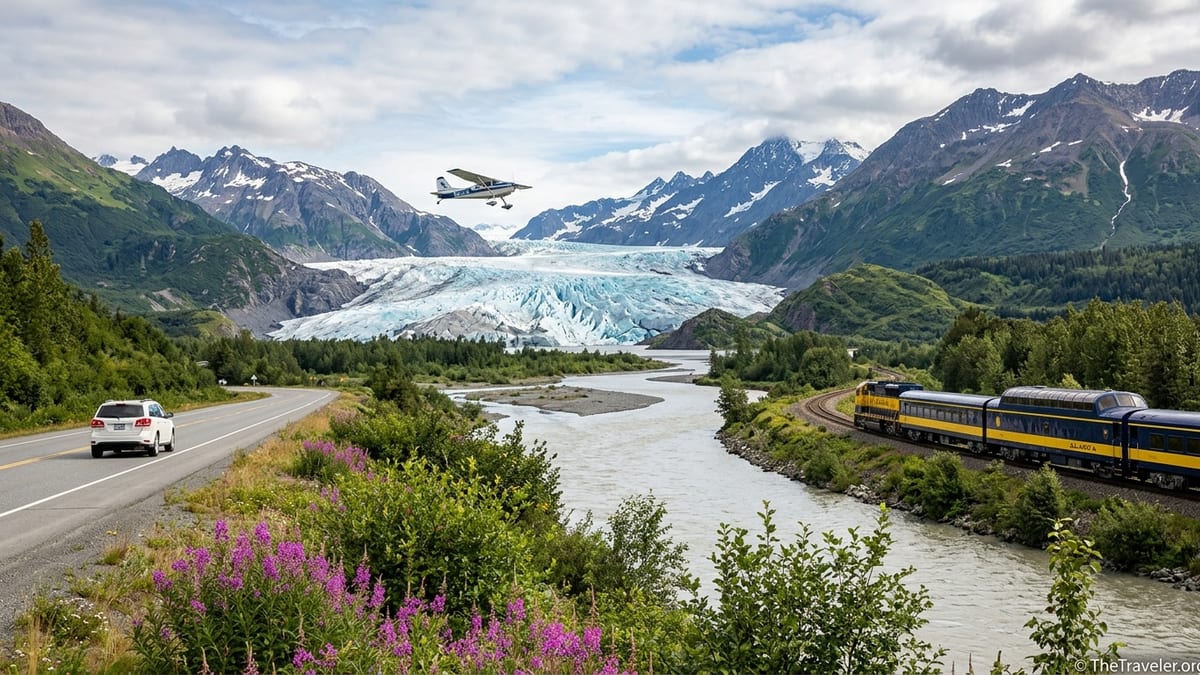
For travelers who prefer to unpack once, Anchorage offers rare access to multiple glacier regions in Southcentral Alaska. The city sits at a crossroads of the Seward Highway, Glenn Highway and Alaska Railroad, which together link road-accessible valley glaciers, the tidewater glaciers of Prince William Sound and Kenai Fjords National Park, and the big ice of the Alaska Range. That geography makes it realistic to plan glacier experiences as day trips or short overnights without complicated logistics.
Driving distances are manageable for single-day outings. The Seward Highway to Seward runs roughly 125 to 130 miles and typically takes about two and a half to three hours of driving each way in summer, while the spur to Whittier is about 60 to 65 miles and around 90 minutes from town, not counting the Anton Anderson tunnel schedule. East of the city, the Glenn Highway leads toward the Matanuska-Susitna Valley and its roadside glaciers, and onward to the Richardson Highway and Worthington Glacier near Valdez for travelers with more time.
Anchorage is also the main aviation gateway for flightseeing and helicopter trips. Some tours depart directly from the city or nearby airstrips such as Merrill Field or Lake Hood, while others connect by road or rail to Talkeetna, Girdwood, Palmer or Seward. Because flightseeing is highly dependent on weather, visibility and seasonal landing permissions, travelers should treat published schedules as starting points and always reconfirm close to departure.
Thinking in terms of time and travel style helps narrow the options. Half-day outings might focus on close-to-town viewpoints and short walks. Full-day plans can combine a self-drive with a guided glacier hike or a national park cruise. For travelers short on days but flexible on budget, a two- to three-hour flightseeing tour offers intense glacier scenery with minimal overland travel.
Roadside and Valley Glaciers East of Anchorage
The Glenn Highway northeast of Anchorage offers some of the most accessible road-based glacier viewing in Alaska, particularly around Matanuska Glacier. The state-managed Matanuska Glacier State Recreation Site near mile 101 provides parking and interpretive trails to viewpoints across the valley, giving wide-angle vistas of the glacier and river. Recent planning documents describe an interpretive nature trail and overlook system within this roughly 300-acre site, but not direct access onto glacier ice. Parking here is typically subject to a modest state recreation fee, and travelers should be prepared to pay at self-service kiosks or with state passes where accepted.
Actual access on to the lower glacier surface is through a separate, privately managed gate near mile 102. As of a verification in November 2026, the private operator lists an adult glacier access fee in the mid-50 dollar range per person for summer 2026, with separate youth and child rates and no recognition of federal or state park passes. These fees grant permission to cross private land and approach or walk on the ice along marked routes. Policies can change season by season, and some summers the landowners or guiding companies may restrict unguided access on safety grounds, so independent travelers should confirm whether self-guided walks are permitted or if a guided tour is mandatory before driving out.
Several guiding outfits in the area run half- and full-day tours that include glacier access fees, gear and instruction. Typical itineraries involve a short shuttle ride from the parking area, followed by a walk of roughly half a mile to a mile to reach stable ice, then two to four hours of exploration with crampons and helmets. For independent travelers basing in Anchorage, Matanuska works as a long but realistic day trip: plan around two and a half hours’ drive each way in good conditions and a full day out of the city. Overnight options exist at nearby lodges and campgrounds for those who prefer a slower pace.
Farther east along the Richardson Highway beyond Glennallen, Worthington Glacier State Recreation Site, near mile 29 of the Richardson Highway, is a classic roadside stop for those continuing toward Valdez. Visitors can take a short, paved, wheelchair-accessible trail to viewing platforms and scopes overlooking the glacier, and a steeper, maintained ridge trail climbs toward a higher overlook. While informal paths may lead closer to the ice, state recreation guidance and on-site signage generally discourage unaccompanied travel onto the glacier due to crevasses and rockfall. Treat Worthington as a scenic viewpoint and short hike unless you have arranged a specific guided outing in the area.
Half-Day Close-to-Town Viewpoints and Walks
Travelers with only half a day in Anchorage can still see impressive glacier scenery without committing to long drives. East of the city, the Glenn Highway quickly leaves the urban area and begins to reveal hanging glaciers in the Chugach and Talkeetna ranges. Even a scenic drive of an hour or two along this route, returning the same way, provides views of distant icefields and river valleys from official turnouts and viewpoints. Although these are not walk-on experiences, they work well for jet-lagged arrivals, shoulder-season visits or days with marginal weather.
South along the Seward Highway, the drive out of Anchorage along Turnagain Arm offers views of alpine glaciers clinging to the mountain flanks above the road, particularly on clear days. Pullouts along this National Forest Scenic Byway provide safe places to stop for photographs, and the Alaska Wildlife Conservation Center near Portage makes a logical turnaround point for a half-day outing. Winter and shoulder-season conditions can be icy, and avalanche control work sometimes affects the highway, so it is important to check the state road information service before leaving Anchorage and to allow extra time in case of delays.
These half-day options are best thought of as scenic road trips with glacier views, not destinations where you can step onto the ice. For independent travelers new to Alaska driving, they offer a low-stress way to get used to local conditions, including variable pavement quality, rapidly changing weather and the long sightlines that can tempt higher speeds. They also highlight a key theme for all glacier travel in the region: many of the most dramatic views do not require technical approaches, but closer contact with ice usually does require professional guidance and specialized equipment.
Because these trips stay relatively close to Anchorage, they pair well with other city-based activities such as museum visits, walking the Coastal Trail or enjoying local restaurants. For travelers planning multi-day stays, using a half-day to test a rental car, observe traffic patterns and practice conservative driving can pay dividends before tackling early-morning departures to Seward, Whittier or Matanuska.
Tidewater Glaciers by Sea from Whittier and Seward
For many visitors, the highlight of a glacier-focused trip is watching huge tidewater glaciers calve into the sea. Anchorage-based travelers can reach two main day-cruise hubs by road or rail: Whittier for Prince William Sound and Seward for Resurrection Bay and Kenai Fjords National Park. Both ports offer trips suitable for day outings from Anchorage, with earlier starts and longer sailings rewarding those who can commit a full day.
Whittier sits about 60 to 65 miles southeast of Anchorage, connected by the Seward Highway and the single-lane Anton Anderson Memorial Tunnel. Recent travel guides list the drive at roughly 90 minutes from Anchorage in dry summer conditions, not including the tunnel wait, and note that the tunnel operates on a fixed schedule with alternating one-way traffic. Major operators in Whittier offer half-day trips of around three and three-quarter hours that focus on nearby glaciers and wildlife, as well as the well-known 26 Glacier Cruise, typically about five to five and a half hours and marketed with a “no seasickness” guarantee thanks to the generally protected waters of Prince William Sound.
As of schedules verified in November 2026, a representative 26 Glacier Cruise operates daily from early May into early October, usually with a midday departure around 12:00 to 12:30 and return in the late afternoon. Published starting prices for the 2026 season are in the low-200-dollar range per adult, with child and occasional promotional fares lower, while shorter Prince William Sound cruises often start in the mid-100-dollar range. An Alaska Railroad day trip that combines round-trip rail between Anchorage and Whittier with a Prince William Sound glacier cruise is advertised as a roughly 12-hour experience, with package pricing in the mid-400-dollar range per adult. All prices and dates are subject to change, so travelers should treat these figures as approximate and reconfirm for their specific travel month and year.
Seward, roughly 125 to 130 miles south of Anchorage at the end of the Seward Highway, serves as the jumping-off point for Kenai Fjords National Park and its dramatic tidewater glaciers. Driving time is usually quoted as about two and a half hours point to point, though local advice strongly recommends allowing three hours or more in summer to account for road construction, traffic, wildlife viewing stops and the temptation to photograph the scenery. From Seward’s harbor, several companies run shorter Resurrection Bay cruises of around three and a half to five hours that focus on coastal wildlife and scenery, as well as full-day national park trips of six to nine hours that journey deep into fjords to see actively calving glaciers.
Current 2026 season outlines indicate that shorter bay cruises may run from March into October, with starting prices typically in the low- to mid-100-dollar range per adult, while full-day Kenai Fjords National Park cruises operate primarily from late May through early September and usually start in the low-200-dollar range or higher depending on length and inclusions. Common departure times for full-day trips are in the morning, around 8:00 to 9:30, with returns in late afternoon or early evening. Because seas in the Gulf of Alaska can be rough, prone-to-motion guests may prefer the more sheltered waters of Prince William Sound out of Whittier, but conditions vary by day and forecasts should be checked close to departure.
Flightseeing and Glacier Landings from Anchorage and Talkeetna
Air-based experiences offer a fast, often unforgettable way to see Alaska’s glaciers. Flightseeing and helicopter tours typically combine aerial views of multiple glaciers with the option, in some seasons, of landing on a snowfield or glacier surface. Anchorage itself hosts operators at Lake Hood and Merrill Field, and additional options exist in nearby communities such as Palmer and Girdwood. Farther afield, Talkeetna has become a major hub for flights into the Alaska Range and Denali region, with companies branding themselves around glacier landings and high-mountain routes.
National Park Service guidance for Denali notes that most glacier landings in the region occur in spring and summer, with availability tied closely to snow conditions and weather. Individual companies out of Talkeetna advertise narrated flights that circle Denali and neighboring peaks, with optional landings on glaciers such as the Ruth or Kahiltna when conditions and permits allow. Alaska Railroad packages that connect Anchorage to Talkeetna for a same-day flightseeing tour describe a seasonal window from about early May to mid-September, emphasizing that exact offerings vary by year.
From Anchorage, fixed-wing and helicopter trips often focus on nearby glaciated regions such as the Knik Glacier area, the Chugach Mountains, or coastal icefields nearer to the Kenai Peninsula. Regional air tour aggregators in 2026 list operations in Palmer, Girdwood and Seward, as well as Talkeetna, with some companies marketing winter flightseeing over Denali or Knik Glacier and encouraging potential guests to inquire specifically about whether glacier landings are possible during their travel dates. Approximate starting prices for 60- to 90-minute scenic flights without landings commonly fall in the mid-300 to mid-400 dollars per person range, with glacier landings or longer itineraries pushing costs higher.
Because aircraft weight limits, weather, and federal land management rules all affect whether a particular landing is possible on a given day, it is essential to understand that no glacier landing is guaranteed. Reputable operators will brief guests on likely routes, backup plans and refund or rescheduling policies if low clouds, winds or warm temperatures make landings unsafe. For independent travelers basing in Anchorage, this uncertainty argues for building flexibility into the schedule, perhaps planning the flightseeing early in the stay to allow room for a one-day weather delay.
Driving, Seasonality and Practical Logistics
Anchorage-based glacier trips depend heavily on road conditions and daylight, particularly in early spring and late autumn. Summer visitors, typically from late May through early September, benefit from long daylight hours and mostly dry pavement, though they must also contend with peak-season traffic and ongoing highway construction projects. Local experience suggests allowing more time than map estimates for drives such as Anchorage to Seward or Whittier, both to absorb potential delays and to take advantage of scenic pullouts without feeling rushed.
Rental car availability can tighten during high summer, especially around prime cruise dates, so reserving vehicles well in advance is wise. Most standard rentals in Alaska come with all-season tires rather than dedicated winter tires, which is generally acceptable in mid-summer but demands slower speeds and extra caution if traveling in shoulder months when snow, ice or slush are possible. Before departure, travelers should check the state’s 511 road information service for up-to-date reports on construction, accidents, avalanche mitigation and any temporary closures.
Fuel services are readily available along major routes like the Seward and Glenn Highways, but distances between stations can be longer than many lower-48 drivers are used to. A conservative practice is to top up in Anchorage, then refuel in larger communities such as Girdwood or Palmer when passing through, especially before continuing to more remote stretches. In winter and early spring, it is also sensible to carry warm layers, food, water and a roadside emergency kit even for day trips, as response times can be longer outside the city.
Seasonality also affects which glacier experiences are realistic. Some cruise operators begin shorter bay sailings as early as March and extend into October, while full-day national park or fjord cruises typically cluster in the core summer months. Flightseeing routes may shift between winter-oriented itineraries over frozen landscapes and summer glacier landings, while private landowners at road-accessible glaciers can change access policies between seasons. Travelers should not assume that a tour available in July will operate in May or September without verifying for specific dates.
Glacier Safety and the Role of Guides
However you approach them, glaciers are dynamic, hazardous environments. What looks like solid snow from a distant viewpoint can conceal deep, unmarked crevasses, thin ice bridges, and unstable seracs. Even on seemingly gentle valley glaciers like Matanuska, ice conditions change daily with temperature, meltwater and movement. Traveling unaccompanied onto glacier ice without proper training, equipment and local knowledge is dangerous and has led to serious accidents in Alaska.
Qualified guides manage these risks by scouting routes, monitoring crevasse patterns and snow bridges, and equipping guests with helmets, crampons, harnesses and ropes where appropriate. They also manage group pacing and decision-making, turning back when conditions or weather deteriorate. On many commercial tours, guides receive ongoing training in glacier travel, rescue techniques and wilderness first aid, and reputable companies will be willing to discuss their safety protocols when you book.
For independent travelers used to hiking without guides elsewhere, hiring a professional for glacier travel in Alaska should be viewed as a safety baseline rather than an optional luxury. Access fees at private gates or state recreation sites typically cover parking, facilities and permission to cross land, not expert oversight on the ice. The safest rule is to treat any unroped, unguided venture beyond obvious, signed viewpoints as off-limits, no matter how many footprints appear to lead further.
Sea and air experiences also carry specific safety considerations. On cruises, operators provide lifejackets and safety briefings and may cancel sailings in response to strong winds or rough seas. On flightseeing trips, pilots make conservative calls about cloud cover, turbulence and landing conditions; guests should expect that routes or landing plans may change at short notice and regard such decisions as essential risk management rather than inconvenience.
Sample Mini-Itineraries from an Anchorage Base
Independent travelers with two to four days based in Anchorage can mix and match the experiences above into compact, rewarding itineraries. With two full days, one realistic plan is to devote a day to a guided glacier hike at Matanuska and a second day to either a Prince William Sound or Resurrection Bay cruise. This combination balances a more physical on-ice experience with relaxed sightseeing from a boat, all reachable by self-drive. Leaving Anchorage early each morning, building in extra drive time and returning in the evening keeps lodging logistics simple.
With three days, consider pairing a full-day Kenai Fjords National Park cruise from Seward with an overnight in town, then returning to Anchorage via a leisurely drive with scenic stops. The third day can then be set aside for a shorter outing, such as Turnagain Arm viewpoints and the Alaska Wildlife Conservation Center, or a short flightseeing trip departing from Anchorage if the weather cooperates. This pattern reduces backtracking stress on the day of a major cruise and allows some flexibility to adjust plans if the marine forecast looks poor.
Travelers with four days might structure their time around one inland and one coastal glacier focus. For example, spend the first night in Anchorage, the second near Matanuska Glacier after a guided hike, and the third in Seward anchored around a full-day fjord cruise. Alternatively, stay in Anchorage throughout and add a Talkeetna-based flightseeing day to complement a Prince William Sound cruise, accepting the longer drive north and the inherent weather dependence of mountain flying.
In all cases, specific schedules, prices, access rules and seasonal offerings change frequently. Before finalizing bookings, readers should reconfirm departure dates and times for cruises, verify current access conditions and policies at road-accessible glaciers, and check directly with flightseeing operators about whether glacier landings are being offered during their travel window. Building in small buffers, both in budgets and in daily schedules, will make it easier to adapt when Alaska’s ice, weather and wild landscapes inevitably rewrite part of the plan.