


More news on this day
Rail travelers heading to and from Italy around the Alps face a double squeeze in November 2026, as a 23-hour national rail strike from the evening of 20 November coincides with ongoing engineering works that are already altering timetables and occasionally closing sections of key cross-border routes such as the Verona–Brenner axis.
Get the latest news straight to your inbox!
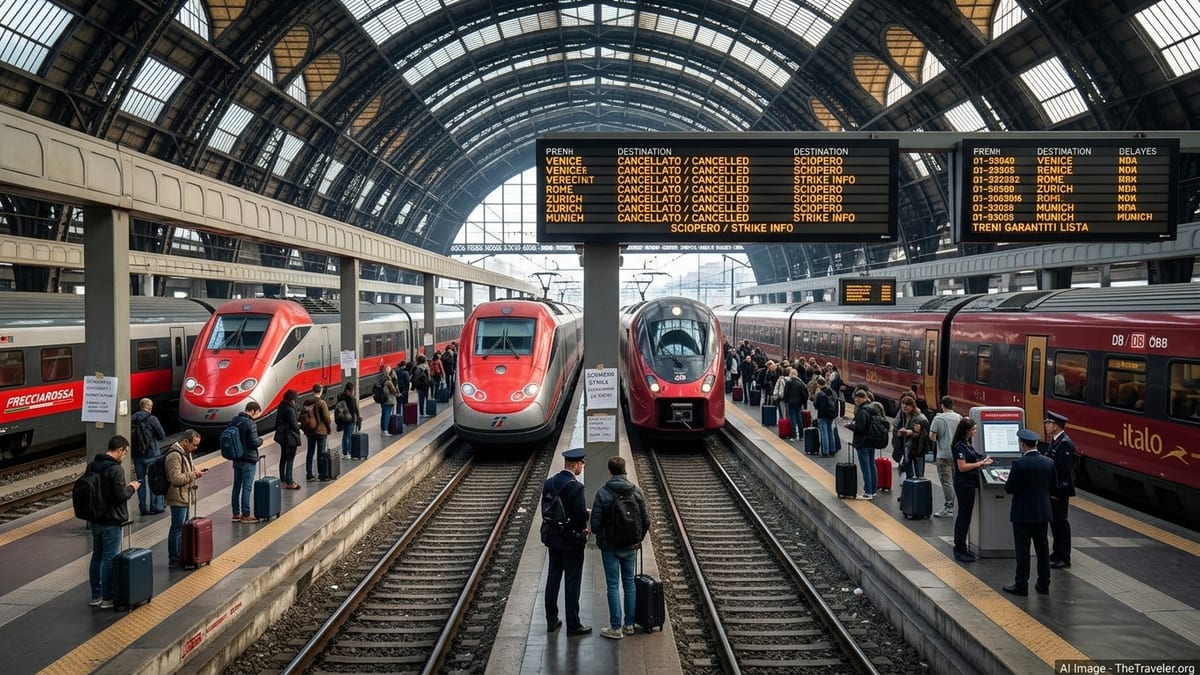
Nationwide rail strike to hit services on 20–21 November
Italian infrastructure manager Rete Ferroviaria Italiana (RFI) and passenger operators have confirmed a national rail strike running from 21:00 on Friday 20 November to 20:00 on Saturday 21 November 2026. The walkout involves staff of Gruppo FS Italiane, including Trenitalia and Trenitalia Tper, as well as Trenord and Italo, and is expected to cause cancellations and alterations across the country for both passenger and freight trains.
Because RFI manages the national network, any operator using Italian tracks can be affected during the strike window, including cross-border EuroCity and Railjet trains operated jointly with ÖBB, DB and SBB. Some international services may still run, but travelers cannot assume that a long-distance or international ticket will be honored at the originally booked time.
Under Italian law, minimum levels of service must be maintained during strikes. For regional traffic this typically means guaranteed services in the weekday “fasce di garanzia,” usually between 06:00 and 09:00 and again from 18:00 to 21:00, although exact patterns vary by region and operator. Outside those windows, trains will only run if they appear on official guaranteed-service lists.
Which trains are guaranteed during the strike
Trenitalia, FS group operators and Trenord have issued notices confirming the strike hours and warning that their long-distance and regional services may be reduced or retimed. They have also published their statutory lists of guaranteed trains, which cover a limited subset of Intercity, Frecce and regional departures that will run even if staff participate in the strike, alongside trains scheduled entirely inside the protected time bands.
Italo has separately released a dedicated “treni garantiti” table for 20 and 21 November 2026, listing specific train numbers, origin and destination stations, departure and arrival times, and whether the guarantee applies to the whole route or only to a section of it. Only those listed Italo services are confirmed to operate during the strike period; all other departures remain at risk of cancellation or significant delay.
Travelers are advised to look up their exact train number and travel date on the operator’s website rather than relying on general timetables. Those holding tickets for unprotected trains on 20–21 November should be prepared to rebook to a guaranteed departure, shift their journey to a non-strike day, or switch to alternative transport such as coaches or flights where available.
Alpine works reshaping the Verona–Brenner corridor
At the same time, RFI has scheduled a series of engineering works on the Verona–Brenner corridor and related Alpine lines that link Italy with Austria, Germany and northeastern Italy. Recent notices for November 2026 covering the Brennero–Venezia/Ancona, Brennero–Bologna and Bolzano–Merano lines detail overnight and weekend blocks for infrastructure upgrades, including work around Ponte Gardena and other key points on the Brenner route.
These works do not shut the Brenner line for the entire season, but they do introduce recurring disruption on specific dates. On affected days and nights, trains can face modified timetables, partial cancellations, or replacement road services over certain sections. For example, some regional and long-distance trains have been listed with altered stopping patterns and extended journey times between Brenner and Verona during November possessions, with sections replaced by buses or omitted altogether.
Swiss Federal Railways has also warned of timetable impacts on international services between Switzerland and Italy due to Italian infrastructure works, including full weekend closures of certain cross-border routes through 2026. Notices highlight that maintenance and upgrade activity in tunnels such as Monte Olimpino 1 will force diversions, reduced frequencies or temporary suspension of some EuroCity services on particular weekends.
Cross-border travelers face compounded disruption
The overlap between the 20–21 November rail strike and the ongoing Alpine engineering program creates particular uncertainty for travelers moving between Italy and Austria, Germany or Switzerland. Where a train is already scheduled to divert or use a replacement bus because of line closures, a strike affecting infrastructure and operating staff can further reduce capacity or disrupt alternative arrangements.
On the Verona–Brenner axis, cross-border EuroCity and Railjet services operated by ÖBB/DB and Trenitalia may run on shortened routes, be diverted, or be replaced by buses on the Italian side on certain November dates, depending on the exact work windows. While many services will continue to operate in some form, direct connections on specific days or time slots can disappear, forcing longer travel times and additional changes even when no industrial action is under way.
Similarly, on the western Alpine flank, SBB and Trenitalia have adjusted timetables on key Switzerland–Italy routes in response to tunnel works and other infrastructure restrictions. Travelers using EuroCity links between cities such as Zurich, Basel or Bern and Milan may find that usual direct departures are retimed, routed differently, or temporarily withdrawn on days when Italian engineering activity is concentrated.
What travelers should check before departure
Because both the strike impact and engineering schedules are subject to last-minute adjustments, individual train status cannot be guaranteed far in advance. Italian authorities can still require unions to modify or defer industrial action, and operators may add extra replacement services or alter bus arrangements as works progress.
Passengers planning to travel on or around Friday 20 and Saturday 21 November 2026 should therefore monitor operator websites closely in the days immediately before departure. The most reliable sources are the infomobility pages and strike advisories of RFI, Trenitalia, Trenitalia Tper, Trenord, Italo, and the international travel updates of ÖBB, DB and SBB for cross-border trains.
Before setting out, travelers should reconfirm the exact train number, departure time and routing, and cross-check it against the latest guaranteed-train lists and engineering notices. Where flexibility allows, shifting long-distance or international journeys away from the strike window or heavily affected engineering weekends can reduce the risk of disruption, especially for time-critical connections such as airport transfers or onward international travel.