


More news on this day
Portugal’s early‑November encounter with depressions Bruna and Charles brought nationwide weather alerts, school closures and coastal shutdowns from 7 to 11 November 2026, briefly disrupting travel yet sharply illustrating how fast Atlantic conditions can turn dangerous for winter visitors along the country’s beaches, cliffs and island trails.
Get the latest news straight to your inbox!
Back‑to‑back storms and a nationwide alert
According to the Portuguese Institute of Sea and Atmosphere (IPMA), the passage of depressions Bruna and Charles over mainland Portugal between 7 and 12 November 2026 produced episodes of intense rainfall and strong winds, with new November records for daily rainfall and maximum gusts in some locations. Authorities began warning of Bruna’s approach on 6 November, with yellow and orange alerts for heavy rain, thunderstorms and rough seas spreading across much of the mainland and Madeira from roughly 8 November onward.
On 10 November the government declared a "situação de alerta" for the whole of mainland Portugal from 00:00 to 23:59 on Wednesday 11 November, explicitly citing the combined effects of depressions Bruna and Charles and forecasts of severe rain, strong maritime agitation and gusts that could reach 120 to 140 km/h. Civil protection raised its readiness to the highest level and urged the public to stay away from beaches, exposed coastal areas, riverfronts and low‑lying urban zones vulnerable to flooding and landslides.
As Charles peaked over mainland Portugal on 11 November, the alert translated into rare, highly visible disruptions. All schools and non‑essential public services on the mainland were ordered shut for the day, with emergency healthcare and essential services remaining open. The IPMA warning map showed a patchwork of red and orange alerts, with Faro district, covering the Algarve, under red wind warnings for much of the day and several southern and central districts under red rain alerts for key daytime hours.
Coastal flooding, surf and cliff risks in resort areas
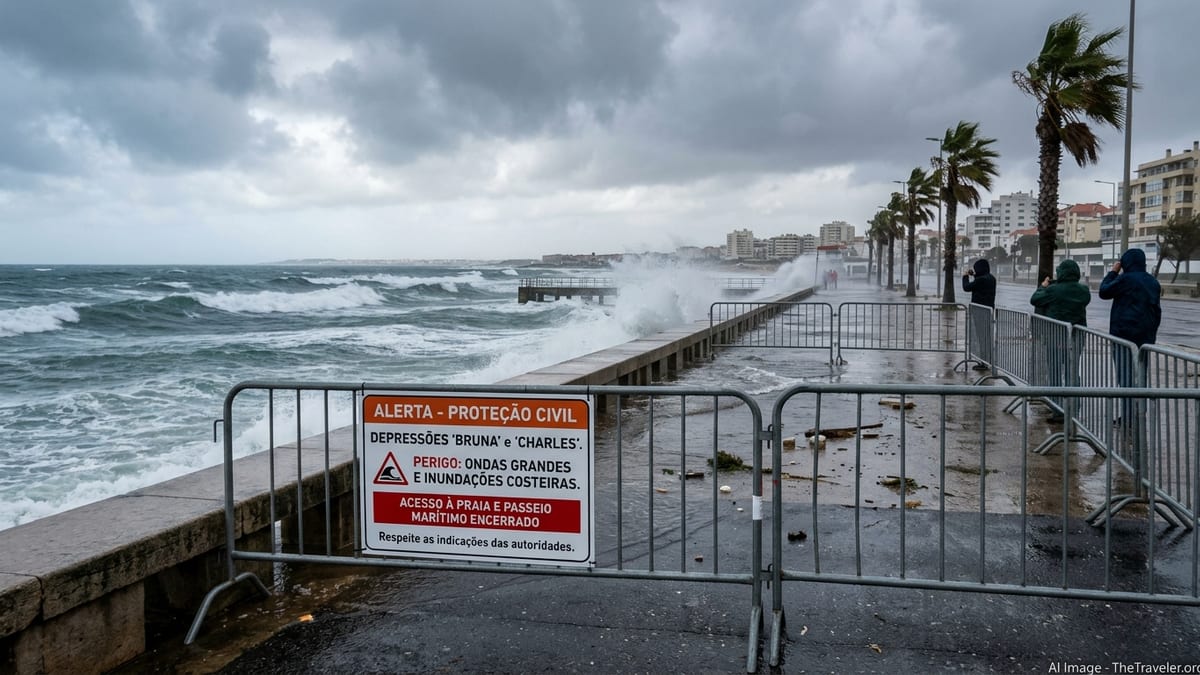
The storms’ most striking images came from Portugal’s Atlantic fringe, offering a case study in hazards that can surprise visitors familiar only with calm summer conditions. In Costa da Caparica, a major urban beach strip across the Tagus from Lisbon, television and online footage during Charles showed waterlogged seafront streets, a closed pier and promenade sections, toppled e‑scooters and municipal teams actively preventing people from accessing the shoreline as waves broke over coastal structures.
Further south, the Algarve stayed under red alerts into the afternoon of 11 November, with civil protection incident reports highlighting urban flooding, downed trees and localised landslides on coastal roads. Authorities warned that strong onshore winds and heavy swell could produce occasional overtopping of sea walls, especially around river mouths and harbour entrances, creating conditions where a single wave could knock walkers from breakwaters or piers into turbulent water.
Officials stressed that the core damage from Charles was limited compared with earlier fears, but the pattern of impacts was revealing for travel planning. Short‑lived closures of seafront promenades, beach access points, clifftop viewpoints and coastal roads occurred not only in remote stretches but also in built‑up resort areas that are normally highly accessible in winter, underscoring how quickly Atlantic low‑pressure systems can transform familiar leisure spaces into exclusion zones.
Madeira trail closures highlight mountain and canyon exposure
The Atlantic islands experienced their own sequence of disruptions. IPMA warnings related to Bruna and then Charles brought first orange and then red alerts for heavy rain and strong winds in Madeira’s mountainous interior between 8 and 11 November. In response to Bruna’s forecast on 8 November, the regional nature authority closed all official walking trails on Madeira and Porto Santo for the day as a precaution against rockfalls, landslides and overflowing levadas.
With Charles approaching, Madeira’s regional government ordered schools across all levels to close through the morning of Wednesday 11 November, citing an IPMA red warning for precipitation and wind overnight and into the early hours. Ferry and some inter‑island flight cancellations followed on 10 and 11 November, according to local travel alert aggregators that draw on IPMA, civil protection and operator feeds, and sea‑access points used for ocean swims and boat excursions were temporarily shut.
By 16 November, hiking reports indicated that around half of Madeira’s signposted routes remained closed because of storm‑related damage or instability, while others had reopened under ongoing monitoring. Although the initial island wide shutdown lasted only a short period, it highlighted how quickly rugged coastal and mountain terrain can become inaccessible after intense rainfall, even once skies clear over Funchal’s seafront.
How visitors can monitor real‑time coastal danger
The November storms also showcased how Portuguese authorities now communicate risk in real time, in ways that foreign visitors can use directly when planning beach days or cliff‑top walks. IPMA’s website and mobile tools publish colour coded district level warnings for rain, wind and sea state, typically updated several times a day during active events, and the agency issues dedicated technical notes summarising expected impacts from named depressions such as Bruna and Charles.
The National Emergency and Civil Protection Authority (ANEPC) supplements these forecasts with "avisos à população" that translate meteorological information into recommended actions, such as avoiding parking along riverfronts, cancelling coastal hikes or staying away from piers, jetties and exposed boardwalks. During Charles, ANEPC and the government disseminated such guidance via SMS alerts, centralised news pages and municipal communication channels, while local authorities in coastal municipalities amplified restrictions on specific promenades, beaches and viewpoints.
For Madeira and Porto Santo, separate systems apply. The regional forestry and nature institute maintains an online list of open and closed hiking routes, updated as inspections follow heavy rain or wind. Independent trackers that aggregate IPMA warnings, trail status, ferry advisories and airport notices provided consolidated overviews during Bruna and Charles, but underlying decisions on closures and reopenings remain with official agencies and can change several times in a single day as conditions evolve.
What the storms signal for off‑season coastal travel
The Bruna and Charles sequence fits into a broader pattern of active Atlantic weather affecting Portugal’s coasts outside the high‑summer holiday period. Earlier in 2026, other named systems such as Leonardo also brought episodes of heavy rain and strong seas, although not accompanied by a nationwide alert and blanket school closure on the scale seen on 11 November. However, authorities have been careful to underline that these are short‑term events, not long‑term shutdowns of Portugal’s resorts or beach infrastructure.
For winter visitors from elsewhere in Europe, the practical implication is not that Portugal’s Atlantic shore has become uniquely hazardous, but that travel plans depend more than ever on close, day by day attention to local warnings. A red or orange IPMA alert, a civil protection advisory or a regional notice of trail closures can temporarily override assumptions based on previous sunny stays in the Algarve, Lisbon coast or Madeira, especially for activities near cliffs, river mouths or harbour walls.
Looking ahead, the immediate emergency phase from Bruna and Charles has passed and current IPMA bulletins for mid November no longer show red warnings for mainland Portugal or Madeira. Travellers arriving in the coming weeks should find resorts operating normally, but are likely to encounter occasional, short notice closures of trails, seafront promenades or sea‑access points whenever new Atlantic systems approach. Checking IPMA alerts, civil protection notices and regional trail status pages on the morning of any planned coastal outing is set to remain a key step in safely enjoying Portugal’s off‑season shoreline.