


September is one of Japan’s most beautiful months, with lingering summer warmth, early autumn festivals and fewer crowds than peak August. It is also the heart of typhoon season. If you are planning a Japan trip for September 2027, it is important to understand what the seasonal statistics really mean, how risk varies by region, and how to build an itinerary that can bend without breaking when the weather turns.
Get the latest updates straight to your inbox!
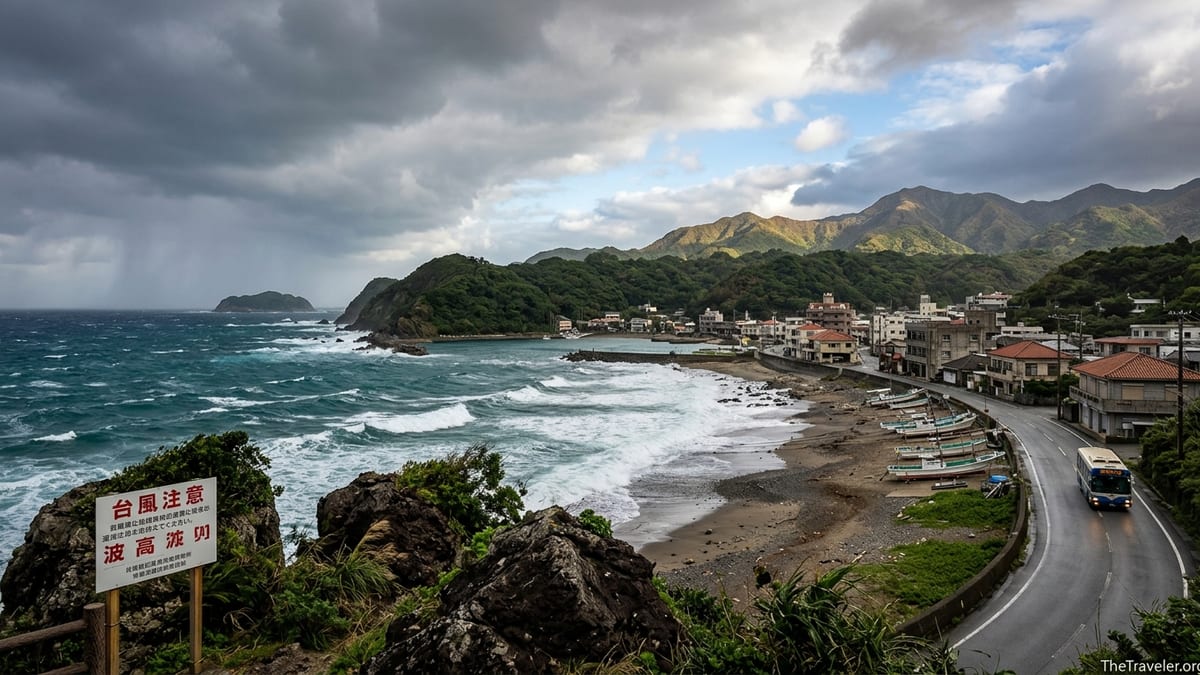
Typhoon season versus the risk on your exact dates
The Japan Meteorological Agency and Japan National Tourism Organization describe typhoon season as broadly running from about July to October, with activity peaking in August and September. Over recent decades, meteorological records show that around two dozen named tropical cyclones form in the Northwest Pacific each year, and only a minority come close enough to affect Japan. Climatological summaries from the Japan Meteorological Agency and Japan’s environment and weather agencies indicate that around a dozen storms on average come within several hundred kilometers of Japan in a year, and only a small fraction make landfall on the main islands.
This difference between “season” and “direct hit” is crucial. Official statistics compiled from 30-year JMA datasets and summarized by Japanese government publications suggest that only a few storms each year make landfall on the four main islands, and about one of those landfalls occurs in September. Non-government analyses based on the same JMA data indicate that in an average year, roughly three storms reach landfall on Hokkaido, Honshu, Shikoku or Kyushu in total, while more simply pass offshore but still bring wind and rain. Put simply, September has an elevated chance of disruptive weather, but the odds that a particular city on a particular day will experience a direct strike remain relatively low.
Equally important for 2027 planning is what weather agencies cannot tell you yet. Long-range seasonal outlooks sometimes discuss whether a given year is likely to see “above normal” or “below normal” typhoon activity, but no scientifically reliable forecast can identify a specific typhoon, track or impact date months in advance. As of November 2026, there is no valid forecast for any individual September 2027 storm, and any detailed path predictions you see for that period should be treated with skepticism. The only responsible way to plan is to use historical risk as a guide and rely on short-range forecasts and warnings from the Japan Meteorological Agency in the days before and during your trip.
For travelers, this means you should not cancel a dream trip just because your dates fall in “typhoon season,” but you also should not assume that smooth blue skies are guaranteed. Instead, treat typhoons like winter snowstorms in Europe or North America: relatively rare on any given day, somewhat more likely in certain regions, and disruptive enough that it is worth having a backup plan.
Regional typhoon patterns across Japan
Historical typhoon statistics from the Japan Meteorological Agency and analyses by Japanese climate research institutes show clear regional differences in exposure. The subtropical islands of Okinawa see the highest number of passing storms. Tourist information based on JMA numbers notes that several typhoons a year typically pass close to or over Okinawa Prefecture, and that the local peak often comes in August, though strong storms also occur in September. On these southern islands, typhoon shutters on hotels and homes, temporary store closures and ferry cancellations are part of normal life.
Kyushu, the southwestern main island that includes Fukuoka and Nagasaki, and nearby Shikoku also sit close to many common storm tracks. JMA long-term averages, summarized by Japanese government climate reports and tourism-focused analyses, indicate that Kyushu and Shikoku see more approaches and landfalls than most other regions. September often ranks among their most active months. This does not mean every September trip to Fukuoka will encounter a storm, but it does mean that travelers should be particularly aware of rain, wind and river flood warnings.
Moving northeast, Kansai and the broader Kinki region, including Osaka and Kyoto, are less exposed than southern Kyushu but still see meaningful risk. Past events such as Typhoon Jebi in 2018, which caused serious damage around Osaka Bay and temporarily closed Kansai International Airport, show how a single strong storm can disrupt a wide area even when landfall is not directly overhead. The Tokyo region on the Kanto plain usually sees fewer direct landfalls than Kyushu and Shikoku but still experiences approaches that bring heavy rain, strong gusts and train disruption in some years.
Further north, the Tohoku region and Hokkaido, including Sapporo, are historically the least affected. Long-term JMA summaries and derived climatologies show significantly fewer landfalls and near approaches here, particularly early in the season. Typhoons that do reach northern Japan are often weakening extratropical systems, though they can still cause flooding. For a cautious September 2027 itinerary, placing more days in northern Honshu or Hokkaido and fewer in Okinawa or southern Kyushu can modestly reduce your exposure to the most intense conditions.
How typhoons disrupt travel, even without a direct hit
A typhoon’s impact is not limited to the point of landfall. JMA and Japanese disaster-management agencies emphasize that outer rainbands can cause sustained heavy rainfall, flooding and landslides far from the storm’s center. In practice, this means that a storm passing along the Pacific coast might trigger mudslide warnings in mountainous parts of Honshu, while a city hundreds of kilometers away experiences only strong wind and cancelled trains.
Common travel disruptions include citywide suspension of local trains, temporary halts on shinkansen lines, closures of popular hikes such as the Kii Peninsula’s Kumano Kodo trails and shutdowns of cable cars and ropeways in places like Hakone or the Japan Alps. For example, when Typhoon Hagibis approached in 2019, extensive rainfall led to shinkansen yard flooding in Nagano and widespread local line suspension across eastern Japan, even away from the core landfall zone. More recently, JR companies have introduced “planned suspensions,” in which they announce in advance that certain shinkansen or limited express services will not run during anticipated severe weather, in order to prioritize safety.
Urban sightseeing is also affected. In Tokyo and Osaka, large outdoor attractions such as Ueno Zoo or Osaka Castle grounds may close on safety grounds during very strong winds, and some department stores pull down shutters hours before landfall. In more exposed regions like Okinawa, resort hotels may close pool areas, remove balcony furniture and restrict access to beaches as soon as gale-force winds are forecast, even if the center of the storm stays offshore.
Beyond wind and rain, landslide and flood risk can outlast the storm itself. Local governments sometimes keep hiking routes, scenic roads or hot spring areas closed until staff can check for rock falls or road washouts. Travelers arriving just after a typhoon may find that mountain bus services, such as routes into Kamikochi or Tateyama Kurobe Alpine Route segments, resume only in stages, and that alternative plans in nearby cities are needed for a day or two.
September weather and sightseeing conditions by major destination
September weather varies widely across Japan. According to long-term averages from the Japan Meteorological Agency and data summarized by Japan National Tourism Organization, Tokyo in early September often still feels like summer, with average highs around the high 20s Celsius, warm nights and high humidity. By late September the heat moderates, rainfall remains possible, and air clarity improves on non-rainy days, making it more comfortable for urban sightseeing.
In Kyoto and Osaka, conditions are broadly similar to Tokyo but can feel slightly more oppressive in still air. Temperatures in the high 20s or low 30s Celsius are common in early September, and temple visits can be hot and sticky. The upside is that popular sites like Kiyomizudera or Fushimi Inari are less crowded than in the cherry blossom or autumn foliage peaks. Hiroshima and nearby Miyajima sit further west and can still be hot and humid, but the sea breezes offer intermittent relief, and late September often brings pleasant, warm days suitable for outdoor walks and Peace Memorial Park visits.
Fukuoka, in northern Kyushu, remains firmly summery in September, with warm seas that are appealing for nearby beach trips on calm days, but it faces a somewhat higher relative exposure to typhoons than Kansai or Tokyo. Visitors should factor in a realistic chance of one or two stormy days and plan extra flexibility if connecting via Kyushu ports or regional airports.
In contrast, Sapporo and much of Hokkaido enjoy milder conditions. Average early September highs are often in the low 20s Celsius, dropping into the teens at night by late month. Humidity is lower, and while rain fronts and the tails of typhoons can still bring wet days, the oppressive heat of central and southern Japan is largely gone. Okinawa remains hot and humid, with sea temperatures suitable for swimming and diving, but September is among its more active typhoon months. Calm periods can be idyllic, with bright sun and clear water, but visitors should be prepared for several days of shut-in weather if a storm approaches.
Trains, flights and ferries during typhoons
Japan’s major rail companies place safety above punctuality when severe weather is expected. JR Central, which operates the Tokaido Shinkansen between Tokyo and Shin-Osaka, explains in its public guidance that it may implement planned suspensions when strong winds or heavy rain are forecast to have a major impact on operations. In practice, this can mean that services are reduced or stopped for much of a day, with notices issued the previous afternoon or evening. JR West and JR East follow similar approaches on the Sanyo, Hokuriku and Tohoku shinkansen lines, often announcing large-scale suspensions the day before an approaching typhoon.
When a reserved shinkansen or limited express train is cancelled, passengers are generally entitled to a full refund of the base fare and limited express or seat reservation charges for the unused segment if they request it, or to change to another train without additional fees, subject to seat availability and the specific conditions of purchase. Exact handling can differ between companies, ticket types and sales channels. For example, discount advance tickets may have more restrictions, while flexible tickets sold to foreign tourists through JR’s official channels usually allow one change, and staff often show discretion in the case of major typhoon disruption. It is important not to assume that every weather-related disruption guarantees extra compensation beyond a refund of the affected segment.
Domestic airlines such as ANA and JAL publish detailed rules for delays and cancellations. Their irregularity handling pages explain that when flights are cancelled or significantly delayed because of bad weather, passengers are commonly offered a choice between fee-free rebooking or a refund. However, carriers draw a clear line between weather-related disruption and problems under the airline’s control, such as mechanical issues. Accommodation, meal vouchers and other out-of-pocket expenses are rarely covered for typhoon-related cancellations on Japanese domestic routes, so travelers should be prepared to arrange their own hotels and alternative transport when a flight is cancelled.
Ferries are particularly sensitive to wind and waves. Services between Okinawa’s main island and outlying islands, or between Honshu and Shikoku and Kyushu, can be cancelled even when a typhoon is distant but swelling seas. Refunds are normally straightforward for cancelled sailings, but replacement capacity can be limited, and sailings may remain off the schedule for several days if port facilities have to be inspected. To minimize knock-on problems, avoid building essential between-island ferry journeys into tight, non-moveable parts of a September itinerary.
Hotels, insurance and what “covered event” really means
Accommodation policies in Japan vary widely, and the small print matters in typhoon season. Many international chain hotels in Tokyo, Osaka or Fukuoka offer a choice between cheaper advance-purchase rates that are non-refundable or only partially refundable, and more expensive flexible rates that can be cancelled up to a day or two before arrival. Independently run ryokan and small city hotels may apply a sliding cancellation scale, with no fee up to several days before arrival, rising to 50 or 100 percent on the day itself. During a typhoon, some properties may apply these rules strictly, while others may waive or reduce fees if transport shutdowns make it genuinely impossible to reach the hotel.
Travel insurance policies frequently distinguish between a severe weather event that has already been officially announced and a general, seasonal risk. Many policies sold in North America or Europe will not cover cancellation simply because a typhoon might form, but will consider coverage once a storm is named, your destination is within an officially warned area, and government or carrier advisories recommend against travel. Some plans emphasize that the event must be “unforeseen” at the time of purchase, meaning that buying insurance after a storm has already formed may limit benefits.
Concrete examples illustrate the difference. If you purchase a policy in March 2027 for a September 2027 trip and a typhoon is officially forecast to make landfall near your arrival airport two days before departure, your insurer may reimburse non-refundable hotel nights if you choose or are forced to cancel, depending on the wording. If you wait until a named storm appears on the forecast map in late August and then buy a policy, many insurers will exclude that specific event. Because wording and coverage differ, reading the typhoon and “natural disaster” sections carefully, and calling the insurer with destination and date details, is essential.
For 2027, a practical approach is to mix fully flexible reservations for key transit stops, such as first and last nights in Tokyo or Osaka, with more restrictive rates in lower-risk periods of the trip. This combination can help you shift your base forward or backward by a day or two without losing the entire value of your bookings if a major storm forces shinkansen or airport closures.
Building a flexible 10 day September 2027 itinerary
A realistic framework for a first or second-time visitor in September 2027 might be a 10 day loop that balances higher and lower risk regions while keeping room for adjustment. One example would start with three nights in Tokyo, followed by two nights in Kyoto, two in Osaka or Hiroshima, and three in northern Honshu or Hokkaido. Crucially, the order of the middle segments should be kept as flexible as possible so you can move south or north a day earlier or later depending on the short-range forecast.
Imagine arriving at Tokyo Haneda on 10 September, with a plan to move to Kyoto on the 13th and fly out of Sapporo on the 20th. If, one week before departure, the JMA track forecast suggests a storm passing near Kyushu and western Honshu around the 14th to 15th, you might decide to shift your Kyoto stay forward by a day, book indoor-friendly attractions such as museums, and then move north earlier to Tohoku hot springs or Sapporo while the south is still clearing. Flexible rail tickets and cancellable hotels make this sort of reordering viable.
Within the itinerary, including inland alternatives in case ferries or mountain routes are shut down will save frustration. For instance, if you had hoped to visit Yakushima in Kyushu or take a ferry from Hiroshima to Matsuyama on Shikoku, have an inland backup such as extra time in Okayama and Kurashiki, or a detour to Onomichi and its covered shopping arcades. Likewise, in the Japanese Alps region, keep an eye on bus and ropeway announcements, and have a plan B that keeps you in Nagano or Kanazawa’s urban centers on days when high passes or cable cars cannot run.
When comparing rail options, consider whether a nationwide rail pass, a regional shinkansen pass or point-to-point tickets suit your risk tolerance and budget. Some of the new digital and regional passes for foreign visitors require you to pre-select activation dates, which may limit flexibility if you want to shift long-distance rides by a day or two because of a storm. Buying key shinkansen segments as individual tickets a few days ahead, or choosing a pass that you can activate on short notice once you see the short-range forecast, will give you more room to adapt. Staying near major hubs such as Tokyo Station, Kyoto Station or Shin-Osaka also makes it easier to catch one of the first resumed trains after a planned suspension.
Packing, alerts and staying safe when weather turns
In addition to usual late-summer clothing, September travelers should pack for heavy rain and short power or communication outages. A compact, wind-resistant umbrella, a lightweight rain jacket with a hood and quick-drying shoes or sandals will make it easier to move around safely on wet streets. A small power bank, ideally 10,000 mAh or more, can keep your phone charged through a long day of delays, and a multi-port USB charger helps if you end up in a crowded airport or station with limited outlets.
Japan’s national emergency alert system can broadcast warnings directly to mobile phones, including foreign devices roaming on Japanese networks, with shrill tones and text alerts in Japanese. Some cities also push English summaries through their own apps or social media channels, and the Japan Meteorological Agency provides color-coded warning maps on its websites and broadcasts. Before departure, install a reputable translation app that can handle screenshots and camera input, so you can quickly understand terms like “heavy rain emergency warning,” “landslide alert” or “planned suspension” of rail lines.
If your area is placed under a strong wind or heavy rain warning, local authorities may issue evacuation advisories, particularly in flood-prone or hillside neighborhoods. Hotels are accustomed to guiding guests through these situations. Staff can explain whether your building is considered safe to shelter in place, point you toward designated evacuation centers if needed, and advise on whether local transport is still operating. Carrying a small overnight kit with medications, a flashlight, portable charger, water and snacks in your daypack will make any temporary relocation less stressful.
For language barriers, simple, pre-written phrases on your phone such as “Is the train to Osaka running today,” “Is it safe to go outside now,” or “Can we stay in the hotel if the typhoon hits tonight” can be shown to staff, then clarified with translation apps. Many larger stations and international hotels in Tokyo, Osaka and Fukuoka have English-speaking staff on duty, but in smaller towns it helps to assume that communication will require patience and simple language.
Sample 2027 budgets for a solo traveler, couple and family
Costs for a September 2027 trip will depend on exchange rates and inflation, but current 2026 prices can provide a baseline. In 2026, a midrange business hotel near a major station in Tokyo or Osaka often charges the equivalent of roughly 9,000 to 14,000 yen per night for a double room, while simple city hotels and some chains can fall below that outside peak dates. Shinkansen fares from Tokyo to Kyoto on a reserved ordinary class seat sit around the low teens of thousands of yen one way, and domestic flights on major carriers between cities like Tokyo and Sapporo or Fukuoka can start in the high single thousands of yen each way on advance purchase, rising closer to or above shinkansen levels when booked late or during busy periods.
For a careful but comfortable solo traveler doing a 10 day September itinerary built around Tokyo, Kansai and either Hiroshima or Sapporo, a realistic daily budget in 2027, using current 2026 prices as a guide, might fall somewhere in the range of the equivalent of 15,000 to 22,000 yen per day. That would cover a private room in a business hotel, local transit, two modest restaurant meals, attraction fees and a share of long-distance transport averaged over the trip. A couple sharing a room could expect a combined daily budget in the approximate range of 25,000 to 35,000 yen, benefiting from the shared cost of accommodation.
For a family of four, with two adults and two children, the picture varies more. Many business hotels in Japan have compact rooms, so families may need two rooms or a larger apartment-style or family room, particularly in Tokyo and Kyoto. Using 2026 prices, a realistic family daily budget for a mixture of city sightseeing and one or two longer rail or air hops might reasonably sit somewhere around 40,000 to 60,000 yen per day, depending on accommodation style, dining choices and how many long-distance shinkansen segments or flights are included. Typhoon season itself does not usually result in systematic price increases, but popular long weekends and holiday periods in September, such as Silver Week when multiple public holidays cluster, can raise both room rates and ticket demand.
Whatever your group size, booking flexible rates where possible and leaving some room in your budget for last-minute hotel nights near airports or major stations will make it easier to adapt if a typhoon forces overnight delays. For example, keeping the equivalent of one extra night’s accommodation and an additional long-distance train ticket in reserve can turn a stressful disruption into a manageable inconvenience.
Is September 2027 still a good time to visit Japan
Viewed in context, September remains a worthwhile time to visit Japan, provided you travel with realistic expectations and a flexible plan. Historical Japan Meteorological Agency statistics show that while typhoon activity peaks in late summer and early autumn, only a limited number of storms significantly affect the country each year, and even fewer directly impact the exact cities and dates most travelers choose. Many September days are hot but sunny, with clear views, enjoyable festivals and thinning crowds after the August holiday surge.
Risk does vary by region. Okinawa and Kyushu face the highest exposure to strong winds and cancellations, Shikoku and parts of Kansai and Chugoku sit in an intermediate band, and the Kanto region around Tokyo, northern Honshu and Hokkaido generally see fewer severe impacts. Structuring a September 2027 itinerary to spend more days in the lower-risk zones, while keeping southern stays shorter or more flexible, can tilt the odds in your favor while still letting you experience a breadth of landscapes and culture.
From a booking perspective, focusing on cancellable or changeable hotels for key transit nights, choosing rail and flight options that allow reasonable rebooking, and purchasing travel insurance that clearly addresses severe weather will reduce both financial and emotional stress. Monitoring official information from the Japan Meteorological Agency, JR group companies and your airline in the week before departure, and again each evening during your trip, will help you make timely decisions as conditions evolve.
If you prefer perfectly predictable weather and fixed schedules, late October or November may suit you better. But if you are willing to trade some risk of a few very wet and windy days for lower crowds, lush green landscapes, warm seas in the south and relatively favorable pricing, September 2027 can still be an excellent choice for Japan. With informed preparation and a willingness to adjust your route, a typhoon season trip can be both safe and deeply rewarding.