


More news on this day
Major global airlines are sharply curtailing flights to Abu Dhabi, Dubai, Doha and Riyadh as widening airspace restrictions linked to the 2026 Iran war trigger mass cancellations, diversions and a scramble for alternative routes across the Middle East.
Get the latest news straight to your inbox!
Delta and global carriers extend Middle East suspensions
Publicly available schedules and airline updates show that Delta has joined a growing roster of international carriers that have suspended or sharply reduced flying to key Gulf gateways amid the ongoing regional conflict. While Delta’s most visible move has been the repeated extension of its suspension of New York–Tel Aviv services, industry tracking indicates the airline has also halted planned and seasonal services that would normally overfly or connect through restricted Gulf airspace, effectively cutting direct options for U.S. travelers heading to hubs such as Dubai and Doha.
European and Asian carriers have taken similar steps. British Airways has cancelled flights to Dubai, Doha, Bahrain, Amman and Tel Aviv through at least the end of May 2026, while flights to Abu Dhabi remain off the schedule until later in the year, according to recent timetable notices and media coverage. Lufthansa Group has postponed the restart of its Dubai route to 13 September 2026 and is keeping at least eight other Middle East destinations, including Abu Dhabi and Riyadh, suspended until late October, erasing peak summer capacity to the region.
Air France, Cathay Pacific, Emirates and Qatar Airways are also operating reduced or heavily modified networks. Reports compiled from airline statements, aviation advisories and specialist travel outlets describe a patchwork of temporary suspensions, limited repatriation services and complex detours that avoid high-risk airspace over Iran, Qatar and parts of the United Arab Emirates. The result is a fragmented and unstable schedule that changes week to week as security assessments evolve.
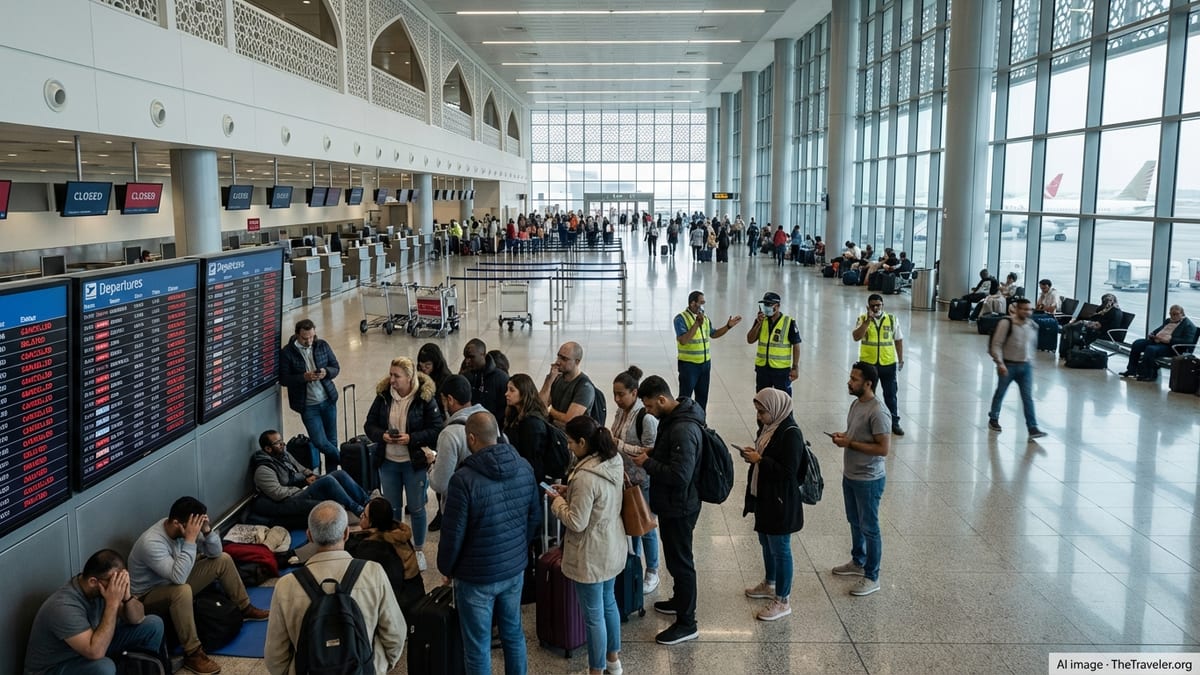
For travelers, the effect is most visible on departure boards, where long lines of cancellations to Abu Dhabi, Dubai, Doha and Riyadh now appear as a direct consequence of overlapping airspace closures and war-risk insurance constraints, rather than isolated operational issues at any single airline.
Airspace restrictions reshape Gulf aviation corridors
The latest wave of disruption stems from the closure and restriction of multiple flight information regions across the Gulf following U.S. and Israeli strikes on Iran on 28 February 2026 and subsequent Iranian attacks on targets in Qatar, the United Arab Emirates and elsewhere. Regional aviation bulletins describe a cascade of airspace shutdowns over Qatar, the UAE, Bahrain, Israel and parts of Iraq and Iran, forcing carriers to abandon traditional high-density corridors linking Europe, Asia, Africa and Australasia.
Industry advisories circulated to corporate travel managers note that Qatar Airways initially suspended all flights after Qatari airspace was closed, with only limited evacuation and cargo operations allowed under emergency procedures. Emirates and other UAE-based airlines halted normal commercial operations at Dubai International Airport while traffic was diverted or grounded during the height of the airspace clampdown. Subsequent partial reopenings have allowed some services to resume, but under tight routing and altitude restrictions that constrain capacity and add significant complexity to flight planning.
Analysts writing in aviation trade publications point out that Gulf hubs such as Dubai, Abu Dhabi and Doha rely on tightly timed connection waves. When adjacent airspace is restricted, airlines must either operate long detours around danger zones, burning more fuel and adding hours to journey times, or cancel flights altogether. In practice, the combination of elevated security risk assessments, higher insurance premiums and crew duty-time limitations has led many long-haul carriers to opt for suspensions on certain city pairs instead of operating highly inefficient routings.
Saudi Arabia’s capital Riyadh is also affected, with regional updates indicating suspensions or frequency cuts on multiple routes as airlines navigate bans or constraints on overflights across neighboring countries. Although Saudi airspace has remained more accessible than Qatar’s at various points in the crisis, the interlinked nature of Gulf air traffic means that operational shocks in one state quickly ripple across the wider network.
Travelers from UK, India, US, Germany and Canada stranded
The sudden withdrawal of capacity has left tens of thousands of passengers from the United Kingdom, India, the United States, Germany, Canada and other markets stranded or facing prolonged delays. Travel advisories and news reports describe crowded terminals in cities such as Dubai and Doha during the initial days of the airspace shutdown, as visitors and residents attempted to rebook onto scarce outbound flights or secure accommodation while waiting for evacuation services.
Government travel notices from several countries urged citizens to avoid non-essential travel to affected states and to leave while commercial options remained available. However, the rapid pace of route suspensions and the closure of key transit hubs meant that many travelers were unable to depart before airlines began consolidating or cancelling flights. In some cases, passengers reported being routed via Muscat, Istanbul or European capitals on fragmented itineraries that replaced what would normally be a single one-stop journey through a Gulf hub.
Travel-law specialists and passenger-rights organizations have warned that compensation frameworks vary widely depending on point of origin and governing regulation. In many cases, carriers are invoking force majeure clauses linked to armed conflict and airspace closures, which typically limit obligations to providing refunds or rebooking assistance rather than cash compensation for delays and consequential losses such as missed cruises, tours or business meetings.
For travelers from India and other South Asian markets, the disruption has been particularly severe. Gulf hubs serve as primary connectors for migrant workers and visiting families heading to Europe and North America, and the contraction in capacity has lengthened journey times while reducing affordable options. Reports from consumer advocacy groups highlight instances of families being split across different flights and dates due to limited availability, with priority often given to those holding fully flexible or premium-class tickets.
Unprecedented cancellations drive soaring fares
Industry tallies compiled since late February indicate that tens of thousands of flights involving Middle Eastern airspace have been cancelled or significantly rerouted, affecting a web of connections far beyond the immediate conflict zone. Aviation analytics firms cited in recent coverage estimate that the closure of Gulf corridors has removed a major portion of Europe–Asia and Asia–North America capacity that would ordinarily flow via Dubai, Abu Dhabi and Doha, compressing demand onto remaining routings through cities such as Istanbul, Cairo and various European hubs.
This sudden shift in booking patterns has pushed fares sharply higher on many alternative routes. Data shared by online travel agencies and ticket consolidators show premium increases on some Europe–India and Europe–Australia itineraries of 50 to 100 percent compared with early February levels, especially where travelers seek last-minute departures. Nonstop services that bypass the Gulf entirely, such as direct flights between India and the United Kingdom or North America, have seen some of the steepest price surges as passengers compete for limited seats.
Travel agents in major outbound markets describe an environment in which inventory is changing by the hour, as airlines adjust schedules in response to new risk assessments and as government advisories tighten or relax. Flexible tickets and those booked through corporate travel programs with access to multiple global distribution systems appear to offer the best chance of securing rerouting, but even these channels are constrained by capacity limits and the time needed for carriers to reposition aircraft and crews.
Observers note that the disruption comes on top of an already tight global aviation market, with aircraft deliveries delayed and many airlines operating at or near pre-pandemic utilization levels. In that context, the extended suspension of high-volume Gulf routes by carriers such as Delta, British Airways, Air France, Cathay Pacific, Lufthansa, Emirates and Qatar Airways has amplified competitive pressures for long-haul capacity, feeding directly into higher fares and reduced choice for consumers worldwide.
What travelers should expect in the weeks ahead
Travel-risk consultancies and airline schedule analysts broadly expect a protracted period of volatility rather than a rapid return to normal patterns. Some carriers in the region have begun cautiously restoring select services as limited airspace corridors reopen under revised safety protocols, but these resumptions remain fragile and subject to sudden reversal if the security environment deteriorates.
For the near term, travelers are being advised through public guidance documents and airline alerts to anticipate last-minute changes, extended journey times and irregular operations at Gulf hubs. Many carriers have relaxed change fees and are offering broader rebooking windows to encourage passengers to shift itineraries away from peak disruption periods, but such measures cannot fully offset the structural capacity loss caused by the prolonged suspension of core routes.
Experts writing in policy and industry journals suggest that airlines and governments may increasingly rely on alternative hubs, including airports in Oman and parts of southern Europe, to sustain critical long-haul connectivity while avoiding the most restricted airspace. However, these airports lack the scale and banked-wave connectivity of Dubai, Doha and Abu Dhabi, meaning that any rerouted network will inevitably be less efficient and more expensive in the short to medium term.
Until broader de-escalation occurs and regulators relax airspace restrictions, passengers from the UK, India, the US, Germany, Canada and beyond are likely to face continued uncertainty when planning trips that would usually cross the Gulf. The current pattern of suspended routes, rolling cancellations and elevated fares underscores how deeply the Middle East’s aviation infrastructure is intertwined with global travel and how quickly geopolitical shocks can reverberate through everyday journeys.