


More news on this day
British holidaymakers heading for Europe this summer are being caught between two sharply contrasting realities, as Spain and France grapple with lengthy queues under the EU’s new biometric border regime while Greece moves to ease the pressure by softening checks for UK visitors.
Get the latest news straight to your inbox!
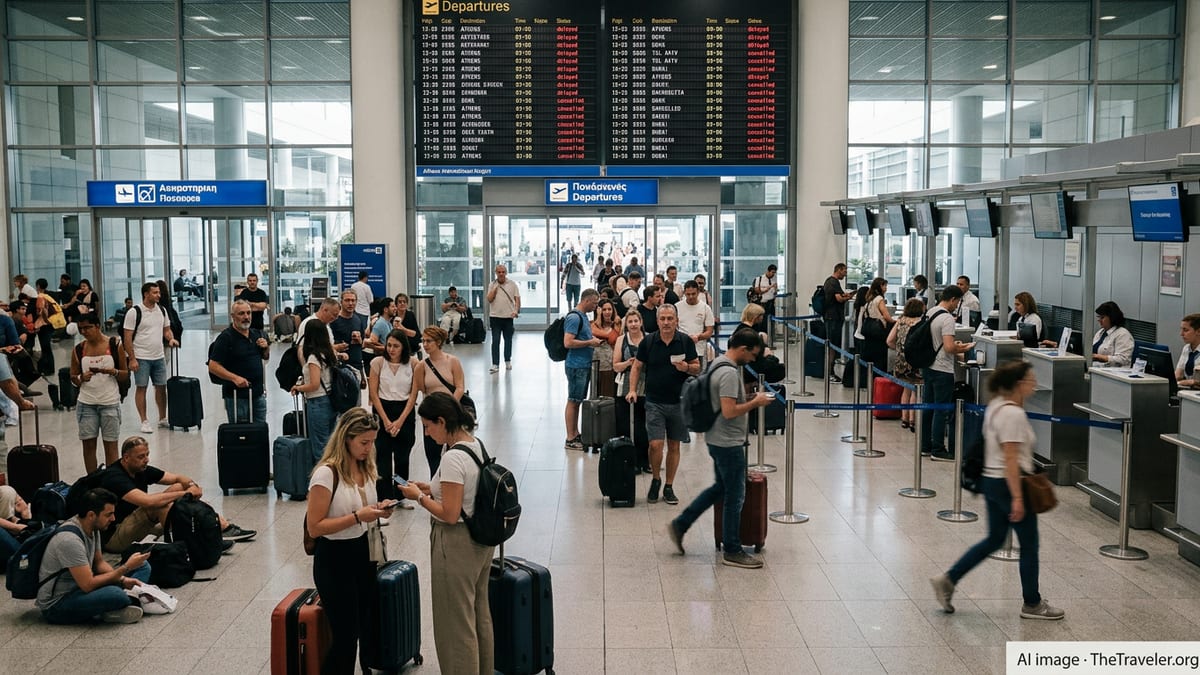
Schengen Biometric Crackdown Turns Peak Season into a Stress Test
The European Union’s Entry/Exit System, fully activated across the Schengen Area on 10 April 2026, was designed to replace passport stamping with digital records backed by fingerprints and facial images for non-EU travellers. In practice, its first main summer season has turned major Mediterranean gateways into an extended stress test for British tourists.
Reports from travel media and aviation analysts describe processing times at some external border checkpoints rising by up to 70 percent as officers take biometric data from every eligible passenger. At large hubs in Spain, France, Italy and Germany, airport associations and industry groups have been warning since late 2025 that infrastructure and staffing would struggle to absorb the additional steps during busy wave periods.
By late spring, those warnings had materialised into queues stretching to three hours or more at certain airports, particularly where biometric kiosks malfunctioned or where manual fallback procedures were triggered. Accounts collected by European news outlets and traveller forums point to missed flights, missed connections and families spending much of their first holiday day in airport arrival halls rather than at the beach or in city centres.
Data released by European institutions indicates that millions of entries and exits have already been logged under the system since its phased launch began in late 2025, underscoring the scale and complexity of the change. For British travellers, who became “third-country nationals” after Brexit, the new controls are now an unavoidable part of visiting the Schengen zone, at least at airports and seaports where the technology is fully deployed.
Spain and France Struggle with Long Queues and Missed Flights
Spain and France, two of the UK’s favourite sunshine destinations, have emerged as focal points of disruption as the biometric rules bite. Travel coverage highlights significant congestion at high-traffic Spanish airports, including Madrid-Barajas, Barcelona-El Prat and Málaga, where 24-hour stress tests of the Entry/Exit System preceded the April switchover but have not entirely prevented bottlenecks.
Budget and leisure airlines serving British holidaymakers have begun issuing tailored guidance. In separate advisories picked up by European travel media, low-cost carriers have urged UK passengers bound for Schengen airports to arrive at least three hours before departure, warning that some travellers have already missed flights due to queues at border control rather than at security or check-in.
France has seen similar flashpoints, especially at busy holiday gateways and connecting hubs. Coverage in specialist visa and travel outlets notes that the new requirements have coincided with existing capacity challenges at some French border posts, amplifying the impact of even minor technical glitches. While some travellers report relatively smooth experiences at certain airports, others describe long waits as lines of non-EU passengers snake through arrival halls.
For now, the picture is patchy: channel-crossing routes used by many UK travellers to reach France by rail or ferry are still largely outside the new biometric regime, but air passengers arriving at Schengen airports are increasingly exposed to it. The result is an uneven landscape in which the same family might breeze through controls in one country, then face prolonged checks on their next trip.
Greece Breaks Ranks With a De Facto Fast Track for Britons
Greece, which relies heavily on the UK for tourism revenue, has taken a different course. Publicly available information from Greek diplomatic channels and tourism bodies indicates that British passport holders have been temporarily exempted from full biometric registration at Greek border crossing points, even though the EU-wide system is formally in force.
Travel trade publications and airline statements describe the move as a strategic intervention to preserve the flow of visitors at the start of the crucial summer season. Major UK-focused tour operators have publicly welcomed the decision, framing it as an effort to avoid the scenes of gridlock witnessed elsewhere in the Schengen Area and to protect late bookings from hesitant British travellers.
Greek tourism representatives cited in industry coverage emphasise that the facilitation is intended to be temporary and conditional on improvements to the EU system, but stress that “frictionless” arrivals remain a top priority. The approach has been characterised by some commentators as a “pragmatic” balancing act between adherence to new European rules and safeguarding a core tourism market.
The stance has also generated confusion. International news outlets report that Greek authorities insist the Entry/Exit System is operational nationwide, even as embassy notices in the UK and statements from travel companies suggest a carve-out for UK holidaymakers in practice. On the ground, recent traveller accounts from Athens and island airports describe standard passport checks with little or no biometric capture for Britons, in contrast with the experience of other non-EU nationals.
Patchwork Implementation Fuels Confusion for UK Holidaymakers
The diverging approaches of Spain, France and Greece have created a patchwork that is difficult for ordinary travellers to navigate. While the core legal framework of the Entry/Exit System is shared across the Schengen Area, national authorities retain discretion over rollout schedules, staffing and the extent of any temporary waivers or workarounds.
Some European commentary suggests that Greece’s unilateral easing for UK visitors could encourage copycat measures in other tourism-dependent states, although public statements from officials in Portugal and Italy indicate they intend to keep digital border checks fully in place. The European Commission, for its part, continues to present the new scheme as central to modernising external borders and improving security, even as it acknowledges early “frictions” at busy crossings.
For British tourists, the lack of uniformity means that trip planning has become more complicated. Travel forums and consumer advice columns are filled with practical questions about how much extra time to allow, whether children must provide fingerprints, and whether pre-registration apps will genuinely speed up the process. Responses often vary by destination, gateway airport and even time of day.
Industry data and anecdotal reports suggest that some would-be visitors are already reconsidering holiday plans, comparing the prospect of biometric bottlenecks in Europe with alternatives such as Turkey, North Africa or long-haul destinations where entry procedures may appear simpler. Tourism boards in Mediterranean countries are therefore under growing pressure to show that system teething problems will not derail the summer season.
Airlines and Airports Scramble to Manage the New Normal
As the first peak post-rollout summer approaches, airlines and airports are adapting rapidly. Carriers with large UK customer bases are updating passenger communications, mobile apps and booking confirmations to highlight potential delays at passport control. Some are urging travellers to complete check in online, arrive earlier than usual and keep documents ready to minimise time at the front of the queue.
Airports in Spain and France are reported to be reallocating staff, opening additional manual booths during busy arrival waves and experimenting with queue management systems around biometric kiosks. Industry bodies representing European airports continue to call for a review of Entry/Exit System procedures, arguing that without more flexibility and investment, systemic disruption to passenger flows will persist.
With British travellers remaining one of the largest single non-EU visitor groups to the Schengen zone, the way the system handles them has become a litmus test for its broader success. Greece’s more permissive model, at least for now, stands in stark contrast to the stricter enforcement seen in Spain and France, raising questions about consistency and fairness but also demonstrating the strength of tourism’s political influence.
In the short term, UK holidaymakers can expect a summer of mixed experiences: smooth arrivals in Athens or Heraklion one week, multi-hour waits in Barcelona or Paris the next. How quickly European authorities can refine the biometric regime, and whether other countries follow Greece’s path of targeted relief, will help determine whether this year’s travel headaches fade into memory or become a new seasonal ritual for British visitors to the Schengen Area.