


More news on this day
Flight-tracking data pointed to a sharp spike in disruption across the Gulf aviation network around September 19, with 1,585 delays and 40 cancellations logged across major Middle East gateways as airlines worked through operational backlogs and shifting air-traffic flows.
Get the latest news straight to your inbox!
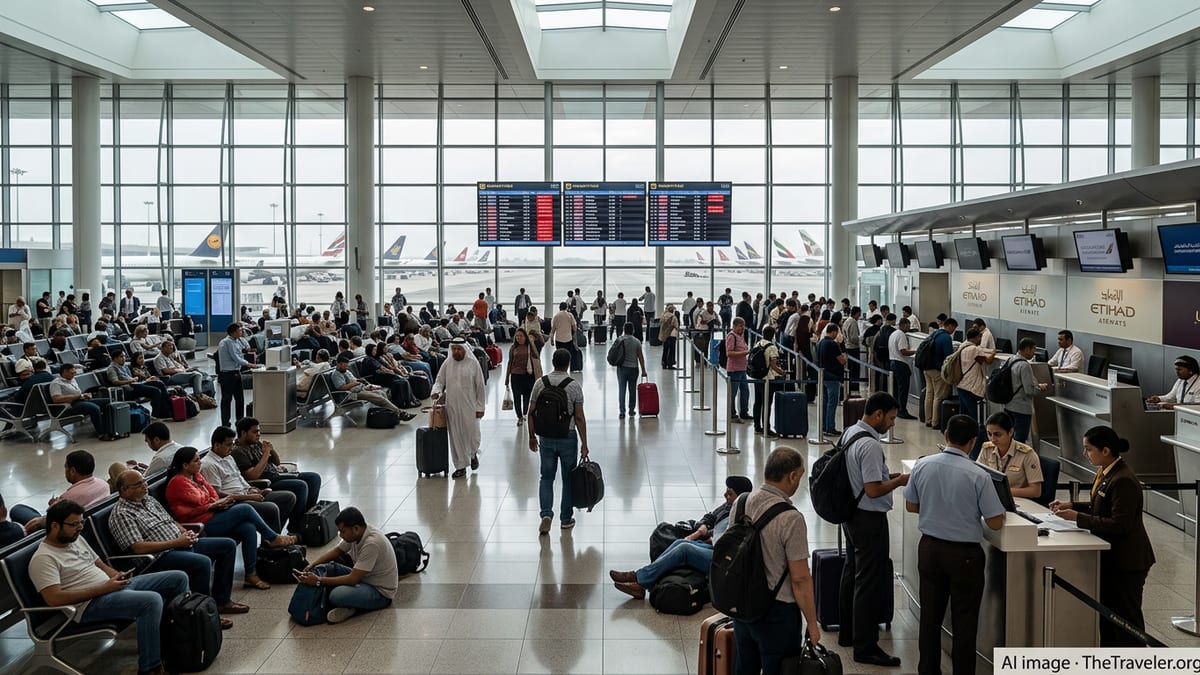
Riyadh disruption ripples through a tightly connected hub system
Riyadh’s King Khalid International Airport emerged as a focal point during the September 19 disruption window after Flightradar24’s airport tracker flagged “major problems” at the hub, a rating associated with long delays alongside multiple cancellations. Published coverage described a fast-moving incident environment near the airport and a rapid shift in conditions as schedules were updated and queues were worked down.
Publicly available flight-tracking coverage also indicated that operations later resumed after temporary disruption earlier the same day, underscoring how Gulf hubs can swing from severe congestion to partial recovery within hours depending on air-traffic restrictions, gate availability, and how quickly aircraft and crews can be repositioned.
Because Riyadh sits inside a dense web of connections feeding Dubai, Doha, Abu Dhabi, Kuwait, and onward long-haul banks to Europe, Asia, and North America, even short interruptions can cascade. When a departure wave slips, aircraft rotations are displaced, inbound flights miss gate windows, and crews can run into duty-time constraints that force rescheduling later in the day.
Where the delays and cancellations showed up across the region
The 1,585 delays and 40 cancellations cited for September 19 were described as spanning hubs across Saudi Arabia, the United Arab Emirates, Qatar, Kuwait, and Oman, with the pattern consistent with network-style disruption rather than a single isolated cancellation burst. In this kind of event, airports may continue operating while still posting heavy delay volumes due to flow controls, late-arriving aircraft, and knock-on congestion.
Live disruption dashboards commonly used by travelers and airline operations teams show how quickly conditions can evolve. For example, Flightradar24’s airport disruption view displays delayed and canceled counts along with an index that can shift as flight plans are revised and airlines consolidate services or swap aircraft types.
Separately, widely used cancellation and delay dashboards have also shown elevated delay totals at major airports during recent periods of regional volatility, including at Dubai International. While these dashboards do not explain the cause on their own, they are often used as a practical snapshot of whether disruptions are localized to one airport or broadly distributed across multiple hubs at once.
Why disruption can spike without a complete shutdown
In the Gulf, heavy delays often follow the same basic mechanics: reroutes to avoid certain corridors, temporary air-traffic flow restrictions, and bottlenecks at peak banks where dozens of widebodies and narrowbodies compete for the same runway and gate resources. A network designed for tight connections can deliver excellent on-time performance in normal conditions, but it can also amplify disruption when the system is stressed.
Operational updates circulated by logistics and travel-risk monitors in September described expectations of daily changes, capacity constraints, and the possibility of short-notice cancellations or delays as airlines validated routings and schedules. That environment can translate into longer taxi times, holding patterns, gate holds, and missed connection windows, even if most flights still operate.
Another pressure point is crew and aircraft legality. When inbound flights arrive late, outbound crews can time out, and replacement crews may not be positioned. Airlines can sometimes recover by swapping aircraft, delaying a later service to protect a long-haul departure, or consolidating frequencies, but those choices can increase the odds of last-minute schedule changes for travelers.
Airspace advisories add planning complexity for airlines and passengers
Alongside day-to-day operational factors, airlines are also navigating an advisory-heavy environment. The European Union Aviation Safety Agency has an active conflict-zone bulletin covering the airspace of the Persian Gulf and Gulf of Oman, listing Bahrain, Kuwait, Qatar, the United Arab Emirates, and Oman, and noting the bulletin’s validity through September 30, 2026. Such guidance does not automatically halt flights, but it can influence routing decisions, altitude planning, and contingency planning.
In practice, even modest routing adjustments can add time and cost. Longer routings increase fuel burn and can change which alternates are feasible, while also complicating crew scheduling if a flight that normally fits within a duty window becomes marginal. In a hub environment, a small number of longer flights can also consume scarce gates and push departure banks later, compounding delays.
For travelers, the immediate effect is often uncertainty: a flight may remain “scheduled” while its aircraft is still inbound late, or a departure slot is being renegotiated. That is why disruption periods can feel uneven, with some flights leaving nearly on time while others slide repeatedly across the day.
What travelers can do right now as schedules keep shifting
During disruption spikes, the most useful habit is timing: check flight status close to departure, not just the night before. Tracking tools and airline apps can reflect rolling changes in departure times, aircraft assignments, and gate information, which can help passengers avoid arriving at the airport during a long gate-hold period or, conversely, missing an earlier-than-expected boarding call after a schedule reshuffle.
Travelers transiting Gulf hubs should also treat tight connections as higher risk when regional delay totals rise. When disruption is widespread, rebooking options may be constrained because later flights fill quickly with displaced passengers, and because aircraft rotations mean a delay at one airport can reduce seat availability elsewhere in the network.
For passengers who do face cancellations, the practical next steps usually come down to re-accommodation and documentation: securing the earliest confirmed alternative, verifying baggage status if a reroute involves a different hub, and keeping records of notifications and itinerary changes for any insurance or expense claims tied to the disruption.