


More news on this day
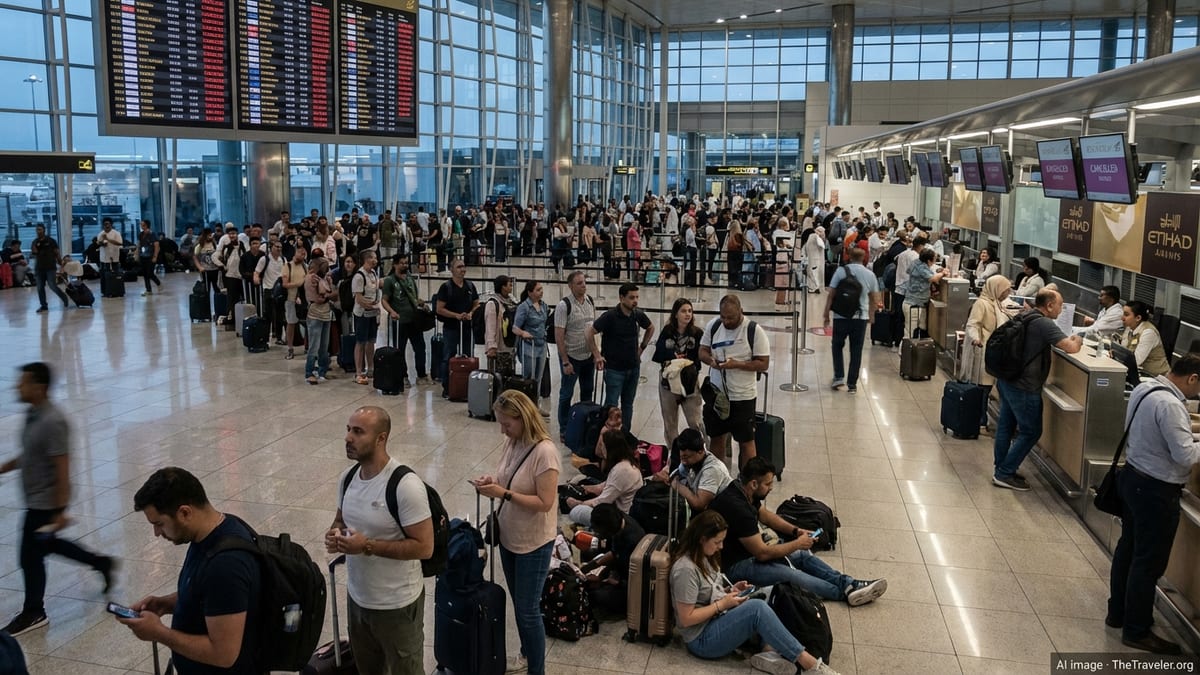
Major Gulf aviation hubs including Dubai, Abu Dhabi, Doha and Kuwait City are contending with more than 1,000 flight disruptions as stormy weather and regional security risks continue to upend tightly wound global travel networks.
Get the latest news straight to your inbox!
Conflict, Closed Airspace and Strained Hub Networks
Publicly available airspace trackers and industry analyses show that since late February 2026, a cascading security crisis linked to the Iran conflict has repeatedly shuttered or restricted skies over Bahrain, Iraq, Israel, Kuwait, Qatar, Syria and parts of the United Arab Emirates. Regional and international airlines have been forced to cancel or reroute thousands of flights that would normally funnel through Gulf hubs, which collectively handle a significant share of global long haul traffic.
Analysis by multilateral aviation bodies and independent consultancies indicates that closures and risk driven diversions across the Middle East are adding up to hours of extra flying time on some Africa Asia and Europe Asia routes. Longer routings consume more fuel, narrow connection windows and reduce the number of rotations that airlines can operate in a day, amplifying the number of delayed or cancelled services even at airports that remain technically open.
Flight data collated in early August points to well over 1,000 individual disruptions at key Gulf gateways since the latest round of security tensions escalated, including outright cancellations, last minute diversions, significant delays and aircraft substitutions. That disruption is spread across both home carriers and foreign airlines, many of which have temporarily scaled back or suspended services into the region while they reassess security and insurance conditions.
Strategic briefings produced for corporate travelers and logistics firms note that Gulf hubs are still functioning as crucial east west connectors, but in a degraded and uneven manner. Capacity on some trunk routes has tightened sharply, while others continue to operate but with heightened schedule volatility, leaving passengers facing a higher risk of missed connections and forced overnight stays.
Severe Weather Compounds Operational Challenges
While security concerns and airspace closures remain the primary driver of the current wave of disruption, seasonal storm systems across parts of the Arabian Peninsula and northern Indian Ocean have further strained operations. Meteorological reports for late July and early August highlight episodes of intense thunderstorms, high winds and dust storms affecting approaches into several Gulf airports.
Air traffic control procedures require additional spacing between aircraft during convective weather, reducing runway throughput at precisely the time airlines are attempting to operate compressed, irregular schedules. Even short periods of ground stops or reduced arrival rates can rapidly cascade into long delays and rolling cancellations when airports are already operating near capacity with limited spare aircraft and crew.
Operations specialists note that the combination of route lengthening around closed or high risk airspace and weather related holding patterns has left aircraft and crews out of position across multiple continents. When storms hit hubs such as Dubai, Abu Dhabi or Doha, airlines have fewer standby resources to recover the schedule, translating into higher cancellation rates and longer recovery periods than would normally be expected for a single weather episode.
Forecast discussions for the coming days indicate the potential for additional unsettled weather, raising the prospect that delays triggered by security related rerouting may continue to intersect with localized storm disruption during a peak travel period for both leisure and business passengers.
Passenger Impact: Missed Connections, Detours and Crowded Alternatives
Reports from travelers, aviation forums and booking platforms describe a patchwork of passenger experiences that ranges from relatively smooth journeys via partially restored Gulf networks to extended detours and unplanned layovers in secondary hubs. Some travelers connecting between Europe and Asia have been shifted from traditional Gulf routings onto itineraries via Central Asia, Africa or southern European gateways, adding hours to total journey times.
In cases where flights into core Gulf hubs have been cancelled outright, passengers have reported difficulties securing timely rebookings because alternative services are heavily subscribed and operating with limited spare capacity. When storms or security alerts disrupt departure banks, hotel availability near major airports has tightened, with some travelers bearing out of pocket costs for additional accommodation and meals if airlines are unable to provide immediate assistance.
Travel industry data suggests that demand has not collapsed, but has redistributed. A proportion of passengers who might normally choose transit in Doha, Dubai or Abu Dhabi appear to be opting for routings through other regions where schedules are perceived to be more predictable, even at higher fares. At the same time, essential business travel and family visits that rely on Gulf connections continue, contributing to crowded departure halls whenever windows of relative operational stability open.
For travelers already in transit, communication lags remain a recurring frustration. Changes to routings and departure times are sometimes being finalized close to departure as airlines wait for updated airspace and weather assessments, leaving limited time for passengers to adjust onward plans.
Airlines Adjust Networks and Risk Profiles
Published coverage from aviation analysts indicates that Gulf based carriers and their global counterparts are managing a complex trade off between maintaining network connectivity and mitigating operational and security risk. Several international airlines have temporarily suspended direct flights to certain Gulf cities or have capped frequencies, instead code sharing with partners on remaining services or channeling traffic through alternative hubs.
Home carriers at the affected hubs have introduced rolling schedule changes, trimming frequencies on some routes to free up aircraft for high demand corridors and to build limited slack into their fleets. Timetables updated in late July and early August show banks of flights being retimed to reflect longer routings around restricted airspace and to avoid periods when convective weather is statistically more likely.
Insurance and risk premiums for overflight in some parts of the Gulf region have reportedly risen sharply during the conflict, influencing routing choices and, in some cases, prompting airlines to avoid certain airspace altogether even when technically open. Industry consultants note that this environment makes it harder for carriers to commit to firm medium term schedules, encouraging the use of shorter planning horizons and more frequent timetable updates.
Cargo operations are also affected. Freighter flights that once relied on Gulf hubs as high volume transfer points are being redistributed across alternate corridors, with implications for transit times and capacity for high value shipments. This can indirectly impact passenger travel as airlines weigh the revenue contribution of belly hold cargo against the constraints of longer, more expensive routings.
What Travelers Can Expect in the Weeks Ahead
Travel risk advisories and airline notices issued in early August emphasize that disruption across Gulf aviation hubs is likely to remain uneven and subject to rapid change. While some airspace restrictions have eased at various points, the broader security context remains fluid, and storms typical of the season can still trigger localized disruptions that ripple through already fragile schedules.
Passengers planning trips through the region in the coming weeks are being encouraged, through publicly available guidance, to leave longer connection times, monitor booking portals and airline applications closely for schedule changes, and consider flexible or refundable fares where budgets allow. Travel insurers in several markets have begun highlighting policy conditions linked to war, security events and weather related disruption, prompting travelers to review coverage more carefully before departure.
Industry forecasters expect Gulf hubs to retain their central role in global aviation once security conditions and weather patterns stabilize, but suggest that airlines may accelerate efforts to diversify routings and develop secondary transfer points to spread risk. For now, the combination of conflict related airspace constraints and seasonal storms means that travelers crossing continents via the Gulf should be prepared for a higher than usual chance of last minute adjustments to their plans.