


More news on this day
Yemen’s Houthi movement has claimed a ballistic missile strike on Riyadh’s King Khalid International Airport and issued what it describes as a “last warning” to global airlines over the use of Saudi airspace, heightening concern among travelers and carriers already navigating a volatile regional security landscape.
Get the latest news straight to your inbox!
Fresh attack claim on King Khalid International Airport
Reports from multiple outlets on October 8, 2026 indicate that Houthi forces said they fired a ballistic missile at King Khalid International Airport, Riyadh’s main gateway, and that the weapon struck its intended target. Houthi military spokesperson Yahya Saree stated in a recorded message that the attack disrupted air traffic and formed part of a wider campaign against Saudi infrastructure.
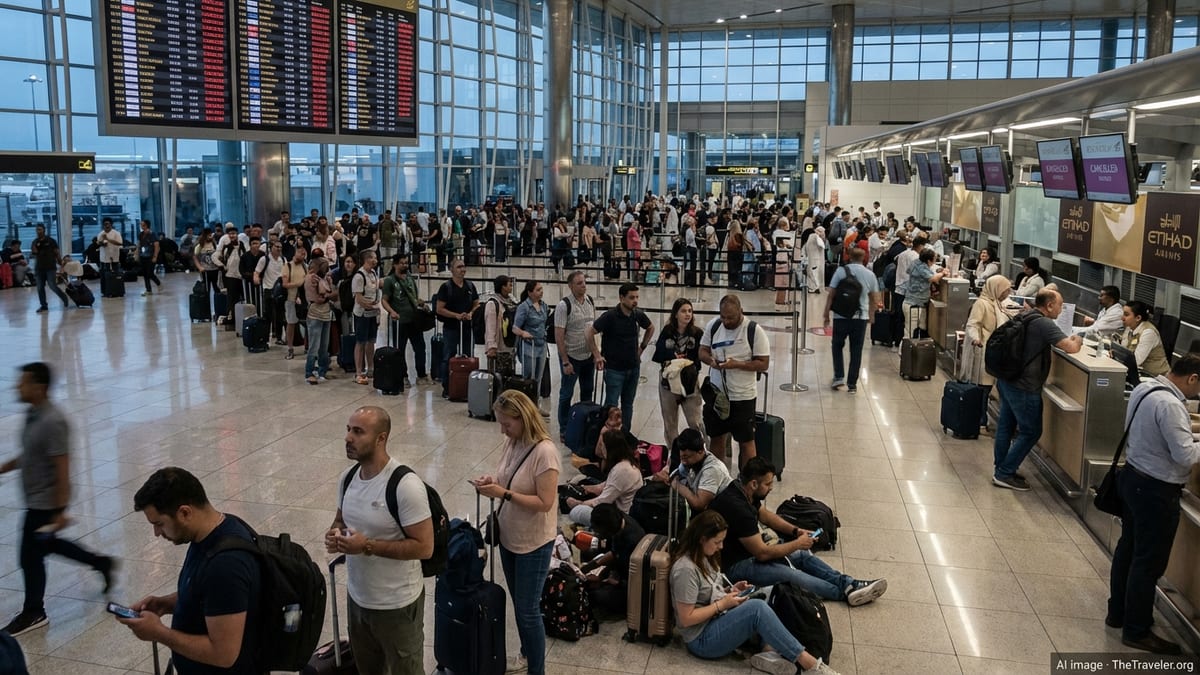
Publicly available flight-tracking data and media coverage point to significant disruption at Riyadh’s airport around the time of the claimed strike, with departures briefly halted and several flights listed as delayed or rescheduled. Some services already in the air were reported to be rerouted or placed into holding patterns as operators assessed the situation and awaited clearance.
Saudi authorities have previously confirmed casualties from earlier attacks on the country’s airports, but as of October 8 there is no detailed public account from Riyadh setting out the impact of the latest incident on terminals, runways, or aircraft. Coverage from international news agencies notes that there has been no independent verification of the Houthi account, underscoring the difficulty of establishing a precise damage assessment in real time.
The reported strike follows a pattern of Houthi activity targeting the Saudi capital and other urban centers. In mid-September, smoke and flames were seen near King Khalid International Airport after Saudi alerts warned of a “hostile aerial threat” in the area, and Houthi statements at the time referenced “sensitive” sites in Riyadh as part of their campaign.
‘Last warning’ over Saudi airspace and exemptions for holy cities
In conjunction with the latest attack claim, Houthi representatives have issued stark language aimed at the global aviation industry. In statements carried by regional and international media, the group warned “for the last time” that international airlines should not operate flights through Saudi airspace, describing it as a “theater” for their military operations.
The warning explicitly exempts the skies above Mecca and Medina, Saudi Arabia’s two holiest cities, from any planned action. Houthi statements cited in published reports say the group does not intend to target airspace over these “sacred areas,” a carve-out that reflects long-standing sensitivities around religious sites and pilgrimage travel.
This latest notice builds on earlier messages issued in recent months, in which the group cautioned airlines to take its threats seriously until restrictions affecting Sanaa International Airport in Yemen are eased. Observers note that the language has sharpened over time, evolving from general cautionary remarks into a “final” or “last” warning that implicitly raises the perceived level of risk for overflights.
Aviation risk advisories for the broader region have periodically referenced the potential threat from missiles and drones launched from Yemen toward Saudi territory. While many carriers continued to use Saudi airspace as a major corridor linking Europe, Asia, and Africa, the renewed warnings and the visible disruption in Riyadh increase pressure on airlines to reassess routing.
Impact on airline routing and traveler itineraries
Saudi Arabia’s airspace is a key north–south and east–west transit route, carrying a large share of traffic between Europe and destinations in South and Southeast Asia, as well as linking the Gulf with Africa. Any sustained perception of heightened threat in this corridor could have significant operational and commercial consequences for airlines and travelers alike.
After earlier missile and drone incidents affecting Saudi infrastructure, some long-haul carriers adjusted flight paths to reduce exposure to specific areas, even when formal airspace closures were not in place. These changes typically add flight time and fuel costs, and in some cases have led to schedule tweaks and tighter connection windows at major hubs.
For individual passengers, the most immediate effects tend to show up as delayed departures, last-minute gate changes, or rebookings where crews and aircraft are out of position. Travel industry reporting on the October 8 disruption in Riyadh notes that several flights were listed as delayed while operators reviewed safety assessments and awaited confirmation that operations could continue.
Embassies and consular services in the region have begun advising citizens to closely monitor airline notifications and airport status pages before traveling, and to allow additional time for check-in and security. However, as of the latest reports, there has been no broad, coordinated closure of Saudi airspace, and most international schedules remain in place, albeit under closer scrutiny.
Escalating regional conflict and risks for civil aviation
The Riyadh airport incident comes against the backdrop of a wider escalation in and around Yemen. The conflict, which began with the Houthi takeover of Sanaa in 2014 and the intervention of a Saudi-led coalition the following year, has periodically spilled over into attacks on airports, oil facilities, ports, and shipping lanes.
Since mid-2026, published analyses describe a marked uptick in cross-border fire and retaliatory operations, including earlier Houthi strikes claimed against Abha airport in southwestern Saudi Arabia and energy infrastructure on the Red Sea. These actions have coincided with broader regional strains linked to maritime routes and the security of oil exports.
Civil aviation has been directly affected before. Documentation from international monitoring bodies and previous media investigations shows that airports such as Abha, Jizan, and Najran have repeatedly been targeted by missiles and armed drones in earlier phases of the conflict, sometimes causing casualties among passengers and airport workers and prompting changes to local safety protocols.
Analysts quoted in open-source reports suggest that the renewed focus on Saudi airspace is part of a strategy aimed at leveraging the economic and symbolic importance of aviation and energy flows. For travelers, this translates into a security picture that can change rapidly, even when headline truce arrangements appear to be holding.
What travelers and airlines are watching next
In the coming days, airlines are expected to review their risk assessments for routes crossing Saudi territory, factoring in the latest Houthi statements, observed activity around Riyadh’s airport, and any updated notices from aviation regulators. Some carriers may explore additional contingency routings over the eastern Mediterranean, central Asia, or North Africa to diversify options should the situation deteriorate.
Travelers with itineraries touching Riyadh or connecting through Gulf and Middle Eastern hubs are being encouraged by travel agents and public advisories to monitor their bookings closely and ensure contact details are up to date in airline systems. Same-day schedule shifts are not unusual in such environments, and passengers may see rebookings to alternate flights or, in limited cases, re-routing through different cities.
Special attention is likely to focus on peak religious travel periods, given the exemption the Houthis have stated for Mecca and Medina airspace and the large volumes of pilgrims moving through Saudi Arabia during those times. Even with those exemptions, any instability affecting the kingdom’s broader airspace can have knock-on effects on domestic and regional connections.
For now, the most consistent message emerging from publicly available advisories is that the threat environment over parts of Saudi Arabia has become more complex, rather than uniformly closed to civil aviation. The Houthi “last warning” to airlines, coupled with a fresh claim of a successful strike on Riyadh’s main airport, is likely to keep Saudi airspace under intense scrutiny from carriers, regulators, and travelers in the weeks ahead.