


More news on this day
Heightened security concerns across Gulf airspace are rippling through global airline schedules, with carriers delaying departures, rerouting services and in some cases suspending routes entirely while they await updated safety clearances.
Get the latest news straight to your inbox!
Stricter advisories reshape Gulf airspace overnight
Publicly available aviation notices show that the European Union Aviation Safety Agency has issued a reinforced conflict-zone bulletin advising airlines not to operate within the airspace of Bahrain, Kuwait, Qatar, the United Arab Emirates and parts of the Gulf of Oman, citing a high risk to civil flights at all altitudes. The move follows a renewed flare-up in the conflict between the United States and Iran and comes on top of existing guidance to avoid Iranian, Iraqi and Lebanese skies.
The latest bulletin extends previous precautions focused on Iran and its immediate neighbors to a wider swathe of Gulf airspace that normally handles dense daily traffic between Europe, Asia and Africa. Safety information notes the potential use of missiles, drones, combat aircraft and air defense systems, describing a fluid environment in which the risk profile for civil aviation can change rapidly.
While advisories do not amount to an outright global ban on flying in the region, the stronger language and broader geographic scope are prompting many airlines to adjust flight plans in real time. Carriers are weighing the operational complexity and cost of long detours against security requirements and the need to keep at least a skeleton network in place for passengers and cargo.
Separate security notices relating to Saudi Arabian airspace urge operators to exercise great caution, underlining how the impact of the latest tensions radiates beyond the immediate Gulf coastline to key hubs and overflight corridors across the Arabian Peninsula.
Delays, diversions and selective cancellations mount
Flight information boards at major Gulf airports on July 14 showed a patchwork of disruption, with long-haul services still operating but some regional connections delayed or cancelled as airlines reassessed exposure to higher-risk airspace segments. Coverage from regional outlets indicates that attacks on Saudi Arabia’s Abha airport triggered cancellations on routes linking the kingdom with the United Arab Emirates, adding to uncertainty for travelers using smaller Gulf gateways.
Elsewhere, live updates from Dubai and Abu Dhabi suggested that the majority of departures were still taking off close to schedule, yet even there passengers faced extended journey times as aircraft took more southerly or westerly tracks to avoid restricted zones. Industry analysts note that such diversions can add up to an hour to certain sectors between Europe and Asia, complicating crew scheduling and aircraft rotations.
Some foreign carriers have opted for more conservative responses, including the suspension of selected services into the Gulf or temporary pauses on flights that would otherwise transit the most affected areas. Other airlines are maintaining operations but issuing travel advisories warning that airspace closures and last-minute routing changes could lead to rolling delays.
Operational briefings shared with the market in recent months underline how even modest adjustments in conflict-zone parameters can create cascading effects across airline networks, particularly in peak summer periods when capacity is already stretched and spare aircraft are limited.
Airlines wait for clearer timelines and risk assessments
The reinforced guidance on Gulf airspace currently carries validity dates into late July, though regulators have signaled that this timeline could be shortened or extended depending on the evolution of the security situation. Airlines are treating these dates as provisional markers, building contingency schedules that can be revised quickly if restrictions ease or tighten.
Public statements from carriers over recent days emphasize that resumption of normal routings will depend on updated security assessments by states and international bodies. In practice, that means many airlines are holding aircraft at origin airports or applying departure holds until they receive firm confirmation that intended flight paths are acceptable under the latest advisories.
For some operators, the uncertainty is compounded by earlier disruptions this year, when sudden airspace closures in parts of the Middle East forced mass cancellations and created significant passenger backlogs. Having already absorbed the financial and reputational cost of those events, network planners are now more inclined to preemptively slow operations rather than risk being caught mid-rotation by new closures.
Industry observers point out that even airlines that continue to overfly the region are carrying out more frequent, structured risk reviews, often several times per day. That iterative process can translate into last-minute changes that passengers experience as unexplained gate holds or extended times on the tarmac while flight plans are recalculated.
Passenger impact and advice for travelers transiting the region
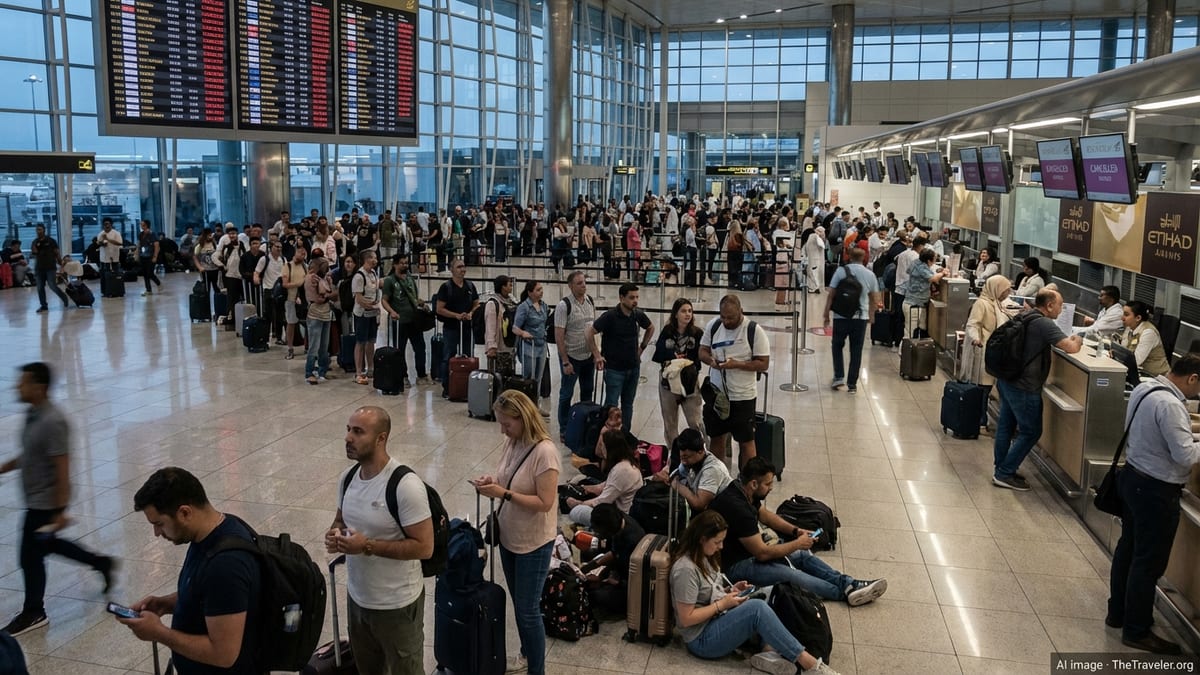
The immediate effect for travelers is greater unpredictability on routes that cross the Gulf, including popular one-stop itineraries between Europe and South or Southeast Asia. Reports from airports in the region describe queues at transfer desks as passengers seek rebooking options after missed connections caused by cascading delays.
Travel industry updates recommend that passengers with upcoming trips through Gulf hubs monitor their booking status closely in the 24 to 48 hours before departure and allow additional time for connections. Some carriers are offering free date changes or rerouting on alternative paths that avoid the most affected airspace, though such options may be constrained during high-demand periods.
Travel management companies note that corporate clients are reassessing routing policies for staff travel, with some organizations temporarily steering travelers away from certain hubs in favor of longer but more predictable itineraries. Insurance providers are also reviewing policy wording around security-related disruptions, an area that can be complex when delays stem from precautionary measures rather than direct damage to infrastructure.
For leisure travelers, the main considerations are flexibility and awareness. With schedules subject to short-notice revisions, industry guidance stresses the importance of keeping contact details updated in airline booking records so that carriers can send alerts if flight times or routings change.
Wider aviation and economic stakes as summer peak unfolds
The timing of the latest Gulf security concerns coincides with the northern summer travel peak, when airlines traditionally rely on high load factors across long-haul networks that connect Europe and North America with Asia and Africa. Any sustained restrictions in Gulf airspace threaten to squeeze already tight capacity on these corridors, potentially driving up fares and reducing options for travelers.
Aviation consultancies have previously estimated that the Gulf region accounts for a significant share of global connecting traffic, particularly via large hubs in the United Arab Emirates and Qatar. If security advisories remain in place for an extended period, airlines may need to re-balance fleets and crew bases towards alternative hubs, at least temporarily, to preserve network connectivity.
The stakes extend beyond passenger travel. Cargo operators rely heavily on Gulf routes for time-sensitive shipments, including pharmaceuticals and high-value electronics. Longer routings and possible slot constraints at alternative airports could increase costs and lengthen transit times, with knock-on effects for supply chains already strained by earlier disruptions in regional sea lanes.
For now, the picture that emerges from publicly available data is one of cautious recalibration rather than a complete halt in Gulf aviation. Airlines are keeping aircraft in the sky where feasible but are proceeding more slowly, building in buffers as they await clearer signals from regulators and security assessments before committing fully to pre-crisis schedules.