


Visiting Hagia Sophia in 2026 is not as simple as just walking into a mosque. Since the upper gallery was turned into a paid visitor area again, tickets, queues, dress codes and confusing “full experience” offers have caught many travelers off guard. Understanding how Hagia Sophia tickets work today will save you both money and frustration once you arrive in Istanbul.
Get the latest updates straight to your inbox!
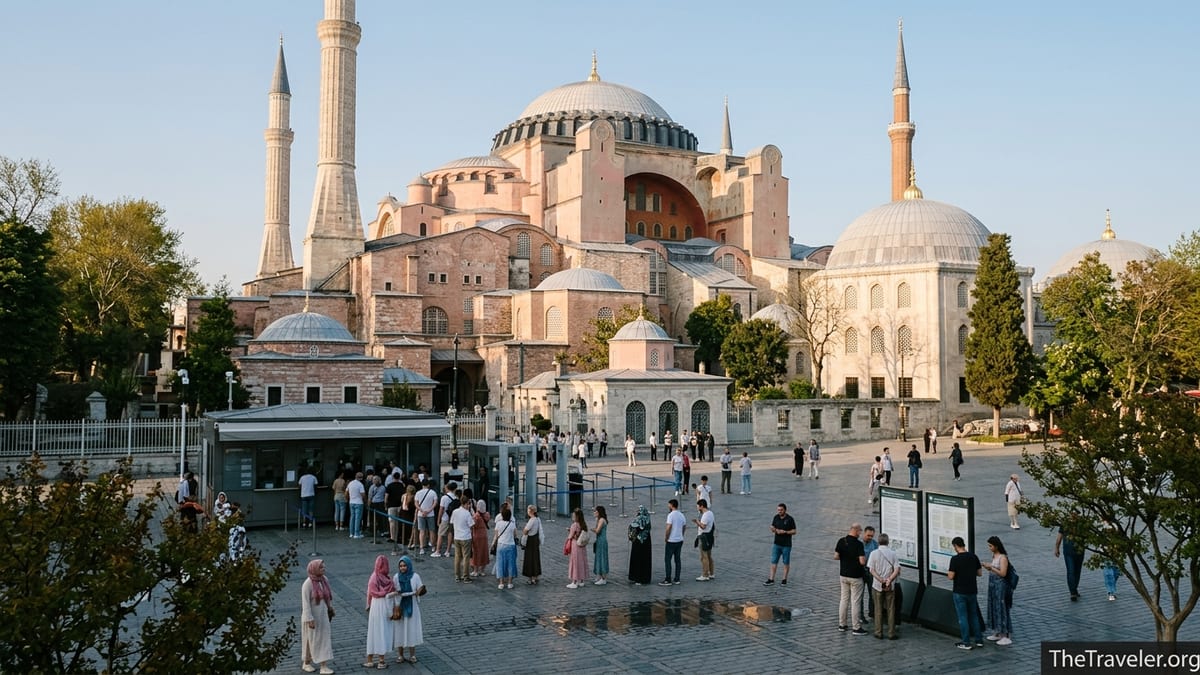
How Hagia Sophia Tickets Work in 2026
Hagia Sophia is once again an active mosque, but its upper gallery operates as a paid museum-style visit for tourists. This means there are effectively two different experiences in the same building: free worship on the main floor for eligible worshippers using a separate entrance, and a paid visit to the upper gallery reached through the northeastern visitor entrance. Since 2024, foreign tourists have been directed almost exclusively to this upper gallery, which is where the famous Byzantine mosaics like the Deesis and imperial donor panels can still be viewed.
For most foreign visitors, “buying a ticket to Hagia Sophia” in 2026 means purchasing timed entry to that upper gallery section. You do not need a ticket for general mosque access if you are entering to pray via the worshippers’ entrance, but as a non-Turkish visitor you should not expect to be able to simply wander the ground floor anymore. Even many Muslim travelers report that they have been asked to buy the gallery ticket if they are visiting primarily as tourists rather than as local worshippers.
The key point is that the 25 euro ticket does not cover the ground-floor prayer hall. That area is treated as a functioning religious space managed by Turkey’s Directorate of Religious Affairs. The upper gallery, by contrast, is run as a museum-type visit under the Ministry of Culture and Tourism with controlled capacity, ticket checks and a separate security line. Once you understand this split, the rest of the ticket rules start to make more sense.
On a practical level, you will encounter ticket sellers, tour promoters and museum booths clustered around Sultanahmet Square, all using phrases like “Hagia Sophia ticket,” “mosque ticket” or “full experience.” Some of these refer to the upper gallery, others to the separate Hagia Sophia History Museum across the square. Taking a moment to confirm exactly what your ticket includes before you pay is essential.
Current Ticket Prices and What They Really Include
As of mid 2026, the standard Hagia Sophia gallery ticket for foreign tourists is approximately 25 euros per adult, verified by multiple official and specialist ticketing sources that track prices updated in April and May 2026. Children under 8 can usually enter free, but you must be prepared to show a passport or ID at the gate to confirm their age. Turkish citizens pay in lira at a lower domestic rate, and museum-card discounts are sometimes available only for locals, not for foreign visitors.
That base 25 euro ticket is a self-guided entry. It gives you access to the upper gallery via ramps and stairways, where you can walk the balcony overlooking the nave, see restored mosaics and Ottoman calligraphic roundels, and use the digital or audio content now bundled with most official tickets. This content is often described as an “AR audio guide” in multiple languages. Travelers describe it as functional but uneven in quality: helpful for basic orientation, less compelling if you already know Byzantine history.
Guided products sit above that base price. A small-group walking tour that includes skip-the-line entry to Hagia Sophia and usually a visit to the Blue Mosque or Hippodrome tends to start around 35 to 70 euros per adult, depending on group size and season. In these formats the guide often cannot deliver a full spoken tour inside the mosque galleries, due to restrictions introduced in recent years, so most of the deeper explanation happens before you enter or just after you exit, with the guide accompanying you through the space for quick questions.
There are also more expensive “full experience” or “combo” tickets sold both online and at kiosks around Sultanahmet. For example, you might see an offer around 50 to 60 euros that combines the Hagia Sophia upper gallery with the Hagia Sophia History Museum and sometimes the Basilica Cistern or Topkapi Palace. What many recent visitors discovered, sometimes the hard way, is that a “full experience” of Hagia Sophia does not mean extra access inside the mosque itself. Instead, it adds a visit to a separate museum building across the square, which some travelers feel is worthwhile and others consider skippable at that price.
Official vs Third‑Party Tickets and Common Pitfalls
To complicate things further, Hagia Sophia now sits at the center of a crowded ecosystem of official tickets, semi-official resellers and independent tour operators. The most reliable baseline is the price published through Turkey’s Ministry of Culture and Tourism, which lists the upper gallery ticket around 25 euros and confirms that museum passes such as the Istanbul Museum Pass are not valid for this particular site. In other words, even if you buy a multi-day pass covering places like Topkapi Palace or the Archaeology Museums, you will still pay separately for Hagia Sophia.
Online, you will find the official ticketing partner listed as DEM Museums, which sells digital skip-the-line entries for the same price or a small service premium. These digital tickets allow you to bypass the cash desk and go straight to security, which can be a major time-saver on busy afternoons when the physical queue wraps around the square. Several major international platforms and local agencies then build on top of that, bundling the DEM ticket into guided tours or combo packages with other Old City highlights.
In practice, many problems arise not online but on the ground. Around Sultanahmet Square, visitors report being approached by sellers offering “VIP access,” “no-line tickets” or “full Hagia Sophia mosque experience” at prices that can reach 50 or even 60 dollars per person. In several recent first-hand accounts, the more expensive ticket simply turned out to be a standard upper gallery entry plus a separate museum ticket, with no extra access beyond what a regular 25 euro ticket would have offered. One traveler described being told at the cash desk that the cheaper option “is only for the balcony,” implying it was inferior, when in reality the balcony is precisely the only area any tourist can visit inside the mosque.
The safest approach is to decide in advance whether you want a simple self-guided visit or a guided experience that also covers other monuments. If you only want the basic upper gallery entry, buy directly from the official booth or the official online seller and decline add-ons you do not fully understand. If you prefer a guided tour, look for recognisable companies with clear inclusions and recent reviews, and treat street-side “official guide” offers with caution, especially if they seem to promise access to closed areas or “special permits” to the prayer hall.
Entry Rules, Dress Code and Security Checks
Hagia Sophia operates under a hybrid system: part mosque, part controlled heritage site. This makes its entry rules slightly stricter than at many secular museums. The visitor entrance for the upper gallery has airport-style security. All bags go through scanners, and large backpacks or suitcases may be refused. Several recent accounts mention being turned away with rolling luggage and directed to left-luggage offices at Sirkeci station or to hotel receptions instead, so it is wise to drop heavy bags before you head to Sultanahmet.
Dress code is enforced more seriously here than at some other mosques in Istanbul. Shoulders and knees must be covered for all visitors. Women are expected to cover their hair, while men should avoid sleeveless shirts and very short shorts. There are usually disposable head coverings and wraps available near the entrance, but the supply can run low on peak days and you may be asked to purchase a scarf from vendors outside. A practical approach is to carry a light scarf or pashmina and wear long, loose trousers or a skirt that comfortably falls below the knees.
Because the ground floor functions as a mosque, shoes must be removed in the worship area. In the upper gallery, however, many sections remain accessible in footwear, with protective walkways laid over historic surfaces. You should still expect some zones where you are asked to step onto carpets without shoes. Packing a small plastic bag to carry your footwear, or using the bags provided at the entrance, helps keep the process smoother when moving between different parts of the complex.
Friday midday prayers are a special case. From roughly 12:00 to 14:30 on Fridays, tourist entry is paused so that worshippers can gather for the main weekly congregational prayer. Travelers who arrived around 12:15 on a recent spring Friday described standing in line for an hour before learning that no tickets would be honored until mid-afternoon. If your Istanbul itinerary is tight, avoid scheduling Hagia Sophia for Friday midday and instead plan an early morning or late afternoon visit.
Planning Your Visit: Timing, Crowds and What You Will See
Hagia Sophia is open daily, with visitor hours typically running from morning through early evening. Ministry information for 2025 listed opening from 9:00 to around 19:30, and 2026 ticketing guides continue to advise that last entry is usually about an hour before closing. In summer, when Istanbul stays light late into the evening, tours commonly meet in the late afternoon for cooler temperatures and softer light on the domes and minarets.
Crowds peak from late morning to mid-afternoon, especially between June and August when cruise ships and tour buses converge on Sultanahmet. Visitors who arrived at 11:00 on a July weekend reported queues of 60 to 90 minutes for same-day tickets, compared with under 15 minutes for those who arrived before 9:30 on a weekday. By contrast, travelers entering after 17:00 on weekdays in shoulder seasons like April or October often found the galleries relatively calm, with space to linger by the Deesis mosaic and the Virgin and Child panel without being rushed along.
A realistic visit for most travelers is 45 to 90 minutes inside the upper gallery. You will walk the long ramp up to the balcony level, where the nave opens below you and the scale of the building becomes clear. From the railings, you can see the great dome, Ottoman chandeliers, and the patterned carpets of the prayer hall. Along the side corridors and apses, you encounter key mosaics: Christ Pantocrator flanked by Mary and John the Baptist in the Deesis, imperial donor mosaics with Empress Zoe and Emperor John II Komnenos, and fragments of seraphim and geometric decoration.
The experience is not identical to the pre-2020 museum era. Much of the lower-level museum signage has been removed or simplified, and conservation scaffolding appears in different areas depending on current restoration phases. However, for many first-time visitors, the emotional impact of standing above the nave, hearing the echo of the call to prayer, and tracing the overlay of Christian and Islamic art remains powerful. If you are especially interested in history and architecture, pairing your visit with the separate Hagia Sophia History Museum or with a good printed guidebook will fill in some of the context that used to be provided more extensively on site.
Real‑World Itineraries and Budget Examples
To understand how Hagia Sophia fits into a wider Istanbul visit, it helps to look at concrete day plans and budgets. A classic first‑timer’s Old City day might combine Hagia Sophia, the Blue Mosque, the Basilica Cistern and a stroll through the Hippodrome and Grand Bazaar. In 2026 prices, you could expect to spend about 25 euros for the Hagia Sophia gallery ticket, 25 to 35 euros for the Basilica Cistern depending on the ticket type, while the Blue Mosque remains free to enter as a mosque, subject to dress code and prayer time closures. Add in a simple lunch of kebab and tea for around 8 to 10 euros and a few extra euros for tram rides or a taxi, and a single sightseeing day in Sultanahmet can easily reach 70 to 90 euros per person without any premium guided tours.
A traveler on a tighter budget might choose a self-guided Hagia Sophia visit at the base 25 euro rate and skip pricey combos. They could then visit the Blue Mosque, Suleymaniye Mosque and Rustem Pasha Mosque, all free, to experience a range of Ottoman architecture without further admission fees. In that scenario, the main out-of-pocket costs become transport, meals, and perhaps a short Bosphorus ferry ride in the evening, which remains an excellent value for the views of the Historic Peninsula skyline.
At the other end of the spectrum, a traveler who values structure and expert commentary might book a small-group “Sultanahmet essentials” tour for around 60 to 90 euros per person. Such tours typically bundle a skip-the-line Hagia Sophia ticket, a guided visit to the Blue Mosque and Hippodrome, and sometimes pre-organised entry to the Basilica Cistern or Topkapi Palace. While this clearly costs more than organizing everything yourself, it can be worthwhile if you have only one full day in Istanbul and want to minimize time spent in queues or figuring out separate ticket systems.
These examples highlight why it is useful to decide your priorities in advance. If Hagia Sophia is a lifelong dream, the 25 euro ticket will probably feel justified even if the galleries are crowded and some scaffolding is present. If you are more interested in experiencing Istanbul’s mosques as living religious spaces rather than museum-like attractions, you might devote more time to free sites like Suleymaniye or Fatih Mosque and treat the Hagia Sophia ticket as optional.
The Takeaway
Hagia Sophia in 2026 is neither a straightforward free mosque nor a simple museum visit. It is a layered experience shaped by its new status as both a major place of worship and one of the world’s most visited heritage monuments. The upper gallery ticket for around 25 euros is now the standard route for foreign tourists and covers only that balcony level, not the ground floor prayer hall that many remember from the pre-2020 museum days.
To make the most of your visit, approach ticket offers with a clear sense of what you want. If you just need access to the gallery, buy the basic ticket from official channels and avoid confusing “full experience” packages unless you specifically want the attached museum or guided extras. Dress modestly, travel light, and aim for early morning or late afternoon slots to reduce time in line and enjoy a slightly calmer atmosphere under the great dome.
Most importantly, set your expectations correctly. You will see some of the finest Byzantine mosaics in existence, feel the vastness of the nave from above, and witness how Ottoman and Orthodox legacies coexist in a single space. The experience is different from how it was a decade ago, and not every visitor feels the price matches the time spent inside, but with good planning and realistic expectations, a visit to Hagia Sophia can still be one of the defining memories of an Istanbul trip.
FAQ
Q1. How much does a Hagia Sophia ticket cost in 2026?
The standard upper gallery ticket for foreign visitors is around 25 euros per adult, with children under 8 usually free when accompanied by an adult and carrying ID.
Q2. Is entry to Hagia Sophia free if I only want to pray?
Worshippers using the designated mosque entrance for prayer can usually enter free, but tourists are generally directed to buy the paid gallery ticket, even if they are Muslim but visiting primarily as sightseers.
Q3. Does the Hagia Sophia ticket include the ground floor prayer hall?
No. The 25 euro ticket covers the upper gallery visitor area only. The ground floor functions as an active mosque and is managed separately, with access restricted during many tourist visiting hours.
Q4. Can I use the Istanbul Museum Pass or other city passes at Hagia Sophia?
Current guidance from ticketing authorities states that museum passes are not valid for the Hagia Sophia upper gallery, so you should budget for a separate ticket even if you hold a pass.
Q5. What is the best time of day to visit Hagia Sophia?
Crowds are lightest early in the morning shortly after opening and again in the late afternoon after about 17:00 on weekdays. Avoid Friday midday, when the mosque is closed to tourists for congregational prayers.
Q6. Are skip‑the‑line tickets worth it?
In peak summer or on busy weekends, skip‑the‑line or timed-entry tickets can save 30 to 60 minutes of queuing. In quieter months or early morning slots, a standard ticket bought on-site is usually sufficient.
Q7. What should I wear when visiting Hagia Sophia?
Dress modestly: shoulders and knees covered, with women covering their hair. Lightweight long trousers or skirts and a scarf or pashmina are practical choices for both respect and comfort.
Q8. How long should I plan for a visit inside?
Most visitors spend 45 to 90 minutes in the upper gallery, not including time in ticket and security lines. If you pair your visit with nearby sites such as the Blue Mosque or Basilica Cistern, allow half a day in Sultanahmet.
Q9. Is the audio guide included, and is it any good?
Many official tickets now include access to a multi-language digital or audio guide. Travelers report that it is useful for basic orientation but less engaging than a strong live guide or a well-researched guidebook.
Q10. Should I buy Hagia Sophia tickets online before I arrive in Istanbul?
Booking online through official or reputable sellers is recommended in high season or if you have limited time. In low season, buying on the day at the official ticket booth usually works, provided you arrive early or avoid peak midday hours.