


Hagia Sophia is one of the few places in the world where visitor numbers almost never dip to zero. Even on a rainy weekday in January you will find tour groups queuing outside the northeast entrance and a constant flow of people inching along the upper gallery. With a little planning, though, you can avoid the worst bottlenecks, cut your waiting time dramatically and see this extraordinary monument at its most atmospheric rather than most chaotic.
Get the latest updates straight to your inbox!
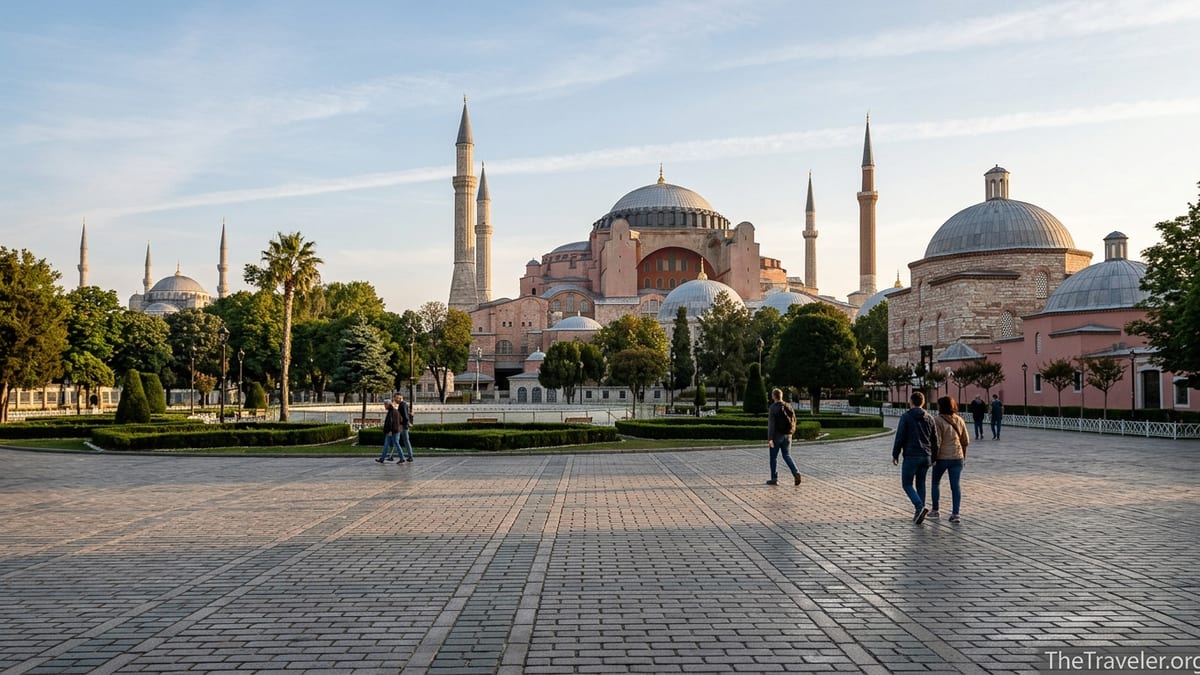
Understanding Hagia Sophia’s Current Visiting System
Before you decide when to visit, it helps to understand how Hagia Sophia works in 2026. Since its reconversion into a mosque, the main prayer hall on the ground floor is primarily reserved for worshippers, while most foreign visitors reach the upper galleries via a dedicated tourist entrance on the northeast side, near the Sultan Ahmed III Fountain and the Topkapi Palace Imperial Gate. This means that instead of dispersing freely across the whole building, sightseeing traffic is funneled along a one-way route up the ramps and around the galleries, which amplifies any peak in arrivals into a heavy crush inside.
Opening hours for visitors in June 2026 are generally 9:00 to around 19:00 or 19:30, with last entry roughly 30 minutes before closing. On Fridays, the visitor route shuts in the middle of the day, typically around 12:30 to 14:30, for congregational prayers, and there are shorter pauses around the five daily prayer times. Visitors are still subject to airport-style security at the square, regardless of whether they hold a standard ticket or a guided-tour voucher, and this queue is separate from any line at the ticket desks or tour meeting points.
Foreign adults currently pay a dedicated visitor fee (widely reported at about 25 euros) to access the upper galleries, with children under 8 usually entering free if you show a passport. This paid section is distinct from the free ground-floor prayer area. In practice, this has created two very different experiences: a busy, time-limited gallery visit for paying tourists, and a simpler, often calmer visit for worshippers using the prayer hall. Your timing strategy should therefore focus on avoiding not only peak tourism demand but also prayer-related closures that compress visitor numbers into fewer usable hours.
Restoration work is another factor. In early 2026, scaffolding and temporary structures occupy part of the central space, and some views from the gallery to the nave are partially obstructed. This does not change the opening hours, but it does make the remaining viewpoints more crowded when large tour groups arrive at once. Choosing your moment well can mean the difference between quietly studying mosaics with space to step back, and shuffling shoulder to shoulder just to glimpse the dome.
Best Time of Day: Hour-by-Hour Crowd Patterns
The simplest way to beat the crowds at Hagia Sophia is to arrive early. Visitor data and on-the-ground guides consistently point to the first hour after opening on a weekday as the sweet spot. In practical terms, this means planning to be at the Sultanahmet tram stop around 8:30 for a 9:00 opening in winter or at 7:45 to 8:00 for an 8:00 opening in the longer-hours summer period. Arriving at the square 15 to 30 minutes before the doors open lets you be among the first through security. Many guided tours start slightly later, around 9:30, which gives you a short but precious window of relative calm inside.
By late morning, usually from about 10:30 to 13:00, crowd levels surge. This is when cruise ship excursions, large coach tours and day-trippers who also want to see the Blue Mosque and the Basilica Cistern all converge. On a busy July day, you might face a 30 to 45 minute wait just to clear security, followed by another queue to enter the gallery route. Inside, it can take several minutes just to move a few meters along the balustrades for a clear photo of the nave. If you are sensitive to crowds or traveling with small children, this is the period you should avoid most aggressively.
Afternoons are more nuanced. Mid-afternoon, roughly 14:30 to 16:30, can still be quite crowded, especially on days when the midday Friday prayer closure pushes visitors into a shorter window. However, the final hour and a half before closing is often calmer. For example, in April or October, arriving around 17:00 for a 19:00 close typically means shorter security queues, fewer big groups and softer, lower-angle light filtering through the windows. Local guides frequently schedule their premium small-group tours around 17:00 to 18:00 for precisely this reason.
One practical scenario: if you are staying near Taksim and planning to combine Hagia Sophia with a Bosphorus cruise, take the tram or metro down early, aim to be in the visitor queue by opening time, spend 60 to 90 minutes inside, then walk across Sultanahmet Square for a relaxed tea or simit break. From there, you can head to Eminönü for a midday boat trip once the heat and crowds in the old city are at their peak, rather than trying to squeeze Hagia Sophia into the worst late-morning window.
Best Months and Seasons: When Istanbul Itself Is Quietest
Crowd levels at Hagia Sophia do not only depend on the time of day. They also reflect Istanbul’s broader tourist calendar, which peaks in European and Middle Eastern school holidays. In 2026, late June through August remains the busiest stretch, combining high international tourism with domestic visitors and hot, often humid weather that makes outdoor queuing in Sultanahmet Square feel punishing. If you visit in July, even an 8:15 arrival for an 8:00 opening can mean joining a substantial line of early birds and organized tour groups.
By contrast, the shoulder seasons of April to May and September to early November typically offer the best balance of manageable crowds, pleasant temperatures and long enough daylight to combine Hagia Sophia with other historic sites. For example, visiting in mid-April, you might find tulips blooming across Sultanahmet Park and daytime highs around the high teens Celsius. On a Tuesday morning in this period, arriving at opening time often means a 10 to 15 minute security queue, followed by space on the gallery railings to take photographs without constant jostling.
Winter brings shorter days and cooler, sometimes rainy weather, but it also brings fewer tour buses. January and February midweek mornings can feel comparatively calm inside Hagia Sophia, although there is always a baseline level of visitors. If you are willing to wear a warm coat and possibly queue in drizzle, you may find that even a 10:00 arrival on a Monday in late January gives you an easier experience than 9:00 in high summer. One trade-off is the risk of slippery pavements in the square and a generally grayer light for photography.
Religious holidays and major events require special attention. During Ramadan and the Eid holidays, the old city and its mosques attract larger numbers of local worshippers and domestic tourists, which can increase both prayer-related closures and general crowd levels. Similarly, when major cruise ships are in port on specific days, you can feel the impact in Sultanahmet starting mid-morning as hundreds of passengers arrive on synchronized buses. If your travel dates are flexible, checking cruise schedules to avoid multiple large-ship days or choosing a week outside major public holiday windows can make a noticeable difference.
Weekdays vs Weekends and How Fridays Change Everything
On almost any week of the year, Tuesday, Wednesday and Thursday mornings are the calmest time slots at Hagia Sophia. Mondays can be busy because other nearby attractions such as some museum sections may be closed, pushing visitors to focus on open sites, while weekends draw more domestic tourists and regional day-trippers. If you only have one full day in Istanbul and want to prioritize a less crowded Hagia Sophia experience, anchor your schedule around a Tuesday or Wednesday morning arrival.
Fridays deserve special planning. Because Hagia Sophia functions as an active mosque, the main weekly congregational prayer takes place early afternoon, and the upper-gallery visitor route usually closes around 12:30 and reopens around 14:30. Non-Muslim visitors cannot simply stay inside through this period. What happens in practice is that many people either rush to arrive before 11:00 in the hope of “beating” the closure or they stack up in the square waiting for the doors to reopen at about 14:30. Both patterns create pronounced spikes in the queues.
If a Friday visit is unavoidable, the most effective approach is either to go very early or much later. Try to be at the site right at opening and plan to be finished and back out in Sultanahmet Square by about 11:15 at the latest. Alternatively, plan your day so you are elsewhere during the closure, for example exploring the Grand Bazaar or enjoying a long lunch in the Spice Market area, then return to Hagia Sophia after 16:00 when the initial reopening rush has thinned out. Many recent visitors report that arriving around 17:00 on a Friday, once prayer crowds have dispersed, offers shorter waits than attempting to push in immediately after 14:30.
Weekends follow their own rhythm. Saturday is often the single busiest day of the week, favored by domestic families and short-break city visitors. Sunday mornings can be surprisingly calm up to around 10:00, especially outside the summer peak, as many people sleep in or linger over breakfast. If your Istanbul trip falls on a tight Friday to Sunday window, the optimal plan is usually to hit Hagia Sophia at opening time on Sunday, then see the Blue Mosque and Basilica Cistern afterwards, rather than fighting Friday closures and Saturday’s heaviest traffic.
Practical Crowd-Avoidance Strategies on the Ground
Timing is crucial, but how you organize your arrival at Hagia Sophia also matters. Security is mandatory for everyone, and on busy days this first bottleneck can swallow 30 minutes or more. Aim to travel light: leave large backpacks at your hotel, keep metal items to a minimum, and carry only essentials like your passport, wallet, phone and a light scarf. Visitors who have to undergo bag checks or repeat scans can hold up the line behind them, while those who breeze through with small crossbody bags or money belts help keep the queue moving efficiently.
Buying your gallery ticket in advance or joining a reputable guided tour with a pre-booked time slot can help but does not magic away security delays. A common pattern works like this: you book an 8:30 guided group tour starting near the Sultan Ahmed III Fountain. You arrive at 8:15, clear security before most day-trippers, and then the guide organizes the ticketing for the group at the dedicated desks, avoiding the second queue. This strategy can turn what might have been a 45-minute independent wait at 10:00 into a smooth, 10-minute pre-opening arrival experience.
The layout of the square also influences your experience. Many first-time visitors instinctively stop and take photographs from the middle of Sultanahmet Park as soon as Hagia Sophia comes into view. If beating the crowds is your priority, resist the urge to linger here. Walk directly toward the northeast corner entrance instead, and save your extended photo session for after your visit, when you can relax on a bench with an ice cream or roasted chestnuts and admire both Hagia Sophia and the Blue Mosque without worrying about missing the quietest hour inside.
Finally, pair your Hagia Sophia visit intelligently with nearby sights. A frequently recommended pattern is to visit Hagia Sophia at opening time, then walk five minutes to the Basilica Cistern when it opens, and leave Topkapi Palace, which requires more hours, for the afternoon or another day. Trying to “do everything” in Sultanahmet in one morning often leaves travelers stuck in back-to-back queues at the hottest and most crowded times of day.
What to Expect Inside at Different Crowd Levels
Understanding how crowd density changes the feel of Hagia Sophia can help set your expectations. In the first hour after opening on a weekday, you might share the galleries with a handful of small tour groups and independent travelers. You can pause in front of the Deesis mosaic, step back far enough to see the gold tesserae shimmer and hear the faint echo of footsteps rather than a wall of noise. This is the moment when photographers can shoot handheld at slower shutter speeds without constant bumping from behind.
By midday on a busy summer Saturday, the same spots can feel radically different. Expect shoulder-to-shoulder clusters near the most famous mosaics, selfie sticks poking into your peripheral vision and a constant low roar of voices that blurs any individual commentary from guides. Moving between vantage points can be slow as you wait for bottlenecks to clear on narrow sections of the gallery. Families with strollers may find it difficult to maneuver, and anyone nervous in crowds may feel overwhelmed. These conditions are not dangerous but can be exhausting, especially in warm weather when the galleries feel stuffy.
Late afternoon typically offers a middle ground. On a Tuesday in October around 17:30, for example, you might still share space with tour groups, but there will be enough gaps between them to step up to the balustrade, watch the late sun striping the floor far below and take in the interplay between Quranic calligraphy and Byzantine architecture without constant jostling. If you plan to stay until closing, you may even find that in the final 20 minutes the space begins to thin out noticeably as groups leave to catch buses and dinner reservations.
Photography conditions also shift with the time of day. Early morning light can be soft but relatively dim, especially in winter, which suits atmospheric images but requires a steady hand or image stabilization. Midday light is stronger but can create harsh contrast near windows and skylights, while late afternoon offers warm tones that flatter both interior and exterior shots. If your priority is capturing a detailed panorama of the dome from the upper gallery, aim for a bright but not fully overhead sun, which you are more likely to get in the mid- to late-morning shoulder-season slots.
The Takeaway
There is no truly quiet time at Hagia Sophia, but there are many bad times that can be avoided with careful planning. In 2026, the most crowd-smart pattern is clear: visit on a weekday, ideally Tuesday to Thursday, arrive at or just before opening, target the shoulder seasons of April to May or September to October, and avoid the late-morning and early-afternoon window, especially on Fridays and Saturdays.
Build your day around this anchor. If you are in Istanbul for three days, make Hagia Sophia your very first major stop on your first morning; this not only gives you the best chance of a calm visit but also ensures that unexpected closures or long queues do not derail the rest of your plans. Combine your early entry with light luggage, pre-arranged tickets or tours and a willingness to postpone leisurely photography in Sultanahmet Square until after you have cleared security.
Above all, remember that Hagia Sophia is both a global monument and a living place of worship. Being flexible with your timing, respectful of prayer schedules and patient with fellow visitors will make your experience far richer than simply ticking a box on a sightseeing list. With the right timing, you will be able to stand beneath the great dome, look down over centuries of history and feel the scale of the building without losing that sense of wonder in the crowd.
FAQ
Q1. What is the best time of day to visit Hagia Sophia to avoid crowds?
The quietest time is usually the first hour after opening on a weekday. Aim to arrive 15 to 30 minutes before doors open so you clear security with the first wave, before large tour groups and day-trippers arrive.
Q2. Which months are best for visiting Hagia Sophia with fewer crowds?
Shoulder seasons like April to May and September to early November generally offer the best balance of manageable crowds and pleasant weather. Winter months can be even quieter but bring shorter days and more rain.
Q3. How should I plan around Friday prayers at Hagia Sophia?
On Fridays, the visitor route usually closes around midday for congregational prayers. Either visit right at opening and finish by late morning, or come later in the afternoon after about 16:00 when the reopening rush has eased.
Q4. Are weekends much busier than weekdays?
Yes. Saturdays are typically the busiest, with a mix of international tourists and local visitors. If you must go on a weekend, try early Sunday morning at opening time, which is often calmer than Saturday at any hour.
Q5. Does buying a guided tour or skip-the-line ticket mean no waiting?
Not entirely. Everyone must pass through security, which can create lines even for tour groups. A good guided tour can reduce or eliminate ticket-desk queues and organize your timing well, but it cannot bypass the main security screening.
Q6. How long should I allow for a visit if I want to avoid feeling rushed?
Most visitors spend 45 to 90 minutes inside. If you enjoy history, architecture or photography, plan for around 90 minutes, plus extra time for security and a short break afterwards in Sultanahmet Square.
Q7. Is it worth visiting during the busiest summer months?
Yes, but you need to be strategic. In June to August, aim for the very first hour of the day or the last 60 to 90 minutes before closing. Avoid the 10:30 to 15:30 window when queues and interior congestion peak.
Q8. Can I visit Hagia Sophia during prayer times?
Visitor access to the galleries pauses during the main congregational prayer on Fridays and briefly around daily prayers. Worshippers may enter the prayer hall, but sightseeing is restricted. Check prayer schedules locally and plan your visit outside those windows.
Q9. How does ongoing restoration work affect the visit and crowding?
Current restoration scaffolding and temporary structures can partially block some views from the galleries, which in turn concentrates visitors at remaining viewpoints. This makes quiet times of day even more valuable for enjoying the mosaics and architecture.
Q10. What are some practical tips to move through more quickly when it is busy?
Travel light to speed security checks, arrive a little before opening, head straight to the northeast entrance rather than lingering in the square, and consider a reputable small-group tour with pre-arranged tickets. Pair Hagia Sophia with nearby sights in a way that keeps you out of the square during the hottest, busiest midday hours.