


Few buildings in the world are as instantly recognisable as Hagia Sophia. On Istanbul itineraries it usually sits at the very top of the list, yet first-time visitors are often unsure exactly where it is or what the most efficient route is from their hotel. This practical guide explains Hagia Sophia’s location in the city and walks you through clear, real-world routes from the main areas where travellers stay.
Get the latest updates straight to your inbox!
Where Exactly Is Hagia Sophia in Istanbul?
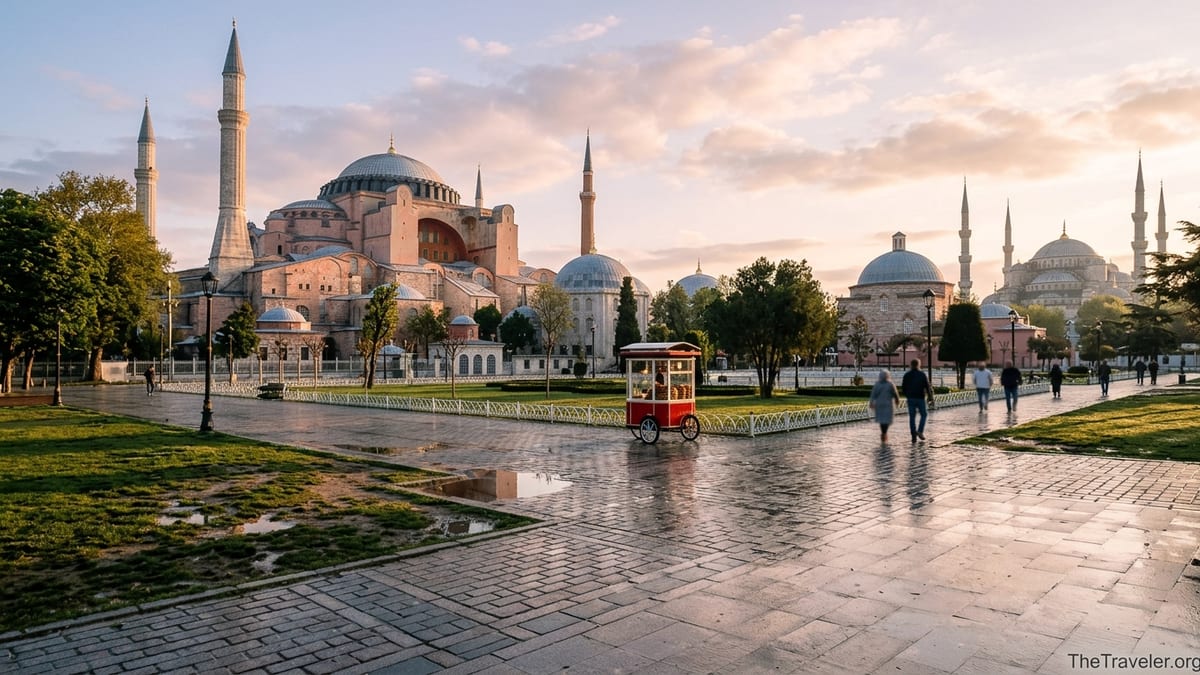
Hagia Sophia stands in the historic heart of Istanbul, in the Sultanahmet district of the Fatih municipality on the European side of the city. It sits on a hill overlooking the Bosphorus and the Sea of Marmara, in the same open square as the Blue Mosque and within walking distance of Topkapı Palace and the Basilica Cistern. When you see photos of two monumental domed silhouettes facing each other across a park and fountain, Hagia Sophia is the reddish, massive dome on one side of that square.
The mosque anchors Sultanahmet Square, a largely pedestrian area paved with stone, lined with benches and chestnut vendors, and busy from early morning until late evening. Around it you will find dozens of small hotels, rooftop restaurants with views over the Bosphorus, and kiosk stands selling freshly squeezed pomegranate juice. If your hotel advertises itself as “steps from Hagia Sophia,” it is almost always somewhere in these few surrounding streets.
Public transport maps list the monument under several names, including “Ayasofya” and “Ayasofya-i Kebir Cami-i Şerifi.” The nearest tram stop is called Sultanahmet on tram line T1. From this stop you walk for about three minutes through the square; the Blue Mosque will be ahead of you, and Hagia Sophia is on your left. Even without a map, the domes and minarets are an easy landmark to follow.
Because Hagia Sophia is in the old city, the surrounding streets are narrow and often jammed with traffic. It is almost always faster for visitors to arrive by tram, metro and ferry, or on foot for the last stretch, rather than relying entirely on taxis for the approach into Sultanahmet.
Understanding Istanbul Transport to Reach Hagia Sophia
To reach Hagia Sophia smoothly it helps to understand the basic structure of Istanbul’s public transport. The system is integrated, so you can move between the modern metro lines, the T1 tram, public ferries across the Bosphorus, buses and funiculars using a single reloadable card known as the Istanbulkart. You tap in at turnstiles or on bus and ferry readers, and the correct fare is deducted automatically.
As of mid 2026, a standard ride on the tram or metro with an Istanbulkart costs the equivalent of just a few US dollars, and even less for discounted local cards. Most visitors find that loading an initial balance of around 200 to 300 Turkish lira is enough for several days of normal sightseeing, especially if you mostly shuttle between central areas such as Taksim, Sultanahmet, Karaköy and Kadıköy. You can top up at yellow or blue machines in metro and tram stations and major ferry piers using cash or bank cards.
The T1 tram line is the key route for reaching Hagia Sophia. It runs in a U-shaped arc along the historic peninsula and the waterfront, connecting Bağcılar in the west with Kabataş near the modern city center. Along the way it stops at tourist landmarks such as the Grand Bazaar (Beyazıt stop), the Spice Bazaar and ferry docks (Eminönü stop), the lower station of the historic Tünel (Karaköy stop), and finally the interchange at Kabataş, where you can change to the F1 funicular up to Taksim Square. For Hagia Sophia, the stop you are aiming for is always Sultanahmet.
Ferries play an equally important role, especially if you are staying on the Asian side of the city. From Kadıköy or Üsküdar, frequent public ferries cross to Eminönü, Karaköy and Kabataş. The ride usually takes between 15 and 25 minutes, and it is both an everyday commuter service and a scenic mini-cruise, with views of the Topkapı Palace and Hagia Sophia skyline as you approach the old city.
Getting to Hagia Sophia From Sultanahmet and Nearby Old City Areas
If you are already staying in Sultanahmet, the answer to “how do I get to Hagia Sophia?” is simply “walk.” Typical small hotels cluster in lanes with names like Akbıyık, Kutlugün or Tevkifhane, often 5 to 10 minutes away on foot. In practice this means leaving your hotel after breakfast, strolling past carpet shops and simit (sesame bagel) vendors, and seeing Hagia Sophia appear ahead between buildings as you approach the square.
From the Grand Bazaar area around Beyazıt, you can either walk or ride one stop on the T1 tram. Walking takes roughly 15 to 20 minutes, slightly downhill through the historic streets of the old city. Many visitors prefer to walk this route after shopping, descending past bookshops and spice stalls until they arrive in Sultanahmet Square. If your legs are tired or you are carrying purchases, taking the tram from Beyazıt to Sultanahmet makes sense and uses the same Istanbulkart you would use elsewhere.
From the Spice Bazaar and the Egyptian Bazaar area at Eminönü, Hagia Sophia is again within walking distance. The route is a pleasant 15-minute walk: you cross the busy square in front of the ferries, continue straight up the gentle hill past street food stands and souvenir shops, and soon see the minarets of both Hagia Sophia and the Blue Mosque. Alternatively you can take the T1 tram from Eminönü to Sultanahmet, a journey of a few minutes, which is useful on hot or rainy days.
If you are in Sirkeci, the historic railway area between Eminönü and Sultanahmet, the walk is even shorter. Many mid-range hotels line the narrow streets here. From Sirkeci station or the T1 stop, you simply follow the tram tracks toward Sultanahmet, then cut through the park to reach Hagia Sophia in around 10 minutes.
How to Reach Hagia Sophia From Taksim, Karaköy and Galata
One of the most common questions is how to get from Taksim Square, where many modern hotels are located, to Hagia Sophia. The simplest route uses the F1 funicular and the T1 tram. From the center of Taksim Square, follow signs for the funicular down to Kabataş. The ride takes about 3 minutes and is included in the standard Istanbulkart fare. At Kabataş you exit the funicular, walk a short distance to the T1 tram platform, and take a tram in the direction of Bağcılar. After about seven stops and roughly 15 minutes, you get off at Sultanahmet. Total travel time from Taksim to Hagia Sophia is usually 25 to 30 minutes, depending on waits for the tram.
Travelers staying near İstiklal Street or Galata Tower often walk downhill to Karaköy and then join the T1 tram there. From Galata Tower you can expect about a 10- to 15-minute walk down steep cobbled streets toward the waterfront. At Karaköy tram stop, board any T1 tram heading toward Bağcılar and ride for about 10 minutes to Sultanahmet. An alternative is to take the historic Tünel funicular from near Galata Tower down to Karaköy, then switch to the tram, which reduces the walking.
Another option from Beyoğlu and Taksim is to walk across the Galata Bridge and continue on foot to Sultanahmet. This is particularly enjoyable in good weather. From Karaköy, you cross the bridge alongside fishermen, pass the New Mosque and Spice Bazaar at Eminönü, and then continue uphill toward the Hippodrome and Hagia Sophia. The full walk from Taksim via İstiklal, across the bridge and up to Hagia Sophia can take 45 to 60 minutes, and many visitors combine it with coffee stops in Karaköy or by the waterfront.
Taxis are widely available in Taksim, Karaköy and the Galata Port cruise terminal, and a direct ride to Sultanahmet usually takes 15 to 25 minutes outside peak hours. However, traffic near the old city can be heavy, and taxis cannot drive directly into the pedestrianised core of the square, so you will typically be dropped a short walk away. For cost and predictability, most experienced visitors still prefer the funicular plus tram combination.
Reaching Hagia Sophia From Kadıköy, Üsküdar and the Asian Side
If your hotel is in Kadıköy or Moda on the Asian side, your journey to Hagia Sophia almost always begins with a ferry ride. From Kadıköy’s busy ferry terminal, look for city-operated ferries heading to Eminönü or Karaköy. Services are frequent throughout the day, with crossings typically taking around 20 to 25 minutes. You tap in with your Istanbulkart at the pier, find a seat on the open deck if the weather allows, and enjoy views of the Princes’ Islands and Istanbul’s skyline.
On arrival at Eminönü from Kadıköy, getting to Hagia Sophia is straightforward. You exit the ferry, follow the crowd across the square and either walk uphill for about 15 minutes or take the T1 tram one stop to Sultanahmet. Many travelers choose to walk on the way there, stopping to photograph the skyline, and then ride the tram back down when they are tired in the afternoon.
From Üsküdar, which sits directly opposite the historic peninsula, ferries to Eminönü and Karaköy are even shorter, often in the 10- to 15-minute range. Once you disembark in Eminönü, the onward route is identical: walk or take the tram to Sultanahmet. Ferries also run from Üsküdar to Beşiktaş and Kabataş, which can be useful if you plan to combine a visit to Hagia Sophia with time in Taksim or Dolmabahçe Palace on the same day.
Some visitors staying farther out on the Asian side, for example along the M4 metro line between Kadıköy and Sabiha Gökçen Airport, ride the metro into Kadıköy and then continue by ferry and tram as described. Although it adds a transfer, the combination of modern metro, scenic ferry and short tram ride gives a reliable and relatively quick route straight into the old city without worrying about traffic on the Bosphorus bridges.
From Beşiktaş, Şişli and Other Modern Neighbourhoods
Staying in Beşiktaş, Şişli or around modern shopping districts like Nişantaşı and Mecidiyeköy can be very convenient for everyday Istanbul life, and Hagia Sophia is still easy to reach with only one or two transfers. From Beşiktaş, a common route is to walk or take a short bus or taxi ride down to Kabataş. This waterfront area is just below Dolmabahçe Palace and serves as a hub where ferries, the F1 funicular from Taksim and the T1 tram all meet. Once at Kabataş, you simply board the T1 tram toward Bağcılar and ride to Sultanahmet.
From Şişli or Mecidiyeköy, the backbone line is the M2 metro, which runs toward the old city. You can take the M2 to either Taksim or Yenikapı. If you get off at Taksim, follow the funicular connection down to Kabataş and then the T1 tram to Sultanahmet. If you travel all the way to Yenikapı, you can choose between taking another short leg on public transport, such as the Marmaray commuter train to Sirkeci, followed by a tram, or simply using a taxi for the final short hop into Sultanahmet.
Many locals who live in areas like Nişantaşı and Osmanbey combine metro and tram. For example, you take the M2 from Osmanbey station to Vezneciler or Haliç, then switch to a short taxi ride or walk through the old city streets toward the Grand Bazaar and Sultanahmet. Travel times vary with connections, but in normal conditions you can expect to be in front of Hagia Sophia roughly 30 to 40 minutes after stepping into a metro carriage in Şişli.
While you can travel door to door by taxi from these modern districts, drivers will usually turn off the meter while stuck in heavy traffic, or you may experience slower progress once you cross into Fatih. It is often quicker to use the metro to bypass congested sections and only rely on taxis for the very last segment, especially at rush hour.
Getting to Hagia Sophia From Istanbul Airports and the Cruise Port
Many visitors hope to go directly from the airport to Hagia Sophia or at least to their hotel nearby. Istanbul has two main airports. Istanbul Airport (IST) lies northwest of the city on the European side, while Sabiha Gökçen Airport (SAW) is on the Asian side. Both are connected to the city by public buses, airport shuttles and metro lines, and both integrate with the transport routes that lead to Sultanahmet.
From Istanbul Airport, one common approach for budget-conscious travelers is to use the M11 metro toward the city and then transfer to other lines, such as the M2 and T1, depending on where they are staying. For example, you might ride the M11 to Kağıthane, change to the M7 or bus toward Şişli or Beşiktaş, then connect onto the M2 metro and finally the funicular and tram to Sultanahmet. This sequence involves several transfers and some walking inside stations, but it keeps costs low and avoids traffic.
Alternatively, many visitors from Istanbul Airport use the Havaist airport shuttle buses to Taksim or Sultanahmet. The Taksim service drops you in the square, where you can switch to the funicular and tram combination described earlier. The dedicated Havaist service to Sultanahmet, when operating, brings you within a short walk of Hagia Sophia itself, although journey times can vary from 60 to 90 minutes depending on traffic on the ring roads.
From Sabiha Gökçen Airport, a typical public transport route into the historic center involves the airport buses or city buses to Kadıköy, followed by a ferry to Eminönü or Karaköy and then the T1 tram. For example, you might board an airport coach at SAW, ride for 45 to 60 minutes into Kadıköy, walk a few minutes to the ferry, cross to Eminönü and then ride one stop on the tram to Sultanahmet. While this sounds like multiple steps, each part is straightforward and uses the same Istanbulkart, and you get a first glimpse of the city from the water.
If you arrive in Istanbul by cruise ship at Galataport, reaching Hagia Sophia is very simple. The port sits between Tophane and Karaköy tram stops. After disembarking, you can walk out of the terminal to the main road, access the T1 tram at either stop, and ride in the direction of Bağcılar until Sultanahmet. Depending on walking speed and waiting time, most cruise passengers find themselves in Sultanahmet Square within 20 to 30 minutes of leaving the ship.
Practical Tips, Journey Times and Common Mistakes
Most public transport journeys to Hagia Sophia from central districts fit into a 20- to 40-minute window. From Taksim, the funicular plus tram route often takes about 25 minutes once you are on the platforms. From Kadıköy, the ferry plus walk or tram adds up to around 40 minutes. From Beşiktaş, a short transfer to Kabataş and then the tram brings you to Sultanahmet within about half an hour. These times can lengthen slightly at rush hour, primarily because trams and ferries are more crowded, but the routes themselves remain reliable.
One of the most useful tips for visitors is to get an Istanbulkart as soon as they encounter a metro, tram or ferry station. At Istanbul Airport and Sabiha Gökçen, vending machines are usually located near exits for the metro or shuttle buses. In the city, machines are easy to find at busy stops like Taksim, Kabataş, Karaköy, Eminönü and Sultanahmet. The interface is available in English, and you can buy a new card, check your balance and top up in a few taps.
Common mistakes include relying entirely on taxis for trips that would be simpler on the tram or ferry, underestimating walking distances in hilly areas like Galata, and assuming that all metro lines go everywhere. In particular, there is currently no underground metro station directly at Hagia Sophia itself; the closest rail access is the T1 tram at Sultanahmet. If your hotel has advised you to “take the metro to Hagia Sophia,” they almost always mean the tram line T1, sometimes with an initial leg on the metro followed by a transfer.
Finally, allow extra time when planning your arrival. Hagia Sophia has become one of the most visited religious sites in the world, and security queues, prayer times and occasional renovation works can affect visitor access. Aim to arrive in Sultanahmet at least 20 to 30 minutes earlier than the time you hope to enter the building, especially in high season or on weekends, so that your carefully planned journey across Istanbul does not feel rushed at the final step.
FAQ
Q1. Where is Hagia Sophia located within Istanbul?
Hagia Sophia is in the Sultanahmet district of the Fatih municipality on the European side, overlooking the Bosphorus and sharing a central square with the Blue Mosque.
Q2. Which tram stop is best for visiting Hagia Sophia?
The closest stop is Sultanahmet on the T1 tram line. From there it is about a three-minute walk through the square to the main visitor entrance.
Q3. How do I get to Hagia Sophia from Taksim Square?
From Taksim, take the F1 funicular down to Kabataş, then change to the T1 tram toward Bağcılar and get off at Sultanahmet. The total journey usually takes about 25 to 30 minutes.
Q4. What is the easiest route from Kadıköy on the Asian side?
From Kadıköy, take a public ferry to Eminönü, walk uphill for about 15 minutes or ride the T1 tram one stop to Sultanahmet, then follow signs to Hagia Sophia.
Q5. Can I walk to Hagia Sophia from the Grand Bazaar or Spice Bazaar?
Yes. From the Grand Bazaar area it is about a 15- to 20-minute walk downhill. From the Spice Bazaar at Eminönü, the walk is around 15 minutes uphill toward Sultanahmet Square.
Q6. Is there a metro station directly at Hagia Sophia?
No. The closest rail access is the T1 tram at Sultanahmet. You can use metro lines like M2 to reach interchange points such as Kabataş or Vezneciler, then walk or switch to the tram.
Q7. How do I use an Istanbulkart to reach Hagia Sophia?
Buy an Istanbulkart from machines at metro, tram or ferry stations, load credit, then tap in at turnstiles or on ferry and bus readers. You can use the same card for all legs of your journey to Sultanahmet.
Q8. What is the approximate taxi time from Taksim or Beşiktaş to Hagia Sophia?
Outside peak traffic, taxis from Taksim or Beşiktaş usually take 15 to 25 minutes. At busy times it can be longer, which is why many visitors prefer the tram and funicular.
Q9. How can I get to Hagia Sophia from Istanbul Airport or Sabiha Gökçen?
From Istanbul Airport, use the metro or Havaist shuttles to reach Taksim or Sultanahmet, then continue on foot or by tram. From Sabiha Gökçen, buses or shuttles to Kadıköy plus a ferry to Eminönü and the T1 tram offer a reliable route.
Q10. Is it safe and practical to visit Hagia Sophia using public transport at night?
Public transport on the main lines and ferries is generally busy and feels safe into the evening. Trams and metros run until late, but it is wise to check the last departure times for your line and avoid very empty carriages when possible.