


Few travel decisions spark as much debate along the Bay of Naples as this one: if you have limited time, should you visit Herculaneum or Pompeii? Both ancient Roman cities were destroyed in the eruption of Mount Vesuvius in AD 79. Today, each offers a very different kind of encounter with that catastrophe. One overwhelms with sheer scale, the other with eerie intimacy. Choosing between them is less about which is “better” and more about which experience will stay with you long after you fly home.
Get the latest updates straight to your inbox!
Two Cities, One Catastrophe: How Their Stories Diverge
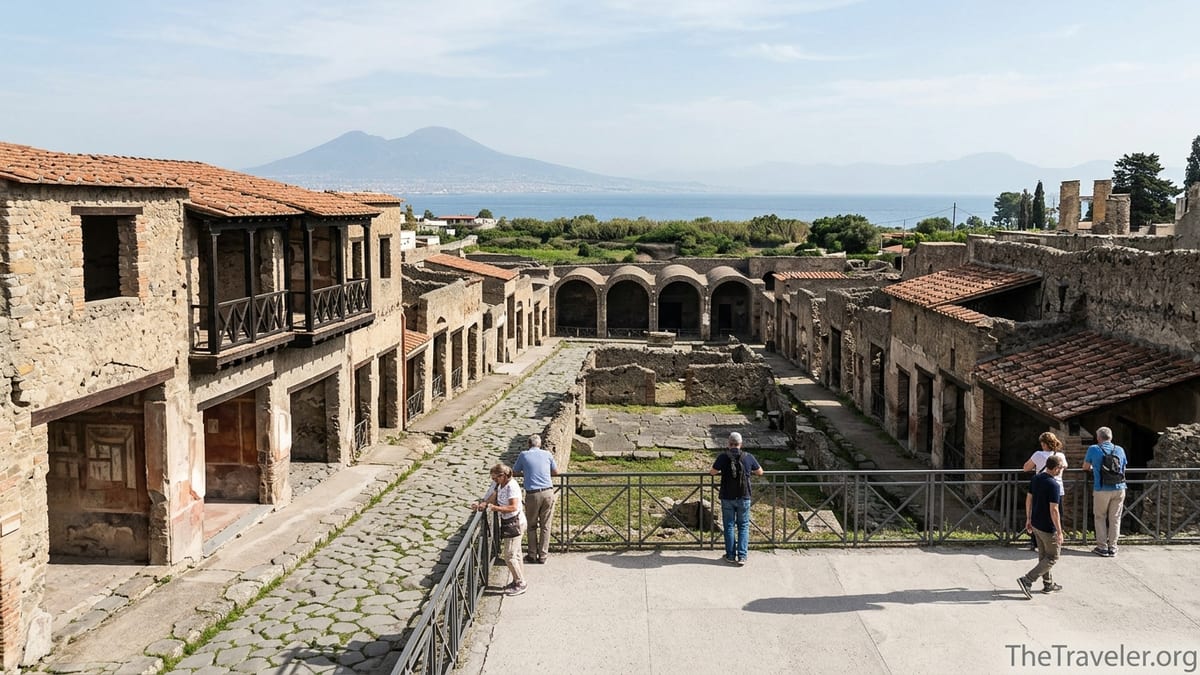
Standing on the main street of Pompeii, with Vesuvius rising at the end of the vista, you feel the size and importance of what was once a regional hub. This was a thriving commercial city, with a forum, amphitheater, theaters, bath complexes and long rows of workshops. Several square kilometers have been excavated, and you can easily walk for 20 minutes without doubling back. The result is an almost cinematic sense of a Roman city frozen mid-morning.
Herculaneum, by contrast, was smaller and wealthier, more of a seaside resort and residential town than a major trading center. The excavated area is compact, roughly a tenth of Pompeii’s, and sunken in a bowl below the modern town of Ercolano. When you first look down from the rim at the grid of streets, terracotta roofs and intact upper floors, the impression is not of ruins, but of a neighborhood waiting for its residents to return from lunch.
The difference comes down to how Vesuvius killed each city. Pompeii was buried mainly under ash and pumice that collapsed roofs but left street plans and masonry exposed to centuries of weather. Herculaneum was overwhelmed later by scorching pyroclastic surges that buried it under around 20 meters of hardened material, carbonizing wood, food and furniture instead of letting it rot. That contrast shapes everything you see on the ground: Pompeii conveys breadth and bustle, Herculaneum delivers detail and atmosphere.
For travelers, this means Pompeii tends to impress as an “entire Roman city you can walk through,” while Herculaneum feels like stepping over the threshold into individual Roman homes. If your imagination is fired by city planning, politics and public spectacle, Pompeii often wins. If you are drawn to daily life, interiors and human stories, Herculaneum can hit harder.
Atmosphere on the Ground: Scale vs Intimacy
The first visceral difference you will notice is scale. A typical visitor spends at least four to six hours in Pompeii and still leaves with streets unexplored. You might start at Porta Marina near the Pompei Scavi train stop, tour the forum with its temples, walk to the amphitheater at the far end of town, then detour through the Lupanar, bakeries and famous houses such as the House of the Faun or House of the Vettii. Even with a map or app, it feels like wandering a real city, complete with shortcuts, dead ends and neighborhood shifts from wealthy villas to modest bars.
In Herculaneum, the entire excavated site can be covered in two to three hours at a measured pace. You descend a ramp, walk under a bridge that used to span the ancient shoreline, and find yourself almost immediately in front of lavish townhouses with painted façades. Within minutes you might step into the House of the Deer with its seaside terrace, then cross to a wine shop where storage jars are still embedded in the counter. You never feel far from where you started, and it is easy to loop back to a room that caught your eye.
Crowd dynamics contribute heavily to the emotional impact. Pompeii attracts millions of visitors a year, and in peak season its main arteries can feel like a Roman theme park. It is not unusual to stand in a line outside the brothel, wait your turn to photograph plaster casts of victims, or share the forum with multiple tour groups holding colored flags aloft. Step just a few streets away and you can find quiet corners, but first impressions are of a bustling attraction.
Herculaneum, by comparison, receives a fraction of those numbers. On a typical midweek morning in May, you might share an entire insula with only a handful of other visitors. Guides speak in low voices, and you can often sit alone on a stone bench, looking at carbonized beams and imagining the seaside view that once lay beyond. That quiet can make the place feel more like a site of mourning than a tourist stop, which many visitors find more haunting than Pompeii’s grandeur.
What You Actually See: Preservation and Detail
Pompeii’s visual power lies in its streetscapes and public buildings. You can walk the same basalt paving stones that carts once rattled across, stepping carefully over raised pedestrian crossings designed to keep feet out of the water that ran down the road. At the bakery of Popidius Priscus, millstones stand ready, and in taverns you see marble counters with deep holes where amphorae of wine or stew were sunk. Election slogans and obscene graffiti still coat the walls of some streets, reminding you that ancient Romans argued and joked in public just as modern people do.
Yet when it comes to intact interiors, Herculaneum often surpasses its better-known neighbor. The pyroclastic flows preserved upper floors, balconies and even wooden staircases in situ. In several houses you can look up to see beams spanning ceilings, or out to wooden shutters that still hang in their frames. In one building, delicate wooden screens divide rooms; in another, carbonized wooden shelving still lines the walls of what might have been a shop or storeroom. Jars, furniture fragments and even carbonized loaves of bread have been found here, giving a tangible sense of life interrupted.
The frescoes and mosaics tell a similar story. Pompeii offers extraordinary wall paintings, especially in the House of the Vettii and the Villa of the Mysteries just beyond the northern gate, but many of its most important pieces have been removed to the National Archaeological Museum in Naples. What remains on site is still impressive, yet often weathered or fragmentary. In Herculaneum, frescoes in houses such as the House of the Relief of Telephus remain surprisingly vivid inside rooms that still feel enclosed, their colors protected by the deep burial.
Then there is the Villa of the Papyri, Herculaneum’s legendary coastal mansion, only partially excavated beneath the modern town. It produced the only intact library from the ancient world, hundreds of papyrus scrolls now housed in Naples. Visitors cannot yet explore the villa in full, but its sculptures and the idea of an elite intellectual retreat add to Herculaneum’s aura of refinement and mystery. For many historically minded travelers, that combination of physical preservation and scholarly intrigue gives Herculaneum an edge.
Experiencing Human Tragedy: Emotion and Memory
Pompeii is famous for the plaster casts of victims whose bodies left voids in the ash. These casts, some shown curled on the ground or shielding children, are among the most photographed images at the site. Seeing them in person is undeniably moving, especially when you realize that the people died from collapsing roofs, falling debris or suffocation as the ash thickened. However, the casts are dispersed, and the open-air setting sometimes dilutes the intensity; a crowd with smartphones can quickly turn a moment of reflection into a spectacle.
Herculaneum’s most shocking encounter comes at the ancient waterfront. When excavations reached what used to be the beach, archaeologists discovered the skeletons of hundreds of people sheltering in vaulted boat houses, huddled in desperate groups. Today, many of those skeletons remain in situ. As you peer into the dark arches, skulls and ribcages lie only a few meters away behind a barrier, their positions still echoing the panic of that final surge. The proximity is startling, and many visitors report this as the single most searing memory of their trip.
The physical layout amplifies that impact. In Herculaneum you walk down from the modern town to the level of the ancient shore, seeing clearly how far the coastline has shifted since AD 79. The modern sea lies hundreds of meters away, with a mass of solidified volcanic material in between. That distance, combined with the skeletons, makes the eruption feel not like a distant historical event but a geological force you can still trace with your eyes.
Emotionally, travelers often describe Pompeii as “fascinating” and “mind-blowing,” words that speak to admiration for its scale and urban complexity. Herculaneum more frequently earns terms such as “haunting” or “unsettling.” If what leaves a bigger impression for you is intellectual wonder, you may find Pompeii’s cityscape unbeatable. If you are most moved by intimate reminders of individual lives, Herculaneum’s boat houses and preserved homes can be unforgettable.
Practicalities: Time, Tickets and Crowds
From a logistics standpoint, both sites are relatively straightforward as day trips from Naples or Sorrento. The Circumvesuviana commuter rail line serves Pompei Scavi for Pompeii and Ercolano Scavi for Herculaneum, with journeys from central Naples taking roughly 30 to 40 minutes to Pompeii and around 20 to 25 minutes to Herculaneum. Trains are frequent but can be crowded, and they function more like a local metro than a reserved intercity service, which surprises some first-time visitors.
As of the 2026 season, a standard adult ticket to Pompeii is around 18 to 20 euros, while Herculaneum is slightly cheaper at roughly 16 euros for full-price entry. Combined tickets and regional passes change periodically, but it is common to find a two-day or three-day option that includes multiple Vesuvian sites at a modest discount compared with buying separate tickets plus local transport. For example, visitors planning to see both sites and at least one Naples museum often find that a multi-day regional card or the official combined park ticket is better value than piecing together individual admissions and train fares.
In terms of time, most travelers should allocate a full day to Pompeii alone if they want to see major highlights without rushing. That means four to six hours inside the site plus breaks for water and a simple lunch either at the on-site cafeteria near the forum or just outside one of the gates. By contrast, two to three hours is usually enough to explore Herculaneum in depth, leaving time the same day for the crater of Vesuvius, the MAV virtual museum nearby or a lingering lunch in Ercolano.
Crowds may be the deciding factor if your visit falls in July or August. At peak midday hours, queues at Pompeii’s main entrances can be long, and some houses or narrow lanes may be periodically closed to manage flow. Herculaneum, although not empty, tends to remain manageable even in high season. If you are sensitive to heat and noise, or traveling with young children or older relatives who tire easily, Herculaneum can provide a far more comfortable experience, which in turn makes it easier to absorb what you are seeing.
Which Site Suits Which Traveler?
For many first-time visitors to Italy, Pompeii is a bucket-list icon. If you grew up seeing its streets in textbooks or documentaries, finally walking through the forum, standing in the amphitheater or tracing cart ruts with your fingers can feel like fulfilling a long-held promise. For travelers particularly interested in Roman history, archaeology or urban planning, Pompeii offers an unparalleled chance to experience the layout of a sizeable Roman city, including elite villas, humble bars, workshops and entertainment venues all within a few hours’ walk.
Herculaneum tends to appeal strongly to travelers who value depth over breadth. If the idea of seeing original wooden doors, carbonized furniture and second-story balconies excites you more than ticking off a long highlights list, this is your site. Visitors who have already seen other major Roman ruins, such as the Forum in Rome or Ostia Antica, often report that Herculaneum still surprises them, because its preservation level feels different in kind, not just degree. It can also be ideal for those with only half a day to spare, or anyone worried about the physical demands of covering Pompeii’s vast area in the heat.
Travel style matters as well. Independent travelers who enjoy wandering without a set route may find Pompeii’s maze of streets endlessly absorbing, especially if they bring a detailed map or download an audio guide. In Herculaneum, the smaller area encourages more focused exploration, and many people find a guided tour particularly rewarding, because the guide can point out details like traces of original wooden shelving or subtle paint layers that might otherwise be missed.
If you are traveling with children or companions who are not particularly enthusiastic about ruins, Herculaneum can sometimes be the more successful choice. Its compact size means less walking, more time in shaded interiors and fewer moments of “are we done yet?” A two-hour guided visit in the morning, followed by gelato in the modern town and perhaps a short bus ride up towards Vesuvius, often leaves everyone satisfied rather than exhausted.
Planning a Trip: Choosing One or Fitting in Both
When time and budget allow, many seasoned travelers recommend visiting both sites, ideally on separate days. One practical strategy is to spend a full day in Pompeii, entering as close to opening time as you can, then devote a second morning to Herculaneum before heading to the Naples Archaeological Museum in the afternoon. That museum houses many of the most important frescoes, mosaics and artifacts taken from both cities, including items from the Villa of the Papyri, and seeing them in one place can help you mentally reconstruct what the houses originally looked like.
If you truly must choose only one, your decision should reflect what you want to feel as much as what you want to see. Opt for Pompeii if you want the drama of scale, the thrill of walking a whole Roman city, and the satisfaction of visiting a world-famous UNESCO site you have probably seen in countless books. Choose Herculaneum if you prefer a quieter, more concentrated experience where details of domestic life come through more clearly and the human tragedy feels up close.
Weather and season should also factor into your plans. In the height of summer, with midday temperatures easily climbing above 30 degrees Celsius, spending six hours under a blazing sun in Pompeii’s exposed streets can be punishing. In those conditions, Herculaneum’s shorter walking distances and more frequent shaded interiors may leave the stronger positive memory simply because you are less drained. Conversely, on a cool, bright day in spring or autumn, roaming Pompeii from gate to gate can be a highlight of an Italy itinerary.
Finally, consider your transport and accommodation. If you are staying in Naples and have flexible days, you might assign one weekday to each site, avoiding Sundays and Italian holidays when local visitors swell the numbers. If you are based in Sorrento or along the Amalfi Coast and only have a single spare day, you may find it easier logistically to make a beeline for Pompeii, spend your energy there, and leave Herculaneum for a future trip.
The Takeaway
Herculaneum and Pompeii are not rivals so much as complementary windows into the same cataclysm. Pompeii impresses with the sweep of an entire Roman city laid bare: forums, theaters, streets and neighborhoods that you can traverse at will. Herculaneum lingers in the mind with its preserved interiors, carbonized wood and the stark reality of skeletons at the ancient shoreline. Each offers something the other cannot fully replicate.
If your idea of a memorable visit is standing in a vast amphitheater, looking down a major Roman street toward Vesuvius and feeling the weight of history in your legs after hours of walking, Pompeii will likely leave the bigger impression. If, instead, you imagine yourself peering into a dim room where a wooden bed frame still sits, or contemplating the remains of families caught in a final attempt to flee, Herculaneum may be the site that stays with you for years.
For travelers who can, the most powerful experience is to see both, ideally combined with time in the Naples Archaeological Museum. Taken together, they tell a layered story of wealth and work, everyday life and sudden death, geology and human resilience. But even if you must choose just one, know that either decision is the right one: both cities of Vesuvius have the power to transform your understanding of the ancient world in a single day.
FAQ
Q1. If I only have half a day, should I choose Herculaneum or Pompeii?
If you truly have only half a day, Herculaneum is usually the better choice. Its compact size means you can see most of the excavated area in two to three hours without feeling rushed, and you are less likely to spend precious time simply walking between distant points. Pompeii can be overwhelming in a short visit, and you may leave feeling you have only sampled a small slice of the site.
Q2. Which site is more suitable for visitors sensitive to heat or with limited mobility?
Herculaneum is generally more forgiving. Distances are shorter, there are more shaded interiors and you can take frequent breaks without losing access to key sights. Pompeii involves more walking over uneven stone streets and offers fewer opportunities to rest in the shade, which can be challenging in summer or for anyone with mobility issues.
Q3. Where will I see better-preserved houses and interiors?
Herculaneum usually wins for interiors. Many buildings still have upper floors, wooden beams, doors and even furniture fragments preserved in place, along with vivid wall paintings. Pompeii has excellent houses too, but a lot of its finest frescoes and mosaics have been removed to the museum in Naples, and the remaining ones are more exposed to the elements.
Q4. Which site is more impactful for understanding daily life in a Roman city?
Each helps in a different way. Pompeii shows the full spectrum of urban life, from the forum and amphitheater to bakeries and bars, so it is excellent for grasping the workings of a Roman town. Herculaneum, with its intimate houses and preserved furnishings, brings domestic life into sharper focus. If you can, seeing both gives the most complete picture.
Q5. Is it realistic to visit Pompeii and Herculaneum on the same day?
It is possible but demanding. You would need an early start, efficient use of the Circumvesuviana trains between the two sites, and the discipline to limit each visit to two or three hours. Many travelers find that doing both in one day leaves them tired and overloaded. Splitting them across two days, with time for the Naples Archaeological Museum, usually makes for a richer experience.
Q6. How should I decide if I am traveling with children or older relatives?
For families and older visitors, Herculaneum is often more comfortable. The smaller area means less walking and fewer complaints about fatigue, and the quieter atmosphere makes it easier to keep everyone together. Pompeii can still be rewarding with a good plan, but you will need to be attentive to rest stops, shade and pacing.
Q7. Which site feels more emotionally powerful?
Reactions are personal, but many visitors find Herculaneum more haunting because of the skeletons in the boat houses and the sense of walking through intact homes. Pompeii tends to impress more intellectually and visually with its grand streets and public buildings. Think about whether you are more moved by large-scale ruins or by close-up human stories.
Q8. Are guided tours more important at Pompeii or Herculaneum?
Guided tours can add a lot at both sites, but they arguably make an even bigger difference at Herculaneum, where subtle details such as carbonized wood or small decorative elements can be easy to overlook. In Pompeii, a guide is particularly useful if you only have a few hours and want to focus on the most significant highlights without getting lost.
Q9. How do ticket costs and value compare between the two?
Ticket prices are broadly similar, with Pompeii generally a little more expensive than Herculaneum. The real value difference lies in how much time you spend at each and whether you combine them with other sites or museums using a multi-site or regional pass. If you plan carefully, it is often possible to see both at a reasonable combined cost.
Q10. If I have already visited one, is the other still worth my time?
Yes. Even though they were destroyed in the same eruption, the experiences are distinct. Travelers who have seen Pompeii often report that Herculaneum still feels surprisingly different because of its preservation and intimacy, and those who start with Herculaneum usually find Pompeii’s scale breathtaking. Visiting both deepens your understanding of what was lost and what survived in AD 79.