


In the shadow of Mount Vesuvius, the ancient seaside town of Herculaneum lay entombed for centuries under a river of volcanic rock. Today, this compact archaeological park just south of Naples offers one of the most vivid encounters with everyday Roman life anywhere in Italy. Less crowded than Pompeii yet in many ways better preserved, Herculaneum rewards travelers who are curious enough to step beyond the big-name site and walk its remarkably intact streets.
Get the latest updates straight to your inbox!
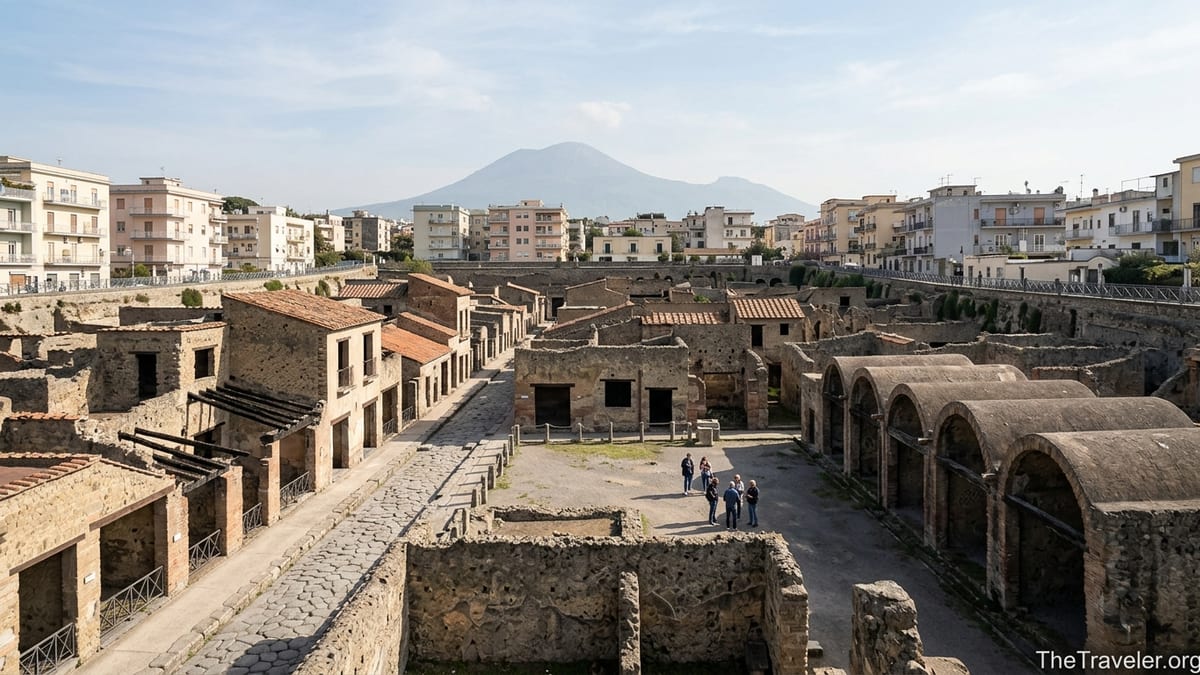
A Roman resort town frozen in an instant
Herculaneum was a prosperous coastal community on the Bay of Naples when Vesuvius erupted in 79 AD, the same disaster that buried Pompeii. Unlike its larger neighbor, Herculaneum was a kind of Roman resort town, dotted with sea-facing villas and elegant townhouses. Many residents were wealthy merchants and members of the local elite who chose to live here for the clean air and waterfront views, then commuted or traded with bustling Naples and the wider Mediterranean.
When you enter the archaeological park today, one of the first impressions is just how compact and legible the town feels. The excavated area covers only a fraction of the original settlement, but the street grid is easy to take in on a single visit. You can walk from the once-seaside arcades at the lower edge of the site up to the northern insulae in under ten minutes, passing houses, shops, bath complexes and shrines along the way.
The way Herculaneum was buried also sets it apart. Whereas Pompeii disappeared under a thick blanket of ash and pumice that collapsed roofs and left many interiors exposed to the elements when they were later excavated, Herculaneum was engulfed by surging, superheated pyroclastic flows. These avalanches of gas and debris hardened into a deep, rock-like shell that sealed much of the town in place, almost like concrete around a time capsule.
For modern visitors, this means that many buildings still stand two or even three stories high. Walking along the Cardo III, one of the main north–south streets, you can look up to see intact upper floors, balconies and windows. It feels less like a ruin and more like a city that residents have just stepped away from, inviting you to imagine the noise of carts, hawkers and children echoing off the walls.
Organic life preserved: wood, food and human stories
The same pyroclastic flows that destroyed Herculaneum also carbonized organic materials that normally decay. This is one of the main reasons archaeologists consider the site so extraordinary. Here, charred wooden beams still span rooms, doors remain on their hinges, and furniture survives in place. In several houses you can see carbonized wooden bed frames pressed into the corner of sleeping spaces, their forms preserved in uncanny detail.
A striking example is the House of the Deer, a luxurious villa near what was once the shoreline. Inside, you do not just see mosaic floors and marble tables. You also find blackened remains of wooden partitions and staircases, giving rare insight into how the spaces were divided and used vertically. In the nearby House of the Carbonised Furniture, an entire cupboard, complete with shelving and decorative details, has survived in carbon form, allowing conservators to reconstruct its original appearance.
Food has also been preserved in extraordinary ways. In a thermopolium, the Roman version of a takeaway snack bar, archaeologists have identified remnants of grains, nuts and seasonings inside the large clay jars set into the counter. In bakeries, loaves of bread were discovered still in their ovens, their shapes intact but turned to charcoal. When you peer into these spaces as a traveler, the effect is disarmingly intimate: these are not abstract “Romans” but people who bought hot food on the street and baked their daily bread.
The human story is most visceral down near the ancient waterfront. In the 1980s, excavations uncovered dozens of skeletons huddled in stone boat sheds, where residents had evidently fled in hope of rescue from the sea. Today, casts and skeletal remains are displayed in situ. Standing in these vaulted chambers, it is possible to picture families pressed together in darkness as the final pyroclastic surge rushed in. It is a sobering counterpoint to the town’s elegant houses, reminding visitors that Herculaneum is both an extraordinary scientific resource and a mass disaster site.
Remarkably intact houses and vivid interior decoration
Herculaneum’s townhouses are among the best-preserved in the Roman world, and for many visitors they are the highlight of a trip. Because upper floors survived, you can understand how multi-level homes functioned, with shops at street level and living quarters above. Some apartments still have evidence of wall partitions and mezzanines, showing how space was maximized in the dense urban fabric.
The frescoes and mosaics are often astonishingly fresh. In the House of Neptune and Amphitrite, a jewel-like mosaic panel shows the sea god and his wife in vivid blues and greens framed by intricate geometric patterns. Just beside it, a decorative fountain niche glitters with glass tesserae. Unlike many Pompeian paintings, which were removed to museums and left only as faded ghosts on the walls, a significant number of Herculaneum’s decorations remain in situ, so you see them in their original architectural context.
Color is everywhere. In one dining room you might find deep red panels divided by delicate painted columns, while a corridor next door is painted a warm yellow that catches the sunlight in late afternoon. In smaller houses, simple but well-preserved wall paintings give insight into more modest tastes and budgets, contrasting with the gilded moldings and imported marbles of elite homes. Walking through, you begin to understand how status and aspiration were expressed visually in a first-century town.
What makes Herculaneum especially compelling for travelers is how close you can get to these details. Because the site is smaller and typically far less crowded than Pompeii, you often find yourself almost alone in a richly decorated room. You can linger over the way a painted border lines up with a doorway, or how a mosaic floor aligns with window light, without the constant pressure of groups queuing behind you.
The Villa of the Papyri and the world’s most fragile library
Just beyond the currently accessible part of the excavation lies one of Herculaneum’s most consequential finds: the Villa of the Papyri. This sprawling seafront residence, thought to have belonged to the family of Julius Caesar’s father-in-law, yielded the only substantial surviving library from the ancient Greco-Roman world. In the mid-eighteenth century, excavators tunneling into the villa discovered more than 1,800 papyrus scrolls, all carbonized by the eruption and initially mistaken for lumps of charcoal.
Many of these scrolls contain philosophical texts in Greek, including works associated with the Epicurean philosopher Philodemus. Some were painstakingly unrolled in past centuries using mechanical devices, often with heartbreaking damage. Others remain tightly rolled and too fragile to touch. While the original scrolls are housed in Naples, their story is inseparable from Herculaneum and remains one of the reasons scholars view this site as extraordinary.
Today, cutting-edge imaging projects are bringing this ancient library back to life without physically opening the scrolls. Teams working with high-resolution X-ray tomography and machine learning have begun to virtually “unroll” intact scrolls, revealing letters and words that have not been read for almost two thousand years. A recent research effort known as the Vesuvius Challenge has even invited computer scientists and enthusiasts worldwide to help develop new algorithms to detect ink within the densely folded layers.
For a traveler, you will not see these technologies at work on site, but you feel their impact in exhibition panels and interpretive materials in Herculaneum and nearby museums in Naples. The idea that somewhere beneath your feet lies the rest of a Roman library, with unread works that could reshape our understanding of ancient literature and philosophy, gives an extra charge to a walk along the cliff edge paths above the buried villa.
Visiting Herculaneum today: practical insights for travelers
Herculaneum is both scientifically important and remarkably accessible. From central Naples, the commuter train on the Circumvesuviana line to Ercolano Scavi typically takes around 20 to 25 minutes, and trains run throughout the day. From the station, it is roughly a seven-minute downhill walk along Corso Resina to the archaeological park entrance, passing cafes, small supermarkets and souvenir stands where you can pick up water and snacks before you enter.
Standard adult tickets to Herculaneum are currently in the mid-teens of euros, with reduced prices for eligible EU citizens and free entry on certain national culture days. Travelers planning a broader exploration of the Vesuvian sites often opt for combined passes valid for several days that include Herculaneum, Pompeii and smaller sites such as Oplontis or Boscoreale; these passes typically cost less than buying separate tickets for each site. It is worth checking current prices and any seasonal offers before you travel, especially in high summer when advance reservations can help you avoid queues under the sun.
The site itself feels manageable in two to three hours, though history enthusiasts often stay longer. There is limited shade within the ruins, especially in the middle of the day, so hats, sunscreen and a refillable water bottle are essential in the warmer months. A modern visitor center at the entrance offers restrooms, a small bookshop and basic facilities, but once you descend into the ruins you will find only a few fountains and benches.
Many travelers combine Herculaneum with either a morning in Naples or an afternoon hike on Vesuvius. Realistically, pairing it with a full visit to Pompeii on the same day can feel rushed, especially in the heat, so it often makes sense to dedicate one day to Herculaneum and the volcano and another to Pompeii. One common itinerary is to take the morning train from Naples to Ercolano Scavi, explore Herculaneum until early afternoon, then catch a shuttle or organized minibus from near the station up to the Vesuvius trailhead for a late-day walk around the crater.
Herculaneum versus Pompeii: why this smaller site leaves a big impression
Travelers often arrive in the Bay of Naples with Pompeii at the top of their list and only later hear about Herculaneum. Those who visit both frequently remark that while Pompeii impresses with its vast scale and monumental public spaces, Herculaneum lingers in the memory for its intimacy and level of preservation. The two sites were destroyed in the same eruption but in different ways, and that divergence is written into every wall and doorway.
Pompaii’s broad streets, amphitheater and forum give a sense of a bustling regional center. In contrast, Herculaneum’s narrow lanes, seafront warehouses and compact bath complexes feel like a tightly knit community. Because organic materials survived here, you see details that rarely appear elsewhere: wooden shop shutters ready to be slid down over counters, ceiling beams that still span atrium spaces, even fragments of textiles and fishing gear uncovered in past excavations.
The visitor experience also differs. On a typical summer day, Pompeii can feel overwhelmed by tour groups, with crowds clustering around iconic sites like the Villa of the Mysteries or the House of the Faun. By contrast, Herculaneum’s smaller size and lower visitor numbers mean that even in peak season it is often possible to stand alone in a painted triclinium or linger by a street fountain listening only to the wind. Photography enthusiasts appreciate the ability to frame shots of intact facades and colonnades without constant streams of people in the foreground.
For many travelers, the best solution is not to choose but to plan time for both. Experiencing Pompeii and Herculaneum together gives a richer picture of Roman urban life: one large, commercial and outward-looking, the other more residential and resort-like. Yet if time or energy is limited, Herculaneum is arguably the more rewarding choice for those who value detail, atmosphere and a powerful sense of stepping inside ancient homes.
Conservation, research and the site’s evolving future
Protecting a town frozen in time is an ongoing challenge. Herculaneum’s very strengths as an archaeological site also make it fragile. Carbonized wood, for example, can crumble if exposed to moisture and temperature fluctuations, while ancient pigments fade under strong sunlight. Since the early 2000s, large-scale conservation efforts have focused on stabilizing roofs, improving drainage and developing protective shelters that allow visitors to see original features without exposing them directly to the elements.
Partnerships between Italian authorities and international foundations have funded targeted projects, from restoring individual houses to re-roofing exposed insulae and consolidating ancient sewers. Visitors today benefit from these efforts when they step into rooms where timber ceilings have been discreetly supported, or into bath complexes where modern interventions are carefully distinguished from original Roman masonry. Interpretive signage often explains how conservation decisions were made, turning the site itself into a kind of open-air laboratory for heritage management.
Research continues alongside conservation. Archaeologists are refining their understanding of how the pyroclastic flows moved through the town, why certain areas suffered more damage than others, and how residents responded in the hours before the final catastrophe. Ground-penetrating surveys and cautious new excavations aim to expand the accessible area without destabilizing the overlying modern town of Ercolano, which still sits on top of the unexcavated portions.
Critically, the work on the Herculaneum papyri has drawn in physicists, computer scientists and experts in artificial intelligence, making this small town a focal point of interdisciplinary research. Each new word recovered from a virtual unrolling of a scroll adds another thread to the tapestry of knowledge that visitors engage with in a much more direct, physical way as they walk the streets below.
The Takeaway
For all its scholarly importance, Herculaneum remains, first and foremost, a place where the past feels startlingly close. In a few compact city blocks, you encounter elegant houses with intact upper floors, snack bars stocked for customers who never arrived, a bath complex ready for afternoon visitors, and a shoreline where desperate families waited in vain for rescue. It is this combination of extraordinary preservation and human scale that sets Herculaneum apart from almost any other archaeological site in Italy.
Travelers who make time for Herculaneum often come away saying it was the highlight of their stay in the Bay of Naples, precisely because it feels like a lived-in town rather than a collection of ruins. Whether you are a casual visitor with a couple of hours between trains or a history enthusiast planning an in-depth itinerary that includes museums and other Vesuvian sites, Herculaneum offers one of the clearest, most moving windows onto daily life in the Roman world.
As research advances and conservation work continues, new details will emerge from its houses, streets and buried library. Yet even now, walking beneath the looming cone of Vesuvius, you sense that Herculaneum has already fulfilled a rare role: not just preserving the past, but allowing modern visitors to inhabit it, briefly and respectfully, in three dimensions.
FAQ
Q1. Is Herculaneum really worth visiting if I have already been to Pompeii?
Yes. Herculaneum offers a very different experience from Pompeii, with better-preserved houses, visible upper floors, more organic remains and generally smaller crowds.
Q2. How much time should I plan for a visit to Herculaneum?
Most visitors find that two to three hours is enough to see the main highlights at a comfortable pace, though history enthusiasts may easily spend half a day.
Q3. How do I get to Herculaneum from Naples by public transport?
Take the Circumvesuviana commuter train from Napoli Garibaldi or Napoli Porta Nolana to Ercolano Scavi. From there it is about a seven-minute downhill walk to the site.
Q4. Can I visit Herculaneum and Pompeii on the same day?
It is possible but can feel rushed, especially in hot weather. Many travelers prefer to dedicate one day to Pompeii and another to Herculaneum and, if desired, Vesuvius.
Q5. How crowded does Herculaneum get compared with Pompeii?
Herculaneum usually has far fewer visitors than Pompeii. Even in peak season you can often explore houses and streets with plenty of space and time for photos.
Q6. Are guided tours necessary, or can I explore on my own?
You can easily explore on your own using the site map and information panels. A guided tour or audio guide, however, can enrich your understanding of specific houses and finds.
Q7. What should I wear and bring for a visit to Herculaneum?
Wear comfortable walking shoes and sun protection, and bring water, especially in warmer months. The site is largely open-air with limited shade and uneven ancient paving.
Q8. Is Herculaneum suitable for children and less mobile visitors?
Children often enjoy exploring the streets and houses, but ancient steps and uneven surfaces can be challenging. Some routes are more accessible; the visitor center can advise on the easiest paths.
Q9. Can I see the Herculaneum papyri at the site itself?
The original scrolls are held and studied in Naples, but Herculaneum features information about the Villa of the Papyri and the ongoing work to read its carbonized library.
Q10. When is the best time of day or year to visit Herculaneum?
Mornings and late afternoons outside of peak summer tend to be most comfortable, with softer light and cooler temperatures. Spring and early autumn are especially pleasant.