


Most visitors experience Boboli Gardens as a scenic backdrop to a day at Pitti Palace: a quick stroll up the central axis, a photo at the Neptune Fountain, a glance at the view, and then back to Florence’s busy streets. Yet this historic green world, stretching across the hillside behind the palace, hides a network of side paths, symbolic details, and nearly deserted terraces where the Medici story comes alive in much quieter ways. With a bit of intention and a willingness to step away from the crowds, Boboli becomes less of a postcard and more of a lived, textured place.
Get the latest updates straight to your inbox!
Understanding the Garden Beyond the Postcard View
Boboli Gardens is often described as an open-air museum of sculpture and landscape design, laid out from the mid 1500s onward as the grand backyard of the Medici. The main route from the rear of Pitti Palace up through the amphitheatre and along the central axis is impressive, but it is only a fraction of what the estate offers. Once you move away from that spine, the garden shifts from formal showpiece to a surprisingly intimate patchwork of orchards, terraces, lawns, and minor buildings that rarely see tour groups.
This is partly a question of time. Many people arrive with a combined ticket that also covers Pitti Palace or even the Uffizi on the same day, and they budget an hour for Boboli at most. That is barely enough for the central highlights. If you set aside two to three hours instead, you can push well past the usual turning points, following gravel avenues under overgrown hedges and stepping into side clearings that once hosted court entertainments, experiments with exotic plants, or private walks for the ruling family.
Boboli’s lesser known corners tend to be quieter at all times of day, but they are especially atmospheric in the late afternoon when the stonework warms to honey tones and the light slants across the lawns. Locals often time their visit for this hour, using the garden almost like a park, while most group tours have already moved on to the historic center. If you can plan your schedule to be here after the indoor museums, you are more likely to experience that more contemplative side of the garden.
It helps to remember that Boboli was never meant as a single, unified design finished at once. Successive generations added new ideas and garden fashions. This layered history means that when you wander off the primary axis you are, in effect, walking through centuries of changing tastes: seventeenth century water theatrics near the Isolotto, eighteenth century fantasies of faraway lands at the Kaffeehaus, and nineteenth century landscape touches that soften some of the original geometry.
The Viottolone and the Quiet World of the Isolotto
One of the most striking but surprisingly uncrowded features is the Viottolone, the long cypress avenue that runs downhill from the higher lawns toward the southern edge of the garden. Many visitors never notice its entrance at the Prato dell’Uccellare because they simply loop back toward the palace instead of committing to this steep descent. If you do, you are rewarded with a sense of procession between dark verticals of cypress, broken at intervals by transverse alleys lined with statues that most people only glimpse in guidebooks.
At the end of this shaded corridor the formal planting abruptly softens as you reach the Vasca dell’Isola, often called the Isolotto. Here, the path opens onto a broad oval basin encircling a small island that feels almost theatrical in its isolation. In the middle rises the Fountain of Ocean, originally created in the sixteenth century and later moved here. Today a copy stands on the island, its classical figures of river gods and sea creatures weathered just enough to blend into the greenery around them.
What most visitors miss is how peaceful this area can be. While the central amphitheatre might be hosting a school group or a small event, the benches around the Isolotto are often half empty. It is a good place to sit with a takeaway panino from a bar near Porta Romana before you entered, or to cool off after the climb from the palace. Early in the season you may see gardeners working on the topiary and pots around the basin, giving you a glimpse into how much labor still goes into maintaining this historical stage set.
Practical details matter here too. The walk down the Viottolone is long and the gravel can be slippery after rain, so flat shoes with some grip are helpful. There are relatively few trash bins and no refreshment stands at this end of the garden, so bring water. If you are visiting in summer, this lower section also feels a degree or two cooler thanks to the tree cover, making it a welcome escape when the stone courtyards of Florence are shimmering with heat.
The Kaffeehaus and Views Most People Never Reach
Another area that is unjustly quiet is the hill crowned by the octagonal Kaffeehaus in the northern sector of the garden. This small, pale green pavilion, completed in the eighteenth century, looks almost like a miniature central European pleasure house set down among Tuscan trees. Because it sits off the main route and requires a steady uphill walk, many itinerary-driven visitors do not make the detour, especially in the heat of the day.
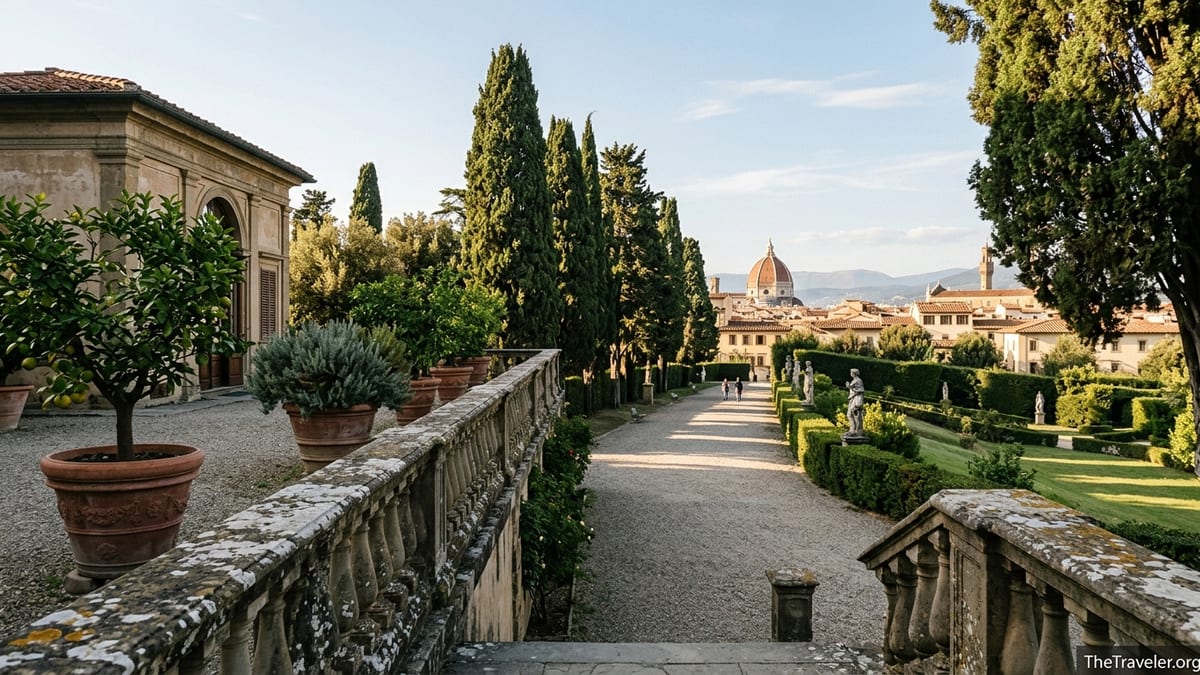
If you do climb up, the payoff is one of the most expansive yet rarely crowded views of Florence. From the terrace near the Kaffeehaus you can see the dome of Santa Maria del Fiore rising above the city roofs, with the bell towers and hills beyond layered in the distance. Unlike the classic postcard shots from Piazzale Michelangelo, this perspective is framed by garden balustrades, terracotta pots, and the soft curve of Boboli’s own lawns, reminding you that the city and this garden were designed to be read together.
Travelers who make this climb often mention how calm it feels compared to Florence’s panoramic hotspots. You may share the terrace with only a handful of other visitors, many absorbed in sketching, reading, or simply leaning on the stone balustrade. In late afternoon, the light catches the city in warm tones while the garden around you slips into deeper greens. Photographers will find it a good place for wide shots at around 24 to 35 mm focal length; the elevation lets you include both garden foreground and city background without heavy distortion.
Although the cafe function that gave the pavilion its name is not always in operation, the surrounding lawns and paths still make an ideal pause point. If you have picked up a pastry or small snack in the Oltrarno before entering Pitti Palace, this is the spot to enjoy it. Just remember that Boboli is more formal than a city park: picnics sprawled on the grass are discouraged, so keep to benches and low walls, and pack your rubbish back out with you.
Montagnola del Cavaliere and the Knight’s Garden
High on the eastern side of Boboli, beyond what most visitors think of as the “end” of the garden, lies the Montagnola del Cavaliere, or Knight’s Hill. Here, a small elevated garden often called the Giardino del Cavaliere sits where stone for Pitti Palace was once quarried. Over time, the Medici transformed this practical scar in the landscape into an ornamental belvedere, reached by a series of steps and ramps that can be confusing to navigate if you are relying only on the basic map handed out at the gate.
For many travelers, this is the quietest part of Boboli. Beds of roses and seasonal flowers curve around small lawns, framed by low hedges and dotted with statues that have a more intimate scale than the heroic figures near the main axis. On clear days there are wide views south toward the hills and villas that dot the outskirts of Florence, reminding you that the Medici controlled not just the city but the surrounding countryside.
The Knight’s Garden is also where you can feel the garden’s horticultural side most clearly. Here the planting is less theatrical and more about color and scent, especially in late spring when roses bloom. Garden enthusiasts often linger to study how historic species have been woven into the beds, and you may spot plant labels tucked discreetly into the soil. Unlike the amphitheatre or Neptune Fountain, there is rarely a crowd pressing you forward, so you can take your time noticing details like lichen-covered stone, the texture of clipped box hedges, and the way gravel paths are edged with brick.
Because this area sits at the top of a series of climbs, it is wise to plan your route so that you visit earlier in your garden circuit rather than tacking it on when you are already tired. From the palace entrance, keep bearing left and upward whenever paths branch, using the occasional brown directional signs as confirmation. If you are visiting on a warm day, consider bringing a small folding fan and plenty of water, as there is little shade on the final slopes.
Symbolic Details: Goats, Dwarfs, and Ice Houses
Even when you stay near the main avenues, there are details that most visitors walk straight past. One of the most intriguing is the recurrent presence of the goat or capricorn motif. This emblem, associated with the Medici, appears on the facade of the Grotta Grande, around the smaller Grotticina della Madama, and on the iron gates that protect the island basin of the Isolotto. Once you start spotting it, you realise that the garden is not just decorative but coded, with symbols that tied the ruling family to ideas of strength, resilience, and cosmic order.
Another easily missed but memorable feature is the Fontana del Bacchino, a small fountain depicting Nano Morgante, a famous court dwarf of Cosimo I de’ Medici, in the guise of Bacchus riding a tortoise. This playful, slightly irreverent work sits off to the side rather than in a central spot, which means many visitors, focused on the big axis and the Neptune Fountain, never find it. Those who do often linger, amused by the contrast between the lavish formal garden and this humorous, human-scaled sculpture.
Between the amphitheatre and the meadows higher up the slope stand two modest domed structures that once served as ice houses. In the Medici period they were used to store snow and ice packed with straw, allowing the court to enjoy chilled drinks and sorbets long before mechanical refrigeration. Today, few people pause to consider what they are, yet they tell a story about courtly innovation and the desire to turn Boboli into a complete world with its own microclimate and luxuries.
Noticing these details can transform how you move through the garden. Instead of simply ticking off major stops, you can treat your visit as a slow-read of a visual narrative, pausing to ask: why is this symbol here, who would have seen it in the sixteenth century, and what message was it meant to send? Taking along a small pair of binoculars or using your camera’s zoom helps you pick out carvings and reliefs high on facades that are otherwise easy to miss in the glare.
Experiencing Boboli as a Living Garden, Not Just a Monument
While Boboli’s historic architecture and sculpture draw most of the attention, the garden is also a living, evolving ecosystem. Away from the main axis, small orchards, citrus collections, and experimental plots hint at how the Medici used Boboli as a place for horticultural display and botanical curiosity. The limonaia, or lemon house, for example, gathers potted citrus trees that are moved outdoors in warm months and sheltered in cooler seasons, continuing a tradition of cultivating exotic fruit under controlled conditions.
Seasonality makes a significant difference here. In early spring, camellias and early roses begin to bloom along side paths that in high summer can feel more austere. By late May and June, roses in the upper gardens are at their peak, while the lawns around the Isolotto are scattered with wildflowers. Autumn brings softer light and changing foliage, especially along the Viottolone and on the hillsides where deciduous trees are mixed with evergreens. If your travel dates are flexible, consider visiting in shoulder seasons like April, May, late September, or October, when both temperatures and visitor numbers are more comfortable.
Boboli is also a working heritage site, which means you will regularly see gardeners, conservators, and maintenance staff at work. Rather than treating this as a distraction from the “perfect” picture, it can be interesting to pause and watch. You might see teams carefully cleaning statues, experts checking stone balustrades for cracks, or gardeners reshaping box hedges with string lines and hand shears. These glimpses underline that Boboli is not frozen in time but constantly cared for and, when needed, subtly adjusted.
For travelers who enjoy quieter, place-based experiences, walking slowly, sitting often, and returning to the same vista at different times of day can be more rewarding than racing through every named feature. That might mean spending twenty minutes simply watching how the light moves across the amphitheatre obelisk, or noticing how the muffled city sounds drift up differently at the Kaffeehaus terrace compared with the Isolotto benches.
Practical Ways to Escape the Crowds and Plan Your Route
To really explore Boboli beyond the main paths, it helps to plan with more intention than most visitors. Start by looking at a detailed map before you arrive, noting not just the central amphitheatre and Neptune Fountain but also the Viottolone, the Isolotto, the Kaffeehaus, and the Knight’s Garden. When you enter from Pitti Palace, resist the instinct to follow the densest flow of people. Instead, consider turning left or right along lateral paths that will eventually reconnect with the primary axis but give you a quieter first impression.
Ticketing also shapes the experience. As of 2026, stand-alone Boboli tickets and combined options with Pitti Palace and other sites are widely available, sometimes including multi day passes that cover several museums. Day-of tickets typically start around the low double digits in euros, with slightly higher prices when purchased in advance or bundled. Check the latest times and prices on official channels just before your visit, and note that the last admission is usually one hour before closing. Free-admission days several times a year can bring heavier crowds, so if you prefer a more tranquil visit, you may choose to avoid those dates even if that means paying the standard fee.
Accessibility and comfort are worth considering. Many of the hidden corners described here lie at the ends of slopes or down long gravel avenues. The garden does include ramps and some more even paths, but visitors with mobility challenges may find certain sections difficult. Good walking shoes, a refillable water bottle, and protection from sun or sudden showers are more than just nice to have; they make the difference between a rushed stroll and a relaxed exploration. Remember too that once you exit the garden you generally cannot re enter on the same ticket, so plan restroom stops and rest breaks before you head for the gate.
Time of day can help you reclaim the quieter side of Boboli. Morning visits just after opening often see a gradual buildup of school groups and tours along the central route, leaving the side gardens comparatively peaceful. Late afternoon, especially outside peak summer, tends to empty out again as day trippers head back toward the city center for dinner. If you have a timed ticket for Pitti Palace, you might visit the palace galleries first, then spend the later part of the day in the garden, ending your walk near the Kaffeehaus or Knight’s Garden as the city lights begin to flicker on below.
The Takeaway
Boboli Gardens rewards curiosity and a slower rhythm. If you stay on the main spine, you will certainly see some of Florence’s classic views: the great amphitheatre behind Pitti Palace, the obelisk, the Neptune Fountain, and the formal perspectives that have inspired garden designers for centuries. Yet the real character of Boboli emerges in the places where most people do not go: the shaded Viottolone that feels almost like a forest aisle, the quiet benches around the Isolotto, the hillside terraces near the Kaffeehaus, and the flower filled Knight’s Garden that still carries the memory of a quarry turned into a belvedere.
By looking for recurring emblems like the Medici goat, pausing at odd little domes that once stored ice, or taking the time to find a humorous dwarf riding a tortoise, you step into the imaginative world that shaped the garden. Combine that attention to detail with a practical plan for navigating slopes, ticket options, and opening hours, and Boboli shifts from being a brief photo stop to one of the most memorable, layered experiences of a stay in Florence. When you finally leave, you are likely to remember not just the famous views, but the unexpected quiet corners where the city felt far away and history felt close at hand.
FAQ
Q1. How much time should I plan to explore the lesser known areas of Boboli Gardens?
Most visitors breeze through in an hour, but to comfortably reach quieter corners like the Viottolone, Isolotto, Kaffeehaus, and Knight’s Garden, plan at least two to three hours. This gives you enough time for breaks, photos, and simply sitting to enjoy the atmosphere.
Q2. What is the best time of day to avoid crowds on the side paths?
Early morning just after opening and late afternoon in the last two hours before closing are typically calmer. During these windows, school groups and tours tend to stay on the central axis, leaving lateral paths and hilltop terraces comparatively quiet.
Q3. Are the hidden corners like the Isolotto and Knight’s Garden easy to find without a guide?
They are reachable on your own, but the standard paper map can feel vague. Before you arrive, study a more detailed map and note key landmarks such as the Viottolone for the Isolotto and the upper eastern slopes for the Knight’s Garden, then use on site signposts to confirm you are on the right track.
Q4. Do I need a special ticket to access areas like the Kaffeehaus or Montagnola del Cavaliere?
No separate ticket is required; these spots are included with general Boboli admission. What you do need is enough time and energy to manage the uphill paths, since they sit well above the central amphitheatre and casual visitors often turn back before reaching them.
Q5. Are there food and drink options inside the quieter parts of the garden?
Refreshment options are limited and concentrated near main entrances and central routes. In more remote areas such as around the Isolotto or Knight’s Garden there are usually no kiosks, so it is wise to bring water and a small snack, and to eat neatly on benches rather than on the grass.
Q6. How challenging are the paths for visitors with limited mobility?
The main central routes include some ramps and broader paths, but many of the hidden corners lie up or down steep, sometimes uneven gravel avenues. Visitors with limited mobility may prefer to focus on the more accessible sections near the palace and amphitheatre, and to check current accessibility notes on official channels before visiting.
Q7. Is it safe to wander off the main paths when I am visiting alone?
Boboli Gardens is generally considered safe during opening hours, and staff patrol the grounds. Wandering side paths is common among solo travelers, though it is sensible to keep to marked routes, stay aware of your surroundings, and avoid very isolated corners close to closing time.
Q8. Can I sit on the grass in the quieter areas to relax or have a picnic?
Boboli is managed more like a historic monument than a casual city park, so sitting or picnicking on the grass is usually discouraged or restricted. Use benches, low walls, or designated seating areas instead, and keep food simple and discreet to respect both the site and other visitors.
Q9. Are there good photo spots that most people overlook?
Yes. The terrace near the Kaffeehaus offers excellent views of Florence with far fewer people than popular outlooks in the city, and the area around the Isolotto allows for reflective water shots framed by statues and greenery. The Knight’s Garden also provides wide views toward the surrounding hills that seldom appear in standard postcards.
Q10. How do seasonal changes affect what I will see in the lesser known areas?
In spring, roses and flowering shrubs around the Knight’s Garden and upper slopes are at their best, while summer emphasizes shade and coolness along the Viottolone and near the Isolotto. Autumn brings rich light and changing foliage, making side paths especially photogenic, whereas winter offers clearer views and fewer crowds but a barer, more architectural feel.