


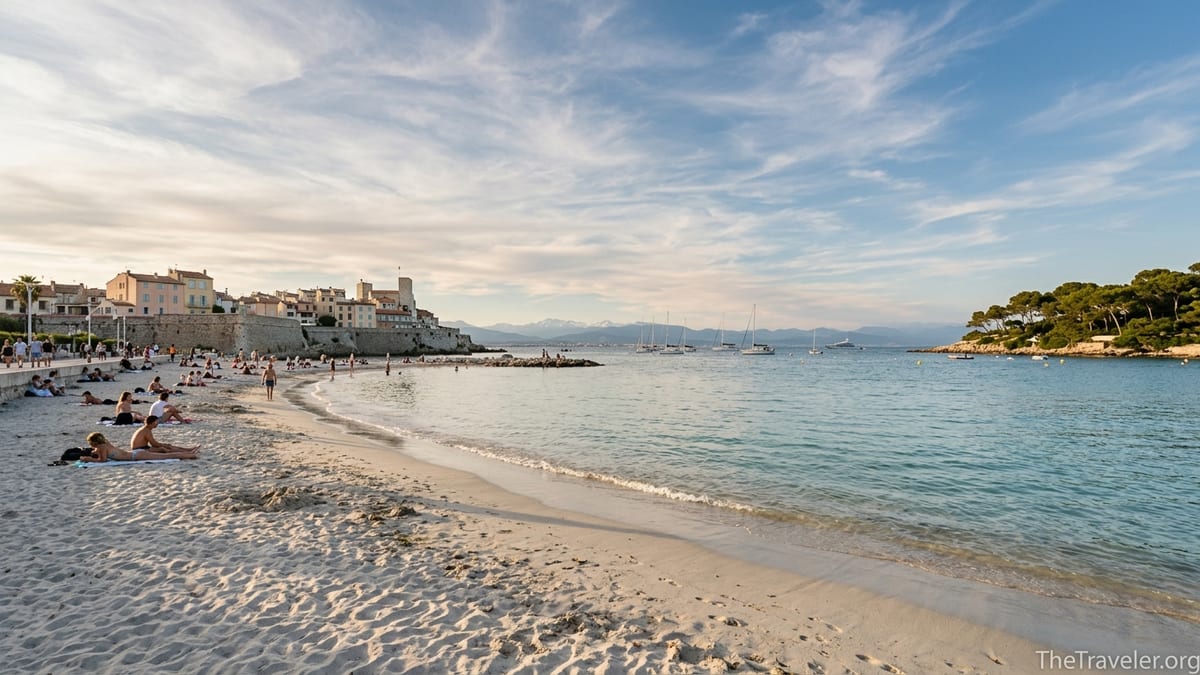
Standing ankle-deep in the shallows of Plage de la Salis, I realized this was not the typical French Riviera beach scene I had been expecting. Yes, there were striped towels, families with ice creams, and the occasional superyacht gliding past. But what truly stopped me in my tracks was the sheer scale of the view: the stone ramparts of Antibes’ old town to one side, the piney curves of Cap d’Antibes to the other, and far beyond, the hazy, often snow-dusted outline of the Alps hovering over the bay. It felt less like a simple city beach and more like the Riviera, distilled into a single sweeping panorama.
Get the latest updates straight to your inbox!
The View That Steals the Show
The first surprise at Plage de la Salis is how dramatic the view is for such an unpretentious, public strip of sand. Look west and you see the medieval ramparts of Antibes, the square tower of the Picasso Museum, and the jumble of ochre rooftops stacked above Port Vauban. On many days, especially in the cooler months or early spring, the Alps form a pale blue and sometimes snow-streaked wall behind the town, giving the scene an almost cinematic depth that you simply do not get from more enclosed coves further along the coast.
Turn your head the other way and the mood shifts entirely. To the east and south, the land curls into the pine-clad peninsula of Cap d’Antibes, dotted with villas hidden behind stone walls and umbrella pines. From the sand, you can see the white tower of the Garoupe lighthouse high on the hill and, closer to sea level, the masts of small boats in Port de la Salis. It is an ever-changing picture: paddleboarders crossing the frame at dawn, sailboats slipping out in the afternoon, and the occasional sleek yacht anchoring beyond the swimming buoys.
What makes this panorama so compelling is the contrast. In one frame you have a working Mediterranean town, complete with local buses trundling along Boulevard James Wyllie, and in the other, you glimpse the more exclusive, gardened world of the Cap. Few beaches let you see so clearly how the Riviera layers old stone, everyday life, and discreet luxury around the same curve of water.
Even the light plays a role in the drama. On a typical summer day, mornings often bring the clearest views, with the mountains etched sharply in the distance. By late afternoon, the sun swings behind the town, and the ramparts turn golden while the sea shifts from turquoise to a deeper cobalt. If you time it right, an early evening swim can come with pastel skies over the Alps and the first lights flickering on along the port.
A Relaxed Local Beach With Big-Room Scenery
Given that view, you might expect Plage de la Salis to feel polished and club-like, the kind of place where lounge chairs come with champagne menus. Instead, the reality is surprisingly down to earth. This is a free public beach, a long, shallow curve of sand that locals from Antibes and nearby Juan-les-Pins treat almost like an extended neighborhood park. On a typical weekday in June, you will see schoolchildren arriving with teachers, retirees in wide-brimmed hats doing slow laps by the buoys, and office workers slipping down on their lunch break for a quick swim.
The facilities support that everyday vibe. Lifeguards are generally on duty during the core summer season, and there are simple public showers and basic toilets behind the beach or at the nearby nautical base rather than glitzy changing cabins. A cluster of modest kiosks and snack bars along Boulevard James Wyllie sells beach staples: paper cones of fries, cold Orangina, coffee from metal counters, and scoops of pistachio or lemon sorbet that drip faster than you can eat them in July heat.
Prices, while higher than inland France, tend to be less eye-watering than on heavily privatized Riviera strips. As of recent summers, a scoop of ice cream might cost around 3 to 4 euros and a pan bagnat sandwich perhaps 6 to 8 euros, depending on the stand. Many locals bring their own picnic: baguettes from a bakery near Place de Gaulle, tomatoes, and a ball of mozzarella, eaten straight from a beach towel with sandy fingers. No one seems out of place doing so, which is not always the case on more exclusive stretches of coastline.
The sand itself is another pleasant surprise. Unlike some beaches along this part of the Mediterranean that are made of large pebbles, Plage de la Salis offers a mostly sandy bottom with some scattered stones near the waterline. The entry is shallow for quite a long way, which helps families with younger children feel more at ease. The water is rarely pool-clear on busy afternoons, but on quieter mornings it often takes on that near-translucent turquoise that the Côte d’Azur is famous for.
How to Reach Plage de la Salis Without a Car
Another aspect that elevates Plage de la Salis is how straightforward it is to reach without a car, which is not something you can say about many of the smaller coves around Cap d’Antibes. From Antibes’ old town, you can simply follow the waterfront promenade past Plage du Ponteil and continue along Boulevard James Wyllie. It is roughly a 15 to 20 minute walk from the ramparts, depending on your pace, and most of the way you are accompanied by views across the bay toward Nice.
If you are staying farther out in Antibes or arriving by train, local buses are a practical backup. One of the town lines regularly connects the center and the Port Vauban area with Port de la Salis, the stop just behind the beach. Tickets are typically inexpensive, and you can often buy a single ride from the driver for roughly the price of a coffee in town. For travelers planning to explore more of the coast by public transport, regional passes that cover buses and TER trains in the Alpes-Maritimes can make day trips from Nice or Cannes to Antibes notably easier on the budget.
From Nice, many visitors choose the coastal train for its reliability and views. The ride to Antibes usually takes around 25 to 30 minutes, passing marinas and small bays along the way. From Antibes station, it is about a 20 to 25 minute walk through the old town and along the sea to Plage de la Salis, or a short hop by local bus or taxi. It is entirely feasible to come for a relaxed half-day beach visit and still have time to wander the Marché Provençal or the Picasso Museum before heading back to Nice in the evening.
For those who do drive, there is some street parking along Boulevard James Wyllie and a small public lot, but in peak summer it fills quickly. Drivers often circle in slow loops, hoping for someone to leave, while pedestrians weave between sun-warmed cars. If you are visiting in July or August, it is wise to arrive before 10 a.m. if you want a relatively stress-free parking experience, or simply leave the car behind and enjoy the walk from town.
From Beach Towel to Coastal Trail
What makes Plage de la Salis particularly rewarding is how naturally it fits into a bigger day of exploring Cap d’Antibes. The beach sits at the hinge between Antibes’ urban waterfront and the peninsula’s wilder edges, which means you can easily combine a lazy swim with one of the area’s celebrated coastal walks. Many visitors spread their towel on the sand for a morning swim, then lace up trainers in the afternoon and set off along the peninsula.
One popular option is to climb from the back of the beach toward the Garoupe lighthouse, either via the Chemin du Calvaire or looping through shady residential lanes. The ascent takes around 30 to 40 minutes at a gentle pace and rewards you with sweeping views back over Plage de la Salis, the old town, and the curve of the bay. On clear days you can trace the coast almost to Italy in one direction and toward the Esterel hills beyond Cannes in the other.
For a closer encounter with the sea, many walkers continue onward to pick up the Cap d’Antibes coastal path, also known as the Sentier du Littoral, which runs between Plage de la Garoupe and the gardens of Villa Eilenroc. The trail threads along rocky cliffs, past tiny inlets where swimmers clamber off rocks into deep, clear pools. It typically takes 1.5 to 2 hours to complete the main loop, not accounting for photo stops or swims, and is best tackled in sturdy shoes rather than flip-flops. Afterward, you can return by bus or on foot to Plage de la Salis for a final, cooling dip.
This easy interplay between city beach and coastal wilderness is rare on the Riviera. On one side of your towel is a promenade with bus stops and snack bars; on the other lies a network of paths leading to lighthouses, landscaped gardens, and secluded coves. For travelers who like their beach days to include a bit of movement and exploration, it is hard to think of a better base than Salis.
Family-Friendly Yet Genuinely Scenic
If you are traveling with children, Plage de la Salis feels almost purpose-built for a relaxed day that still feels like a real Riviera experience. The shallow gradient of the seabed near the shore allows younger swimmers to splash in waist-deep water while adults stand nearby. In high season there are usually marked swimming zones and buoys that keep most boat traffic at a polite distance from bathers, adding an extra layer of comfort for parents.
The sand, while not as powdery as some Caribbean beaches, is soft enough for sandcastle building and soccer games at the water’s edge. Mornings often see local families setting up small camps under compact beach umbrellas, unpacking Tupperware containers of sliced melon and cherry tomatoes. By late afternoon, when the sun begins to slip behind the old town, groups often gather closer to the promenade, sharing picnic dinners of roast chicken and baguette while children run in and out of the gentle waves.
Accessibility is another strong point. The promenade behind Plage de la Salis is generally flat, and during the main summer months the town offers dedicated support at the beach for visitors with mobility, visual, or other disabilities, including assistance getting into the water from the nautical base side. For a coastline that can often be challenging to navigate with strollers or wheelchairs due to steep stone stairways and pebbly shorelines, the relatively straightforward layout of Salis is a welcome exception.
At the same time, the beach never feels like a bland, generic resort. The backdrop of old stone ramparts, the sight of fishing boats heading out in the early morning, and the outline of the Alps on the horizon give even simple activities a sense of place. Building a sandcastle here means doing so in front of a town that has been watching over this bay since Roman times, which is a delightful thought to share with curious kids.
When to Go and What to Expect Through the Seasons
The character of Plage de la Salis changes markedly with the seasons, and timing your visit can shape what surprises you most. In high summer, roughly from late June through August, you can expect crowds on any sunny day, particularly on weekends. Towels lie end-to-end near the water, and the chorus of languages ranges from French and Italian to English, German, and Scandinavian tongues. Water temperatures are usually pleasantly warm for long swims, and daylight stretches late enough to allow an after-dinner plunge.
Come in late April, May, or late September, however, and the atmosphere softens. On many weekdays, you may find whole segments of the beach with only a handful of people scattered about, especially earlier in the day. The sea can still be brisk in spring, but determined swimmers often start their season early, emerging from the water with rosy cheeks and wide smiles. On these shoulder-season days, the mark of a local is a thermos of coffee and a light sweater for when the breeze picks up.
Winter brings another personality altogether. While the sand is largely empty of sunbathers, the promenade is busy with dog walkers and joggers, and the clarity of the light often makes the mountain backdrop at its most dramatic. On bright January mornings, you might see someone doing a quick cold-water dip in a wetsuit or swimsuit, followed by a brisk rub-down with a towel and a hot drink at a nearby café. It is not the classic Riviera beach holiday image, but for many long-time residents, this is when Plage de la Salis feels most like theirs.
Whenever you come, it is wise to bring sun protection, including a hat and high-SPF sunscreen, as there is little natural shade directly on the sand. Basic beach gear, from inexpensive folding umbrellas to inflatable rings, is easy to pick up in Antibes’ supermarkets or seasonal shops if you do not want to pack it in your luggage. Water shoes can be handy for those with sensitive feet, as patches of stones and shells appear here and there along the shoreline.
Small Details That Make a Big Difference
While the headline act at Plage de la Salis is undoubtedly the view, it is the smaller, practical details that often linger in memory. One is the easy proximity to everyday amenities. Cross the road behind the beach and within a few minutes’ walk you may find a corner shop selling chilled bottles of rosé and sparkling water, a bakery with still-warm croissants in the morning, and a simple café where you can sit at a metal table with a tiny espresso and watch beach life unfold.
Another is the way the beach allows you to improvise your day. You might start with the intention of a quick morning swim, then decide to walk along the promenade to watch the fishing boats near Port de la Salis, add a spontaneous stroll toward the lighthouse, and end up lingering for sunset back on the sand. There is no need for advance bookings or elaborate logistics. The buses, coastal paths, town center, and beach are all close enough that you can change plans on a whim, which is a liberating feeling on a coastline where restaurant reservations and timed entries can dominate the schedule.
Plage de la Salis also pairs well with cultural stops. A short walk takes you back to Antibes’ old town, where you can visit the Picasso Museum in the Château Grimaldi, wander the Marché Provençal for olives and local cheeses, or simply get lost in lanes lined with pastel shutters and bougainvillea. Returning to the beach afterward for a late-afternoon swim or a quiet hour of reading on the sand creates a satisfying rhythm between sea and stone.
Finally, there is a sense that this beach still belongs more to the town than to tourism. You will see families greeting each other by name, older residents with their preferred spot on the promenade bench, and local teenagers meeting after school for a quick dip. As a visitor, you are stepping into a scene that continues with or without you, which is perhaps why, after a day here, the memory that lingers is less about ticking off a famous Riviera sight and more about feeling, briefly, like you were part of a small community by the sea.
The Takeaway
What surprised me most about Plage de la Salis was how a beach so grounded in everyday local life could offer such an extraordinary, almost theatrical view. The sweeping panorama from old town ramparts to pine-covered Cap d’Antibes, framed by distant mountains, would not feel out of place at a high-end private club. Yet here it unfolds above a public strand where people arrive with supermarket picnics, school backpacks, and folded parasols.
For travelers, that combination is powerful. In a single, car-free day, you can ride a train from Nice, walk through Antibes’ cobbled streets, spread your towel on Salis’ sand, swim in water shallow enough for children, and set out on a coastal walk with cliffside vistas. You can finish the day sharing a simple baguette sandwich as the lights come on along the port, watching the sky fade behind the old ramparts.
In a region known for exclusivity, Plage de la Salis stands out as a reminder that some of the Côte d’Azur’s finest views are still open to anyone with a towel and the time to linger. If you are planning a trip to Antibes, make room in your itinerary for at least one unhurried afternoon here. Chances are, you will leave with a camera roll full of mountain-backed seascapes and a quiet sense that you discovered one of the Riviera’s most generous corners.
FAQ
Q1. Where exactly is Plage de la Salis located in Antibes?
Plage de la Salis sits at the eastern edge of Antibes, along Boulevard James Wyllie, right where the town’s seafront meets the Cap d’Antibes peninsula.
Q2. Is Plage de la Salis a sandy or pebbly beach?
Plage de la Salis is predominantly sandy with some scattered stones near the shoreline, and the seabed remains shallow for a good distance, which is comfortable for most swimmers.
Q3. How do I get to Plage de la Salis from Antibes train station?
From Antibes station, you can walk through the old town and along the seafront in about 20 to 25 minutes, or take a short local bus ride to the Port de la Salis stop just behind the beach.
Q4. Are there lifeguards and basic facilities on the beach?
During the main summer season, lifeguards generally supervise dedicated swimming zones, and you will find public showers and simple toilet facilities close to the sand.
Q5. Is Plage de la Salis suitable for children and families?
Yes, the gentle slope of the seabed, shallow water near the shore, and family-friendly atmosphere make it popular with local and visiting families alike.
Q6. Can I visit Plage de la Salis without a car?
Absolutely. The beach is easily reached on foot from Antibes’ center, and local buses regularly connect the old town and Port Vauban area with stops right behind the beach.
Q7. When is the best time of year to enjoy the view from Plage de la Salis?
The view is striking year-round, but many visitors enjoy the clearer mountain vistas in spring and autumn, while summer offers warmer water for long swims.
Q8. Are there cafés or shops near the beach?
Yes, snack kiosks and small cafés line the road behind the beach, and within a short walk you will find bakeries, corner shops, and additional places to buy drinks or snacks.
Q9. Is the beach accessible for people with reduced mobility?
The promenade behind Plage de la Salis is mostly flat, and in summer the town provides dedicated assistance from the nautical base for visitors with mobility or other disabilities who wish to swim.
Q10. Can I combine a visit to Plage de la Salis with other sights in Antibes?
Yes, it is easy to pair beach time here with a stroll through the old town, a visit to the Picasso Museum, or a walk on the Cap d’Antibes coastal path, all within walking or short bus distance.