


In a city overflowing with masterpieces, it is surprisingly easy to walk straight through Piazza della Signoria on the way to the Duomo or the Uffizi and barely look up from your gelato. Yet this irregular, sunlit square in front of Palazzo Vecchio is not just another pretty stop on a walking tour. For seven centuries it has been Florence’s civic stage, an open-air gallery of power, rebellion and art. Skipping it, or treating it as a quick photo stop, means missing the square where the Florentine Republic was born, where Michelangelo’s David once stood guard, and where the city still gathers to celebrate, protest and perform.
Get the latest updates straight to your inbox!
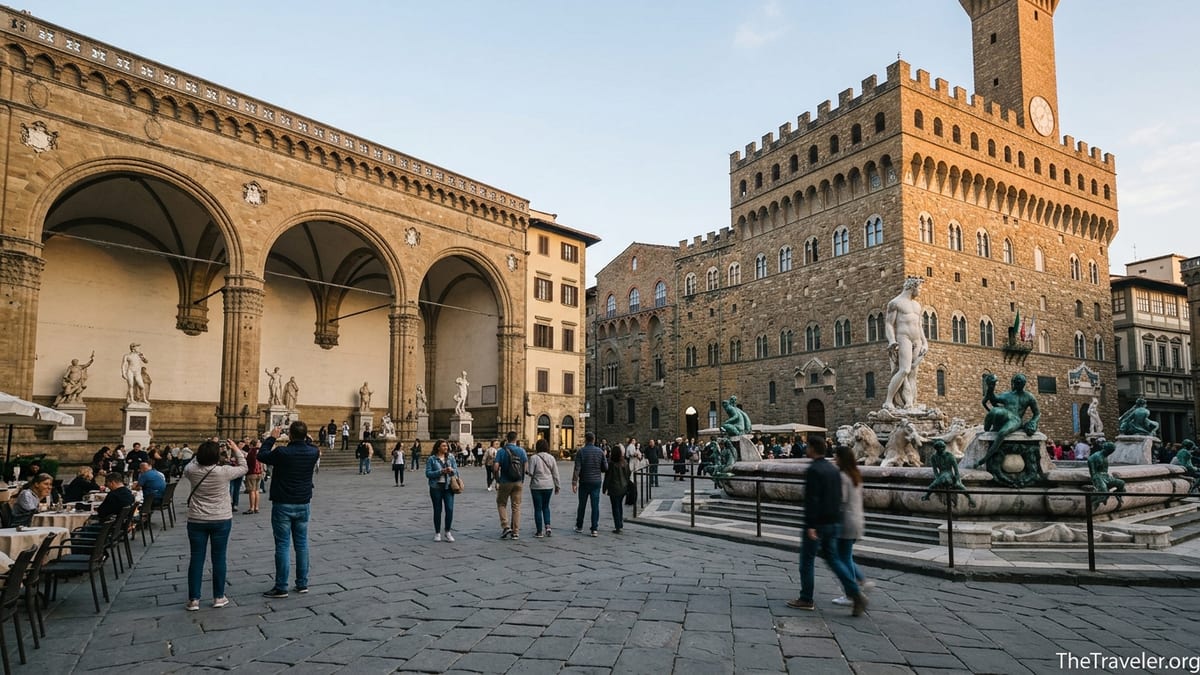
Florence’s Outdoor Throne Room
Piazza della Signoria sits at the political heart of Florence’s historic center, just a five to ten minute walk south of the Duomo along Via dei Calzaiuoli. The medieval bulk of Palazzo Vecchio dominates the eastern side of the square, its crenellated tower once the tallest symbol of civic power on the skyline. This is where the Signoria, the ruling council of the Florentine Republic, met, legislated and sometimes ordered executions in full view of the populace. Today, city government offices still occupy the building and Palazzo Vecchio functions as both town hall and museum, so the sense that this is a working civic space has never entirely faded.
Unlike the tight canyon streets that lead to it, Piazza della Signoria opens abruptly into a wide, irregular space flooded with light. Cafes spill tables onto the paving stones, office workers cross the square with takeaway coffee and school groups cluster under guides’ umbrellas. It is easy to see it as just another pretty piazza on the route between the Duomo and Ponte Vecchio, yet this is the square where Florentines historically gathered when anything important happened, from the return of the Medici to 20th century liberation celebrations and modern political demonstrations.
Spend ten minutes here at different times of day and you notice how the square still functions as the city’s outdoor throne room. In the morning, delivery vans edge carefully between the statues to supply nearby businesses. By late afternoon, when the long shadows of Palazzo Vecchio reach the Fountain of Neptune, you might catch a street musician playing under the Loggia dei Lanzi or see a small march organizing beside Via dei Gondi before heading off through the historic center. The square is not preserved under glass. It is still used, argued over and walked across by locals every day.
Where Revolutions, Bonfires and Public Justice Played Out
Skipping Piazza della Signoria means stepping over the very stones where Florence’s most dramatic episodes unfolded. In the late 15th century, this was the stage of the Dominican friar Girolamo Savonarola, who denounced Medici luxury and foreign corruption. Here he organized the famous "Bonfire of the Vanities" in 1497, when citizens piled paintings, books and fine clothes into a great pyre. A year later, on almost the same spot, Savonarola himself was hanged and burned after being condemned by the same public he had once inflamed.
For centuries, public justice and punishment took place in this square. When rival factions fought for control of the Republic, victorious leaders made sure their enemies’ sentences were carried out in Piazza della Signoria where everyone could see. The open space allowed large crowds to gather, and the looming façade of Palazzo Vecchio underscored who held power at any given moment. Travelers reading accounts from the 15th and 16th centuries often find the square mentioned in the same breath as executions and triumphal processions, which gives a sense of how central it was to Florence’s political life.
Even in the modern era, the square has not lost that function as a space for public expression. Local associations have organized flash mobs here to protest changes to sales tax on feminine hygiene and infant products, and rallies against gender-based violence have filled the square with hundreds of people wearing red or holding placards. When national demonstrations about international conflicts reached Florence, Piazza della Signoria again became the natural gathering point before marches moved along the river or towards Santa Maria Novella. To walk through without pausing is to miss how Florentines still use their historic center to speak to power.
An Open-Air Sculpture Gallery You Do Not Pay to Enter
Travelers often budget carefully for Florence’s museums, weighing whether they can afford tickets for both the Uffizi and the Accademia, which commonly cost the equivalent of several cafe lunches per person. Yet right in Piazza della Signoria there is an open-air sculpture gallery that costs nothing at all to enjoy, and many visitors barely give it more than a passing glance. The Loggia dei Lanzi, on the south side of the square, houses masterpieces such as Benvenuto Cellini’s bronze Perseus holding the head of Medusa and Giambologna’s dynamic Rape of the Sabine Women, all under a 14th century vaulted shelter.
Walk a few steps out into the square and you are surrounded by monumental works. A muscular, marble Hercules and Cacus stands to the right of Palazzo Vecchio’s entrance. Beside it, a gleaming copy of Michelangelo’s David occupies the exact spot where the original guarded the doorway for nearly three centuries before being moved to the Accademia in the 19th century. Across the paving, Donatello’s Judith and Holofernes is represented by another replica, while the originals rest inside museums for protection. Even knowing that some are copies, many art historians point out that these works were designed to be read in this exact urban context, with the square, palace and passing crowds as their backdrop.
The Fountain of Neptune, known locally as the Biancone for its pale marble, anchors the northwest corner of the piazza with a sea god rising from a ring of bronze figures. Sculptor Bartolomeo Ammannati’s design was commissioned to celebrate Florence’s brief naval ambitions under Medici rule in the 16th century. Despite mixed reviews from contemporaries who preferred Michelangelo’s work, the fountain remains a key symbol of Florence and a magnet for evening crowds. After recent restoration campaigns, details such as the curls of Neptune’s beard, the tritons and the bronze horses are again clearly visible, rewarding anyone who approaches for a closer look.
The Political Meaning Behind the Marble
One reason Piazza della Signoria matters so much is that its sculptures were never just decoration. They are statements about power, virtue and public order, selected and positioned to send messages that ordinary Florentines could understand. Michelangelo’s David, for example, stood here as a symbol of the small but defiant republic facing much larger enemies. Citizens walking to market or to Mass passed the youthful shepherd every day, a reminder that intelligence and courage could defeat brute strength.
Cellini’s Perseus, holding Medusa’s severed head high in the Loggia dei Lanzi, was completed under Cosimo I de’ Medici and positioned where it faces towards the palace entrance. To a 16th century audience, the image of a hero destroying a monster carried clear political overtones. It signaled that the new ducal regime would eliminate threats and cement order. Similarly, the group of Hercules and Cacus, with its raw display of controlled force, read as a warning to potential rebels: this was a government that admired strength combined with discipline.
Even the Neptune Fountain carries layered meaning. Commissioned to honor a Medici duke’s control over Tuscan ports, it turned the square into a stage for celebrating Florence’s maritime ambitions. Locals today sometimes joke that visitors seem more interested in snapping selfies than in the fine points of Medici water politics, but the fountain’s very presence still nods to the era when rulers used public art to project their reach far beyond the Arno. Understanding these statues as deliberate political tools rather than random ornaments deepens any visit to the square.
A Hub That Connects Florence’s Big-Hitters
From a practical standpoint, bypassing Piazza della Signoria makes little sense because it naturally knots together Florence’s most famous sights. To the east is Palazzo Vecchio, whose museum offers access to frescoed council halls and, for a separate fee, the tower with views over the dome of the Duomo. To the south, under a shallow arch, lies one of the entrances to the Uffizi Gallery, whose official directions often describe the building complex as running between Piazza della Signoria and the Arno River. A traveler with a timed Uffizi ticket can comfortably spend part of their waiting period exploring the statues in the square just steps away.
Walk north along Via dei Calzaiuoli for five to ten minutes and you reach Piazza del Duomo, with the cathedral, bell tower and baptistery crowding the skyline. Many visitors report that their first day in Florence naturally follows this line, from Santa Maria Novella station through the Duomo to Piazza della Signoria and then to Ponte Vecchio. The city center is compact enough that you can stroll this route without taking public transport, and several independent guides describe the walk between the Duomo and Piazza della Signoria as just under a kilometer. In practice, the shops and gelaterie that line the route ensure that most travelers stretch that stroll into an hour.
Because the square sits on this main axis, it also makes a logical base for exploring the center. Apartments and small hotels within a block or two of Piazza della Signoria put you within a fifteen to twenty minute walk of nearly every major sight, from the Accademia to Santo Spirito across the Arno. Travelers who choose to stay slightly outside the very center often mention in reviews that they still plan at least one early morning or late evening pass through the square, when most tour groups have gone and the paving stones are washed with softer light.
Everyday Life Between Tour Groups and Historic Ceremonies
While Piazza della Signoria attracts constant waves of organized tours, it is also woven into Florentine daily routines in small but telling ways. Office workers cut diagonally across the square to reach streets like Via della Condotta or Borgo dei Greci. Local teenagers gather on the low steps near the Loggia dei Lanzi with takeaway pizza, using the statues as meeting points. Street musicians set up by late afternoon, and it is not unusual to hear a cellist playing classical pieces that echo off the palazzo walls while children chase pigeons nearby.
The square also hosts formal civic occasions. Historical parades linked to events such as the Calcio Storico tournaments use Piazza della Signoria as either a starting or arrival point, with participants dressed in Renaissance-style costumes bearing flags and drums. On certain feast days and anniversaries, the city organizes processions that begin inside Palazzo Vecchio, descend the broad staircase and emerge directly into the square, reminding everyone that the palace is not just a museum but a living institution.
In recent years, large international events have also recognized the square’s symbolic power. When Florence hosted ceremonial moments for major cultural festivals or sporting events, such as pre-race presentations and ribbon cuttings, Piazza della Signoria has been chosen as a prestigious backdrop, sharing the honor with spaces like Piazzale Michelangelo. These choices underline how the city continues to see the piazza as its public face, the place most likely to be photographed, televised and shared with the world.
How to Experience Piazza della Signoria Without Rushing
Because it costs nothing to visit and sits on the way between headline sites, many travelers treat Piazza della Signoria as a quick corridor rather than a destination. To appreciate it properly, it helps to schedule at least half an hour here during a quieter time. Early morning, before the first big tour groups reach the Uffizi, gives you room to walk up close to the statues without jostling. Late evening, once most day-trippers have gone back to buses and trains, offers a very different mood, with the palace and Loggia softly lit and the square buzzing with locals out for an aperitivo.
A simple way to structure your visit is to walk the perimeter in a slow circle. Start opposite Palazzo Vecchio, so you can take in its full façade and tower. Continue towards the Loggia dei Lanzi and step inside under the arches, noting how the sculptures interact with the city outside. Pause by the Neptune Fountain long enough to pick out the details of the bronze figures and the surface of the marble, worn and restored over centuries. Then approach the entrance to Palazzo Vecchio and imagine the original David standing there, as contemporaries did when reading the political messages embedded in the statue’s posture and gaze.
If your budget and schedule allow, consider pairing time in the square with a short visit inside Palazzo Vecchio, or at least climbing the tower. The view back down into Piazza della Signoria from above helps you read how the space connects to the rest of the historic center, with the straight line of Via dei Calzaiuoli leading towards the Duomo and the Uffizi courtyard framing the river beyond. Even travelers who do not climb often find value in ducking into the palace’s courtyard, which is accessible for free and offers a cool, frescoed contrast to the bright expanse of the square outside.
The Takeaway
For many visitors, Florence becomes a checklist of major sites: Duomo, Uffizi, Ponte Vecchio, possibly a day trip to Pisa or Siena. Piazza della Signoria is sometimes treated as merely the space you cross between those destinations, but doing so means overlooking the square that best condenses the city’s story into one walkable frame. Here the Florentine Republic debated its future, Medici dukes projected their power, reformers preached and were punished, and modern citizens still gather to protest, celebrate and mark important days.
You can see world-class sculpture here without queuing or buying a ticket, from the taut muscles of Hercules and Cacus to the swirling forms in the Loggia dei Lanzi. You stand where Michelangelo’s David once confronted the city and where the Neptune Fountain continues to spark debates about restoration, vandalism and the responsibilities of mass tourism. The square neatly links the Duomo, Uffizi, Palazzo Vecchio and the riverfront, making it not only historically essential but also logistically unavoidable for anyone exploring the city center.
Taking time to truly see Piazza della Signoria, rather than just passing through with a camera, adds a layer of understanding that colors the rest of your stay. The next time you glimpse Brunelleschi’s dome from a side street or cross the Arno at sunset, you will know that the city’s civic heart still beats in this irregular, statue-filled square, just as it has for hundreds of years.
FAQ
Q1. Where is Piazza della Signoria located in relation to the Duomo?
The piazza lies about a five to ten minute walk south of the Duomo along Via dei Calzaiuoli, forming one end of the main north–south axis of Florence’s historic center.
Q2. Is it worth visiting Piazza della Signoria if I only have half a day in Florence?
Yes. Because the square sits between the Duomo, Uffizi and Ponte Vecchio, you will likely pass through anyway, and even a 20 minute stop adds important context to your visit.
Q3. Does it cost money to see the statues in Piazza della Signoria?
No. All of the sculptures in the square and under the Loggia dei Lanzi can be viewed for free at any time, making it one of Florence’s most valuable open-air galleries.
Q4. Are the statues in the piazza originals or copies?
Some, like the David and Judith and Holofernes, are represented by high-quality copies outdoors while the originals are preserved in museums, but several important works in the Loggia are originals in their historical positions.
Q5. What is the best time of day to visit Piazza della Signoria?
Early morning offers fewer crowds and softer light on the statues, while late evening provides a pleasant atmosphere with illuminated buildings and locals out for drinks.
Q6. Is Piazza della Signoria safe to visit at night?
In normal circumstances it remains busy and well lit into the evening, with cafes open and people passing through, though visitors should follow usual city precautions with valuables.
Q7. Can I visit Palazzo Vecchio from the piazza?
Yes. The main entrance of Palazzo Vecchio opens directly onto the square, giving access to the museum, guided tours and, with a separate ticket, the tower climb overlooking the city.
Q8. How long should I plan to spend in Piazza della Signoria?
Plan at least 30 minutes to walk the perimeter, study the statues and step into the Loggia dei Lanzi. If you also visit Palazzo Vecchio, allow two to three hours in total.
Q9. Are there public events or protests often held in the piazza?
Yes. The square is a traditional gathering point for civic ceremonies, small demonstrations and cultural events, although most days you will simply see regular city life mixed with visitors.
Q10. Can I sit and have a drink or meal in Piazza della Signoria?
Several cafes and restaurants on the square offer outdoor seating, where you can expect to pay a premium compared to side streets, but you gain uninterrupted views of the statues and palace.