


I expected Piazza della Signoria in Florence to feel like a beautiful relic. Instead, standing between the Palazzo Vecchio and the open arches of the Loggia dei Lanzi, I was struck by how intensely alive the square still felt. For all its statues, museums and centuries of history, this is not a quiet monument preserved under glass. It is a place that breathes, argues, performs, eats, protests and lingers late into the night.
Get the latest updates straight to your inbox!
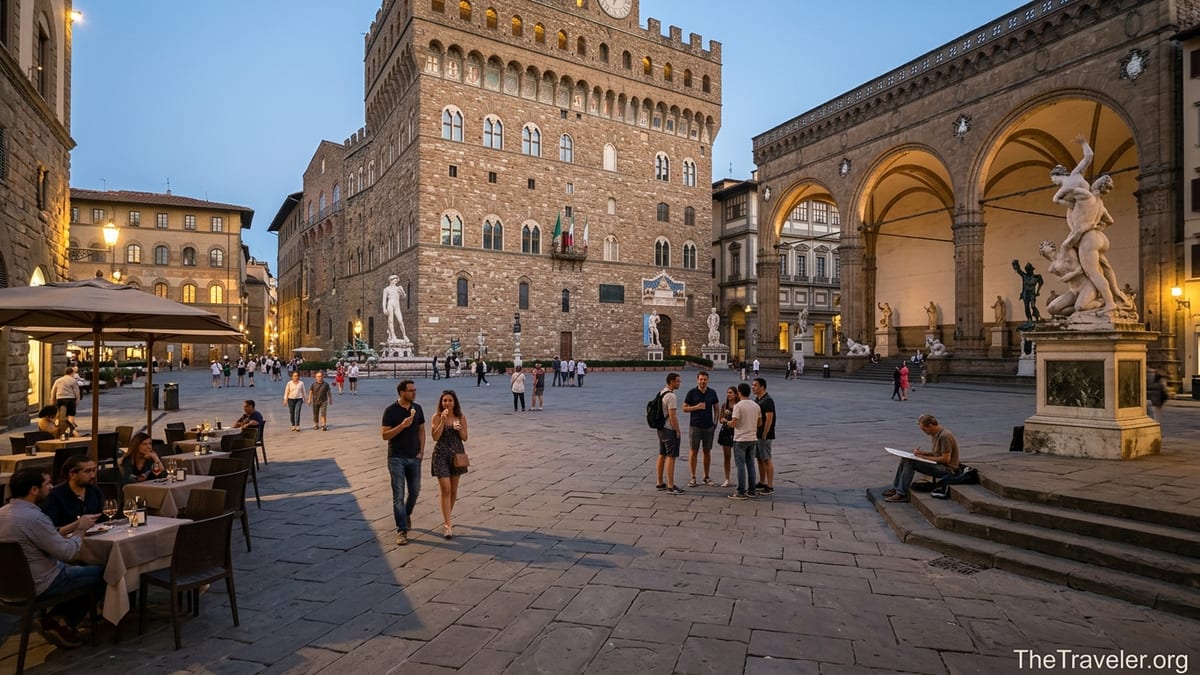
A Medieval Power Stage That Still Hosts Daily Life
The first surprise hits the moment you step out from the narrow streets into the vast openness of Piazza della Signoria. This was the political heart of the Florentine Republic, the stage for announcements, executions and revolution. Today, instead of armored riders and messengers, you are more likely to dodge rolling suitcases, a florist’s delivery bike and families pushing strollers across the same paving stones.
On one side rises Palazzo Vecchio, the fortress-like town hall whose crenellated tower appears in almost every postcard of Florence. Its stone walls once housed powerful councils and, later, the Medici dukes. Now, on a typical afternoon, you will see school groups gathering on the steps, guides holding up colored umbrellas, and travelers checking ticket times for the Palazzo Vecchio museum while office workers slip through a side entrance to get back to modern city business inside.
The square is rarely empty. At around 9 in the morning in high season, you might see delivery vans easing along one edge, dropping off goods for cafés under strict time windows before pedestrian-only rules take over. By midmorning the paving fills with walking tours in half a dozen languages. Yet among the visitors you still notice locals cutting diagonally across the piazza, using it as an everyday shortcut between Via dei Calzaiuoli and the Uffizi or the river, earbuds in and eyes on their phones like in any other European city.
In the evening, the atmosphere shifts again. Office lights in Palazzo Vecchio glow behind small windows, and the square takes on the feel of a public living room. Couples lean on the low stone barriers that protect the Fountain of Neptune, teenagers gather in clusters near the equestrian statue of Cosimo I, and older Florentines claim the same bench near the Loggia dei Lanzi night after night, quietly observing it all.
An Open-Air Sculpture Gallery That People Actually Use
Many European squares have statues; what is unusual in Piazza della Signoria is how intimately people live beside them. The Loggia dei Lanzi, at the south side of the square, is essentially an open-sided sculpture gallery that has functioned as a public space since the late 1300s. Grand arches shelter masterpieces like Benvenuto Cellini’s bronze “Perseus with the Head of Medusa” and Giambologna’s twisting marble “Rape of the Sabine Women,” both still in place after centuries of weather and politics.
Instead of being roped off behind glass, these works stand almost at arm’s length. On a typical day you will see art students from the nearby academies sitting on the wide stone steps of the loggia with sketchbooks open, trying to capture the curve of a marble arm or the angle of Perseus’s sword. A few meters away, a tired family might settle on the same steps to share a packet of bakery biscuits from Via dei Neri, barely glancing at the statues that art history books treat as icons.
That closeness can have consequences. The city has increased surveillance around the Fountain of Neptune and other works after a series of high-profile incidents where visitors climbed statues for selfies and caused damage. Barriers are now a little higher and signs more explicit about fines. Even so, the overall feeling remains remarkably relaxed. Street musicians sometimes choose the shelter of the loggia as their stage, their guitar cases resting on the same stone floor where public ceremonies once took place.
For a visitor, this mix of high art and casual use is disorienting in the best way. You can stand inches from Renaissance bronze, listening to an impromptu violin performance and the hum of café conversation drifting across the square. It feels less like a curated museum and more like a shared inheritance that locals and visitors negotiate together every day.
Café Tables, Aperitivo Culture and New Rules
Another element that keeps Piazza della Signoria so alive is its café culture. Along one side of the square, under the arcades, you will find long-established cafés and restaurants that spill tables onto the paving in good weather. A late-morning cappuccino here costs noticeably more than it would at a bar on a side street, but many visitors still settle in willingly for the view of Palazzo Vecchio and the constant people-watching.
Prices vary by season and seating. At a typical table-service café directly on the square, you might pay in the region of 4 to 6 euros for an espresso-based drink and 10 to 15 euros for a spritz during aperitivo hours, sometimes more if live music is included. Snacks like a simple plate of olives or chips can add a few more euros. The premium goes not to the ingredients but to the setting: a front-row seat on centuries of history and human theater.
Florence’s city government has been adjusting how outdoor dining works in the historic center, particularly in areas within the UNESCO World Heritage zone. From 2026, stricter rules will limit or remove some temporary outdoor structures in the streets around major monuments, including those just off Piazza della Signoria, in an effort to protect views and reduce congestion. For travelers, this may mean fewer bulky platforms and plastic enclosures and more emphasis on lighter, seasonal setups like removable chairs, small planters and parasols.
In practice, you are still likely to find places to sit with a drink on the square itself, especially in spring and summer evenings, but the layout of terraces may feel slightly more open than the dense rows of tables that became common in the early 2020s. The underlying ritual, however, will remain the same. Around 6 or 7 in the evening, locals and visitors alike order spritzes or glasses of Tuscan wine, and plates of simple snacks begin to appear as the sky turns soft gold behind the tower of Palazzo Vecchio.
Street Performers, Protests and the Soundtrack of the Square
One of the clearest signs that Piazza della Signoria is still a civic space rather than just a postcard is its sound. On any given day, the background noise might include the murmur of tour commentary, the chime of Palazzo Vecchio’s clock, and a busker’s rendition of Vivaldi or contemporary pop echoing off the stone façades.
Street performers tend to cluster closer to the Uffizi exit or along the edge of the square rather than directly beneath the statues, but their presence shapes the atmosphere. A violinist might draw a ring of listeners who stand half in the sun, half in the loggia’s shade, while children dance in front, gelato in hand. At night, you can sometimes hear a small amplified act drifting into hotel rooms facing the square, turning the piazza into a shared concert hall for a few songs.
This open character also makes Piazza della Signoria a natural gathering point during political or social events. Demonstrations and rallies still pass through here, using the space between the statues of David’s replica and Cosimo I’s horse as a symbolic backdrop. Locals recall rallies in recent years related to labor disputes, cultural funding and national politics, where banners and megaphones briefly replaced selfie sticks and guide flags.
Even outside organized events, there is a constant micro-drama playing out: a street artist spreading out prints on the stones, a city worker asking an unauthorized vendor to move along, a wedding party cutting across the square for photos in late afternoon light. The square is tightly monitored by municipal police and cameras, yet the human energy remains unpredictable and unscripted.
Layers of History Under Your Feet
The sense of vitality in Piazza della Signoria comes not only from what you see but from what lies just below the surface. Archaeological work in the 1980s revealed layers of earlier structures beneath the paving, including remnants of Roman Florence. Today, most visitors are unaware that as they stand near the Fountain of Neptune, they are above what was once a tangle of earlier streets and buildings.
Inside Palazzo Vecchio, a guided visit can take you down into parts of this buried past, where interpretive panels explain how the medieval and Renaissance city literally built on top of its predecessors. Stepping back out into the open sunlight of the square, with the massive tower overhead and the Uffizi’s long galleries just beyond, you feel that vertical layering of time in an unusually direct way.
Even the statues themselves tell stories of political change. The copy of Michelangelo’s David that guards the entrance to Palazzo Vecchio recalls the original that once stood here as a symbol of republican defiance before it was moved indoors to the Accademia Gallery for protection. Nearby, the Fountain of Neptune, begun in the 16th century, celebrates Medici ambitions over maritime trade, though Florentines famously gave it the nickname “il Biancone,” roughly “the white big guy,” hinting at their mixed feelings.
Walking across the square at dusk, you might notice how the floodlights pick out details on Perseus’s bronze muscles or the marble folds of a Sabine woman’s dress. It is easy to imagine processions and speeches taking place here centuries ago. Yet you are also sharing the same paving with a courier delivering takeout from a trattoria on Via dei Neri and a teenager scanning for a ride-hail car on nearby Via dei Leoni. Past and present collide at every step.
Practical Ways to Experience the Square’s Living Character
To feel how alive Piazza della Signoria still is, timing and perspective matter. Arriving just after sunrise, perhaps in late spring, you may find only a handful of early risers and street cleaners in fluorescent vests. This is when you can stand alone in front of the replica David or Perseus, listening to the sound of rolling trash bins and the distant bells from other churches in the historic center. Café shutters are still down, and delivery workers pull steel trolleys stacked with crates of mineral water and espresso cups.
By late morning, especially between April and October, the square becomes one of the densest concentrations of visitors in Florence. For travelers who want to appreciate the art without constant jostling, stepping into the Loggia dei Lanzi itself can provide a little relief. From inside, you can look out at the crowd while staying in the shade, and the elevated floor gives a slightly detached vantage point from which to observe the currents of people making their way toward the Uffizi or the river.
Lunch hours are a good time to notice how locals still use the square. Office workers from nearby streets may cross the piazza carrying paper-wrapped panini from small bakeries, choosing to eat on a low step rather than at a full-service restaurant. You will also see municipal employees checking stone surfaces for graffiti, a constant concern in such a heavily visited space, and adjusting barriers around vulnerable sculptures after busy weekends.
After dark, the rhythm changes again. While the area remains busy, the proportion of day-trippers to overnight visitors shifts. People staying in central hotels or apartments often return to the square after dinner, walking off plates of bistecca alla fiorentina or bowls of ribollita. Photographers set up small tripods near the center of the piazza to capture Palazzo Vecchio and the statues lit against the night sky. The mood feels less hurried, and you may find it easier to stand still for a few minutes and simply absorb the layered sounds and sights.
The Takeaway
What surprised me most about Piazza della Signoria was not its beauty, which I expected, but the way its beauty is constantly in motion. This is a place where masterpieces of Renaissance sculpture share space with delivery carts and protest banners, where a city hall dating back to medieval power struggles still functions as the seat of local government, and where café tables come and go in response to new rules yet the ritual of meeting for an evening drink endures.
Many historic squares risk becoming stage sets, frozen for visitors. Piazza della Signoria has not. Its statues have been copied, restored and sometimes fenced more carefully, and the city continues to adjust how commerce and conservation coexist here. Yet day after day, Florentines still cross the piazza on their way to work, musicians still test the acoustics of the loggia, and children still chase pigeons between the shadows of Neptune and David.
If you approach the square expecting only a checklist of famous sights, you might miss its most compelling quality: the sense that history is not locked in the past but is actively negotiated on these stones every hour. Stand for a few minutes near the center and look around. You will see centuries of politics, art and everyday life compressed into a single open space that, remarkably, still feels like the beating civic heart of Florence.
FAQ
Q1. Where exactly is Piazza della Signoria in Florence?
Piazza della Signoria sits in the historic center of Florence, just behind the Duomo area, directly in front of Palazzo Vecchio and beside the Uffizi Galleries, a few minutes’ walk from the Arno River.
Q2. Is Piazza della Signoria free to visit?
Yes. The square itself and the Loggia dei Lanzi with its sculptures are free and open at all hours. You only pay if you enter nearby museums like Palazzo Vecchio or the Uffizi.
Q3. What is the best time of day to experience the square?
Early morning offers quieter views and soft light on the statues, while evening brings lively aperitivo crowds and buskers. Midday is the busiest and can feel crowded, especially in peak season.
Q4. Can you sit on the steps of the Loggia dei Lanzi?
In practice, many people do sit on the lower steps, and it is generally tolerated as long as you respect the artworks, avoid eating messy food and follow any instructions from local police or security.
Q5. Are there cafés and restaurants directly on the square?
Yes, several historic cafés and restaurants line the piazza. Prices are higher than on nearby side streets, but you are paying partly for the view and atmosphere over the square.
Q6. Is it safe to be in Piazza della Signoria at night?
The area is usually well lit and busy into the evening, with regular police presence. As in any crowded tourist area, keep an eye on personal belongings and avoid obvious scams.
Q7. How long should I plan to spend in Piazza della Signoria?
Plan at least 30 to 45 minutes to look closely at the statues and soak in the atmosphere. If you combine it with a visit to Palazzo Vecchio or the Uffizi, you can easily spend several hours nearby.
Q8. Can I see the original statue of David in the square?
No. The statue outside Palazzo Vecchio is a copy. The original Michelangelo David is housed in the Galleria dell’Accademia elsewhere in Florence to protect it from weather and pollution.
Q9. Are there public restrooms in or near the square?
There is no large stand-alone public restroom in the center of the piazza, but you will find facilities inside nearby museums and in some cafés for customers, as well as signed public toilets within a short walk.
Q10. Do events or protests still take place in Piazza della Signoria?
Yes. The piazza remains a symbolic civic space, so occasional rallies, cultural events and performances still happen here, sharing the square with everyday visitors and café-goers.