


On a coastline lined with marquee names like Nice, Cannes and Saint-Tropez, it is surprisingly easy to overlook Plage de la Garoupe, a modest crescent of sand on Cap d’Antibes. Yet for many Riviera regulars, this sheltered cove is exactly what they picture when they dream of the Mediterranean: translucent turquoise water, honey-colored sand, pine trees leaning toward the sea and low-slung villas hidden behind stone walls. Skipping it would mean missing one of the French Riviera’s most atmospheric and historically rich beaches.
Get the latest updates straight to your inbox!
Why This Quiet Crescent Rivals the Riviera Icons
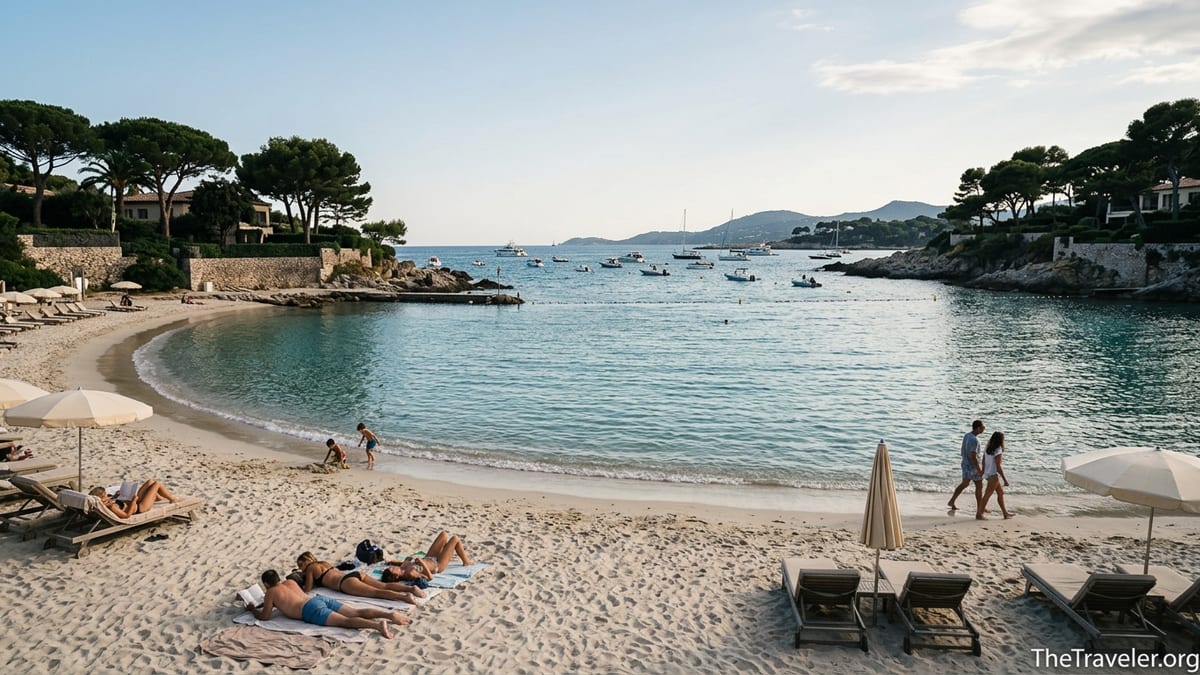
Stand on the sand at Plage de la Garoupe and you instantly understand why it has long been counted among the loveliest beaches on the Côte d’Azur. The bay forms a near-perfect curve on the eastern side of Cap d’Antibes, protected from the prevailing swell and framed by rocky headlands that keep the water unusually calm. Unlike the pebbled shores in Nice, the sand here is soft and pale, so you can walk barefoot straight into the sea without needing plastic beach shoes. On clear days the views stretch across the Baie des Anges toward the Alps, with the old town of Antibes etched along the horizon.
The setting is particularly striking compared with some of the Riviera’s more built-up strips of sand. On La Croisette in Cannes or the Promenade des Anglais in Nice, multi-lane roads and high-rise hotels crowd the back of the beach. At Garoupe you are instead backed by umbrella pines, low stone walls and discreet villas. There are restaurants and beach clubs, but nothing climbs higher than a couple of storeys, which keeps the scale human and the atmosphere intimate. Even when every lounger is full in August, the cove still feels like a place carved into nature rather than a strip of urban waterfront.
The water here has a different character too. The bay’s shelter and sandy bottom give it that pale, almost milky turquoise that visitors often expect from Riviera postcards but do not always find on more open, shingle beaches. The shallows extend several meters from shore before dropping off, so you can wade out slowly, and families with children can let them splash near the edge with relative peace of mind. A line of yachts and small boats often anchors just outside the swimming zone, adding to the picture-book scene without disturbing swimmers close to shore.
A Beach with a Literary and Glamorous Past
For all its present-day tranquility, Plage de la Garoupe has played a starring role in the mythology of the Riviera. In the 1920s, American expatriates Gerald and Sara Murphy settled on Cap d’Antibes and spent months clearing this beach of seaweed and old fishing gear to make it more appealing to their circle of friends. Their efforts helped shift the Côte d’Azur from a winter escape for aristocrats into a summer playground that lured painters, writers and movie stars. Regulars included figures like F. Scott Fitzgerald, whose novel "Tender Is the Night" was inspired by the social whirl around Antibes, and Pablo Picasso, who would later spend time in the town’s Château Grimaldi.
Much of that glamour still lingers, if more softly than in the heyday of the Jazz Age. Private villas built during the Belle Époque and interwar period still dot the cap, hidden behind high walls and thick vegetation. The Garoupe lighthouse and the nearby chapel of Notre-Dame de la Garoupe sit above the beach on a plateau, reminders of the cape’s longer maritime history, when sailors offered ex-votos in thanks for safe passage. For today’s visitor, that combination of literary legend, nautical heritage and effortless elegance gives the beach a sense of depth you might not feel on more anonymous stretches of sand.
Even small details hint at this heritage. Regulars often arrive from nearby boutique hotels in Antibes or from classic properties further along the coast, such as the grand hotel on the western side of the cap. At lunch, elderly locals in crisp linen share tables with families from Paris and couples from abroad, all lingering over chilled rosé and grilled sea bream as cicadas buzz in the pines above. The scene has changed since the days of Fitzgerald, but the essential ingredients of Riviera dolce vita are still very much in evidence.
Understanding the Layout: Public Patches and Private Clubs
Plage de la Garoupe today is a patchwork of public sand and private concessions, and understanding this layout can make the difference between a frustrating visit and a perfect day. The majority of the bay is occupied in season by established beach clubs, notably Plage Keller and Plage Joseph, which offer rows of sun loungers, waiter service and full-service restaurants directly on the sand. Between them sit small slivers of free public beach, especially toward the northern end of the cove, where anyone can spread a towel without paying a centime.
In practice, this means you have two very different experiences available. Opt for the public section and you get the same sparkling water and postcard view as the guests in the front-row loungers, but you will need to bring your own shade and sit fairly close to your neighbors in peak summer. Facilities are basic but functional: seasonal lifeguards, outdoor showers and simple public toilets set back from the sand. This setup appeals to budget-conscious travelers and locals, including families who arrive early with coolers, parasols and inflatable toys.
Choose a private club and your day takes on a more polished tone. A typical front-row lounger with umbrella at one of the main clubs in July might cost around 35 to 55 euros per person for a full day, with slightly lower prices in June and September and higher rates for prime first rows. At Plage Keller, for example, guests can reserve a sunbed in advance, order coffee to the mattress in the morning, then break for lunch on a shaded terrace overlooking the bay, before returning to their spot for an afternoon swim. Service usually includes towels, drinks and snacks delivered to your lounger and access to changing cabins and more comfortable showers.
For many visitors, the ideal compromise is to mix the two: spend a day or two in a beach club to savor the classic Riviera experience, then return another morning to enjoy the public section at sunrise, when even in August you might share the bay with just a few local swimmers and paddleboarders. Knowing that these choices exist is what allows Garoupe to work for a broad range of travelers, from backpackers passing through Antibes by train to honeymooners splurging on a once-in-a-lifetime stay.
Planning a Visit: When to Go and How to Get There
Cap d’Antibes lies between Antibes and Juan-les-Pins, making Plage de la Garoupe relatively easy to reach from most Riviera bases. From central Antibes, the beach is roughly a ten to fifteen minute drive by taxi in light traffic, though in July and August the single-lane road that loops around the cap can slow to a crawl at peak times. Local buses connect Antibes with Cap d’Antibes, typically stopping within walking distance of the beach, and many visitors staying in Antibes or Juan-les-Pins simply rent a bicycle or e-bike, as the gradients on the peninsula are modest and distances short.
If you are driving, plan to arrive early. Parking near the beach is limited to a small paid lot and a scattering of roadside spaces along Chemin de la Garoupe and nearby streets. By 10 a.m. in midsummer, these spots can be full, pushing latecomers farther up the hill or onto less convenient residential roads. A practical alternative is to leave the car closer to Antibes, for instance near Plage de la Salis or in one of the town’s structured car parks, and either walk or take a local bus the rest of the way. The walk from Plage de la Salis to Garoupe takes around thirty to forty minutes at a leisurely pace and follows the shoreline for much of the route.
Timing your visit also matters. In late June and early September, the sea is warm, beach clubs are still operating and the crowds are thinner than at the height of the French vacances. May and October can bring beautifully clear days, but the water may feel brisker and some facilities operate on reduced hours or close entirely. If your schedule is fixed to July or early August, aim for either an early start, arriving by 9 a.m., or a late-afternoon session from around 4 p.m., when families begin to leave and the light over the bay turns golden. Sunrise visits can be particularly special: locals jog along the shoreline, the sea is glassy and tranquil, and the scent of pines is strongest before the heat builds.
From Beach Towel to Coastal Trail: Making a Day of It
One of the most compelling reasons not to skip Plage de la Garoupe is that it opens directly onto one of the Riviera’s most scenic coastal walks. At the southern end of the beach begins the Sentier du Littoral, also known locally as the Chemin des Douaniers or the Tire-Poil trail, a path that hugs the cliffs for several kilometers around the tip of Cap d’Antibes. The route threads between low rock walls and the crashing sea, with views out to the Lérins Islands and back toward the skyscrapers of Nice in the distance.
Many visitors structure their day so that beach time and hiking complement one another. A common pattern is to arrive mid-morning, swim and sunbathe for an hour or two, then set off on the coastal path just as the sand becomes hottest. The main cliff-hugging section from Garoupe toward the area near Villa Eilenroc typically takes about two hours of steady walking, including stops to photograph secluded coves or watch waves exploding against the rocks. Underfoot, the path alternates between smoothed rock and sculpted steps, with some narrow sections where you will want good footwear rather than flip-flops.
There are few reliable places to reach the sea from the cliff trail, but determined swimmers often detour at known access points such as Baie des Milliardaires, where ladders and small landings make it possible to slip into deep, exceptionally clear water. For less adventurous walkers, the reward is simply the sense of immersion in scenery that feels far wilder than you would expect this close to resort towns. Returning to Plage de la Garoupe for a late-afternoon dip and an ice cream from a nearby kiosk makes a satisfying conclusion, and you will have seen a side of Cap d’Antibes that beach-only visitors often miss.
If you prefer a gentler outing, you can swap the coastal hike for a stroll up to the Garoupe lighthouse and chapel on the plateau above the beach. The climb follows shady lanes and occasionally steep paths, but the payoff is a broad panorama taking in Antibes, Nice, the Alps and the shimmering arc of the Baie des Anges. Many travelers bring a simple picnic from a boulangerie in Antibes and eat it at one of the viewpoint benches before walking back down to the sand for a swim.
How Garoupe Compares to Other Riviera Beaches
Travelers planning a short trip to the Côte d’Azur often weigh Plage de la Garoupe against more famous beaches. Compared to the long shingle stretch along Nice’s Promenade des Anglais, Garoupe offers softer sand, calmer water and a more human scale. Nice’s beach wins on urban buzz, convenience and nightlife, but if your mental picture of the Mediterranean involves actually walking on sand, Garoupe comes closer. Families in particular may appreciate the shallow, sheltered bay, while adults who enjoy an evening passeggiata might still opt to base themselves in Nice and visit Garoupe as a day trip.
Against Cannes or Juan-les-Pins, the comparison is subtler. Both have sandy beaches with a full suite of services. La Croisette in Cannes is grander and more ostentatious, lined with designer boutiques and luxury hotels; Juan-les-Pins is lively, with a younger crowd and busy bars. Garoupe, by contrast, feels more intimate and residential. There are upscale beach clubs and polished restaurants, but they are surrounded by villas and pine groves instead of apartment blocks. If you picture a quieter Riviera, where you step from the sand into narrow lanes with low stone walls and bougainvillea draped over gates, Garoupe delivers that atmosphere more readily.
Even within Antibes, Garoupe has a different character from other local beaches. Plage de la Gravette, near the old town, is a convenient, family-friendly public beach tucked behind the harbor walls, with easy access to ice cream shops and cafés. It is lovely in its own way, and many visitors staying inside the ramparts use it as their daily swimming spot. Yet the setting is more urban, with concrete piers and the bustle of the port close at hand. The extra effort required to reach Garoupe rewards you with a cove that feels separate from town life, even though it lies only a few kilometers away.
Practical Tips to Make the Most of Your Day
To truly appreciate Plage de la Garoupe, a bit of practical planning goes a long way. Start with footwear: while the main beach is sandy, the approaches and the neighboring rocks are uneven, so pack sandals you can walk in rather than only flimsy flip-flops. If you intend to continue onto the coastal path, bring sneakers or sturdy walking shoes and a small backpack for water and sun protection. The trail offers little shade, and the combination of reflected heat from the rocks and Mediterranean sun can be intense, especially around midday.
Booking ahead is wise if you are visiting between late June and late August and plan to use a private beach club. Many clubs accept reservations by phone and often hold loungers until late morning. Without a booking you may still find spots in the back rows or on the side terraces, but the premium first and second rows closest to the water often sell out days in advance during high season, particularly on weekends. For the public section, early arrival remains your best strategy. By mid-morning, towels cover most of the usable sand, and latecomers end up perched close to the tide line or squeezed against the path.
Food and drink options are another consideration. The beach clubs typically offer full restaurant menus, from grilled fish and seafood platters to salads and pasta, with main dishes commonly in the 25 to 40 euro range. Drinks, including chilled local rosé, cocktails and fresh juices, are widely available, and service continues through the afternoon. If you are relying on the public section, you will need to plan differently: take a picnic from a market in Antibes or Juan-les-Pins, or factor in a short walk to nearby cafés set back from the sand. Local regulations often limit glass on the beach, so opt for reusable bottles or cans rather than wine in traditional glass form.
Finally, think about your exit. Late afternoon, particularly between 5 p.m. and 7 p.m., can bring traffic bottlenecks as beachgoers drive back toward Antibes and Juan-les-Pins. If you are staying nearby, consider lingering a bit longer to enjoy the softer evening light, then walking or cycling back once the roads have cleared. Alternatively, head up toward the lighthouse or along the coastal path for a sunset stroll before returning to town by taxi or rideshare. Many visitors describe this combination of late swim, golden hour walk and simple dinner in Antibes’ old town as their single favorite day on the Riviera.
The Takeaway
In a region rich with beaches, Plage de la Garoupe manages to feel both quintessentially Riviera and quietly individual. Its sheltered turquoise bay, soft sand and backdrop of pines would be enough on their own to justify the detour from Antibes or Nice. Add in its literary history, the immediate access to one of the coast’s most scenic walking trails and the choice between laid-back public patches and polished beach clubs, and it becomes clear why so many seasoned travelers consider it a must-visit stop.
Skipping Garoupe often means defaulting to the most convenient or famous stretches of coastline, which are undeniably enjoyable but can also feel interchangeable after a few days. Here, the scale is small enough that you start to recognize faces if you stay all week; the sea is close enough that you fall asleep to the sound of waves rather than traffic; and between swims you can step straight onto cliff paths or up toward a lighthouse that has watched over sailors for generations. For anyone seeking the Riviera that lives in photographs and novels as much as in travel brochures, Plage de la Garoupe may be the missing piece in the itinerary.
FAQ
Q1. Where exactly is Plage de la Garoupe?
Plage de la Garoupe sits on the eastern side of Cap d’Antibes, between the towns of Antibes and Juan-les-Pins on the French Riviera, a short drive or bus ride from either.
Q2. Is the beach public or private?
The bay is a mix of both. Most of the sand is occupied by private beach clubs in season, but there are clearly marked free public sections, especially toward the northern end of the cove.
Q3. How much does a sun lounger typically cost?
Prices vary by club and season, but in summer you can expect to pay roughly 35 to 55 euros per person for a full-day lounger with umbrella at one of the main clubs.
Q4. Is Plage de la Garoupe suitable for children?
Yes. The water is usually calm and shallow close to shore, with a sandy bottom and lifeguard supervision in the main summer months, which makes it popular with families.
Q5. How do I get to the beach without a car?
Local buses run from central Antibes and Juan-les-Pins toward Cap d’Antibes, stopping within walking distance, and many visitors also walk or cycle from nearby beaches like Plage de la Salis.
Q6. When is the best time of year to visit?
Late June, early July and September offer warm water, operating beach clubs and slightly fewer crowds than peak August. Spring and early autumn can be beautiful but quieter in terms of services.
Q7. Can I combine the beach with a hike?
Yes. The Sentier du Littoral coastal path starts at the southern end of the beach and follows the cliffs around the tip of Cap d’Antibes for several kilometers, making it easy to pair swimming with a scenic walk.
Q8. Are there restaurants or should I bring a picnic?
Several beach clubs and nearby restaurants serve full meals, snacks and drinks. If you plan to stay on the public section, it is wise to bring at least water and simple food, especially outside peak season.
Q9. Is snorkeling good at Plage de la Garoupe?
The sandy center of the bay is better for swimming than snorkeling, but the rocky edges and nearby coves offer clearer water and marine life for those comfortable exploring around the headlands.
Q10. Why choose Garoupe over more famous beaches like Nice or Cannes?
Garoupe offers softer sand than Nice’s pebbles and a more intimate, pine-framed setting than the urban seafronts of Cannes or Juan-les-Pins, while still providing classic Riviera atmosphere and services.