


Ask a Neapolitan where the city feels most alive right now and many will point you uphill, beyond the historic center, to Rione Sanità. Once shunned as a neglected backwater, this tight-knit neighborhood north of the old city walls has become a symbol of Naples at its rawest and most hopeful: crowded, noisy, proud of its ancient past and fiercely determined to write a different future.
Get the latest updates straight to your inbox!
An Ancient Valley of the Dead With a Very Lively Present
Rione Sanità sits in a natural hollow just above the old city gates, a basin that was once outside the walls of Greek and Roman Neapolis. For centuries this “valley of health” was anything but healthy. It functioned as a burial zone, dotted with Hellenistic tombs and early Christian catacombs carved into the soft tufa rock. Even today, guides describe the area as having been a sort of city of the dead beneath what is now one of the liveliest working-class districts in Naples.
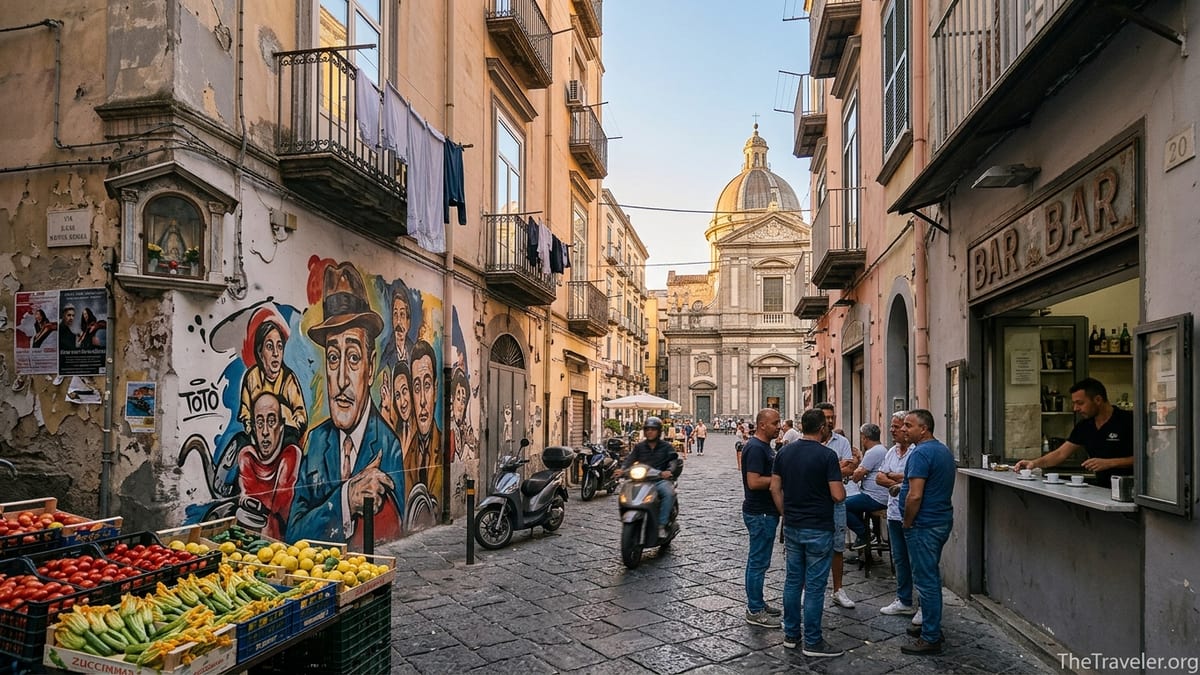
You see this overlap between past and present immediately at Porta San Gennaro, the symbolic entrance to the neighborhood. Local walking tours often start here before crossing into Borgo dei Vergini, where a street market spills through the gateway and clusters around crates of zucchini flowers and San Marzano tomatoes. Above the vendors, faded baroque facades hint at the 17th and 18th century palazzi that once attracted aristocrats to build suburban villas here, long before the area fell on harder times.
Locals are proud of this complex identity. They will tell you that La Sanità is not just another Naples neighborhood but a world of its own, with roots sinking down into millennia of history. Elder residents remember when outsiders avoided the area, but younger people now speak of the “rione” as a place reborn, somewhere you deliberately bring friends to show them a Naples that is tough, authentic and unexpectedly beautiful.
For visitors, that layered history is not a museum piece. It is something you step into on an ordinary morning: schoolchildren racing past baroque churches that sit above Roman burial galleries, fruit sellers calling out prices in a sing-song dialect that has echoed here for generations.
Catacombs and Cults of Memory Beneath Everyday Life
If there is a single reason history lovers fall for Rione Sanità, it is the catacombs. The Catacombs of San Gennaro and San Gaudioso, together with the nearby Fontanelle Cemetery, form one of Europe’s most atmospheric underground complexes. They began in the Roman and early Christian period and grew over centuries as Neapolitans carved chambers, chapels and burial niches into the rock beneath what would become the modern district.
Today, visiting the catacombs does not feel like joining a standard archaeological tour. The sites are managed by La Paranza, a local social cooperative founded by neighborhood youth who were determined to turn the district’s dark reputation into an asset. Young guides from the area lead small groups past rough frescoes of saints, carved arches and early Christian mosaics, explaining not only the iconography but also how managing this heritage has created real jobs and a sense of pride.
Travelers are often struck by how closely the sacred and the everyday coexist here. Above ground, scooters weave through Piazza Sanità, and laundry crackles across balconies. A few meters below, in the Catacombs of San Gaudioso, you walk past skulls set into walls and stylized skeletons of nobles painted with their worldly attributes, a reminder of how death once served as a social equalizer. At the nearby Fontanelle Cemetery, an ossuary packed with anonymous skulls, local tradition gave rise to the “pezzentelle” souls, a popular devotional practice where residents adopted and cared for the bones of the nameless dead.
This ritual has largely faded, and modern guides describe it in cautious, historical terms. Yet older residents still speak of the Fontanelle as a place of protection. For them, the bones are not macabre decor but part of a long relationship between the living neighborhood and its dead. Understanding this connection helps explain why Rione Sanità feels so emotionally dense: memory is not confined to monuments; it is woven into how locals see their own lives.
Baroque Palazzi, Film Legends and Everyday Architecture
On street level, the weight of centuries reveals itself in unexpected architectural flourishes. Two of the city’s most celebrated baroque staircases rise within Rione Sanità at Palazzo Sanfelice and Palazzo dello Spagnolo. From the outside, both palazzi might look worn, their plaster cracked and balconies patched up with satellite dishes. Step into the courtyards, though, and the staircases curve in theatrical double flights, arches crisscrossing above in a design that has attracted architects and photographers from across Europe.
These palazzi are not roped-off heritage sites. Families still live above, children race down the steps, and neighbors lean from railings to gossip as visitors snap photos. Film buffs know that the neighborhood has served as a backdrop for classics of Italian cinema. Scenes from Vittorio De Sica’s “L’oro di Napoli” captured Sophia Loren at work in a streetside pizzeria here, while more recent films have used the district’s narrow alleys and hanging laundry as shorthand for raw Neapolitan life.
The most beloved local celebrity, though, is Totò, the comic actor born on Via Santa Maria Antesaecula. His face appears on small ceramic plaques, shop signs and large-scale murals around the neighborhood. Older residents can point out the courtyard where he is said to have rehearsed, or the church he attended as a boy. For them, Totò is proof that a child born in a cramped Rione Sanità apartment can become a cultural icon known across Italy, and his story gives the district a narrative of resilience that residents are eager to share with visitors.
At the same time, many of the most characteristic details are small: the grocer who still measures beans from a sack by hand, the bar with Art Deco tiles behind the counter, or the votive shrines set into corners with flickering lights and photos of saints, footballers and deceased family members. Taken together, they show why locals say the neighborhood’s architecture is not only in its grand palaces but in the everyday life that animates them.
Street Art, Social Projects and a New Kind of Neighborhood Pride
Over the past decade, Rione Sanità has transformed into an open-air gallery that tells the story of its rebirth. Walls that once carried only football slogans and political graffiti now host works by international and local street artists. Near the entrance to the neighborhood, murals depict Totò with his trademark sly expression, while a short walk away you may find large, contemplative figures by artists such as Francisco Bosoletti or Mono Gonzalez, painted on side walls of churches and apartment blocks.
Some of the most striking works cluster around Borgo dei Vergini and streets like Vicolo della Cultura, a narrow laneway where quotes, portraits and abstract designs turn the alley into a kind of public library without books. A tall totem-like mural called “Perseveranza,” created with the participation of a local youth, celebrates the determination of young people trying to improve their district through culture rather than crime. Guides from community foundations lead “social street tours,” walking visitors through these works while explaining the stories of the artists and the local teenagers who helped them.
These tours are not just about art appreciation. A portion of the ticket price usually supports neighborhood initiatives, from after-school programs to small grants for local businesses. Travelers booking a two-hour street art and food walk can expect to pay roughly the cost of a modest restaurant meal in Naples, but many find the experience more memorable than a standard sightseeing loop. You might pause beneath a mural of Maradona, now rendered almost as a neighborhood saint, while a guide explains how football, faith and social justice overlap in local identity.
For residents, this new creative layer has altered how they see their own streets. Where once a blank concrete wall represented neglect, it can now become a canvas for a collective story. Parents bring children to pose in front of the murals not only because they are colorful, but because they symbolize a district that is learning to tell its own story to the world, rather than having it told by headlines about crime or poverty.
Street Markets, Food and the Daily Choreography of the Rione
What most visitors remember, however, is not an individual monument or mural but the sound and rhythm of day-to-day life. In the morning, Borgo dei Vergini fills with plastic crates and metal stalls as vendors set up for the daily market. Elderly women in house dresses inspect bunches of basil and artichokes while teenagers on scooters edge through impossibly narrow gaps. You might pay the price of a single euro coin for a bag of ripe apricots or a cup of strawberries, depending on the season.
Just off Piazza Sanità, small bars serve short, intense espressos for around one euro, usually accompanied by a glass of water and friendly, if brisk, conversation. Many locals skip the polished cafes of the historic center and come here instead, where a sfogliatella pastry fresh from the oven costs notably less than in the more touristy streets further downhill. Fried pizza, one of Naples’ most beloved street foods, is also central to the district’s identity. Small storefronts sell folded disks of dough stuffed with ricotta and salami, fried to order and handed over wrapped in paper that quickly turns transparent with oil.
Food here is still mostly for locals first. You will see workers in overalls ordering sandwiches at tiny “salumerie” where the counter is stacked high with provolone, cured ham and jars of peppers in oil. A simple panino, assembled on the spot, might cost only a few euros and be eaten standing in the shade of a baroque church facade. On summer evenings, families come down with strollers to lick gelato on the steps of the Basilica of Santa Maria della Sanità, turning the church parvis into a communal living room.
For travelers, these routine rituals offer a chance to enter the neighborhood’s choreography rather than just observe it. Buying fruit at the market, chatting with a baker about the best time to visit the catacombs, or accepting an unsolicited recommendation for a cousin’s trattoria are all ordinary moments that add up to an experience of Naples that is more relational than monumental.
Why Neapolitans Love the Energy Here
Ask locals why they are so attached to Rione Sanità and you will rarely get a single answer. Some talk about the social cooperatives that have given young people alternatives to leaving or joining the criminal economy. Others mention the way the neighborhood has begun to attract visitors and investment without, so far, losing its character. Many simply say that the rione “has a soul,” something they feel in the way neighbors look out for one another and in the stubborn humor people bring to difficult circumstances.
There is also a sense that Rione Sanità encapsulates Naples’ contradictions more intensely than other districts. It is both ancient and youthful, scarred and proud, at times chaotic but surprisingly organized beneath the surface. Residents know that the area has a reputation and that not all of it is undeserved, yet they see the new projects, restored churches and full restaurants as proof that their efforts are working. When local guides talk about the catacombs or street art, they often slip into “we” rather than “they,” describing a shared project rather than an attraction to be sold.
The neighborhood’s energy is especially palpable during religious festivals and cultural events. Processions wind through streets strung with lights, with statues of saints carried past murals of modern heroes, and brass bands competing with trap music from car stereos. Street theater performances or small concerts sometimes take over Piazza Sanità, drawing mixed crowds of residents, university students and curious visitors. In those moments, the boundaries between audience and performers blur, and the sense of collective ownership of public space is striking.
For many Neapolitans, supporting Rione Sanità by visiting its catacombs, booking a local tour or simply buying coffee in its bars feels like a concrete way of backing a story of regeneration from below. In a city often portrayed as ungovernable, the rione has become a case study in what can happen when residents, priests, associations and small business owners decide to reclaim their own streets.
Practical Tips for Experiencing Rione Sanità Respectfully
For travelers, the question is not only why locals love Rione Sanità, but how to experience that love without disrupting what makes the area special. The neighborhood remains primarily residential and working class, so it helps to approach it as a guest in someone else’s living room rather than an open-air theme park. Dressing modestly, avoiding loud behavior late at night and asking before taking close-up photos of people are small gestures that residents appreciate.
Most visitors reach the area on foot from the historic center, walking up from Via Foria toward Porta San Gennaro, or arriving by bus or metro and continuing on foot. Guided visits to the catacombs are usually booked with timed entry, often in both Italian and English, and it is sensible to reserve a slot in advance during weekends or high season. Many combined tours include both catacombs and a short neighborhood walk, sometimes with a tasting of typical street foods, which can be a good introduction if you are slightly intimidated by the city’s traffic and pace.
Prices in Rione Sanità remain lower than in the most touristy parts of Naples, but they are rising as more visitors arrive. Choosing to spend money with local cooperatives, family-run trattorias and long-standing market stalls helps ensure that the benefits of this new attention are shared. It is common, for example, for social cooperatives or community foundations to operate small bookshops, cafes or tour desks whose earnings fund youth projects or cultural programming.
As with any busy urban area, basic precautions apply. Keep valuables secure, avoid displaying large amounts of cash, and stay on well-used streets, especially after dark. Locals are quick to offer directions or warn you away from a shortcut that might be confusing. Listening to their advice, even when it contradicts something you read in a guidebook, is part of treating the area with the respect that its residents have fought to earn.
The Takeaway
Rione Sanità is not the prettiest or easiest corner of Naples, but that is precisely why so many Neapolitans love it. In a few compact streets, you encounter early Christian catacombs and 18th century palazzi, street art by international names and spray-can tributes by local teenagers, fried pizza stands and experimental theater. Above all, you encounter a community that has decided its story will no longer be written only in police reports and social statistics, but in murals, processions, tours and small entrepreneurial bets on the future.
For travelers willing to step a little off the classic routes, visiting Rione Sanità offers more than a checklist of sights. It offers a chance to see how a city uses its oldest layers to build something new, and how ordinary residents can transform a place once defined by death and decline into a neighborhood that pulses with energy, memory and street life. Go with curiosity and humility, and you may find that this hillside rione becomes the part of Naples you remember most vividly long after your trip ends.
FAQ
Q1. Is Rione Sanità safe to visit for travelers?
Rione Sanità is a busy, working-class neighborhood that has improved significantly in recent years, especially around main streets, the catacombs and Piazza Sanità. As in any dense urban area, it is wise to stay aware of your surroundings, avoid poorly lit backstreets at night and keep valuables secure, but most visitors who take normal city precautions experience the area as welcoming and vibrant.
Q2. How do I get to Rione Sanità from the historic center of Naples?
Many visitors walk from the historic center, heading up from streets like Via dei Tribunali or Via Foria toward Porta San Gennaro, the symbolic gateway to the neighborhood. Others arrive by metro to nearby stops or by bus and then walk the remaining few minutes. Taxis or ride-hailing services can also drop you directly at Piazza Sanità or near the catacombs for a relatively modest fare compared with longer city trips.
Q3. Do I need to book in advance to visit the catacombs?
It is strongly recommended to reserve tickets in advance, especially on weekends, holidays and during the main travel season, because entry is managed by guided tours with limited group sizes. Same-day spots are sometimes available in quieter periods, but booking ahead ensures you can choose a time and language that works for you and allows the cooperative that runs the site to plan staffing.
Q4. What should I wear when visiting Rione Sanità and its churches or catacombs?
Comfortable shoes are essential because you will likely walk on uneven cobblestones and climb steps, both in the streets and underground. Light, modest clothing is appreciated, especially if you plan to enter churches, with shoulders and knees roughly covered as a sign of respect. The catacombs can feel cool even in summer, so bringing a light layer such as a cardigan or thin jacket is helpful.
Q5. Are there good places to eat in Rione Sanità?
Yes, the neighborhood is known for simple, flavorful food aimed primarily at locals rather than tourists. You will find small pizzerias serving classic and fried pizza, bars offering espresso and pastries at local prices, and delicatessens where staff assemble generous sandwiches from cured meats and cheeses. Many travelers choose to follow the lead of neighborhood residents, eating where you see families, workers and students lined up rather than seeking out formal restaurants.
Q6. Can I explore the neighborhood on my own or should I take a guided tour?
You can certainly wander Rione Sanità independently, especially along main streets and around Piazza Sanità and Borgo dei Vergini. However, a guided tour led by a local association or social cooperative can deepen your understanding of the history, street art and current social projects, and your ticket often helps fund community initiatives. Many visitors choose to combine a guided visit to the catacombs with some free time to explore the surrounding streets at their own pace.
Q7. What time of day is best to experience the neighborhood’s street life?
Morning is ideal for seeing the markets at their busiest, with fresh produce arriving and residents doing their daily shopping. Late afternoon into early evening is also lively, as people gather in piazzas, children play in the streets and bars fill with neighbors chatting over coffee or an aperitivo. Midday can be quieter, especially during the hottest months, when shutters close and the neighborhood slows for lunch and rest.
Q8. Is Rione Sanità suitable for families with children?
Many families enjoy visiting Rione Sanità, particularly the catacombs, which older children often find fascinating, and the lively piazzas where kids can observe local life. That said, sidewalks can be narrow, traffic somewhat chaotic and streets crowded, so smaller children should be closely supervised and strollers may require extra patience on steps and uneven surfaces. Choosing quieter times of day and sticking to main routes can make the experience more comfortable.
Q9. How is Rione Sanità different from other popular Naples neighborhoods like the Spanish Quarters?
While both are dense, traditional districts with strong identities, Rione Sanità feels more like a self-contained valley with a particularly strong link to underground heritage sites such as the catacombs and Fontanelle Cemetery. It has become known as a laboratory for community-led regeneration and cultural projects, including street art and social tourism. The Spanish Quarters are more central and heavily associated with nightlife and football iconography, whereas Rione Sanità is often described by locals as more residential and introspective, with a growing but still relatively recent tourism scene.
Q10. What can I do to support the neighborhood positively when I visit?
You can support Rione Sanità by booking tours with local cooperatives, visiting the catacombs and community-run cultural spaces, and spending money in long-standing small businesses such as family pizzerias, bars and market stalls. Being respectful in your behavior, asking before photographing people or private courtyards, and taking an interest in the stories residents wish to share all contribute to the sense that visitors are allies in the neighborhood’s ongoing transformation rather than just spectators.