


Few artworks stop travelers in their tracks the way La Pietà does. Carved in luminous Carrara marble by a young Michelangelo at the end of the 15th century, this quiet scene of the Virgin Mary holding the body of Christ is one of the first major works visitors see when they enter St Peter’s Basilica in Vatican City. Despite the crowds, security glass, and the constant click of phone cameras, the sculpture still radiates a calm, almost shocking beauty. Understanding what La Pietà is, how it was made, and why it continues to move people from all over the world can deepen any visit to Rome and turn a quick photo stop into a powerful encounter with Renaissance art.
Get the latest updates straight to your inbox!
What Exactly Is La Pietà?
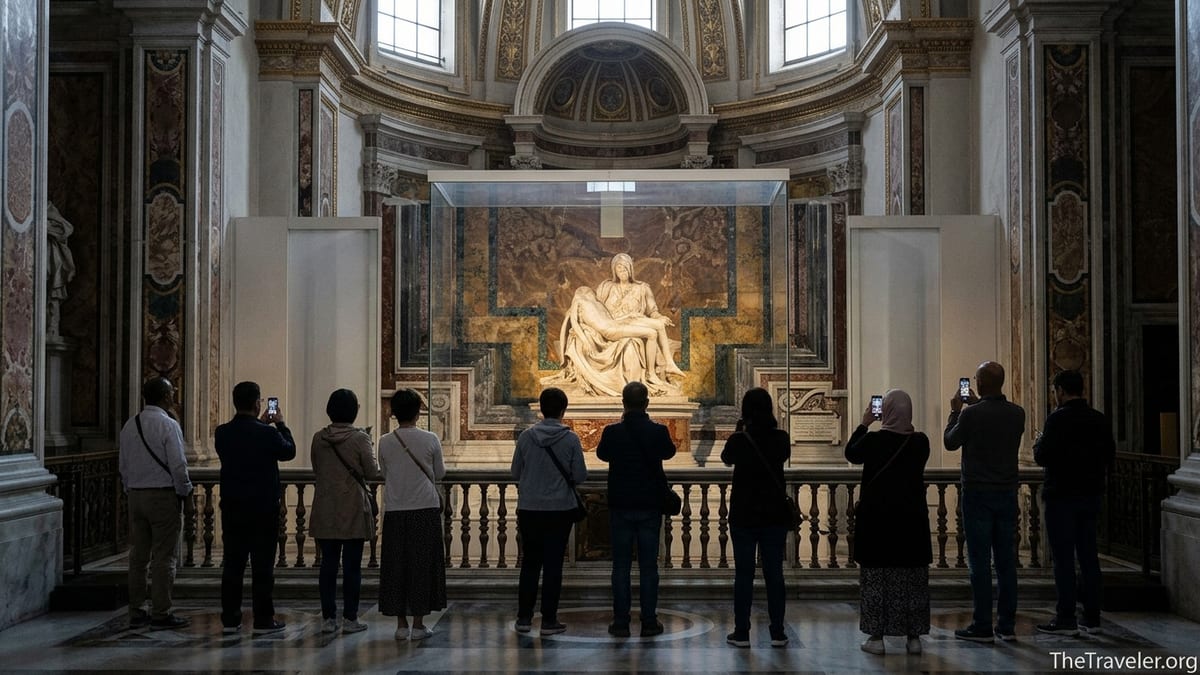
La Pietà is a marble sculpture by Michelangelo Buonarroti, completed around 1498–1499 for a French cardinal, Jean de Bilhères de Lagraulas. Today it stands in the first side chapel on the right as you enter St Peter’s Basilica in Vatican City, resting on a marble altar and protected behind a tall pane of bulletproof glass. The name “Pietà” comes from the Italian word for “pity” or “compassion,” and in Christian art it refers to images of the Virgin Mary cradling the dead body of Jesus after the Crucifixion. Michelangelo’s version is the most famous Pietà in Western art.
For visitors, La Pietà is usually the first major masterpiece they encounter after queuing to enter St Peter’s. Once you step through the basilica’s main doors and your eyes adjust to the dim interior, you will see a dense crowd on the right-hand side, phones held high. That cluster of people is your landmark. From the public viewing zone you stand several meters away, separated by a balustrade and the glass barrier, but even at that distance the sculpture’s soft polish and intricate detail are unmistakable.
The work is slightly smaller than life-size, about 1.7 meters high, but it feels monumental because of the way Michelangelo composed the figures into a sweeping pyramid. Many travelers report that La Pietà is quieter and more intimate than the Sistine Chapel ceiling or Michelangelo’s David in Florence, yet it lingers longest in their memories. The emotion here is contained rather than theatrical, and that restraint is part of its power.
The Story Behind the Commission
Michelangelo carved La Pietà in Rome in his early twenties, when he was still an ambitious sculptor trying to make his name among powerful patrons. Cardinal Jean de Bilhères, the French ambassador to the Holy See, commissioned the work for his funeral monument in the chapel of Santa Petronilla, a space linked to the old St Peter’s Basilica. The brief required a sculpture that would honor both the cardinal’s faith and his status, and Michelangelo responded with an unusually refined vision for a funerary work.
At the time, the idea of a Pietà was more common in northern European art than in Italy. By taking this devotional theme and rendering it in polished Carrara marble, Michelangelo was deliberately fusing northern emotional intensity with Italian classical elegance. He negotiated with marble suppliers in the quarries above Carrara, selecting an exceptionally pure block that he believed could withstand deep carving without flaws. Modern guides still point out the fine grain of the stone when leading small-group tours through the basilica.
The sculpture was initially installed beside the cardinal’s tomb, but in the 18th century it was moved to its current location in the new St Peter’s Basilica, completed long after Michelangelo’s death. For visitors today, that relocation means it is no longer tucked away but prominently placed along the main processional route, so it is easy to incorporate into a short visit or a guided Vatican tour that also includes the dome and the papal grottoes.
Why La Pietà Is Considered a Masterpiece
La Pietà is widely regarded as one of Michelangelo’s greatest masterpieces for several intertwined reasons: its technical perfection, emotional subtlety, and ambitious reimagining of a traditional theme. Even travelers with no background in art history often notice, without prompting, how real the marble seems. Mary’s veil appears to float over her hair, the folds of her cloak fall in heavy layers, and the lifeless weight of Christ’s body rests naturally across her lap. Guides frequently invite visitors to zoom in with their phone cameras on details like Christ’s ribs or the delicate veins in his arm, evidence of Michelangelo’s deep study of human anatomy.
Another reason scholars admire La Pietà is its sophisticated geometry. The figures form a stable triangular composition: Mary’s broad, draped body creates a solid base, while Christ’s diagonal form draws the eye across the sculpture. This balance allows the group to look serene from a distance but richly complex up close. Many art historians consider it the work in which Michelangelo first fully demonstrates the blend of ideal beauty and believable humanity that would define High Renaissance art.
Travelers are often surprised to learn that La Pietà is the only work Michelangelo ever signed. On the sash running across Mary’s chest, he carved “Michelangelo Buonarroti, Florentine, made this” in Latin. According to early biographers, he did this after overhearing visitors attribute the work to another sculptor. You can no longer get close enough to read the signature with the naked eye, but high-resolution reproductions are often shown on screens during guided art-focused tours, underlining how proud the young artist was of this achievement.
How Michelangelo Shaped Marble Into Flesh
From a traveler’s perspective, one of the most astonishing aspects of La Pietà is how Michelangelo coaxed softness from such a hard material. Working with chisels, drills, and abrasives, he carved the entire group from a single block of marble. Today’s stone carvers in Carrara still point to La Pietà as a benchmark for what their material can do at its absolute limit. The transitions from rough to polished surfaces, barely visible in photos, become striking under the basilica’s side lighting, especially in the morning when natural light filters through the high windows.
Michelangelo used subtle textural contrasts to bring the scene to life. Christ’s skin is polished to a satin sheen, catching light in a way that suggests living flesh even in death. Mary’s heavy robes are treated more crisply, with deep undercutting that throws the folds into shadow. If you stand toward the left side of the viewing area and use a modest zoom on your smartphone (around 2x to 3x), you can see how the edges of the drapery slice into darkness while the surfaces glow, creating a sense of depth no photograph fully captures.
The artist also employed deliberate idealization. Mary looks far younger than a woman who has just lost a grown son. Michelangelo later defended this choice by arguing that her purity preserved her from the marks of age. In practice, her youthfulness allows viewers, whether religious or not, to focus on the universality of grief rather than the specifics of biblical chronology. Modern visitors often describe Mary’s face as calm rather than anguished, an expression of quiet acceptance that resonates with people processing their own losses.
Symbolism and Emotional Impact for Today’s Visitors
Although La Pietà was created for a specific religious context, its emotional language is remarkably universal. The central gesture is simple: a mother holding her dead child. Whether you arrive as a pilgrim, a casual tourist, or an art lover, that image tends to cut through jet lag and sensory overload. Guides who work daily in St Peter’s often report that even groups of teenagers, who may chat through other parts of the basilica, fall silent when they stop in front of the sculpture.
The way Michelangelo stages the scene reinforces this emotional clarity. Christ’s body is relaxed, not contorted by suffering; the wounds of the Crucifixion are present but understated. Mary does not look upward in theatrical despair. Instead, she gazes downward, presenting her son’s body to the viewer. Many visitors sense in this a kind of invitation: you are not just looking at a private moment of grief, you are being asked to contemplate sacrifice, compassion, and mortality more broadly.
At the same time, there is an unmistakable devotional dimension. For Catholic pilgrims traveling to Rome for a Jubilee year or major feast day, pausing before La Pietà can feel like an extension of prayer. On busy mornings you might see small groups from different countries quietly making the sign of the cross or whispering rosary prayers as they edge forward for a better view. Others approach it as a purely aesthetic experience, comparing it afterward with other major works in the city, such as Bernini’s baldachin over the main altar or Caravaggio’s paintings in the nearby church of San Luigi dei Francesi.
Damage, Restoration, and the Bulletproof Glass
One of the most striking aspects of seeing La Pietà in person today is the thick glass screen that separates it from the public. This modern layer of security has a dramatic origin story. On May 21, 1972, during Pentecost, a man attacked the sculpture with a hammer, shouting that he was Jesus Christ. In seconds he delivered multiple blows, breaking Mary’s nose, chipping her eyelid, and knocking fragments from her arm and veil. Newspaper photographs from the following day showed marble shards scattered across the altar steps, a sight that shocked people around the world.
The Vatican quickly recovered as many fragments as possible, even vacuuming the floor to gather tiny chips. A team of restorers then spent months reassembling the damaged sections in laboratories within the Vatican Museums, using adhesives mixed with Carrara marble dust to blend the joins. To reconstruct Mary’s nose, which was largely destroyed, they carved a new piece using marble taken from the back of the statue where it would not be noticed. About ten months later the restored Pietà returned to public view, now protected by bulletproof glass that has since been upgraded with modern shatter-resistant panels ahead of recent Jubilee celebrations.
For travelers, this history explains both the distance and the lighting you experience today. The glass sits several meters in front of the sculpture, which means reflections from camera screens and bright clothing can sometimes interfere with photographs. Guides often recommend standing slightly to one side and angling your camera to minimize glare. Some morning tours schedule the basilica first thing after opening to take advantage of softer, less reflective light, when the marble seems to glow more evenly behind the barrier.
While the glass inevitably alters the intimacy Michelangelo originally intended, it also adds another layer to the story. Modern visitors are not just looking at a Renaissance masterpiece, but at an object that has survived fanaticism, restoration, and the concerns of contemporary security. The barrier is a visible reminder of how highly the world now values this piece of stone that once lay, unremarkable, in a mountain quarry above Carrara.
Planning Your Visit to See La Pietà
Seeing La Pietà in person is straightforward, but a few practical choices can dramatically improve the experience. The sculpture sits inside St Peter’s Basilica, which is free to enter but subject to airport-style security screening. Queues on busy days can stretch across St Peter’s Square and easily reach 45 to 90 minutes by mid-morning. Many seasoned travelers aim to arrive at the security line 30 to 45 minutes before the basilica opens, especially during spring and autumn when tour groups are most numerous.
Dress codes are enforced: shoulders and knees should be covered, which means bringing a light scarf or shawl in summer and avoiding very short shorts. Security staff may turn visitors away for clothing they consider too revealing, and being sent back to change can mean losing your place in line. Small backpacks and handbags are generally allowed but will be scanned; large suitcases are not. Photography is permitted inside the basilica, including in front of La Pietà, but tripods and drones are not allowed.
Once inside, most visitors walk straight ahead, overwhelmed by the scale of the nave, and only gradually drift to the right. If your time is limited, head immediately toward the right side aisle and follow the flow of people until you reach the glass-fronted chapel where crowds gather. Budget about 10 to 15 minutes here if you want to observe the sculpture from different angles, take a few photos, and simply stand quietly to absorb it. Travelers combining St Peter’s with the Vatican Museums and Sistine Chapel on a single day often find that this early encounter with La Pietà sets the emotional tone for everything that follows.
For deeper context, you might consider a guided tour that focuses specifically on art and architecture rather than a general highlights circuit. Many reputable operators offer small-group or private tours that include time in front of La Pietà, with guides explaining the sculpture’s history while you look at it rather than in a hallway beforehand. If you prefer to explore independently, carrying a compact art guidebook to Rome or downloading an audio guide in advance can help you notice details that casual onlookers may miss.
The Takeaway
La Pietà is much more than a famous stop on a checklist of Roman sights. It is a turning point in the career of Michelangelo, an early demonstration of the High Renaissance ideal of beauty, and a deeply human scene that speaks across cultures and centuries. Travelers who approach it with a bit of background find that the sculpture’s quiet power stays with them long after they leave the cool interior of St Peter’s and step back into the sunlight of the square outside.
Understanding what you are looking at can transform a brief, crowded viewing into a richer experience. Knowing that the artist was in his twenties when he carved it, that the figures emerge from a single block of stone, that the calm expression on Mary’s youthful face is a deliberate choice, and that the glass barrier exists because of a modern act of violence all deepen the encounter. Whether you are visiting Rome on a once-in-a-lifetime trip or returning for the second or third time, carving out a few reflective minutes in front of La Pietà is one of the most rewarding ways to connect with both the genius of Michelangelo and the long, layered history of St Peter’s Basilica.
FAQ
Q1. Where is Michelangelo’s La Pietà located?
It is housed inside St Peter’s Basilica in Vatican City, in the first side chapel on the right as you enter from the main doors.
Q2. Do I need a ticket to see La Pietà?
No ticket is required to see La Pietà itself. Entry to St Peter’s Basilica is free, although you must pass through security and may wait in line.
Q3. Why is La Pietà behind glass?
The sculpture is protected by bulletproof glass because it was badly damaged in a hammer attack in 1972. After restoration, the barrier was installed and later upgraded.
Q4. How old was Michelangelo when he carved La Pietà?
Michelangelo was in his early twenties, around 23 or 24 years old, when he completed La Pietà at the end of the 15th century.
Q5. Is La Pietà life-size?
The figures are slightly smaller than life-size, but the composition and setting give the sculpture a powerful, monumental presence in the chapel.
Q6. Why does Mary look so young in La Pietà?
Michelangelo chose to depict Mary as youthful to emphasize her purity and timelessness, creating a more idealized and universal image of maternal grief.
Q7. Can I take photos of La Pietà?
Yes, photography is allowed inside St Peter’s Basilica, including La Pietà, but without flash or tripods, and you must remain behind the viewing barrier.
Q8. Is this the only Pietà by Michelangelo?
No, he created other Pietà sculptures later in life, such as the Florentine Pietà and the Rondanini Pietà, but the one in St Peter’s is the most famous.
Q9. How long does it take to visit La Pietà?
Once inside the basilica, you can reach La Pietà within a few minutes; most visitors spend about 10 to 15 minutes viewing and photographing it.
Q10. Why is La Pietà considered one of Michelangelo’s greatest works?
It combines extraordinary technical skill, emotional depth, harmonious composition, and innovative interpretation of a traditional theme, all achieved when the artist was very young.