


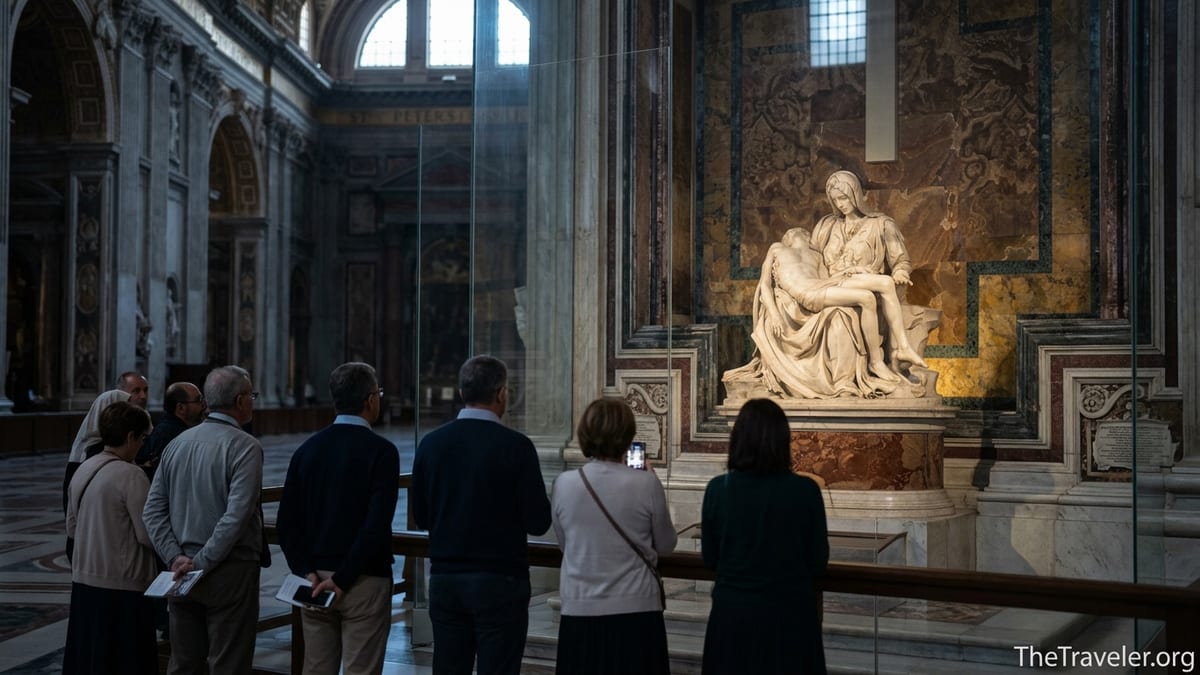
There is a hush that falls over the crowd the moment people reach the first chapel on the right inside St Peter’s Basilica. Behind a thick pane of bulletproof glass, lit by a soft, cool glow, Michelangelo’s La Pietà appears almost to breathe. For many travelers this is their first close encounter with Renaissance sculpture, and it rarely matches what they expect. Mary looks young. Christ’s body seems impossibly lifelike. And for a moment, in the swirl of tour groups and camera shutters, everything goes quiet. Understanding how this marble came to hold such emotional power not only deepens that first encounter, it turns a brief stop on a Vatican itinerary into one of the most moving experiences in Rome.
Get the latest updates straight to your inbox!
The Commission: A Young Sculptor and an Ambitious Cardinal
La Pietà was born from a specific commission, not from a vague burst of inspiration. Around 1497, a French cardinal in Rome, Jean de Bilhères de Lagraulas, ordered a devotional sculpture for his funeral chapel in the old St Peter’s Basilica. He wanted a Pietà, a traditional northern European image of the Virgin Mary cradling the dead Christ. The commission went to a remarkably young Florentine sculptor named Michelangelo Buonarroti, not yet twenty-five, who had only recently arrived in Rome and was still far from the celebrity he would become.
For travelers walking into today’s St Peter’s, it helps to remember that the sculpture was never intended as a museum piece. It was created for prayer and mourning, for a private French chapel in what was then a crumbling medieval basilica. Michelangelo signed a contract promising that the marble group would be, in the words of the document, the most beautiful work of its kind in Rome. That confidence, bordering on audacity, shaped every decision he made as he carved.
The artist chose a single block of Carrara marble, the fine white stone quarried in the Apuan Alps of Tuscany. Visitors who later day-trip from Rome to Carrara can still see similar blocks leaving the mountains by truck today, a reminder that La Pietà is also a product of a very physical, industrial process. Michelangelo reputedly spent months selecting this block, aware that any hidden flaw could ruin the delicate anatomy and drapery he envisioned.
When the work was unveiled around 1499, it immediately attracted attention. Contemporary accounts describe Romans gathering to marvel at how flesh, fabric and hair could appear so soft in stone. The reaction was so intense that Michelangelo, stung by rumors that another sculptor must have made it, did something he almost never did: he carved his name across the sash on Mary’s chest, the only time he ever signed a work of art.
What You See Up Close: Composition, Youth and Impossible Calm
The emotional force of La Pietà begins with its composition. From a distance, travelers notice a stable pyramid shape, with Mary’s head at the top and Christ’s body forming the sloping sides. This triangular structure, common in High Renaissance painting, gives the group a sense of calm and balance despite the subject’s raw grief. When you finally make your way through the crowd and claim a spot at the rail in front of the glass, that stability is what holds your gaze.
The details, however, are what linger in memory. Mary’s left hand is open, palm up, in a gesture that seems to say at once “here he is” and “how could this have happened.” Her face is serene, almost withdrawn, as if the shock has passed into a deeper, quieter sorrow. Many visitors expect a mother Mary of about fifty and are surprised to find a woman who looks barely older than her son. Guides in the basilica often point out that Michelangelo chose to show Mary as eternally youthful, a visual way of expressing her purity and her role in Christian theology rather than her biological age.
Christ’s body is another point where the sculpture feels startlingly real. The weight of his torso sinks into Mary’s lap; the muscles of his chest and abdomen are relaxed but not exaggerated. A traveler standing a few meters back can still see how the veins on his arm faintly rise beneath the marble “skin.” In the folds of Mary’s robe, the fabric seems to pool and fold like heavy wet cloth, a technical tour de force that art students and sculptors still study closely today.
Practical viewing conditions shape how all this is experienced. Since a violent hammer attack in 1972 damaged the statue’s face and arm, La Pietà has been protected behind thick glass and a low barrier. On busy mornings the space in front of the chapel can be three or four people deep. Travelers who want to appreciate details like the carved fingernails or subtle transitions of light on the marble often aim to visit at quieter times, such as shortly after the basilica opens at 7:00 a.m. on weekdays, when crowds and tour groups are thinner.
The Meaning of a Pietà: Sorrow, Compassion and Human Suffering
“Pietà” in Italian carries the sense of pity, compassion and tender mercy. As a subject, the Pietà scene emerged in German-speaking regions in the late Middle Ages, where carved wooden groups sometimes showed gruesomely wounded bodies intended to stir emotional identification with Christ’s suffering. When Michelangelo took on the theme for a Roman audience around 1500, he softened the horror without erasing the pain, pivoting from graphic agony toward contemplative sorrow.
Travelers who pause for more than a quick photograph will notice how gently Christ’s body rests across Mary’s lap. There is almost no visible blood; the wounds are restrained. This restraint is deliberate. The sculpture invites viewers to meditate not on the violence of the crucifixion but on the mystery of a mother holding her dead son, on the human cost of suffering and sacrifice in general. The scene is religious, but the emotion is universal enough that even non-Christian visitors often describe a visceral response.
The youthfulness and serenity of Mary are central to this meaning. Some guides in St Peter’s explain that her smooth, idealized face reflects the belief that spiritual purity preserves inner beauty. Others note that the contrast between her calm expression and the limp weight of Christ’s body creates a tension that viewers subconsciously try to resolve. Standing in front of the sculpture, many travelers find themselves projecting their own experiences of grief, caregiving or loss onto the scene, which is exactly how devotional art of the period was meant to function.
In practical terms, this emotional pull shapes how people behave in the chapel. It is not unusual to see visitors who earlier were snapping pictures of the Vatican colonnades fall silent here, sometimes wiping away tears. You might see a Roman office worker stop on the way to work, standing still for a minute in front of the glass. The sculpture has long served as a place where people bring contemporary sorrows, from private family losses to global tragedies, and find them mirrored in marble.
From Funeral Chapel to Global Icon: A Sculpture on the Move
Although La Pietà was originally made for the old medieval St Peter’s, the basilica itself was rebuilt in the 16th and 17th centuries. The sculpture was moved into the new church and eventually placed in the first chapel on the right as you enter from the main doors, where travelers encounter it today. Its prominent position means that for millions of visitors each year, La Pietà becomes the visual introduction not only to Michelangelo but to the entire experience of St Peter’s.
The sculpture’s public life has occasionally taken it far from home. In 1964, for the New York World’s Fair, the Vatican agreed to send La Pietà to the United States, its first and only trip outside Italy. American visitors remember long, winding lines and a moving walkway that carried crowds slowly past the sculpture in a darkened pavilion. The logistics were intense: the marble group was wrapped, crated and shipped across the Atlantic under tight security, insured for a vast sum and guarded around the clock. That journey cemented La Pietà as a global celebrity of Renaissance art, recognizable to people who had never been to Rome.
Back in the basilica, the statue’s fame has practical effects for today’s travelers. Even though entry to St Peter’s is free, the time “cost” can be significant. On peak summer days, the wait to pass through security on St Peter’s Square can stretch to an hour or more. Some visitors choose guided basilica tours that include reserved access, or they combine an early Vatican Museums ticket with the internal passage that leads directly from the Sistine Chapel into the basilica, shortening the line outside. Either way, for many people La Pietà is the first stop once they step inside.
Inside the chapel itself, the Vatican adjusts arrangements occasionally for liturgical events or major jubilees. Travelers visiting in Holy Year periods sometimes find temporary screens or barriers that change viewing angles or push the crowd further back. It is worth being patient and moving slowly along the rail; shifting just a meter or two can make a striking difference in how the folds of Mary’s robe catch the light.
Damage, Restoration and the Decision to Protect
The peaceful expression on Mary’s face belies a more turbulent recent history. On a Sunday in May 1972, a man jumped the rail during Pentecost Mass and attacked La Pietà with a hammer, shouting incoherently. He struck the sculpture multiple times, breaking off Mary’s left arm at the elbow, chipping her eyelid and nose and knocking pieces from the veil. Travelers who saw photographs in newspapers at the time recall the shock of seeing such a familiar, serene image violently shattered.
The Vatican Museums quickly launched a painstaking restoration. Conservators collected more than two hundred marble fragments from the chapel floor, some as small as fingernails. Using old photographs and detailed measurements, they reattached original pieces using invisible joins and filled missing areas with specially prepared marble dust and resin. The work took months, and the sculpture was temporarily removed from public view. When it returned, the restored areas were virtually undetectable to the naked eye, but one thing was permanently different: La Pietà now sat behind a protective barrier of bulletproof glass.
For today’s visitors, that glass is a practical reality. It creates a reflective surface that can interfere with photography, especially in the afternoon when light from the nave bounces across the chapel. Many travelers find that putting their camera or phone lens directly against the glass, or shading it with a hand to cut reflections, yields clearer images. Others accept that the best way to experience the sculpture is simply to look and let the details sink in, rather than to chase a perfect shot.
The 1972 attack also changed how major artworks throughout the Vatican are protected. The same concern for conservation that now surrounds Michelangelo’s frescoes in the Sistine Chapel or Raphael’s rooms also informs climate controls, security and visitor flow around La Pietà. In recent years, the Vatican has invested in better environmental monitoring inside the basilica, aware that millions of annual visitors bring not just admiration but humidity, dust and accidental risk.
Seeing La Pietà Today: Practical Tips for Travelers
Most travelers will first encounter La Pietà as part of a broader visit to St Peter’s Basilica in Vatican City. As of 2026, entry to the main floor of the basilica remains free, but you must pass through security on St Peter’s Square, similar to an airport-style check. Lines are longest from mid-morning to mid-afternoon, especially in peak seasons like May, June and September. Arriving before 8:30 a.m., or later in the afternoon after 4:00 p.m., often means a shorter wait and a less crowded experience in front of the chapel.
Dress codes are enforced at the basilica: shoulders and knees should be covered for both men and women, and hats removed inside. In practice, this means packing a light scarf or shawl to cover bare shoulders and avoiding very short shorts or skirts. Security can refuse entry if clothing is deemed inappropriate, and this is not negotiable at the gate. Travelers coming directly from a hot morning of sightseeing in Rome often bring a spare layer in a daypack specifically for visiting the Vatican.
Once inside, the flow of visitors naturally carries you toward La Pietà within the first few minutes. It is tempting to stop immediately and stay put, but the small chapel can quickly become congested. A practical strategy is to take a first brief look, then continue exploring other parts of the basilica, such as Bernini’s baldachin over the main altar or the Vatican Grottoes below, and return later when tour groups have moved on. This approach is especially helpful for travelers who want a quiet moment to reflect without pressure from the crowd behind them.
Budget-conscious visitors should know that no ticket is required specifically for La Pietà, and you do not need to pay extra or join a tour to see it. Guides and audio tours can deepen understanding, but the sculpture is fully visible from the public area of the chapel. However, if you are already investing in a guided Vatican Museums visit that uses the internal passage into St Peter’s, it often positions you near the front of security lines and gets you to the basilica, and therefore to La Pietà, earlier than many independent travelers.
Beyond One Masterpiece: Other Pietàs and Michelangelo’s Lifelong Theme
Michelangelo’s engagement with the Pietà theme did not end with the Vatican sculpture. Later in life, he returned to the subject several times, giving travelers additional opportunities to trace the evolution of his thinking across Italy. In Florence, at the Museo dell’Opera del Duomo, visitors can see the so-called Florentine Pietà, a later work that Michelangelo partly carved and then attacked himself in frustration. In this version he included his own aged face in the figure of Nicodemus, who supports Christ’s body, suggesting a deeply personal identification with both suffering and redemption.
Another late work, the unfinished Pietà Rondanini in Milan’s Castello Sforzesco, offers a stark contrast to the polished perfection of the Vatican La Pietà. Travelers who have seen both often comment that the Milan sculpture feels raw and almost modern, with elongated figures and visible tool marks. It shows how, over decades, Michelangelo’s interest shifted from anatomical virtuosity toward a more spiritual, inward expression, as if he were trying to carve directly into the stone the struggle between human fragility and divine hope.
Replicas of La Pietà around the world also testify to its enduring resonance. In churches from the United States to the Philippines, plaster or marble reproductions of the Vatican group occupy side chapels and funeral spaces, where local congregations light candles and say prayers just as Romans once did in the original French cardinal’s chapel. While connoisseurs can easily spot the differences in quality, ordinary visitors often respond to the same core image of a mother holding her son, an image that transcends language and culture.
For travelers planning broader itineraries in Italy, weaving these sites together can turn a trip into a kind of Michelangelo pilgrimage. A route that includes Rome for La Pietà and the Sistine Chapel, Florence for the Florentine Pietà and David, and Milan for the Pietà Rondanini reveals not just scattered masterpieces but a single artist thinking about suffering, beauty and faith over the course of a long, complicated life.
The Takeaway
La Pietà rewards more than a glance. On a practical level, it is one stop among many in a packed day that might also include the Vatican Museums, the dome of St Peter’s and an evening walk across the Tiber. Yet the sculpture has a way of lingering long after the trip is over. Travelers who arrived mainly to “check off” a famous work of art often find themselves replaying Mary’s open hand, the tilt of Christ’s head or the way the marble seems to glow in the basilica’s filtered light.
Knowing the story behind the sculpture helps explain why it exerts such a pull. It is the product of a bold young artist fulfilling a demanding commission, shaped by late medieval devotion and early Renaissance ideals, scarred by modern violence and protected by contemporary conservation science. It has traveled across oceans and across centuries of interpretation. And yet its core meaning remains disarmingly simple: a mother, a son and the quiet, enduring weight of love in the face of loss.
For anyone traveling to Rome, making time for La Pietà is less about adding another sight to a list and more about allowing space for a moment of shared humanity. Whether you stand before it as a believer, an art lover or a curious visitor, the sculpture offers a rare chance to feel history, faith and feeling converge in a single block of marble. In a city filled with wonders, that still counts as one of the most powerful experiences you can have.
FAQ
Q1. Where exactly is La Pietà located inside St Peter’s Basilica?
La Pietà is in the first chapel on the right as you enter through the main doors of St Peter’s Basilica. After passing through security on St Peter’s Square and stepping into the nave, walk straight ahead a few meters and look immediately to your right; you will see the chapel with the sculpture behind protective glass.
Q2. How close can visitors get to La Pietà today?
Visitors cannot approach the sculpture directly; a low barrier and thick glass separate the public from the marble. In practice, you will stand several meters away, behind a rail at the front of the chapel. From there you can clearly see the overall composition and many details, especially if you move slowly along the railing to find the best angle.
Q3. Do I need a special ticket or tour to see La Pietà?
No special ticket is required. Entry to the main floor of St Peter’s Basilica, including the chapel with La Pietà, is free. You do not need to book a dedicated tour or pay an extra fee to view the sculpture, although guided tours and audio guides can provide additional context if you want a deeper understanding while you are there.
Q4. What is the best time of day to visit La Pietà to avoid crowds?
The basilica is generally least crowded shortly after opening at 7:00 a.m. on weekdays and again later in the afternoon after about 4:00 p.m. Visiting during these times usually means a shorter security line on the square and fewer people clustered in front of the chapel, giving you more space and time to appreciate the sculpture.
Q5. Why does Mary look so young in La Pietà?
Michelangelo deliberately portrayed Mary as youthful and idealized rather than as a middle-aged woman. Many scholars and guides explain this choice as a way to emphasize her spiritual purity and eternal grace rather than her literal age. The contrast between her serene, youthful face and the lifeless body of Christ enhances the sculpture’s emotional and theological impact.
Q6. Is La Pietà the only Pietà Michelangelo created?
No, Michelangelo returned to the Pietà theme several times. The Vatican La Pietà is his earliest and most polished version, but later in life he carved the Florentine Pietà, now in Florence, and the Pietà Rondanini, in Milan. These later works are more experimental and introspective, offering an interesting comparison for travelers who visit multiple Italian cities.
Q7. What happened during the 1972 attack on La Pietà?
In May 1972 a man jumped the barrier during a Mass and struck La Pietà repeatedly with a hammer, damaging Mary’s arm, face and veil. Conservators collected hundreds of marble fragments from the floor and carried out a careful restoration, reattaching original pieces and filling losses. Since that incident the sculpture has been displayed behind bulletproof glass to prevent further damage.
Q8. Can I take photos of La Pietà inside the basilica?
Yes, photography for personal use is generally allowed inside St Peter’s Basilica, including in the chapel with La Pietà, as long as you respect other visitors and avoid using flash if staff ask you not to. Reflections on the protective glass can make photos challenging, so many travelers find that standing close to the railing and angling the camera slightly helps reduce glare.
Q9. How long should I plan to spend in front of La Pietà?
Many visitors pause for five to ten minutes, but if you are interested in art or religion it is worth allowing a bit longer. Spending fifteen or twenty minutes gives you time to look at the sculpture from different angles, notice details like Mary’s hand and the folds of her robe, and absorb the atmosphere of the chapel without feeling rushed by the movement of the crowd.
Q10. Is La Pietà suitable and meaningful for non-religious visitors?
Yes. While La Pietà is a deeply Christian image, its core theme is the universal experience of loss and compassion. Many non-religious travelers describe being moved simply by the tenderness between mother and son, the beauty of the carving and the sense of shared human emotion it conveys. You do not need a specific faith background to find the sculpture powerful and memorable.