


Most travelers arrive in Pisa with their camera already focused on the Leaning Tower. They might step into the cathedral next door, admire the glittering apse and gilded ceiling, and be back outside in ten minutes. Yet Pisa Cathedral’s interior is one of the most complex and revealing spaces in Romanesque Europe, layered with stories that almost nobody pauses to read. Look a little closer, and you start to see a hidden world of recycled mosque columns, fire scars, experimental science, and radical sculpture that quietly rewrote the rules of Western art.
Get the latest updates straight to your inbox!
A First Glance That Hides Centuries of Experiment
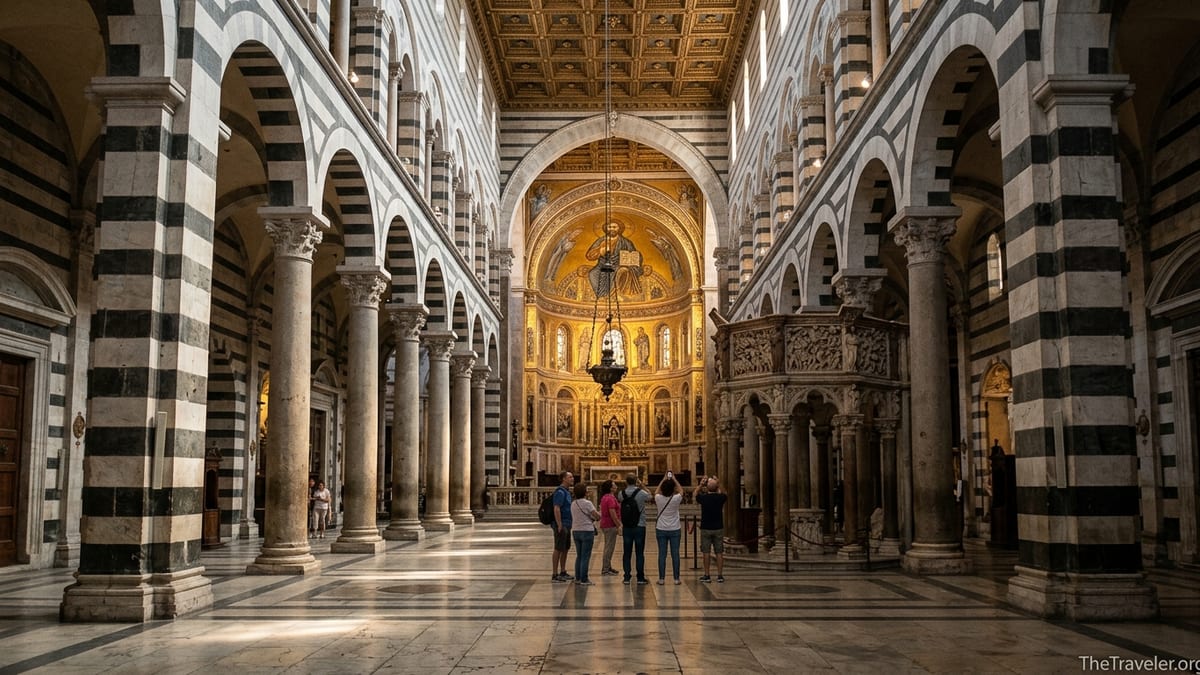
Walk in from the bright glare of Piazza dei Miracoli and your eyes need a moment to adjust. Many visitors register only a grand central nave, two side aisles on each side, and a glittering apse. Yet that first impression conceals how unusual the building really is. The plan is more complex than a standard Latin cross, with the transept itself divided into three aisles and side chapels, which is easier to notice if you stand midway down the nave and look left and right. You will see that each arm of the transept mirrors the nave in miniature, a reminder that this was conceived as a prestige project meant to rival the great churches of the Mediterranean.
Even the famous black and white interior striping rewards closer scrutiny. At first it looks like a simple Tuscan echo of Siena’s cathedral, but in Pisa the pattern is less theatrical and more functional. Look at the lower walls of the nave: the alternating dark and light bands are regular and almost understated, designed to emphasize the long horizontal flow toward the apse. When you move into the transept, the banding becomes less dominant as your eye is drawn upward to the dome and apse mosaics instead. Guides rarely mention it, but the changing strength of the striping gently directs how you read the building as you move through it.
For a vivid sense of this, take a slow walk from the main entrance to the crossing and then spin around. Many people photograph the apse only. If you deliberately frame the view back toward the doors, you will notice how the receding stripes on the piers and the rhythm of the arches create a visual funnel that pulls your gaze to the suspended lamp in the center of the nave. This line-of-sight, from apse mosaic to lamp to bronze doors, is a carefully orchestrated axis that turns the interior into a long narrative corridor, rather than just a static space.
Columns from a Distant Mosque and a War-Funded Floor
Most visitors vaguely notice that the cathedral has elegant Corinthian columns and a marble floor. Few realize they are walking through a monument to Pisa’s medieval naval ambitions. Several of the granite columns near the crossing are traditionally understood as spolia, spoils brought back from Islamic Palermo in the 11th century after a joint Pisan and Norman campaign. When you stand near the high altar and look back toward the nave, focus on the color and texture of the columns immediately in front of you: they are darker, smoother, and subtly different from the grey shafts that line the aisles. Guides sometimes point out that these are likely the captured mosque columns, repurposed here as silent trophies.
The floor beneath your feet tells a similar story. Instead of a single unified pattern, the pavement is a patchwork of marble inlay and geometric panels that reflect centuries of interventions as money flowed in and out of the city. Near the crossing you can pick out starbursts and interlocking circles that echo motifs from Mediterranean Islamic art, but translated into a Romanesque vocabulary. Stand between the central nave and the left aisle and look down: you will see bands of colored marble that do not quite align, evidence of later repairs and reconfigurations after earthquakes and fires. What feels like a single smooth surface is actually an archaeological record of Pisa’s rising and falling fortunes.
To experience the floor properly, take a moment away from the crowd that clusters near the main altar. Walk toward the right transept and pause just before the side chapel railings. Here the flow of visitors thins out, and you can safely look down without being jostled. Notice where older, slightly worn stones meet crisper modern inserts, particularly around heating grates or cable channels. The cathedral authorities have quietly threaded 20th and 21st century infrastructure through a medieval pavement, and once you notice the seams you start seeing the building as a living, evolving interior rather than a frozen museum.
A Gilded Ceiling That Is Not As Ancient As It Looks
Everyone looks up at the ceiling, but almost no one realizes how relatively “new” it is. The flat, richly coffered wooden ceiling that spans the nave dates to the 17th century, created after a devastating fire in 1595 destroyed the earlier medieval roof structure. From the entrance it feels at one with the Romanesque arcades and Byzantine-style apse, yet stylistically it belongs to the world of late Renaissance Florence, complete with lavish gilding and the Medici coat of arms carefully painted within the compartments.
The easiest place to spot that coat of arms is roughly mid‑nave. Stand under one of the large central coffers with a clear view straight up and look for a shield shape studded with roundels. Those colored discs are the Medici palle, a political signature inserted into what might otherwise be perceived as a purely sacred ceiling. It is a reminder that when the roof was rebuilt, Pisa’s fate was already tied to the Grand Duchy of Tuscany. Visitors rarely register this, but the cathedral ceiling doubles as a subtle advertisement for Medici power hovering above worshippers.
The fire that prompted this redesign also left quieter traces. Move into the left transept and look up at the junction of arches and vaults close to the dome. In certain light you can see slight changes in the stone color and patchwork patterns where the fabric was repaired. The dazzling gold and painted figures of the ceiling often distract from these scars, yet they tell an important story: beneath the glitter, this is a building that has burned, cracked, and been put back together multiple times. When you notice the repairs, the ceiling stops being just decorative and starts to feel like a carefully stitched canopy protecting centuries of history.
The Apse Mosaic: A Survivor with a Fragile Face
The great apse mosaic of Christ in Majesty is the one interior feature that most visitors do notice. Far fewer realize how fragile and partial it is. The colossal Christ enthroned between the Virgin and Saint John belongs to a long Byzantine tradition familiar from Ravenna, Venice, and Norman Sicily, but here the composition has a distinctive Pisan flavor. The golden background glows in low light, and the folds of Christ’s robe are rendered with an almost archaic stiffness that sets it apart from later Renaissance frescoes elsewhere in Tuscany.
What most people miss are the layers of authorship and survival embedded in this image. The figure of Saint John is widely attributed to the Florentine painter Cimabue around the very end of the 13th century, and remarkably his delicate face survived the 1595 fire almost intact while other sections were heavily restored or reworked. If you bring a small pair of binoculars, or simply zoom in with a modern smartphone camera from the nave, you can see a difference in style: Saint John’s features are softer and more melancholic, with subtle shading around the eyes that stands in contrast to the more rigid treatment of Christ’s drapery and the Virgin’s face.
A practical way to appreciate this contrast is to stand just behind the modern altar rail, as close as regular visitors are allowed, and focus first on Christ’s right hand raised in blessing. You will notice the strong, linear outlines and stylized highlights typical of Byzantine mosaic. Then shift your gaze to Saint John’s face and the lines of his hair and beard. The modeling feels more exploratory, almost like a painter pushing against the limits of the mosaic medium. What you are seeing is a quiet artistic revolution flickering within a traditional icon, and it is easy to overlook if you rush past on your way to the Leaning Tower.
Galileo’s Lamp and the Science Hidden in a Legend
Near the crossing, hanging from the nave vault, is one of the most photographed objects in the cathedral: a large bronze lamp sometimes called Galileo’s lamp. Guides often repeat the story that a young Galileo, attending Mass here in the late 16th century, watched this lamp swing and deduced the principle of pendulum isochronism, paving the way for more accurate timekeeping. Historians doubt that the specific lamp now on display is the one he saw, but the legend captures a real moment when scientific curiosity grew out of careful observation inside a sacred space.
Most visitors treat the lamp as a quick photo stop. To see it differently, stand slightly off center under the crossing, where you can watch the chains rise to a single point high above. The object is not just a decorative chandelier but part of a carefully engineered visual axis. From this spot, if you look straight ahead, the lamp lines up with the apse mosaic; if you turn around, it aligns with the main entrance doors and the striping of the nave. In other words, it occupies the precise center of a spatial experiment that balances theology, geometry, and, later, physics.
There is another layer that most people miss. The very idea that a regular, measurable physical motion could be discovered and studied during a liturgical service hints at how porous the boundary between faith and science once was in places like Pisa. If you visit on a quieter weekday morning, when the crowds thin out, try standing beneath the lamp during a moment of relative silence. Even the gentle air currents created by opening doors can set it moving in a slow, barely perceptible arc. Watching that subtle swing, you can imagine how a bored teenager with a good eye for patterns might have been drawn into a lifetime of experiment by what others saw only as church furnishing.
The Pulpit That Quietly Rewrote European Sculpture
Tucked to one side of the nave, often half‑blocked by tour groups checking maps, stands one of the most influential works of Gothic sculpture in Europe: the marble pulpit carved by Giovanni Pisano between the early 14th century. Many visitors walk straight past it, mistaking it for just another carved platform. In reality, this polygonal structure, crowded with figures and reliefs, represents a radical step toward the emotional intensity and naturalism that would eventually define Renaissance art.
If you circle the pulpit slowly, panel by panel, you will find densely packed scenes from the life of Christ: the Annunciation and Nativity, the Adoration of the Magi, the Massacre of the Innocents, the Crucifixion, and the Last Judgment. What most visitors never notice is how violently these compositions break from the calm, frontal figures of earlier Romanesque relief. Look at the Massacre of the Innocents: mothers twist and scream, soldiers lunge forward, children writhe in terror. Even with centuries of wear and multiple restorations, the drama is unmistakable. This is not a tidy biblical tableau but a carved crowd scene pushed to the physical limits of the marble block.
Equally overlooked are the figures that support and frame the pulpit. Between the arches and around the base, you can pick out personifications of Christian Virtues, prophets, and sibyls, female seers from the classical world who were believed in the Middle Ages to have foreseen the coming of Christ. To spot them, step back toward the aisle until you can see the whole pulpit at once, then move slowly closer again, focusing on the spandrels above each arch. The result is a kind of encyclopedic stone library of human wisdom, sacred and pagan, literally holding up the preaching platform. Average visitors rarely get close enough, or stay patient enough, to read this sculpted program as anything more than decoration.
The pulpit’s own history adds to its hidden complexity. It was dismantled around 1600 after the fire and only reassembled in the 1920s, with some elements recarved or repositioned. If you look closely at the junctions between panels and columns, you can see subtle differences in marble color and finish that betray these interventions. For a traveler used to pristine museum displays, these shifts are easy to misread as damage or dirt. In fact they reveal how modern conservation choices keep reshaping what we think of as a medieval masterpiece.
Side Chapels, Quiet Corners, and the Drama of Light
Beyond the showpieces of apse, ceiling, and pulpit, Pisa Cathedral has a wealth of side chapels and altars that most visitors barely glance at. In the left transept, for example, is the glass-sided tomb of San Ranieri, Pisa’s patron saint. On busy days a steady flow of tour groups moves past it without pausing, yet the silver reliquary and its carefully staged lighting were designed to create an intimate encounter with the city’s spiritual protector. If you let the crowds move on and then step closer, you will see how the polished marble frame and flicker of votive candles set up a very different mood from the grand public space of the nave.
Nearby chapels preserve fresco fragments and altarpieces that tell the story of changing tastes over time. Late Gothic panel paintings coexist with baroque canvases and 19th century devotional art, often within a single bay. Stand in the right transept and slowly scan from one altar to the next: you will notice halos that shift from flat gold disks to softly modeled Renaissance circles, then to more sentimental 19th century faces. Most guidebooks mention only the big names, but this quiet gallery of lesser works reveals how ordinary Pisans updated their sacred interior to keep pace with fashion, theology, and personal piety.
Light is the final element that ties these scattered details together, and it is something that casual visitors rarely stop to feel. On a bright afternoon, shafts of sun filter through the clerestory windows and slide down the striped piers, picking out flakes of gold on the ceiling and sending glints across the mosaic. On overcast days the whole interior shifts into a silvery, almost monochrome register that makes the black and white marble more pronounced and the gilding recede. If you have flexibility in your schedule, visiting the cathedral at two different times of day can feel like seeing two different buildings. Even within a single visit, returning to the pulpit or apse after the light has changed by an hour can reveal carvings and color contrasts that were invisible before.
The Takeaway
Pisa’s cathedral is often introduced as part of a postcard set: the Leaning Tower, the marble facade, the baptistery. Yet the interior is where the city’s real story plays out, in details that visitors rarely notice. Granite columns from a distant mosque, a war‑funded floor riddled with repairs, a “new” gilded ceiling stamped with Medici ambition, a fire‑scarred but luminous mosaic in the apse, a hanging lamp tied to the birth of modern physics, and a pulpit that changed the direction of European sculpture all coexist within a single, deceptively calm space.
Taking time to seek out these elements transforms the experience from a quick checklist stop into a layered encounter with medieval ambition, early science, and artistic innovation. On your next visit, try giving the Leaning Tower fifteen minutes less and the cathedral fifteen minutes more. Stand under the lamp, circle the pulpit, study the face of Saint John in the apse, and look twice at the worn floor under your feet. Once you learn to read these hidden signs, Pisa Cathedral stops being the backdrop to a famous tower and becomes what it has always quietly been: one of the most revealing interiors in Italy.
FAQ
Q1. Do I need a ticket to visit Pisa Cathedral’s interior?
Access to the cathedral is often included in combined Piazza dei Miracoli tickets that also cover the baptistery, cemetery, and museums. In quieter periods, entrance to the cathedral alone may be free but still requires a timed pass collected from the ticket office. Check current on‑site information boards for the exact system in place on the day of your visit.
Q2. How much time should I plan inside the cathedral to see these hidden details?
Most group tours spend about 15 minutes inside, which is enough for a quick look at the apse and ceiling only. To explore the pulpit, side chapels, floor, and apse mosaic properly, plan at least 40 to 60 minutes. If you enjoy art history or photography, allowing a full hour gives you time to wait out tour groups and experience the space when it briefly empties.
Q3. Can I get close to Giovanni Pisano’s pulpit, or is it roped off?
The pulpit is usually accessible from several sides, with low barriers that keep visitors from touching the marble but still allow you to stand close enough to see the carved details. You can comfortably circle it, pausing in front of each relief panel, and in less crowded moments you may find yourself almost alone with it for a few minutes.
Q4. Is photography allowed inside Pisa Cathedral?
Handheld photography without flash is generally allowed, and many visitors photograph the apse, ceiling, and pulpit. Tripods, flashes, and large camera rigs are typically prohibited, and staff may ask you to put away equipment that obstructs movement. Be considerate of services and other visitors when taking pictures.
Q5. When is the best time of day to appreciate the interior light?
Late morning and mid‑afternoon on sunny days tend to produce the most dramatic interior lighting, with angled sun rays highlighting the mosaics and gilded ceiling. On overcast days, the softer light can make it easier to photograph the striped piers and carved pulpit without harsh contrast. If possible, avoid the tightest midday tour-group peak.
Q6. Are there guided tours that focus on the cathedral interior rather than just the Leaning Tower?
Yes, several local operators and independent guides offer tours that emphasize the art and architecture of the cathedral and baptistery. These tours often include detailed explanations of the pulpit, apse mosaic, and Galileo’s lamp. You can usually arrange them in advance online or negotiate with licensed guides who wait near the square’s ticket offices.
Q7. Is the interior accessible for visitors with limited mobility?
The main entrance area has a few shallow steps, but there are usually alternative access points or ramps for visitors with wheelchairs or limited mobility. Once inside, the nave and most transept areas are on a single level with smooth marble flooring. Some side chapels may have small steps, and seating is available along the side aisles for those who need to rest.
Q8. How can I best see the details of the apse mosaic from the nave?
The apse is high and distant, so using a good zoom on a smartphone or camera is very helpful. Stand just behind the main altar rail in the central nave, zoom in on the face of Saint John and the folds of Christ’s robe, and then review the image on your screen. This simple trick lets you appreciate the different styles and later restorations that are difficult to distinguish with the naked eye.
Q9. Does the cathedral still use Galileo’s lamp during services?
The large bronze lamp now hanging in the nave is primarily decorative and symbolic. During major liturgical celebrations, the cathedral relies on modern electric lighting rather than swinging the lamp as an actual source of illumination. Its role today is to recall the historic link between the cathedral and early scientific observation rather than to function as a working fixture.
Q10. Are there quiet times when I can experience the interior without large crowds?
Early opening hours on weekdays outside the peak summer season tend to be the calmest, with shorter lines and fewer tour groups. Late afternoon can also see a lull, especially if weather turns hot or rainy and groups adjust their schedules. Avoid the busiest mid‑morning slots in high season if you want time and space to study the pulpit, side chapels, and floor without constant shuffling.