


The moment I stepped inside Pisa Cathedral, the crowds and camera flashes of the Leaning Tower faded into a low murmur behind me. Beneath the striped marble arches and golden coffered ceiling of Santa Maria Assunta, Tuscany’s medieval history stopped being something I had studied in guidebooks and became something I could feel under my feet, hear in the echo of whispered prayers, and trace with my fingertips along cool stone worn by centuries of pilgrims.
Get the latest updates straight to your inbox!
From Famous Tower to Forgotten Masterpiece
Piazza dei Miracoli is one of Europe’s most photographed squares. Most visitors arrive in Pisa with a single objective: the Leaning Tower shot, often taken on the manicured lawns that frame the monument ensemble. Yet step a few meters away from those playful poses and you enter a different world, one dominated by Pisa Cathedral, whose massive Romanesque facade and domed roof set the tone for Tuscan church architecture from the 11th century onward.
The cathedral, formally the Duomo di Santa Maria Assunta, predates the tower and was once one of the largest churches in Europe. Its construction began in 1064, when Pisa was a powerful maritime republic trading with the eastern Mediterranean. The wealth of that era is still visible in the building materials: alternating bands of dark green and white marble on the exterior, recycled classical columns, and sculpted capitals that mingle Islamic geometric patterns with Christian symbolism. Standing in front of the bronze doors by Bonanno Pisano, with scenes from the life of Christ rippling across their surfaces, feels like shaking hands with the city’s medieval past.
What makes the interior so affecting is not simply its grandeur but the realization that it was a statement piece in a centuries-long rivalry with other Tuscan cities, notably Florence and Siena. Pisa’s cathedral was meant to declare that this port city, at the mouth of the Arno River, had both the money and the artistic ambition to rival any inland neighbor. When you walk into the nave, you are literally stepping into a political manifesto carved and painted in stone, gold, and glass.
Practically speaking, most travelers today encounter the cathedral as part of a combined ticket that may include the Baptistery, Camposanto cemetery, and one or more museums. Entry to the cathedral itself is often included when you buy any other monument ticket for a time slot, which in peak season can cost roughly the price of a modest trattoria lunch. You typically collect your ticket at the official ticket office on the edge of the square, and from there it is a short walk across the grass to the cathedral’s main entrance.
Crossing the Threshold: First Impressions Inside
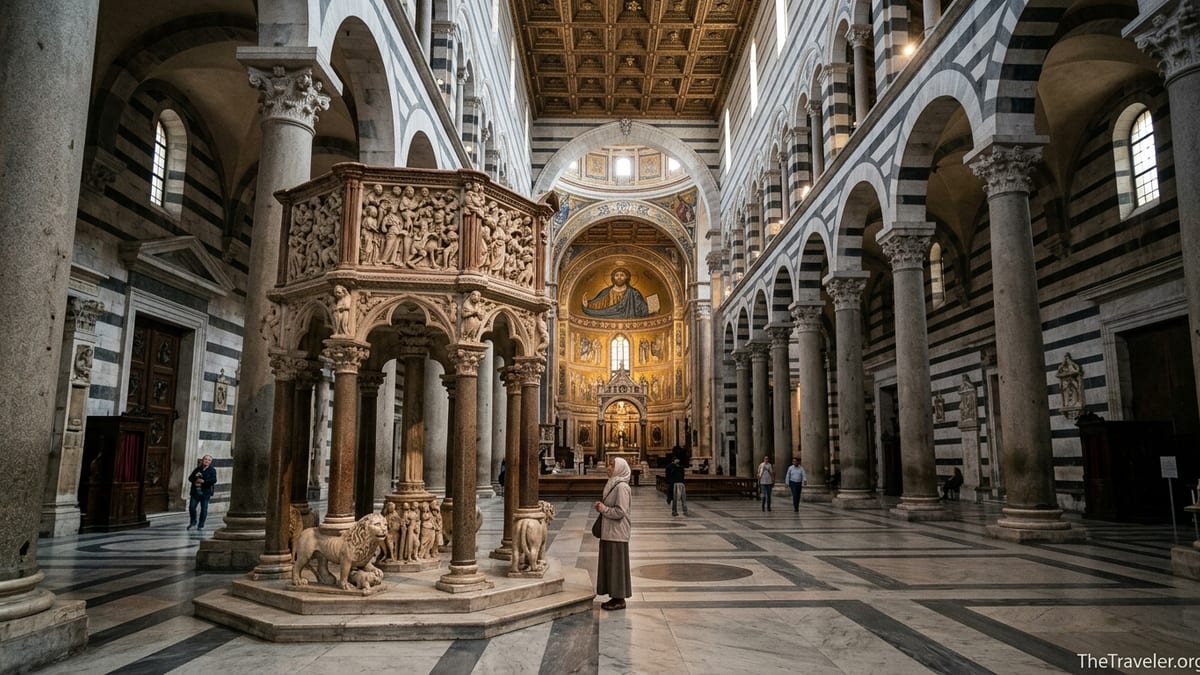
Inside, the light changes immediately. After the bright glare of the Tuscan sun on white marble outside, the cathedral’s interior is softer and more diffuse. Sunbeams slip in from clerestory windows high above, catching dust motes in the air and gilding the tops of the black-and-white striped columns. The nave stretches out like a stone forest, its arches leading your eyes straight toward the glowing apse mosaic of Christ Pantocrator, one of the cathedral’s defining images.
The floor underfoot is a geometric puzzle of inlaid marble, some slabs veined like stormy skies, others a soft cream. Many visitors instinctively lower their voices, not because of staff reminders but because the building itself seems to ask for it. When a small group tour guide speaks, the sound rises, travels along the nave, and returns as a low echo. It is easy to imagine a medieval congregation hearing the Latin mass carried the same way, the words half understood but fully felt.
On a typical summer morning, you might find a steady stream of visitors, yet there are still pools of quiet near the side aisles. People cluster around the famous pulpit, craning their necks, then drift toward side chapels or stand under the central dome, taking in the starry decorations. Others sit on the wooden benches for a moment, letting the constant movement of the square fall away. For many, this is the first time Pisa becomes more than a leaning tower; it becomes a living church with a rhythm and atmosphere distinct from the carnival outside.
Even small practical details contribute to making the past feel close. You are asked to cover shoulders and wear knee-length garments, a reminder that this is an active place of worship. On certain days, parts of the nave may be roped off for services or choir rehearsals. If you happen to visit at such a time, the sound of organ music or sung responses can transform your visit, momentarily aligning you with generations of worshippers who experienced the building primarily through liturgy rather than tourism.
Giovanni Pisano’s Pulpit: A Medieval Storyboard in Marble
No single artwork inside Pisa Cathedral does more to collapse the distance between present and past than Giovanni Pisano’s pulpit. Carved between 1302 and 1310, this polygonal masterpiece rises from a forest of columns, each supported by sculpted lions, allegorical figures, or prophets. From a distance, it looks like a miniature Gothic tower set in the middle of the nave. Up close, it becomes a crowded stage of biblical scenes, saints, and swirling draperies.
What makes this pulpit revolutionary is how it treats its figures. Earlier medieval sculptures tended to be rigid and symbolic. Here, by contrast, Giovanni’s characters twist, lean, and react. In the Nativity scene, Mary reclines in a pose that recalls ancient Roman sarcophagi, while midwives wash the newborn Christ in a basin. In the Crucifixion panel, bodies cluster in grief, faces contorted with emotion. You may not know that art historians see this as a bridge between Gothic expressiveness and the dawning naturalism of the Renaissance, but you can feel its power as storytelling.
For a modern visitor, the pulpit works almost like a 3D graphic novel. Travelers cluster around its base, audio guides in hand, tracing scenes of the life of Christ with their fingers hovering just above the marble. The slightly curved relief panels, an innovation at the time, draw you in as though the narrative were wrapping itself around you. When a guide points out Hercules standing among Christian virtues on one of the supporting figures, the blend of classical myth and Christian theology suddenly becomes tangible instead of theoretical.
Access to the pulpit area may be gently controlled by staff to prevent overcrowding, especially during high season. If you want a quieter moment with it, arriving at the cathedral early in the morning or in the late afternoon after large tour groups have departed can make a real difference. Standing there almost alone, with the soft light catching on the carved curls of hair and folds of cloaks, you can easily imagine a 14th century preacher climbing the stone steps to address merchants, sailors, and nobles gathered below.
Mosaics, Ceiling, and the Echo of a Scientific Revolution
As your eyes travel beyond the pulpit, the apse mosaic demands attention. A monumental Christ in Majesty dominates the curved wall, rendered in glittering tesserae that catch the light like scales. To his side, the figure of Saint John the Evangelist maintains a solemn watch. The style is distinctly Byzantine, a reminder of Pisa’s maritime links to Constantinople and the eastern Mediterranean. Even after later fires and Baroque renovations, this medieval core still glows with an otherworldly presence.
Above the nave, the coffered wooden ceiling tells another chapter of the building’s history. After a devastating fire in 1595, much of the interior was rebuilt. The ceiling that replaced the earlier structure is richly gilded, with painted coats of arms and medallions framed by deep recesses. When you tilt your head back to study it, the contrast is striking: medieval stone arches supporting a late Renaissance display of power and piety. It is a visual reminder that the cathedral has never been frozen in time but has evolved as Pisa itself changed fortunes.
Then there is the story of Galileo’s lamp. According to local tradition, a young Galileo Galilei observed a swinging bronze lamp inside the cathedral and used its regular motion to study the laws of pendulums. Whether the story is embellished or not, a lamp still hangs from the nave, and guides inevitably stop under it to retell the anecdote. For many visitors, it is a moment when scientific history collides with sacred space: one of Tuscany’s most famous sons first glimpsing the rhythms of the cosmos within the flicker of church light.
Even small decorative details invite closer inspection. In the side aisles you can find painted panels from the 16th and 17th centuries by Tuscan artists such as Andrea del Sarto and Domenico Beccafumi, depicting saints and Old Testament stories. Nearby chapels house relics, including those of San Ranieri, the patron saint of Pisa, whose cult once drew pilgrims from across the Mediterranean. Standing before these shrines, surrounded by the smell of wax and stone, it is far easier to understand how medieval devotion functioned as a web linking cities, trade routes, and ordinary believers.
Walking Pisa’s Medieval Story Beyond the Cathedral Walls
Stepping back outside the cathedral, blinking again in the bright light of Piazza dei Miracoli, the whole square rearranges itself in your imagination. The Leaning Tower becomes not just a photographic quirk but the campanile of a functioning religious complex. The Baptistery, with its circular walls and layered domes, is where centuries of Pisans were brought into the Christian community. The long marble rectangle of the Camposanto Monumentale holds cloistered arcades and faded frescoes that once covered its walls with images of death, judgment, and resurrection.
Walking a slow circuit of the square after visiting the cathedral helps stitch these monuments together into a coherent medieval story. Many travelers choose a combined ticket that allows timed entry to the Baptistery and Camposanto in addition to the cathedral. Inside the Camposanto, look for traces of the 14th century Triumph of Death fresco, where skeletal riders gallop across a Tuscan landscape. In the Baptistery, you can see another great pulpit, this one by Nicola Pisano, Giovanni’s father, whose more classical, composed figures provide a fascinating contrast to the emotional energy of the cathedral pulpit.
Beyond the square, medieval Pisa reveals itself in fragments rather than grand ensembles. A short walk toward the Arno River brings you to the tiny church of Santa Maria della Spina, a lacework of Gothic pinnacles whose size belies the richness of its decoration. Streets in the historic center still preserve tower houses and narrow alleys that hint at the dense urban fabric of the 12th and 13th centuries. Following this route after a morning inside the cathedral can make the rest of the city’s history feel more legible, as though you have been given a key to decode stone and brick.
This connection between monument and everyday life is one of the rewards of dedicating real time to the cathedral rather than treating it as a quick add-on to a Leaning Tower visit. A typical traveler might spend just 20 to 30 minutes inside before rushing on, but spending an hour carefully reading its spaces, then exploring the wider city, turns Pisa from a half-day stop into a destination where the medieval world still breathes beneath the surface.
Practical Ways to Experience the Cathedral Deeply
To feel Pisa’s medieval history come alive inside the cathedral, a little planning goes a long way. In high season, entrance to the monument complex operates on timed tickets. Buying a combined ticket that includes at least one paying monument, such as the Baptistery or Camposanto, often gives you access to the cathedral itself at no extra charge, but you still select a time slot. Arriving 10 to 15 minutes before your slot helps you clear any security or dress-code checks without stress.
Inside, it pays to move slowly and to break your visit into zones: the nave and pulpit, the apse and mosaic, the side chapels, and the crossing under the dome. Rather than trying to photograph everything, choose a few works to engage with closely. For instance, spend five full minutes in front of one relief panel on the pulpit, looking at every figure, or trace with your eyes the path of light from a high window to a specific pattern on the marble floor. These small, deliberate acts of attention can make the building’s age and layered history feel much more immediate.
An audio guide or a small-group art history tour can also transform the experience. Several local operators and official channels offer tours that include the cathedral, often priced similarly to a mid-range restaurant meal. A good guide can help you notice details you might miss on your own: the way certain columns show signs of having been reused from Roman buildings, or how the striped marble pattern relates to other Pisan Romanesque churches along the coast. For travelers who prefer independence, reputable guidebooks focused on Pisa or Tuscany often include detailed floor plans and suggested routes through the cathedral, which you can follow at your own pace.
If your schedule allows, consider visiting twice: once during the brightness of midday, when mosaics and gilding glitter most intensely, and again closer to closing time, when the interior grows dimmer and quieter. On some evenings, special services or concerts may be held, announced on boards near the entrance. Attending one of these events, even if you do not understand the language fully, lets you experience the cathedral closer to how medieval and early modern Pisans did: as a place where sacred ritual, civic identity, and communal memory converged.
The Takeaway
Many travelers leave Pisa with camera rolls filled with the famous tilted tower but only a hazy memory of the cathedral beside it. Yet for anyone curious about how Tuscany’s medieval history looked, sounded, and felt from the inside, Pisa Cathedral is the real revelation. Its striped arcades and glittering apse carry the imprint of an 11th century maritime republic asserting its power. Giovanni Pisano’s pulpit acts as a marble hinge between the Middle Ages and the Renaissance, while stories of Galileo and San Ranieri fold scientific curiosity and local devotion into the same shared space.
By taking the time to slow down inside the cathedral, to trace reliefs with your eyes and follow beams of light across centuries-old stone, you move beyond the postcard version of Pisa. The city’s history stops being a list of dates and names, and instead becomes a sensory experience that lingers long after you leave the square. In that sense, stepping inside Pisa Cathedral does more than complete a visit to the Leaning Tower. It opens a door into a deeper, more textured understanding of Tuscany’s medieval world, one that is still very much present in the stone and silence of this extraordinary building.
FAQ
Q1. Do I need a ticket to enter Pisa Cathedral?
In most cases you need a timed ticket obtained at the Piazza dei Miracoli ticket office, but entry to the cathedral is often included at no extra cost when you purchase tickets for other paid monuments such as the Baptistery or Camposanto. Policies can vary by season, so it is wise to check current arrangements on arrival.
Q2. How much time should I plan inside the cathedral?
Many visitors spend around 20 to 30 minutes, but allowing at least an hour gives you enough time to appreciate the pulpit, mosaics, side chapels, and overall architecture without rushing. If you are especially interested in medieval art, combining a cathedral visit with the Baptistery and Camposanto can easily fill half a day.
Q3. What is the best time of day to visit for fewer crowds?
Early morning shortly after opening and late afternoon toward closing tend to be quieter than midday, when tour groups and day-trippers from Florence or the coast are most common. Visiting outside peak summer months can also make the experience more relaxed.
Q4. Is there a dress code for Pisa Cathedral?
Yes. As it is an active place of worship, visitors are expected to cover shoulders and wear garments that reach roughly to the knees. Light scarves or shawls are useful if you are visiting in summer and wearing sleeveless tops.
Q5. Can I take photos inside the cathedral?
Photography for personal use is generally allowed, but flash and tripods are typically prohibited to protect artworks and avoid disturbing worshippers. It is courteous to avoid photographing during services and to follow any instructions given by staff on site.
Q6. Is Pisa Cathedral accessible for visitors with limited mobility?
The cathedral floor is largely flat, and main entrances are usually accessible, though some areas may have slight steps or uneven marble surfaces. Dedicated visitors with mobility concerns may wish to inquire at the ticket office or information desk about current access routes and any available assistance.
Q7. What should I not miss inside Pisa Cathedral?
Key highlights include Giovanni Pisano’s pulpit in the nave, the apse mosaic of Christ in Majesty, the gilded coffered ceiling, and the chapels containing relics of San Ranieri. Taking time to notice the striped marble columns and reused classical elements also deepens your sense of the building’s history.
Q8. Are guided tours of the cathedral worth it?
For many travelers, a guided tour or audio guide adds significant value by explaining the symbolism of the sculptures and mosaics and placing the cathedral in the context of Pisa’s medieval rivalry with other Tuscan cities. Those already familiar with Romanesque and Gothic art may be content with a detailed guidebook and independent exploration.
Q9. Can I attend a religious service in the cathedral?
Yes, regular masses and special liturgical events are held, particularly on Sundays and major feast days. Visitors are generally welcome to attend respectfully, but photography and movement may be restricted during services. Service times are usually posted near the entrance or provided by local information points.
Q10. How does visiting the cathedral change the way I see the Leaning Tower?
Experiencing the cathedral first helps you understand the tower as part of a larger religious and civic complex rather than an isolated curiosity. The Leaning Tower becomes the campanile of a powerful medieval republic, and the whole Piazza dei Miracoli reads as a carefully planned statement of faith, wealth, and artistic ambition rather than just a backdrop for a single famous structure.