


From the Manhattan side of the Hudson, Hoboken looks like a quiet front-row seat to New York City: a slim waterfront, a few piers, and that famous skyline stretched out just across the river. I arrived expecting a quick photo stop and maybe a sunset drink with a view. Instead, over a few days of wandering its streets and parks, I discovered a place that feels far more like a compact neighborhood city than a suburb of Manhattan, with a daily rhythm that quietly pulls you in.
Get the latest updates straight to your inbox!
Arriving for the Skyline, Staying for the First Stroll
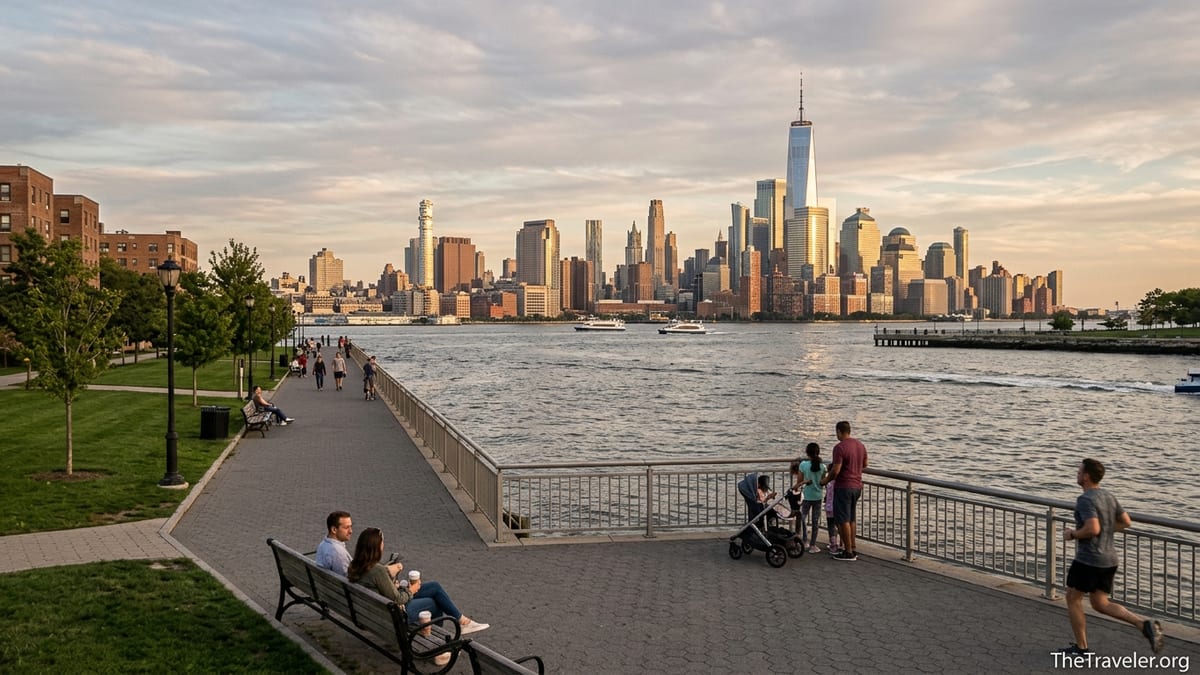
If you come in on NJ Transit to Hoboken Terminal, your first steps already feel cinematic. The station’s vaulted ceilings and old brass fixtures open directly onto the waterfront, where Frank Sinatra Drive runs along the Hudson with uninterrupted views of Lower Manhattan. Within minutes of stepping off the train, I was standing at the edge of Pier A Park, watching ferries cut across the river while the One World Trade Center spire glowed behind them.
Like most first-time visitors, my plan revolved around those skyline moments. Locals told me that on clear evenings, Pier A and the path north toward Frank Sinatra Park become an informal viewing party, with office workers sitting on the grass in business-casual, families unwrapping pizzas, and joggers doing intervals with Midtown as their backdrop. Around golden hour, photographers quietly claim corners of the promenade, angling their lenses toward the light on the glass towers across the river.
Yet almost as soon as I veered away from the water and into the grid of streets behind it, the focus shifted. Within a couple of blocks, the view of Manhattan slipped out of sight, replaced by rows of brick walk-ups, stoops with bikes locked to railings, and corner bakeries doing a brisk trade in iced coffee and egg sandwiches. The soundtrack went from lapping water and ferry horns to the clink of dishes and the low hum of people who obviously live here, not just pass through.
By the time I had walked from the terminal up to around 6th Street, Washington Street felt less like a commuter strip and more like the main street of a small city. A mix of independent cafés, restaurants, and old-school bars share the sidewalk with barbershops, nail salons, and dry cleaners, the kinds of businesses that exist because locals visit them every week, not because they appear in vacation planning searches.
Waterfront Parks: From Postcard Views to Everyday Backyards
Hoboken’s waterfront is what grabs you first, and it’s not hard to see why. Frank Sinatra Drive strings together a series of parks and piers designed so that almost every bench seems to have a direct sightline to Manhattan. Pier A Park, just north of the terminal, is a long green lawn jutting into the river, with rows of trees and plenty of benches facing the skyline. It is one of those places where travelers and residents blend seamlessly: a couple with small suitcases waiting for their train, a group of teenagers taking graduation photos, a lone reader with a paperback and a deli coffee.
Farther north, the character of the waterfront shifts with each pier. Frank Sinatra Park, backed by the Stevens Institute of Technology hillside, feels a bit more local, with soccer fields, a small amphitheater, and clusters of friends sharing takeout on the low walls. On summer weekends, it turns into a magnet for picnics and casual birthday gatherings, the kind where someone shows up with trays from a Washington Street bakery and kids run laps between games of frisbee.
Uptown, the scene becomes more festive around seasonal spots like Pier 13, which functions as a waterfront playground in warm weather. During summer 2026, the pier is lined with food trucks selling tacos, lobster rolls, and soft-serve, plus bars serving plastic cups of draft beer and frozen drinks. It is a place where a sunset skyline photo is almost a side benefit to the social scene: groups of friends stake out high-top tables, dogs lounge under chairs, and a DJ or playlist keeps a steady beat while the lights of Midtown flick on across the river.
Not every pier is picture-perfect at every moment. Pier C, for example, a beloved park with playgrounds and fishing spots, has faced recent closures due to structural issues, a reminder that even the most scenic spaces need constant care. But the overall effect along Frank Sinatra Drive is of a linear neighborhood “backyard” that locals use in small, ordinary ways: morning runs with strollers, early solo yoga sessions on the grass, midweek dog walks timed to catch a sliver of sunset before dinner.
Washington Street: A Main Street with a Commuter’s Commute
Step a block or two inland and the waterfront glamour recedes into something more grounded. Washington Street, running the length of Hoboken, is the artery that keeps the local rhythm going. On a weekday morning, the sidewalks are full of commuters heading toward the PATH station or the bus stops, coffee in hand. By lunchtime, office workers from the neighborhood’s co-working spaces and small firms drift into cafés and delis for salads and sandwiches, and by evening the same sidewalks host dog walkers, stroller-pushing parents, and friends meeting up for happy hour.
The cafés alone could occupy an entire visit. You might start with a carefully made flat white at a sleek spot with big windows on lower Washington, then wander past a newer independent café further uptown where laptops and sketchbooks share table space with stroller parking. Places like these reflect broader shifts in Hoboken: new-wave coffee culture arriving in old storefronts that used to house hardware stores or family-run bars, yet still serving the same local faces day after day.
Hoboken’s restaurant scene is in constant motion. Longtime favorites like The Brass Rail on Washington Street, with its historic brick façade and two-story dining rooms, coexist with newer arrivals that reinterpret what a neighborhood place can be. A well-reviewed Cuban restaurant and bar on Washington mixes strong mojitos with live music nights, while healthy fast-casual spots offer grain bowls, juices, and rotisserie chicken to a crowd that clearly cares about both convenience and quality. Rents can be punishing here, and storefront turnover is real, but the effect for a visitor is a streetscape that always feels like it has one more new place to discover around the next corner.
Prices, unsurprisingly, skew city-level. Expect to pay roughly what you would in Manhattan for a glass of wine or a craft cocktail, and only slightly less for a casual dinner: two people can easily spend the equivalent of a mid-range New York meal once you add drinks. Many locals shrug this off as the cost of living in a place where they can walk to everything, but savvy travelers often balance nights out with simple, satisfying slices from corner pizzerias or bagels and coffee from no-frills shops to keep the budget in check.
Morning Rituals and Weeknight Routines
What ultimately made Hoboken feel like more than a vista point was the way its daily routines revealed themselves to anyone willing to slow down. Early one weekday, I skipped the rush into Manhattan and instead followed the cadence of people starting their day in town. On residential side streets near Church Square Park, front doors opened to release a shuffle of school-bound children with oversized backpacks, while parents carried paper coffee cups and called out greetings to neighbors across the narrow roadway.
By mid-morning, playgrounds at Church Square, Columbus Park, and Elysian Park were busy with nannies and parents pushing toddlers on swings. A small line formed outside a popular bakery on a side street as locals picked up boxes of pastries for the office. The energy felt different from Manhattan’s all-business pace. Hoboken’s morning has a kind of layered life: yes, plenty of residents are headed for trains and ferries, but just as many seem to be staying put, running errands, walking dogs, or sitting on park benches with laptops balanced on their knees.
Weeknights have their own distinct cadence. Around 6 p.m., Washington Street shifts as commuters return from Manhattan. You can see them pouring out of the PATH station or hopping off ferries, often walking straight to a nearby bar for a quick drink before heading home. Happy hour menus offer a modest break from the city’s typical drink prices, and patios fill quickly in warm weather. But by 9 or 10 p.m. on weeknights, many parts of Hoboken feel surprisingly calm, with light spilling from apartment windows and a handful of late-night spots serving a second dinner crowd.
This is one of the city’s underappreciated strengths for visitors: you can have a lively evening out without committing to a full Manhattan-level blowout. You might start with cocktails at a buzzy spot on Washington, walk a few blocks for a laid-back dinner at a neighborhood Italian restaurant, then detour to the waterfront for a quiet look at the skyline before heading back to a hotel or rental. The whole thing feels far more manageable than navigating multiple subway lines and neighborhoods across the river.
Getting Around: Small-City Convenience with Big-City Access
For such a compact city, Hoboken offers an impressive range of ways to move. The PATH train from Hoboken Terminal gets you to Lower Manhattan in roughly 15 minutes under the Hudson, making it entirely feasible to stay in Hoboken and spend most of your daytime hours in New York. Frequent travelers mix the PATH with ferry rides from either the terminal or the 14th Street uptown pier, opting for the scenic route on days with good weather or when special deals on tickets are available.
The ferries are their own small experience. Boarding at the Hoboken terminal, you can cross to Battery Park City or Midtown West, emerging a short walk from major office districts and tourist sights. From 14th Street, boats connect to Manhattan terminals as well, with service patterns shifting slightly by season and weekday. Morning crossings feel like a moving slice of local life: young professionals with tote bags and coffee, construction workers in high-visibility vests, parents guiding kids to schools across the river during a temporary PATH disruption.
Within Hoboken, walking is the default. The city is roughly a square mile, which means that no destination is truly far away. From the southern edge near the terminal up to the 14th Street area, it is about a 20 to 25 minute stroll at a relaxed pace, and most cross-streets take only a few minutes to traverse from west to east. Hudson County buses and local shuttles fill in the remaining gaps, particularly for residents in the western parts of town, but as a visitor you will likely experience Hoboken at sidewalk speed.
That walkability changes how the skyline feels. In Manhattan, skyscrapers are usually the environment you move through. In Hoboken, they become the constant backdrop. Even a quick errand run might end with a detour to the river for a minute of quiet, watching late-afternoon light catch the sides of downtown towers before you turn back toward tree-lined streets and brick facades.
Food, Drinks, and the Evolving Social Scene
Hoboken’s social life once revolved heavily around its bar scene, a reputation shaped by generations of young professionals using it as a launchpad into the city. That legacy remains in stretches of Washington Street, where sports bars, Irish pubs, and modern cocktail spots sit almost shoulder to shoulder. On weekend nights, groups of friends spill out onto the sidewalks between places, especially during big game days or in the first warm weeks of spring.
In recent years, though, the balance has shifted more toward food and daytime culture. Newer restaurants lean into diverse influences: Latin American flavors at a lively Washington Street spot where tapas-style plates and strong rum cocktails dominate the tables; contemporary American bistros offering seasonal menus with local produce; Middle Eastern, Italian, and Asian eateries tucked into small storefronts that can fill up quickly by 7 p.m. on a Friday. Many of these places feel like true neighborhood hubs, where staff recognize returning guests and regulars greet each other across the room.
Cafés and bakeries play a bigger role than their square footage suggests. On weekday afternoons, it is common to find nearly every table occupied by a mix of remote workers, college students from nearby Stevens Institute, and parents with strollers. Conversation drifts from project deadlines to local school fundraisers to plans for the weekend food truck lineup on the waterfront. For a visitor, these are some of the best places to absorb the city’s mood: you can sit with a pastry and coffee, watch the ebb and flow of locals checking their phones and greeting friends, and feel more like a temporary resident than a tourist.
Outdoor dining has become a visible part of the streetscape in warm months, although the exact setups evolve over time with city regulations and business realities. Simple bistro tables on the sidewalk, string lights over compact patios, and seasonal parklets all contribute to that European-inflected café feel. As rents and licensing costs rise, some restaurants come and go, but the underlying culture of meeting “on Washington” for a drink or a casual dinner remains deeply woven into Hoboken life.
How Hoboken Feels Different from Manhattan
For all its physical proximity to New York, Hoboken carries a noticeably different emotional weight. On the surface, both places share dense housing, transit hubs, and a constant flow of people. Yet in Hoboken, scale changes everything. The buildings rarely rise above mid-rise heights away from the waterfront, so the sky always feels present. Crosswalks are short, traffic is calmer than in Midtown, and it is entirely possible to bump into the same person three times in a day just by virtue of everyone using the same handful of routes.
This smallness creates a strong sense of familiarity. Bartenders remember faces, baristas recall complicated coffee orders, and park regulars recognize each other’s dogs. When someone mentions “the park” or “the ferry,” there is usually only one or two plausible options in context. That shared geography builds a quiet community language that visitors can quickly tune into. After a couple of days, you might find yourself saying “up the hill by Stevens” or “down by the terminal” as if you had lived here for months.
At the same time, Hoboken benefits from big-city diversity. You will hear multiple languages on a single block and find everything from casual taquerias to refined date-night restaurants within a short walk. The difference is that the experiences stack vertically less often and horizontally more often. Instead of climbing to a 40th-floor cocktail bar, you step sideways into another storefront, where the lights are low, the music softer, and the bartender asks if you are in town visiting friends or thinking about moving here, because plenty of people do exactly that after a few stays.
That is perhaps Hoboken’s greatest surprise: it is easy to imagine a repeat visit, or even a longer stay. Where Manhattan can overwhelm, Hoboken invites you to settle, even if just for a weekend. You realize that the skyline, stunning as it is, becomes more of a reassuring constant than a singular attraction. It is always there when you want it, but it does not demand your attention in the same way once you start paying attention to everything happening at street level.
The Takeaway
I arrived in Hoboken obsessed with finding the perfect angle on the Manhattan skyline and left with mental snapshots of much smaller scenes: a pair of friends sharing a quiet bench in Church Square Park, parents leaning on stroller handles as the ferry docked in late afternoon light, a barista waving goodbye to a regular who had clearly lingered longer than planned over a laptop and a latte.
The city works beautifully as a base for New York adventures: fast PATH trains and scenic ferries, enough restaurants and bars to keep evenings interesting, and that endless riverfront promenade for decompressing after busy days across the Hudson. Yet it also stands on its own as a destination for travelers who like their cities compact, walkable, and deeply lived-in.
If you come only for the skyline, you will get your postcard. Stand at the edge of Pier A or along Frank Sinatra Drive at sunset and you will see why so many photos of Manhattan are actually taken from this side of the river. But give yourself time to wander a few blocks inland, to sit in a neighborhood café or linger on a park bench, and you might find that what you remember most about Hoboken is not the view of the city across the water, but the feeling of belonging, however briefly, to the one you are standing in.
FAQ
Q1. Is Hoboken a good place to stay when visiting New York City?
Yes. Hoboken offers quick access to Manhattan via PATH trains and ferries while providing a calmer, small-city atmosphere with walkable streets, parks, and a strong neighborhood feel.
Q2. How long does it take to get from Hoboken to Manhattan?
On the PATH from Hoboken Terminal to Lower Manhattan, typical travel time is around 15 minutes. Ferries from Hoboken to Manhattan terminals take a similar amount of time, depending on the route and time of day.
Q3. Where are the best skyline views in Hoboken?
Pier A Park and the promenade along Frank Sinatra Drive offer some of the best views of the Manhattan skyline. In warm weather, Pier 13 also provides excellent vistas paired with food trucks and outdoor seating.
Q4. Is Hoboken walkable without a car?
Very. Hoboken is roughly one square mile, so most destinations, from the waterfront to Washington Street and neighborhood parks, are within a 10 to 25 minute walk. Many residents and visitors rely entirely on walking and public transit.
Q5. Are Hoboken restaurants expensive compared to Manhattan?
Prices are similar to many Manhattan neighborhoods. Cocktails and wine can be close to city prices, and dinner for two at a sit-down restaurant can reach the same range as a mid-range Manhattan meal, especially once drinks are included.
Q6. What is the nightlife like in Hoboken?
Hoboken has a mix of lively bars, sports pubs, and more relaxed cocktail spots, especially along Washington Street. Weekends can be energetic, but many weeknights feel more low-key and neighborhood-oriented than Manhattan’s major nightlife areas.
Q7. Is Hoboken family-friendly?
Yes. The city has multiple playgrounds, neighborhood parks like Church Square and Elysian, and a waterfront with wide paths for strollers and scooters. Families are a visible part of daily life, particularly in the mornings and early evenings.
Q8. Can I visit Hoboken as a day trip from New York City?
Absolutely. Many visitors take the PATH or ferry over for a few hours to walk the waterfront, explore Washington Street, and enjoy a meal with skyline views before heading back to Manhattan.
Q9. When is the best time of year to experience Hoboken’s waterfront?
Late spring through early fall is ideal, when parks are green, outdoor dining is in full swing, and seasonal spots like Pier 13 are active. Clear winter days can also offer striking skyline views, just with colder temperatures.
Q10. Is Hoboken safe for solo travelers?
Hoboken is generally considered safe, especially in the busy areas around the waterfront and Washington Street. As in any city, standard urban precautions apply, but many solo travelers feel comfortable walking around, even in the evening, along well-lit main routes.