


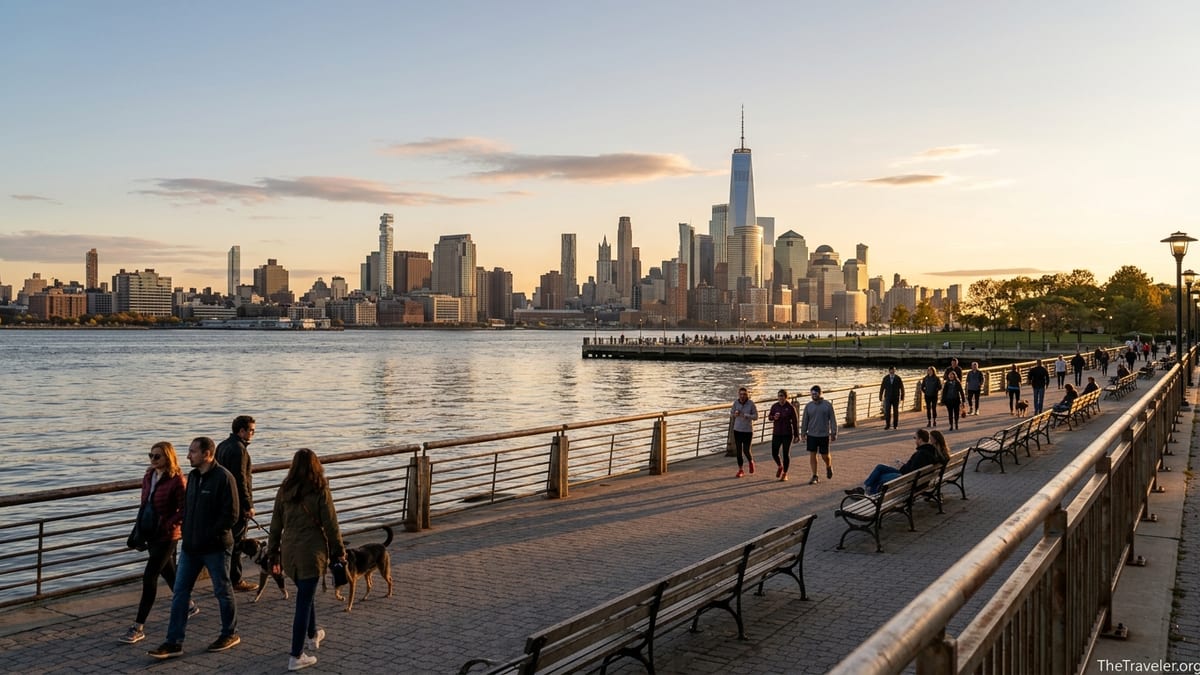
Stand on Hoboken’s riverfront at golden hour and it becomes obvious why so many New Yorkers now slip across the Hudson for a reset. The Manhattan skyline glows just a few hundred yards away, yet the mood on this New Jersey waterfront is unhurried. Joggers move along the promenade, families linger over ice cream, and friends cluster at outdoor tables with the Empire State Building as their backdrop. In the span of a 10 to 15 minute train or ferry ride, the pressure of Manhattan gives way to a compact city that feels like a neighborhood-scale retreat. Hoboken has quietly become one of the most appealing short escapes from New York City, precisely because it offers what many visitors crave: the energy of an urban destination without the constant intensity.
Get the latest updates straight to your inbox!
A Tiny “Mile Square City” With a Big-City Skyline
Hoboken is officially just about one square mile in size, which is why locals and real estate agents alike call it the Mile Square City. Bordered by the Hudson River to the east and New Jersey’s Palisades to the west, it sits directly opposite Midtown and Lower Manhattan. That geography shapes almost every aspect of a visit: you are close enough to see individual windows in the World Trade Center, yet far enough to feel like you have stepped into a separate, smaller-scale world.
The city’s industrial past as part of the Port of New York is still visible in its long piers and historic rail terminal, but those working waterfronts have largely been replaced by landscaped parks, playgrounds, and a continuous riverfront walkway. Today, visitors come less for cargo ships and more for stroller-friendly promenades, sunset photo ops, and the novelty of watching Manhattan from the outside looking in.
Because the city is so compact, visitors quickly get a feel for its layout. Washington Street runs north to south as the commercial spine, packed with restaurants, bars, bakeries, and boutiques. Just a block or two east, the waterfront arc of Sinatra Drive, Pier A Park, and Pier C Park offers panoramic skyline views and a calm antidote to crowded Midtown sidewalks. Walk a few blocks west and the vibe shifts again, with tree-lined side streets lined by brownstones and low-rise apartment buildings that feel more like a residential neighborhood than a destination.
That combination of neighborhood intimacy and world-class skyline is key to Hoboken’s appeal as an escape. You can spend the morning exploring New York’s museums, then be sitting on the grass in Pier A Park with a coffee, watching ferries glide by and helicopters arc over the river, within the same half hour.
Access in Minutes: PATH Trains, Ferries, and Easy Logistics
Part of what makes Hoboken such an attractive bolt-hole from Manhattan is how little effort it takes to get there. The PATH train from Manhattan’s 33rd Street corridor to Hoboken Terminal typically runs on a schedule counted in minutes rather than tens of minutes, and the actual river crossing itself takes roughly 10 minutes on most services. For New Yorkers staying in Midtown, the routine is straightforward: swipe into the PATH at 33rd Street near Herald Square and emerge at Hoboken’s historic terminal facing the river.
Travelers coming from Lower Manhattan have a similar option via the PATH line from the World Trade Center, which reaches Hoboken in a short ride, often comparable in time to a crosstown subway journey. Many visitors treat Hoboken as an after-dinner stroll or sunset outing precisely because the round-trip feels no more complicated than taking the subway to another neighborhood in the same borough.
For those who prefer fresh air to tunnels, NY Waterway ferries add another layer of convenience and atmosphere. Regular ferry routes link Hoboken’s 14th Street pier and Hoboken Terminal with the West Midtown ferry terminal near West 39th Street, as well as with Brookfield Place in Battery Park City at peak times. In practice, that means a visitor staying near the Hudson Yards or Hell’s Kitchen area can walk to the pier at West 39th Street, buy a ticket at the machines or through the NY Waterway app, and be on a boat to Hoboken within minutes.
Prices vary by route and pass type, but a one-way adult ferry ticket from Midtown to Hoboken is typically in the high single digits to low teens in US dollars, with discounts for multi-ride packs. PATH fares are lower, roughly in line with or slightly above a standard New York City subway ride. The end result is that an evening escape to Hoboken can feel like an impulse decision rather than a budget-heavy day trip: you tap in or scan your ferry barcode and you are across the river before you have had time to rethink it.
Waterfront Parks: Manhattan Views Without Manhattan Pace
Once visitors arrive, the waterfront is almost always the first stop. Hoboken has invested heavily in turning its former piers into public space, and for someone coming from Manhattan’s crowded riverfront parks, the difference in breathing room is immediately noticeable. The broad lawn of Pier A Park, a short walk north from the terminal, is one of the most popular gathering spots. On warm evenings you will see picnic blankets spread out facing One World Trade Center, kids running along the paths, and couples sitting along the stone seawall watching the Staten Island Ferry trace orange arcs across the harbor far to the south.
Just north, Pier C Park introduces a different kind of escape. Jutting further into the river, this park has a small beach-like edge, a playground, and a looping path that feels almost like a floating island. From here, the Empire State Building and the Midtown skyline rise nearly straight across the water. On a clear day, it is a prime photograph spot, but it is also a place where a traveler can simply sit on a bench with a takeout sandwich and watch the shifting light on the glass towers across the river.
Continue along the Hudson River Waterfront Walkway and the city reveals more pockets of quiet. Joggers make use of the long, uninterrupted path, while visitors stop at small overlooks to snap pictures of landmarks like the Chrysler Building and Hudson Yards. Because the path is wide and the crowd volumes are generally lower than on Manhattan’s Hudson River Park, it feels more like a local recreation space than a tourist corridor.
These parks help explain why Hoboken reads as an escape instead of simply a bedroom community. Even a short visit can revolve entirely around the riverfront: coffee from a Washington Street cafe, an hour on a bench at Pier A Park, and a slow wander back to the ferry at sunset. The city may be one square mile, but the psychological distance from Midtown’s office towers feels much greater once you are settled into the rhythm of the waterfront.
Dining, Nightlife, and Local Flavor on Washington Street
While the views draw people in, Hoboken’s food and drink scene gives them reasons to linger. Washington Street runs the length of the city and is dense with restaurants and bars catering to everyone from young professionals and college students to families. On a single block you might find a Neapolitan-style pizzeria, a casual Mexican spot with sidewalk seating, a modern cocktail bar, and a 24-hour diner frequented by late-night crowds and early-morning commuters alike.
For visitors used to Manhattan pricing, Hoboken can feel marginally kinder to the wallet, especially at casual spots. A good espresso drink at an independent cafe often costs in the same range as across the river, but happy hour wine and beer specials are common, and many restaurants offer weekday prix fixe deals to draw in both locals and visitors. It is increasingly popular for New Yorkers to book dinner in Hoboken, whether at a waterfront restaurant facing the skyline or a buzzy neighborhood bistro just off Washington Street, then head back to the city afterward.
Nightlife tends to be concentrated along and just off Washington Street, with a mix of sports bars, music venues, and cocktail lounges. Many of these bars lean into the local crowd, airing European soccer matches in the morning or hosting trivia nights during the week. However, the scale remains smaller than Manhattan’s large clubs and mega-bars, which suits travelers looking for something social but not overwhelming. On a Friday night you might step off the PATH with groups heading to meet friends, but even at peak times the sidewalks do not feel as compressed as they can in parts of the East Village or Lower East Side.
The atmosphere shifts again on Sunday mornings, when Washington Street fills with people carrying farmers’ market produce, strollers, and takeaway coffee. For visitors, that is part of the appeal: you are not in a replica of Manhattan, but in a self-contained small city whose social life has its own rhythms. You can spend a Saturday night bar-hopping and a Sunday morning browsing boutiques and bakeries without ever needing a cab.
Staying Over: Boutique Waterfront Hotels and Neighborhood Strolls
Hoboken’s rise as an escape has been matched by new hotel development along the river. The W Hoboken, with its glass facade facing the Manhattan skyline, has become a fixture for travelers who want immediate waterfront access. Guests can step out of the lobby and be on the riverfront walkway within moments, or walk a few blocks west to join the action on Washington Street. Rooms with river views are especially prized, turning the skyline into a kind of living artwork outside the window.
In recent years, additional high-end options have appeared, including a new Hilton-branded hotel near the historic post office on the southern waterfront. Roof terraces, design-forward lobbies, and event spaces that frame the skyline are part of a broader trend: Hoboken is no longer just a commuter hub where visitors sleep only if they have meetings in nearby office parks. It is positioning itself as a destination in its own right for weekend stays and city breaks.
For travelers who prefer a more residential feel, smaller hotels and short-term rentals west of Washington Street offer quieter streets and easier access to local eateries. Staying a few blocks inland often means waking to the sound of dogs being walked and school children heading to class rather than morning commuter traffic. From there, it is usually a 5 to 10 minute walk back to the waterfront.
Importantly, the city’s small footprint means that even travelers with only one night can experience several distinct slices of Hoboken. An afternoon might start with check-in at a waterfront hotel, move into a pre-dinner cocktail on a terrace overlooking Midtown, continue with a leisurely meal on Washington Street, and end with a moonlit walk back along Sinatra Drive before bed. For many, that sequence captures the essence of Hoboken as a gentle counterpart to Manhattan’s relentless pace.
From Industrial Rail Yard to Walkable Urban Village
Hoboken’s modern appeal did not happen by accident. For much of the 20th century, this was a working city dominated by shipyards, freight rail yards, and manufacturing plants. As port activity shifted and industry declined, Hoboken faced the same question as many post-industrial American cities: what to do with its waterfront and underused land. Over several decades, the city gradually converted former piers into parks, redeveloped obsolete industrial buildings, and encouraged mixed-use residential and commercial projects near transit.
The result today is a city that feels intentionally walkable. Sidewalks along Washington Street are wide enough for outdoor seating and foot traffic. Crosswalks are frequent. The Hudson-Bergen Light Rail threads along the city’s western edge, giving residents and visitors car-free access to neighboring Jersey City and Bayonne, while also linking into Hoboken Terminal’s web of trains, buses, and ferries. For a visitor, that translates into less time spent puzzling over transit maps and more time realizing that nearly everything they want to see is within a 15 minute stroll.
This built environment helps explain why Hoboken resonates as a mental and physical break from Manhattan. Although it is technically part of the same metropolitan region, the scale is different. Instead of endless avenues, there are short, numbered east-west streets. Instead of supertall towers on every corner, most residential blocks top out at a few stories. The most ambitious vertical gestures are reserved for a handful of waterfront towers, which themselves are softened by adjacent parks and promenades.
Even small design choices matter. Many visitors comment on the presence of pocket parks, playgrounds, and dog runs squeezed into leftover corners. When combined with the constant visual anchor of the river and skyline, these features give Hoboken the feeling of a self-contained village that just happens to sit across from one of the most intense urban environments on earth.
Experiences That Feel Local, Not Packaged
One reason Hoboken has become such a beloved escape is that it rarely feels curated for tourists. There are attractions, certainly, but they are woven into daily life rather than fenced off. The Hoboken Historical Museum, located along the northern waterfront, tells the story of the city’s evolution through rotating exhibits and neighborhood walking tours. Visitors interested in music history gravitate toward sites associated with Frank Sinatra, who was born here, while food-focused travelers seek out longstanding Italian delis and bakeries that predate the city’s latest wave of development.
Seasonal events add more layers of interest without tipping Hoboken into full tourist-town territory. In warmer months, outdoor concerts, movie nights, and cultural festivals pop up in waterfront parks. Washington Street hosts parades and community fairs that draw both locals and visitors, creating a sense of shared ownership over the public realm. Travelers who time their visits to coincide with these events often report that they feel less like outsiders and more like temporary participants in city life.
For simple, low-key escapes, even everyday experiences can feel special in Hoboken. Renting a bike and riding the riverfront path, grabbing a bench to watch kayakers paddle on the Hudson, or nursing a coffee while writing postcards with the skyline spread out ahead: these are the kinds of moments that make the city feel like a pressure valve for Manhattan’s intensity. They are accessible, unstructured, and unhurried.
Because the city’s visitor infrastructure is modest compared with major tourist districts in Manhattan or Brooklyn, lines are often shorter and reservations slightly easier to secure, especially on weeknights. A table at a well-reviewed neighborhood restaurant on a Tuesday is usually easier to come by here than in SoHo or the West Village. For New Yorkers who are weary of refreshing booking apps or waiting in long queues, that alone can make Hoboken feel like a luxury.
The Takeaway
Hoboken’s rise as a favorite escape from Manhattan rests on a simple equation: proximity plus contrast. It is close enough that a visitor can decide on a whim to cross the river after work, yet different enough in scale, pace, and atmosphere that the trip feels like a genuine change of scene. Waterfront parks convert former industrial piers into front-row seats to one of the world’s great skylines. Washington Street offers a dining and nightlife scene energetic enough to be interesting yet compact enough to remain manageable. New waterfront hotels turn the city into a viable weekend base rather than merely a commuter stop.
For travelers spending several days in New York City, budgeting an afternoon or evening in Hoboken can be a way to reset without sacrificing urban energy. You still have the skyscrapers in sight, the buzz of bars and restaurants, and the convenience of rapid transit. What you gain is breathing room, a human-scale grid of streets, and the pleasant sense that you are visiting a functioning community rather than only its tourist-facing facade.
In the end, that is Hoboken’s secret. It offers not a spectacle, but a shift in perspective. From its waterfront benches and hotel terraces, Manhattan becomes a view, not an obligation. For many visitors, that alone is reason enough to make the short trip across the Hudson, again and again.
FAQ
Q1. How long does it take to get from Manhattan to Hoboken?
In typical conditions, the PATH train ride from Midtown or Lower Manhattan to Hoboken takes around 10 to 15 minutes of in-train time, with additional minutes for station access.
Q2. Is Hoboken worth visiting if I only have a few hours?
Yes. Because the city is compact and the main sights cluster along the riverfront and Washington Street, you can enjoy views, a meal, and a stroll in just a few hours.
Q3. What is the best time of day to visit Hoboken?
Late afternoon leading into sunset is especially appealing, when the light hits the Manhattan skyline and waterfront parks fill with locals relaxing after work.
Q4. Are ferry tickets from Manhattan to Hoboken expensive?
Ferry fares are typically higher than PATH fares but still in the range of other city transit options. Many visitors consider the river views worth the extra cost, especially for a one-off trip.
Q5. Can I walk everywhere in Hoboken?
For most visitors, yes. The city is roughly one square mile, so walking from the PATH station or ferry to the waterfront parks and Washington Street restaurants is manageable for anyone comfortable with urban walking.
Q6. Is Hoboken safe for evening and nighttime visits?
Hoboken is generally perceived as a safe, lived-in community, especially along main streets and the waterfront. As in any city, standard urban awareness is recommended, but many visitors feel comfortable staying after dark.
Q7. Are there good hotel options if I want to stay overnight?
Yes. Hoboken has several modern hotels, including waterfront properties with direct skyline views, as well as smaller options inland that offer a quieter neighborhood feel.
Q8. What makes Hoboken different from visiting Brooklyn or Queens?
Hoboken offers similar neighborhood energy and food culture but in a much smaller, more walkable package, with the added novelty of seeing Manhattan from across the river rather than from within the same boroughs.
Q9. Do I need a car to explore Hoboken?
No. Most travelers arrive by PATH train or ferry and then get around entirely on foot, occasionally using local buses or light rail for specific trips along the New Jersey waterfront.
Q10. Is Hoboken family-friendly?
Very much so. The city has multiple playgrounds, waterfront parks with open lawns, and a relaxed restaurant scene that makes it easy to visit with children of different ages.