


Hostelworld makes it easy to book a bunk bed in Lisbon on your lunch break or line up a month of dorms across Southeast Asia in a single evening. Yet many travelers only discover the fine print on deposits, payment timing, and cancellation rules when a card is unexpectedly charged or a refund never arrives. Understanding how Hostelworld’s fees and booking policies actually work can save you real money, and just as importantly, protect the flexibility most backpackers rely on.
Get the latest updates straight to your inbox!
The Real Cost of a Hostelworld Booking
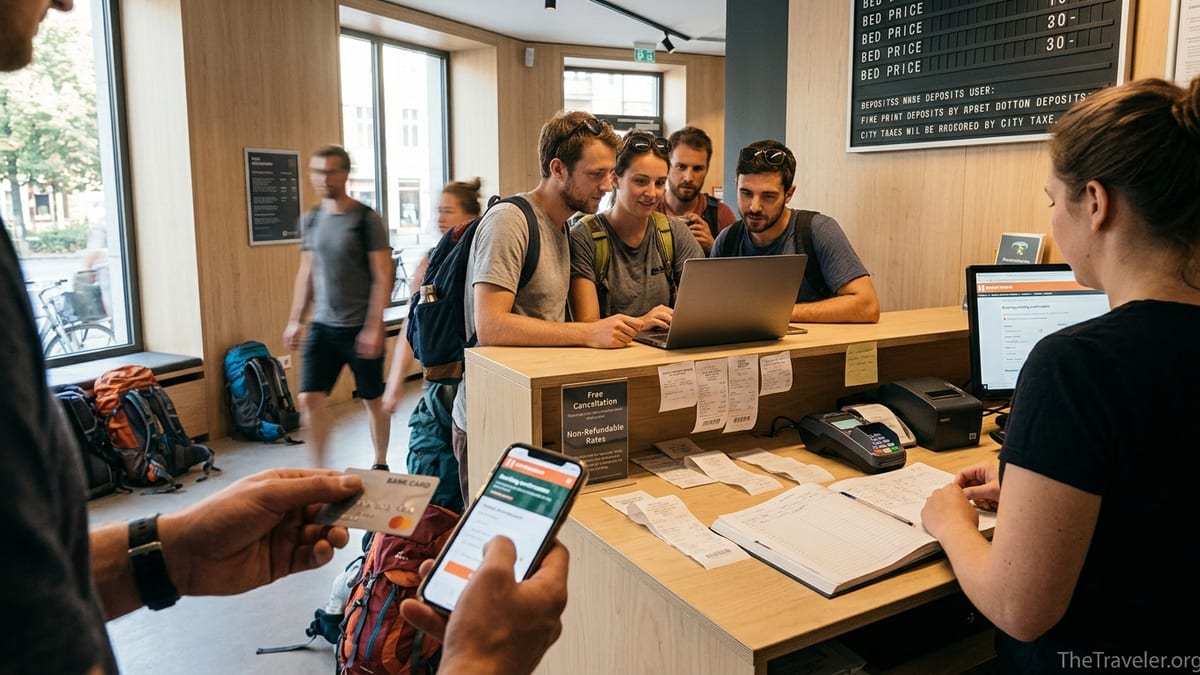
When you confirm a reservation on Hostelworld, you are usually paying two separate parties. A small percentage is charged immediately by Hostelworld as a deposit and service fee, and the remaining balance is paid directly to the hostel, either on arrival or, in some cases, before you check in. The exact split and timing depend on the rate type you choose. For a typical two-night dorm bed in Barcelona priced around 30 euros per night, Hostelworld might charge you a non‑refundable deposit of roughly 10 to 15 percent upfront, while the remaining 51 to 54 euros is due at the property. That initial payment is effectively Hostelworld’s commission and booking fee, not a down payment the hostel later “deducts” from its bill.
This structure catches many guests off guard because the word “deposit” suggests money that will be applied to the final bill. In reality, when you arrive in a hostel in places like Lisbon or Prague, the receptionist will often ask you to pay the full amount shown as “due at property” in your confirmation email, with no mention of the amount you paid online. From the hostel’s perspective, the deposit never reached them; it was retained by Hostelworld. This is why, when you cancel or no‑show under many rate types, you lose that upfront payment even if the hostel does not charge you further.
The confusion is amplified with “Pay now” style rates where more or all of the stay is charged online. Some properties on Hostelworld, especially in expensive cities such as Amsterdam or New York, offer non‑refundable deals that require payment in full at booking. In these cases, you may see two card transactions: one from Hostelworld for its commission and another from the hostel (or its payment processor) for the rest. If you later change plans, whether any of that money comes back depends entirely on the rate conditions you accepted.
Another overlooked cost is currency conversion. Hostelworld can display prices in US dollars for a trip through Japan or in euros for a journey through South America, but the actual charge may be processed in a different currency depending on your card and Hostelworld’s systems. If your bank charges foreign transaction fees or uses a poor exchange rate, your real cost can be several percent higher than the figure you saw during booking, and any eventual refund may not match what you originally paid.
Rate Types: Free Cancellation vs Non‑Refundable
Hostelworld surfaces several rate categories that look similar at a glance but behave very differently when plans change. The most common are Free Cancellation (sometimes labeled “Standard Flexible” or “Refundable”), Non‑Refundable, and a small set of mixed or flexible non‑refundable options that individual hostels configure. On a typical search for Berlin in summer, you might see the same 8‑bed dorm bed at a central hostel offered at about 26 euros with Free Cancellation and 22 euros on a Non‑Refundable rate. Many travelers instinctively choose the cheaper option without recognizing that they are trading away almost all flexibility.
With a Free Cancellation rate, you usually pay Hostelworld’s deposit and service fee at the time of booking and nothing more until you arrive. As long as you cancel before the stated deadline, commonly 24 to 72 hours before your arrival date, the hostel will not charge you additional fees. Depending on the exact product, your initial deposit may be refunded to your card or converted into a voucher for future bookings. For example, a solo traveler booking three nights in Vienna might pay around 12 euros upfront as a deposit on a Free Cancellation rate; if they later cancel four days before arrival, the hostel will not bill the remaining balance and the deposit could be returned under the conditions specified on the confirmation.
By contrast, Non‑Refundable rates are cheaper precisely because they shift the risk to you. Once you confirm, both Hostelworld’s deposit and the remaining balance are typically non‑refundable, and the hostel may be allowed to charge your card for the full stay even if you cancel or fail to appear. A traveler who books a four‑night non‑refundable dorm stay in Rome at a discounted 20 euros per night may be charged the full 80 euros shortly after booking. If their flight is cancelled or they decide to shorten their trip, the property is generally entitled to keep the entire amount.
There are also hybrid options, such as flexible non‑refundable or “standard flexible booking” protections that you can add for a small extra fee at checkout. These often apply only to the Hostelworld deposit rather than the entire stay. In practice, this might mean paying one or two euros more per booking so that, if you cancel in time, Hostelworld converts the deposit into a credit you can reuse within a fixed period, often a few months. The hostel’s own cancellation window still matters: cancel outside it and you may avoid additional charges; cancel too late and you could face both a lost deposit and a first‑night fee from the property.
Cancellation Deadlines, No‑Shows, and Partial Changes
One of the most costly misunderstandings on Hostelworld involves when you actually have to cancel to avoid being charged. The platform displays each property’s deadline on the booking page and in your confirmation. Many hostels set a 24‑hour rule, meaning you must cancel no later than the day before arrival. Others, especially in high‑demand destinations such as Positano or along the Amalfi Coast, may require 72 hours or more. If you cancel after that deadline, the hostel can often charge your card for at least the first night, even if you never check in. For a guest with a three‑night booking in an Australian city like Sydney, missing a 24‑hour cutoff could turn a one‑night penalty of around 40 Australian dollars into an expensive lesson.
No‑shows are treated even more strictly. If you simply do not arrive and fail to cancel through Hostelworld, the standard outcome is that you lose your deposit and the hostel is free to charge the first night’s rate, and in some cases more, to the card on file. In popular European capitals, this can mean a 30 or 40 euro charge appearing days after you have moved on. Some travelers only discover these fees when checking their bank statements back home, assuming that ignoring a booking would mean it quietly disappears.
Partially changing a booking can be equally tricky. Hostelworld’s interface has limited options to edit guest numbers or individual nights after confirmation, especially close to arrival. If, for instance, you booked a four‑bed private room in Budapest for four friends and one person drops out a week before arrival, you cannot always remove that bed from the booking on Hostelworld itself. Instead, you may need to cancel and rebook or contact the hostel directly. Many properties are willing to adjust the price on their own systems, but there is no guarantee, and your original deposit through Hostelworld will almost never be returned unless you booked with a specific flexible option.
It is also important to remember that changing dates is usually treated as cancelling and rebooking. If you shift a Paris reservation two days later at short notice, the hostel is not obliged to honor the original price or the original cancellation terms, especially if you initially chose a non‑refundable rate. In busy seasons, some properties will insist that you cancel the first booking, forfeit the deposit or prepayment, and create a new reservation at current rates. Travelers planning long multi‑city trips in Europe or South America should build this into their budgeting and avoid locking in rigid rates for every night weeks in advance unless they are certain of their itineraries.
Taxes, Local Fees, and Currency Gotchas
Another set of charges that regularly surprise Hostelworld users are city taxes and local fees that are not fully included in the price shown on the search page. Many European cities, such as Rome, Florence, and Amsterdam, apply nightly tourist taxes per person that hostels must collect in cash or on card at check‑in. A listing may show a bed in central Florence for 28 euros per night, but the fine print in the “house rules” section notes an additional local tax of a few euros per person per night. Over several nights, especially for groups, this can add up to a substantial unplanned cost, and Hostelworld’s upfront payment does not cover it.
In some destinations, value‑added tax or similar levies are handled in a way that fragments the payment further. A hostel in Mexico City or Buenos Aires may choose to quote base rates on Hostelworld without certain taxes to keep its listing competitive, then charge those taxes separately at the property. From the traveler’s perspective, it feels as if the property is suddenly adding extra fees. In reality, the hostel might simply be following local tax rules while still paying Hostelworld a commission based on the pre‑tax rate you saw online, which is why not all costs are bundled into the original figure.
Currency is another often overlooked complication. Hostelworld allows you to view prices in your preferred currency, such as US dollars or British pounds, even when booking in countries where the local currency is different. The actual charge, however, may still be processed in euros, pesos, or another currency. A backpacker from Canada booking a dorm in Tokyo listed at the equivalent of 35 Canadian dollars per night might later see that their card was charged in Japanese yen and then converted by their bank at a slightly different rate. If they cancel under a refundable policy, fluctuations in exchange rates between the time of booking and the time of refund can mean they receive a few dollars less than they paid.
To avoid surprises, it is wise to scan the “Important information” or “house rules” text on each Hostelworld listing for mentions of city tax, service charges, or payable‑on‑arrival fees. When in doubt, email the hostel directly before booking your entire week in one place. Many long‑established hostels in cities like Amsterdam, Dublin, or San Francisco publish detailed breakdowns of their taxes and surcharges on their own sites and are happy to clarify what you will actually owe at reception compared to what you paid online.
Group Bookings, Peak Dates, and Overbooking Risks
For solo travelers booking a single bunk, Hostelworld’s system is relatively straightforward. But once you start reserving multiple beds or planning around major holidays, the policies become more complex. Many hostels treat groups of six or more guests differently, even if you make the booking through the standard Hostelworld interface. They may require higher deposits, longer cancellation windows, or special terms that are buried in the property description. A group planning a summer festival trip to Budapest, for instance, could find that their Hostelworld reservation is subject to a 7‑day or even 14‑day cancellation deadline rather than the familiar 24‑hour rule.
Some hostels also use separate contracts for large groups that go beyond the simple per‑bed pricing shown online. This can include non‑refundable deposits taken by bank transfer, damage deposits held on a credit card at check‑in, or minimum stay requirements around popular events like New Year’s Eve. It is not unusual for a hostel in a city like Edinburgh or Munich to require that group bookings over a certain size contact them directly after reserving on Hostelworld to confirm details. Failure to follow through can result in the property cancelling the reservation or charging higher penalties if the group does not arrive as planned.
Overbooking is another risk that surfaces during peak periods. While Hostelworld’s policy requires hostels to honor confirmed bookings, there are occasional reports of guests arriving to find their bed unavailable due to a system error or the property accepting more reservations than it can accommodate. In these situations, established practice is that the hostel must find you alternative accommodation of a similar standard nearby or compensate you, and Hostelworld may refund its commission or provide account credit. Nonetheless, arriving late at night in a popular summer destination to discover that there is no bed waiting for you is an experience most travelers would rather avoid.
To minimize this risk, consider contacting the hostel directly a day or two before arrival, especially during festivals or in destinations with limited budget options. A brief email confirming your late‑night check‑in time or asking about directions often prompts the hostel to verify your booking in their own system. This simple step, combined with having a back‑up option in mind, can help you sidestep the worst‑case scenario of walking around with your backpack after dark looking for a last‑minute bed.
Strategies to Protect Your Money and Flexibility
Once you understand the way Hostelworld’s fees and policies operate, you can adjust your booking strategy to balance savings against flexibility. For short stays and firm plans, such as a one‑night airport layover in Madrid, a non‑refundable rate that saves you several euros might make sense as long as you are comfortable assuming the risk. For longer stays or trips involving multiple flights and border crossings, spending a little more for Free Cancellation often pays off. Paying a few extra euros per night in a city like Tokyo or Berlin is usually cheaper than forfeiting an entire multi‑night non‑refundable stay if your plans change.
It is also sensible to think about how you bundle your bookings. Instead of reserving ten consecutive nights at one hostel on a rigid rate, consider splitting your stay into shorter segments or mixing flexible and non‑refundable bookings. For example, you might book the first three nights in Krakow on a Free Cancellation rate and the following three nights on a cheaper non‑refundable deal once you are confident you like the hostel and your schedule is stable. This approach limits the amount of money at risk while still letting you benefit from occasional discounts.
Another protection is to track cancellation deadlines carefully. As soon as you book a hostel, add its deadline and local time zone to your calendar or notes app. If you are traveling across continents, remember that a 24‑hour cutoff is based on the hostel’s local time, not yours. A backpacker flying from Los Angeles to Athens who cancels “the day before” using their home time might actually miss the Greek hostel’s deadline by hours. Setting reminders a couple of days in advance gives you time to rethink your route or extend your stay before penalties kick in.
Finally, choose your payment method with care. A card that waives foreign transaction fees and offers decent travel protections can soften the impact of surprise charges, currency fluctuations, or disputes. Some premium credit cards also provide limited trip interruption coverage, which can be helpful if you have to cancel prepaid stays due to covered reasons. Always keep screenshots or PDFs of your Hostelworld confirmations, including the rate type and cancellation terms, so you can reference them if you need to contest a charge or clarify a misunderstanding with the hostel.
The Takeaway
Hostelworld remains one of the most useful tools for budget travelers, offering thousands of hostels worldwide with detailed reviews, photos, and availability in one place. Yet its fee structure and the way it interfaces with individual hostel policies leave plenty of room for confusion. The “deposit” you pay online is often non‑refundable commission, not a credit against your bill; free cancellation only applies when you cancel before the property’s specific deadline; and non‑refundable rates can allow the hostel to keep your entire payment even if you never check in.
If you treat each booking as a small contract and take a moment to read the conditions, you can avoid most unpleasant surprises. Check whether the rate is refundable or non‑refundable, note the cancellation cutoff in local time, look for mentions of city taxes and extra fees, and think carefully before sacrificing flexibility for a slightly lower nightly price. For complex itineraries or group trips, verify terms directly with the hostel once you have reserved through Hostelworld, so that everyone agrees on prices, deposits, and deadlines.
By combining Hostelworld’s convenience with a clear understanding of how its fees and policies work, you can protect your budget, keep your options open, and spend more of your trip exploring new cities instead of arguing over unexpected charges at reception.
FAQ
Q1. Is the Hostelworld “deposit” taken off my bill when I arrive at the hostel?
The deposit you pay to Hostelworld is usually its commission and booking fee rather than a down payment to the property. In most cases, the hostel will ask you to pay the full remaining balance shown as “due at property,” and the amount you paid online will not be deducted unless the rate and confirmation state otherwise.
Q2. What is the difference between Free Cancellation and Non‑Refundable rates on Hostelworld?
Free Cancellation rates allow you to cancel before a stated deadline, often 24 to 72 hours before arrival, without the hostel charging the remaining balance. Non‑Refundable rates are cheaper but typically mean that if you cancel or do not show up, both the deposit and the remaining balance can be kept by the property, with little or no refund.
Q3. If I cancel on time, do I always get my Hostelworld deposit back?
Not always. Some flexible products refund the deposit to your card, while others convert it into a credit or voucher for future bookings within a set period. Standard bookings may still treat the deposit as non‑refundable even if the hostel does not charge you more. Always check the wording on the booking page and in your confirmation to see how your specific rate handles the deposit.
Q4. What happens if I am a no‑show for my Hostelworld booking?
If you fail to arrive and do not cancel through Hostelworld before the deadline, you usually lose your deposit and the hostel can charge your card for at least the first night’s stay. In some cases, especially for non‑refundable or special event rates, the property may be able to charge the entire booked stay, depending on its posted policy.
Q5. Why was I charged more than the total price I saw on Hostelworld?
There are several possible reasons. City taxes or local fees may not have been fully included in the advertised price and can be added at check‑in. Currency conversion by your bank can slightly increase the real cost compared to the displayed estimate. If you chose a non‑refundable or pay‑now rate, the hostel may also have charged the remaining balance separately, creating multiple transactions on your statement.
Q6. Can I change the dates or number of guests on an existing Hostelworld booking?
Hostelworld offers limited tools for modifying confirmed bookings, and changes close to arrival can be difficult. In many cases you must cancel and rebook, which can mean losing your original deposit or facing stricter rates. For adjustments such as one person dropping out of a shared room, contacting the hostel directly is often the only practical option, though the property is not obliged to change the price.
Q7. How do group booking policies differ from standard Hostelworld reservations?
Group bookings, often defined as six or more people, frequently come with longer cancellation windows, higher deposits, and additional terms such as damage deposits or minimum stays. Even if you book through the normal Hostelworld interface, the hostel may apply group terms explained in its description, so it is important to read these carefully and follow up directly with the property when organizing trips for larger groups.
Q8. Are city taxes included in Hostelworld’s prices?
Sometimes, but not always. Many cities charge per‑night tourist taxes that hostels must collect separately, and these are often listed in the “house rules” or fine print rather than in the main nightly price. When planning your budget, assume that you may need to pay a few extra units of the local currency per person per night, especially in popular European destinations.
Q9. What should I do if a hostel overbooks my bed or cannot honor my Hostelworld reservation?
If you arrive and your confirmed bed is not available, speak to the reception immediately and show your Hostelworld confirmation. Reputable hostels will try to find you alternative accommodation of a similar standard or offer compensation. You should also contact Hostelworld customer support with details of the situation, as they may refund their fee or provide credit, particularly when the issue is clearly on the property’s side.
Q10. How can I avoid unexpected charges when using Hostelworld?
To reduce surprises, always read the rate type and cancellation policy before booking, check the property’s notes on taxes and extra fees, and add cancellation deadlines to your calendar. Choose flexible rates for parts of your trip that are likely to change, and consider using a credit card with no foreign transaction fees. Keeping copies of your confirmations makes it easier to resolve any disputes that arise later.