


More news on this day
Since the first Japanese bullet train left Tokyo Station on October 1, 1964, just days before the Tokyo Olympics, the Shinkansen network has carried more than 10 billion passengers over six decades of uninterrupted high-speed service, emerging as one of the most influential transport projects of the modern era.
Get the latest news straight to your inbox!
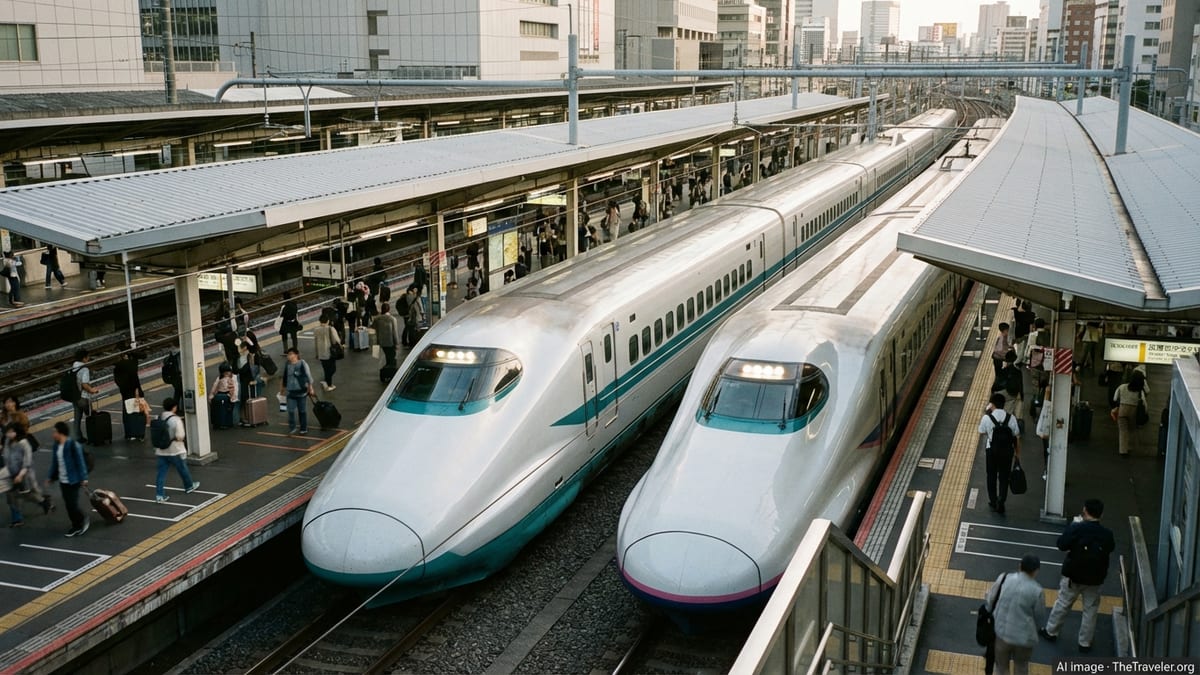
A 60-Year Milestone For High-Speed Rail
The original Tokaido Shinkansen, linking Tokyo and Osaka, began operating at speeds of around 210 kilometers per hour in 1964 and quickly became a symbol of Japan’s postwar recovery. According to published historical accounts, the line slashed journey times between the country’s two largest metropolitan areas and immediately reshaped patterns of business, commuting and domestic tourism.
Over time, the system expanded far beyond its first corridor. Lines now extend north toward Hokkaido and south to Kyushu, with a maximum operating speed of around 320 kilometers per hour on some services. Publicly available data indicates that the wider Shinkansen network now carries close to a million passengers on an average day, handling several hundred services daily on the Tokaido corridor alone during peak travel periods.
Reports on the 60th anniversary celebrations in 2024 describe a mix of nostalgia and national pride, with media coverage emphasizing how the trains have become part of everyday life. For many residents, boarding a Shinkansen is an almost routine act, even as visitors continue to view the trains as a futuristic experience.
Unmatched Safety And Punctuality
A central part of the Shinkansen story is its safety record. Publicly available information from rail industry groups and transport analyses highlights that over six decades of commercial service, involving more than 10 billion passenger journeys, there have been no passenger fatalities caused by train collisions or derailments on the core high-speed network. This record is frequently cited as unique among high-speed rail systems worldwide.
Safety experts attribute this outcome to a combination of dedicated tracks, automatic train control, strict maintenance regimes and conservative operational rules in severe weather. When earthquakes, typhoons or heavy snow are detected, operators routinely slow or suspend services. Analysts note that these disruptions can frustrate passengers in the short term but are seen within Japan’s rail sector as evidence that safety takes precedence over punctuality or revenue.
Punctuality remains another hallmark. Industry figures compiled around the anniversary indicate that average delays are typically measured in seconds rather than minutes over the course of a year, even on heavily trafficked sections of the network. In international comparisons, the Shinkansen is often cited as a benchmark for timetable reliability, especially when contrasted with long-distance rail performance in Europe and North America.
Economic Engine And Tourism Icon
From its earliest years, the Shinkansen has been closely linked to Japan’s economic development. Studies referenced by transport economists describe how high-frequency services between major cities helped integrate regional labor markets, supported the rise of business districts around key stations and encouraged companies to relocate offices to areas with fast rail access.
Rail operators’ integrated reports and government planning documents frame the Tokaido corridor in particular as an economic spine that connects Tokyo, Nagoya and Osaka. Shorter travel times, combined with dense urban development around stations, are credited with expanding the effective “commuter shed” of each metropolitan area and stimulating intercity business travel that would otherwise have gone by air or not taken place at all.
The trains have also become a tourism draw in their own right. Travel features in Japanese and international media frequently highlight the experience of riding the Shinkansen as part of itineraries that link Tokyo with Kyoto, Hiroshima and Fukuoka. Discount tourist passes, special-livery trains and coordinated campaigns for regional attractions underscore how rail and tourism authorities increasingly treat the network as both an access tool and a destination experience.
Global Influence And Growing Competition
When the Shinkansen opened in 1964, it was the world’s first dedicated high-speed rail line. Transport historians note that for decades it defined both the technical and operational standard for fast intercity rail, inspiring later systems in Europe and, more recently, in China and other parts of Asia. International delegations have long visited Japan to study everything from scheduling practices to passenger flows on platforms.
Published coverage of the 60th anniversary points out that Japan’s technology has been exported to projects such as Taiwan High Speed Rail, where trains based on Shinkansen designs operate on a dedicated north–south corridor. Analysts describe this as a proof of concept for Japanese trainsets and signaling systems outside the country, even as Japan faces competition from European and Chinese suppliers in global tenders.
At the same time, the Shinkansen is no longer the fastest network by top speed. Chinese high-speed rail lines and experimental maglev projects elsewhere now post higher operating or test speeds. Commentators observing this trend suggest that Japan’s comparative advantage increasingly rests on system reliability, lifecycle maintenance and proven long-term performance rather than raw speed alone.
The Next Chapter: Maglev And Sustainability
Looking ahead, attention is turning to how Japan’s high-speed rail story will evolve over the coming decades. Central Japan Railway and other stakeholders continue to promote the planned Chuo Shinkansen maglev line between Tokyo and Nagoya, with an eventual extension to Osaka. Public reports describe expectations that the maglev, if fully realized, would cut journey times dramatically and further integrate the country’s largest economic regions.
The project faces environmental, financial and political scrutiny, and its timetable has been subject to delays. Commentators note that debates around the maglev echo broader questions about infrastructure priorities in a country facing demographic change and budget pressures. Supporters argue that a next-generation line could extend the Shinkansen’s legacy of technological leadership, while critics question whether incremental improvements to the existing network might deliver better value.
Environmental considerations are also shaping the conversation. Comparative studies routinely highlight that high-speed rail, including the Shinkansen, produces significantly lower emissions per passenger kilometer than short-haul aviation. As Japan pursues climate goals and other countries weigh investments in rail, analysts point to the Shinkansen’s performance as evidence that long-distance land transport can be both fast and relatively low carbon.
Sixty years after the first bullet train left Tokyo Station, the Shinkansen remains a central part of Japan’s national identity and everyday mobility. With more than 10 billion journeys already completed and new projects on the horizon, its evolution continues to influence how countries worldwide think about speed, safety and the role of rail in a changing climate.