


Flight delays and cancellations across Europe are increasingly common, yet many passengers never claim the money they are legally owed. EUclaim is one of the longest‑running specialist firms that steps in between you and the airline, handling the legal and administrative work required to secure compensation. Understanding exactly how EUclaim works can help you decide if using such a service is worth it for your next disrupted trip.
Get the latest updates straight to your inbox!
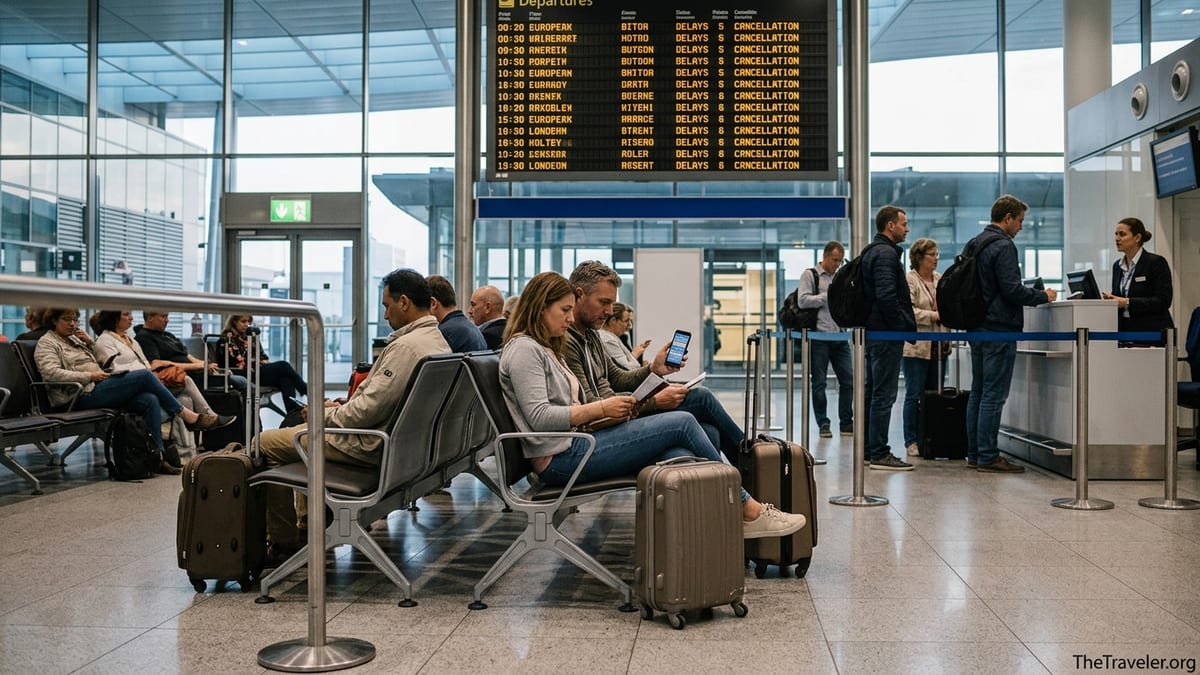
What EUclaim Is and When It Can Help
EUclaim is a European company that helps air passengers claim compensation when their flight is delayed, cancelled, or overbooked, primarily under Regulation (EC) 261/2004 and the post‑Brexit UK equivalent. It focuses on flights departing from the European Union, plus flights operated by EU or UK airlines arriving into the EU or UK. The company has been active since the mid‑2000s and operates in several languages, serving passengers from countries such as the Netherlands, Germany, the United Kingdom and Spain.
In practice, EUclaim becomes relevant when you experience a disruption such as a long delay or last‑minute cancellation on flights like Amsterdam to Barcelona with KLM, London to Rome with British Airways, or Frankfurt to New York with Lufthansa. If the disruption meets the legal criteria and is not caused by "extraordinary circumstances" such as severe weather or air traffic control strikes, you may be entitled to fixed amounts of cash compensation. EUclaim evaluates your case and, if it looks promising, pursues that compensation on your behalf.
EUclaim does not handle every kind of travel problem. It focuses mainly on flight delay, cancellation and denied boarding compensation, not routine service complaints, luggage issues, or frequent flyer disputes. It also relies on European passenger rights law, so a purely domestic route such as Chicago to Denver on a US carrier would fall outside its scope, while a Paris to Athens delay or a Madrid to London cancellation will typically be covered.
Many travelers come to EUclaim after they have already tried dealing with the airline themselves and faced silence or a generic rejection. Others go directly to EUclaim as soon as they land, especially if they know their arrival delay was more than three hours and they want a specialist to navigate the legal arguments and correspondence.
The Legal Basis: How EC 261 and UK Rules Work
EUclaim’s entire business model rests on the rights created by Regulation (EC) 261/2004, which established common rules on compensation and assistance to passengers in the European Union for long delays, cancellations and denied boarding. Under this regulation, passengers can be entitled to fixed cash sums when they reach their final destination three hours or more later than scheduled, as well as when flights are cancelled at short notice or boarding is refused due to overbooking.
The amounts are set by flight distance, not by ticket price. For flights up to 1,500 kilometers, such as Brussels to Berlin or Milan to Paris, compensation is usually 250 euros per person. For flights between 1,500 and 3,500 kilometers, like Lisbon to Stockholm or Dublin to Athens, and any intra‑EU flight longer than 1,500 kilometers, the typical amount is 400 euros per person. For long‑haul routes over 3,500 kilometers that are not entirely within the EU, such as London to Los Angeles or Frankfurt to Tokyo, the compensation can reach 600 euros per person.
After Brexit, the United Kingdom copied these protections into domestic law. For flights departing the UK or operated by UK airlines, passengers can often claim similar amounts, although the compensation may be paid in pounds instead of euros. EUclaim handles both EU and UK claims, applying whichever rules are relevant depending on your route, airline, and the date of travel.
Not every disrupted flight qualifies. If the airline can prove that the delay or cancellation was caused by extraordinary circumstances, such as volcanic ash clouds, sudden airport closures, or serious air traffic control failures, it may not have to pay compensation. However, technical faults, tight crew scheduling, or routine operational issues are usually considered the airline’s responsibility. This is where EUclaim’s experience with court decisions and precedents becomes important in assessing a case.
Step‑by‑Step: How an EUclaim Case Typically Works
For a typical traveler, the EUclaim process starts online. You visit the EUclaim website, enter your flight number, date of travel, and route, and answer a few questions about what went wrong. For example, imagine you flew from Amsterdam to Rome and arrived more than four hours late because your original flight was cancelled due to a technical problem with the aircraft. You would enter those details, indicate the total delay at arrival, and confirm whether the airline offered rebooking or refunds.
EUclaim then performs an initial automated check using its database of flight data and historical disruptions. The system compares your flight’s real‑world performance, including departure and arrival times, against schedules and known issues such as weather and strikes. This first check often happens in seconds and gives you an indication of whether your flight is likely to be eligible for compensation and approximately how much.
If the case looks promising, you are asked to formally submit a claim. This typically involves providing booking confirmations, boarding passes if you have them, and a short description of what happened. Once you sign EUclaim’s mandate or power of attorney, the company is authorized to act on your behalf. From that point on, you generally do not need to communicate with the airline directly about the compensation claim unless EUclaim asks you for more information.
EUclaim will then contact the airline with a formal demand based on the relevant regulation. In straightforward cases, airlines sometimes agree to pay within a few weeks or months. In more contested situations, EUclaim may involve partner law firms and take the case to court in the appropriate country. Throughout, EUclaim keeps you informed by email and via your online account, although timelines can vary significantly depending on airline behavior and court backlogs.
Fees, Payouts, and "No Win, No Fee" Explained
EUclaim operates on a results‑based model often described as "no win, no fee." This means you do not pay upfront. Instead, if and only if EUclaim successfully recovers compensation from the airline, it deducts a service fee from the payout before sending the remainder to you. If the claim ultimately fails, EUclaim absorbs its own costs and you receive nothing but also owe nothing for its work.
As of mid‑2026, EUclaim’s Dutch‑language service information indicates that for a successful claim on a delayed or cancelled flight, the standard fee is around 31 percent of the compensation amount plus a fixed dossier cost per passenger in the range of a few dozen euros, including VAT. For example, if you and your partner each receive 400 euros for a delay on a Barcelona to Stockholm flight, the total compensation would be 800 euros. After EUclaim deducts its percentage and the per‑person fee, you might receive somewhat over half of that total in your bank account, depending on the exact fee level at the time of your claim.
This model can be attractive if you do not want to invest time and energy in arguing with the airline, or if you have already tried and been rejected. For instance, some passengers turn to EUclaim after airlines like Lufthansa, Ryanair or easyJet dismiss claims by citing vague "operational reasons" or incorrectly categorizing events as extraordinary. In several reported cases, EUclaim and similar firms have taken such disputes to court and obtained compensation that individuals struggled to secure alone.
However, using EUclaim means you will receive less than if you handle a straightforward case yourself and the airline pays without resistance. If your flight from Paris to Madrid was delayed by four hours due to a crew scheduling error and the airline promptly pays 250 euros after a simple email, you would keep the full amount by doing it yourself. Travelers who are comfortable with paperwork and persistence sometimes attempt direct claims first, turning to EUclaim only if the airline ignores or rejects them.
Real‑World Examples of EUclaim Cases
Consider a business traveler on a London to Frankfurt to Warsaw itinerary with a major European airline. A missed connection in Frankfurt due to a technical issue on the first leg leads to an overnight delay and arrival in Warsaw more than nine hours late. The airline initially blames air traffic control and sends a generic rejection when the traveler submits a claim. After months of back‑and‑forth, the traveler contacts EUclaim. Using detailed flight data that shows other flights operating normally and no broad airspace restrictions that evening, EUclaim argues that the disruption stemmed from the airline’s own operations. The case eventually settles with 400 euros compensation per passenger, minus EUclaim’s fee.
Another example involves a family of four flying from Amsterdam to New York on a peak summer weekend. Their flight is cancelled on the day of departure due to a technical defect with the aircraft. The airline rebooks them for the next day but does not mention compensation, only offering meal vouchers and one hotel night. Upon return, the family submits their details to EUclaim. The company determines that the cancellation was within the airline’s control, the rerouting led to an arrival delay greater than four hours, and the route length qualifies for 600 euros per person. The airline resists at first, but after legal correspondence the family receives a substantial payout, with EUclaim retaining its share.
EUclaim is also used in denied boarding situations where flights are overbooked. A solo traveler booked from Madrid to Lisbon is refused boarding despite arriving on time and having a confirmed seat, while the airline searches for volunteers. The airline provides a new flight four hours later but offers only a meal voucher and a small travel credit. After the trip, the traveler uses EUclaim, which invokes the specific provisions for involuntary denied boarding. The case leads to cash compensation in addition to the rerouting that was already provided at the airport.
These examples highlight both the financial value at stake and the role EUclaim plays in gathering evidence, interpreting case law, and standing firm against airlines that might otherwise rely on passengers giving up.
When It Makes Sense to Use EUclaim vs Claiming Yourself
Deciding whether to use EUclaim depends on your situation, appetite for paperwork, and how complex your case is. If your disruption was clear‑cut, such as a three‑and‑a‑half‑hour delay on a simple Paris to Rome flight where the airline has already admitted to a technical fault, you might first submit a direct claim through the airline’s website using a template letter that cites EC 261. Many passengers have successfully received 250 or 400 euros per person this way without paying any fee.
On the other hand, if you have a more complicated itinerary or if the airline has already rejected your claim in confusing or contradictory terms, EUclaim can be a useful ally. For example, connecting journeys involving non‑EU airports, code‑shares between different airlines, or disputes about whether weather was truly severe enough to count as extraordinary circumstances all benefit from professional handling. Travelers on routes like Warsaw to Dubai via Vienna or Manchester to Toronto via Amsterdam often find it difficult to interpret which parts of their journey are covered by EU or UK rules and which airline is legally responsible. EUclaim’s case handlers and lawyers deal with these questions daily.
Language and location also play a role. A passenger from the United States who experiences a delay on a Barcelona to New York flight operated by a European airline might not feel comfortable navigating European legal terms or dealing with an airline’s customer service in another language. For that traveler, sharing part of the compensation with EUclaim could be an acceptable trade‑off for not having to follow up repeatedly or understand foreign court procedures.
Time is another factor. Some people do not want to spend hours compiling documentation, reading up on EC 261, and chasing airline responses. EUclaim essentially converts that time into a fee. For a 600‑euro long‑haul claim, even after EUclaim’s share, a traveler may still receive several hundred euros in exchange for filling out a short online form and waiting for updates.
Practical Tips for Starting a Claim With EUclaim
If you are considering EUclaim after a disrupted flight, it helps to preserve as much documentation as possible. Keep your boarding passes, e‑tickets, and any written notices from the airline about the reason for the delay or cancellation. Screenshots of departure boards and airline app notifications showing the timeline of events can also be useful. EUclaim often uses this information alongside its own flight data to reconstruct what happened.
When you first enter your flight details on EUclaim’s website, be as accurate as you can about timings. The key figure is the delay at your final destination, not just at a connection point. For example, if your London to Lisbon flight was late leaving but you still arrived less than three hours behind schedule, your case may not qualify, even if you spent a long time waiting at the gate. On the other hand, if a missed connection caused your arrival in Lisbon to slip past the three‑hour mark, the whole itinerary may be eligible.
It is also worth being honest about whether you have already contacted the airline and what the response was. If the airline has provided a written explanation blaming weather, strikes, or air traffic control, EUclaim will compare that claim with its own records of conditions on the day of travel. In some situations, airlines overuse the label of extraordinary circumstances. EUclaim and other specialists track patterns across many flights, which can reveal when an airline is stretching that definition.
Finally, understand that timelines are unpredictable. Some cases resolve in a matter of weeks, especially when the airline prefers to settle rather than risk an adverse court judgment. Others can drag on for many months if the airline contests liability or if legal action becomes necessary. EUclaim cannot guarantee a specific outcome or deadline, but it can relieve you of the day‑to‑day chasing and legal argument.
The Takeaway
EUclaim has carved out a role as an intermediary between passengers and airlines in the complex world of European flight compensation. By combining detailed flight data, knowledge of EC 261 and UK law, and partnerships with local law firms, it offers travelers a way to pursue compensation they might otherwise never receive, especially in cases where airlines resist paying.
For straightforward, uncontested disruptions, claiming directly with the airline can still be the most efficient and cost‑effective approach. But when airlines stall, reject valid claims, or hide behind vague references to extraordinary circumstances, EUclaim’s no‑win‑no‑fee model can turn a frustrating experience into a meaningful cash recovery, even after fees. For many travelers whose holidays or business trips were upended by cancellations and long delays, that share of 250, 400 or 600 euros per person is worth the extra help.
FAQ
Q1. What kinds of flights does EUclaim handle?
EUclaim mainly handles flights that fall under European passenger rights rules, including departures from EU and UK airports and flights operated by EU or UK airlines arriving into those regions.
Q2. How much compensation can I get through EUclaim?
Under the regulations EUclaim uses, eligible passengers can typically claim 250, 400, or 600 euros per person, depending on the flight distance and delay at arrival.
Q3. Does EUclaim charge upfront fees?
No. EUclaim works on a no‑win, no‑fee basis, taking a percentage of any compensation recovered plus a fixed case fee per passenger if the claim succeeds.
Q4. How long does an EUclaim case usually take?
Timelines vary widely. Some airlines pay within a few weeks, while contested cases that go to court can take many months or occasionally longer than a year.
Q5. Can I use EUclaim if the airline already rejected my claim?
Yes. Many passengers turn to EUclaim after a rejection. The company reviews the case, checks the airline’s explanation against flight data, and may still pursue compensation.
Q6. Will using EUclaim affect any refunds or vouchers I already received?
Generally, EUclaim focuses on compensation that is separate from refunds or rerouting. However, you should inform them about any refunds or vouchers so they can assess the full picture.
Q7. Do I need to live in Europe to work with EUclaim?
No. Passengers from outside Europe, including the United States or Canada, can use EUclaim as long as their disrupted flight falls within the scope of the EU or UK regulations.
Q8. What evidence should I keep for an EUclaim case?
Keep boarding passes, booking confirmations, written notices from the airline about the disruption, and any screenshots that show flight times and delay reasons.
Q9. Can I still claim if the airline says the delay was due to weather?
Possibly. EUclaim will check whether the weather conditions genuinely met the legal standard for extraordinary circumstances or whether the disruption was within the airline’s control.
Q10. Is it better to claim directly with the airline or use EUclaim?
If your case is simple and the airline is cooperative, claiming directly may let you keep the full amount. EUclaim becomes more attractive when airlines ignore, delay, or wrongly reject valid claims.