


More news on this day
Passengers at Miami International Airport are confronting hours-long delays, cancellations and diversions after an Amazon cargo plane overshot a runway on Sunday, killing five people and forcing a full ground stop at one of the nation’s busiest hubs.
Get the latest news straight to your inbox!
Ground Stop After Runway Crash Halts Operations
According to published coverage, the disruption began early Sunday afternoon when a cargo aircraft operating for Amazon went off a runway at Miami International Airport and struck multiple vehicles just beyond airport property. Local reports indicate that five people were killed and five others injured, three of them in critical condition, in the fiery crash outside the airfield perimeter.
The Federal Aviation Administration implemented a full ground stop at Miami International Airport while emergency crews responded and investigators secured the scene. Publicly available flight-tracking data and aviation advisories show that all departures and arrivals were temporarily halted as authorities worked to assess the condition of the runway and surrounding taxiways.
Reporting from South Florida outlets describes a dense plume of smoke rising near the airport and a heavy presence of fire and rescue vehicles staged along the affected runway. The crash occurred near a busy roadway adjacent to the airport, contributing to traffic congestion on surrounding streets as well as in the terminals.
Airport status information posted by federal aviation authorities on Sunday referenced a disabled aircraft and traffic management programs for flights bound for Miami, noting that the event was producing extended departure and arrival delays throughout the afternoon and evening.
Runways Reopen but Cascading Delays Continue
As emergency operations progressed, limited flight activity gradually resumed. Local broadcast coverage indicates that one of Miami International’s four runways reopened at approximately 4:15 p.m. Eastern time, with a second runway returning to service roughly 30 minutes later. Even with partial capacity restored, airlines faced a significant backlog of grounded aircraft and displaced passengers.
Federal airport status updates cited average delays of several hours for flights heading to Miami as the evening wore on, with some advisories indicating ground delays of more than six hours for affected routes. Travel industry reports on Monday continued to show above-normal congestion, with average hold times and schedule disruptions persisting as carriers attempted to reposition crews and aircraft.
Some flights bound for Miami were diverted to other Florida airports during the initial shutdown, including regional fields used as alternates when primary hubs are unavailable. Aviation coverage notes that diversions and missed connections contributed to knock-on disruption across multiple airline networks, affecting passengers who were not originally scheduled to pass through South Florida.
Even after the formal ground stop was lifted, a ground delay program remained in place for much of Sunday evening, according to air traffic advisories. That framework allowed traffic to flow but required airlines to operate within controlled arrival and departure slots, slowing the pace of schedule recovery.
Passengers Describe Packed Terminals and Limited Options
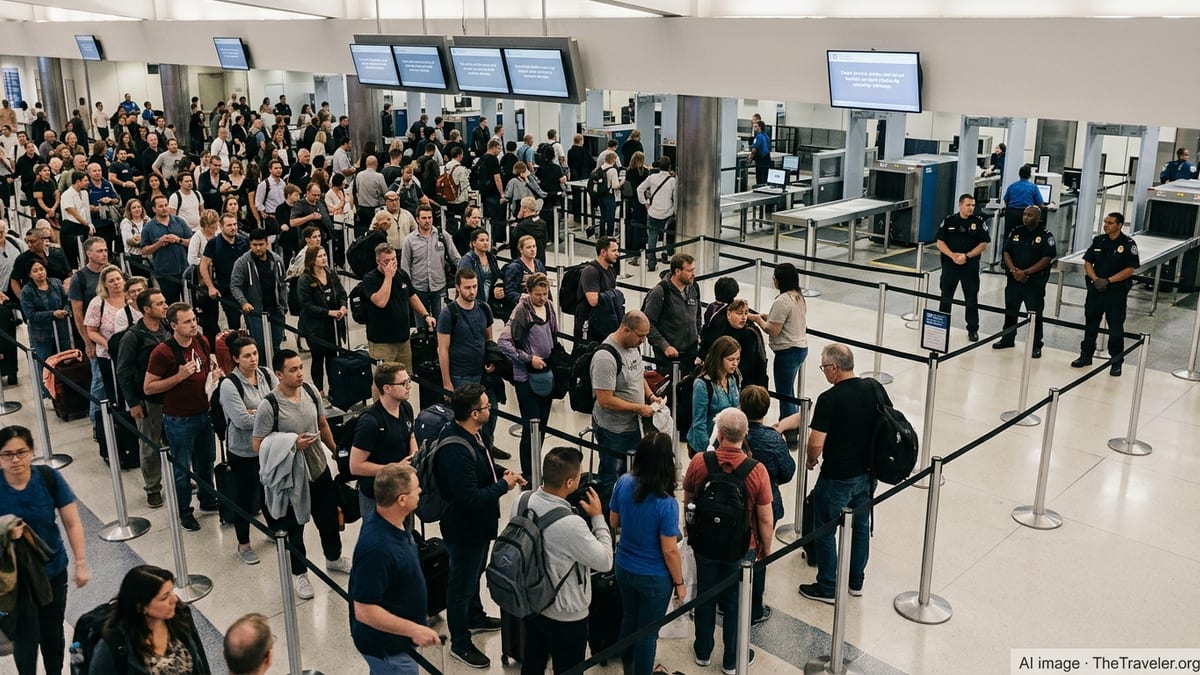
Inside the terminals, travelers encountered long queues, crowded gate areas and mounting frustration as departure times slipped further into the night. Coverage from local television stations described lines wrapping through concourses as passengers tried to rebook canceled flights, collect luggage or secure hotel rooms for unexpected overnight stays.
Reports from stranded travelers referenced multiple rounds of rolling delays that ultimately turned into cancellations, with some passengers recounting being rebooked days later than planned. In several cases highlighted by local and national outlets, travelers said the earliest alternative itineraries departed on Tuesday or beyond, reflecting how quickly open seats disappeared once the disruption spread through airline systems.
Airport staff distributed bottled water in some areas as lines grew, according to on-the-ground reporting, while airline agents worked through backlogs at ticket counters and customer service desks. Social media posts shared by travel forums and aviation communities also described aircraft holding on ramps or returning to gates as the airport’s status evolved over the course of the afternoon.
Published accounts indicate that many passengers expressed sympathy for those killed and injured in the crash, acknowledging the human toll of the accident even as they faced significant changes to their own travel plans. Some travelers interviewed in broadcast segments said they chose to seek hotels or alternate airports rather than wait overnight in crowded terminals.
What Travelers Need to Know if Flying Through Miami
Travel industry reporting and federal aviation data suggest that while operations at Miami International Airport have resumed, residual disruption is likely to linger as airlines continue to absorb the effects of the ground stop. Passengers with flights into or out of Miami in the next several days are being encouraged through public advisories and airline alerts to monitor their reservations closely and allow extra time at the airport.
Real-time federal airport status pages for Miami International on Sunday and Monday referenced traffic management programs tied to a disabled aircraft, warning of significant average delays for some arrivals and departures. Although those averages may fluctuate throughout the day, travel analysts note that large, unplanned pauses at a major hub often take more than 24 hours to fully unwind.
According to consumer guidance published by airline and airport authorities, travelers affected by irregular operations such as this crash-related shutdown should check in directly with their carrier’s website or mobile app for the most current rebooking options. Some airlines typically implement flexible change policies, including waivers of change fees or fare differences on select dates and routes, in response to large-scale disruptions, though the precise terms vary by carrier.
Even for flights that remain on schedule, experts recommend that passengers factor in the possibility of security lines and boarding procedures moving more slowly than normal. Crowded gate areas and busy baggage carousels are common after extended ground stops, particularly at peak banks of connecting flights.
Safety Investigation Underway as Airport Recovers
National and local news outlets report that a formal investigation into the cause of the crash has begun, focusing on why the aircraft failed to stop on the runway and how it ultimately came to rest beyond airport property. Investigators typically examine flight data, cockpit recordings, aircraft maintenance records and air traffic communications to reconstruct the sequence of events.
While that work proceeds, Miami International Airport is operating with heightened attention to airfield safety, according to aviation and transportation coverage. Portions of the impacted area remained restricted on Sunday as crews documented the wreckage and assessed any damage to pavement, lighting and navigation aids along the runway and taxiways involved.
Historically, serious runway incidents at major commercial airports have prompted reviews of procedures for handling disabled aircraft and managing tarmac delays. Miami International maintains a tarmac delay contingency plan filed with federal regulators, outlining how airlines and the airport coordinate to care for passengers during extended ground events and how they restore normal operations once the airfield is cleared.
For now, published information indicates that the airport is gradually returning to service, even as many travelers continue to feel the ripple effects of Sunday’s tragedy on their itineraries. The full impact on schedules, passenger volumes and cargo flows in and out of Miami is expected to become clearer as airlines complete their recovery efforts in the days ahead.
CBS Miami: Travelers face canceled flights after deadly Miami International Airport crash
FAA: Miami International Airport real-time airport status information
Travel Weekly: Delays at Miami Airport following Amazon plane crash