


From the waterfront in Naples, Mount Vesuvius looks dramatic and imposing, its dark cone rising above the city and the Bay of Naples. Yet for most visitors, reaching its crater is less of an extreme mountaineering feat and more of a short but steady uphill walk on loose volcanic gravel. Understanding how difficult the hike really is, how to reach the trailhead, and what conditions you are likely to face will make the difference between a memorable half-day adventure and a stressful, exhausting outing.
Get the latest updates straight to your inbox!
How Difficult Is the Mount Vesuvius Hike in Reality?
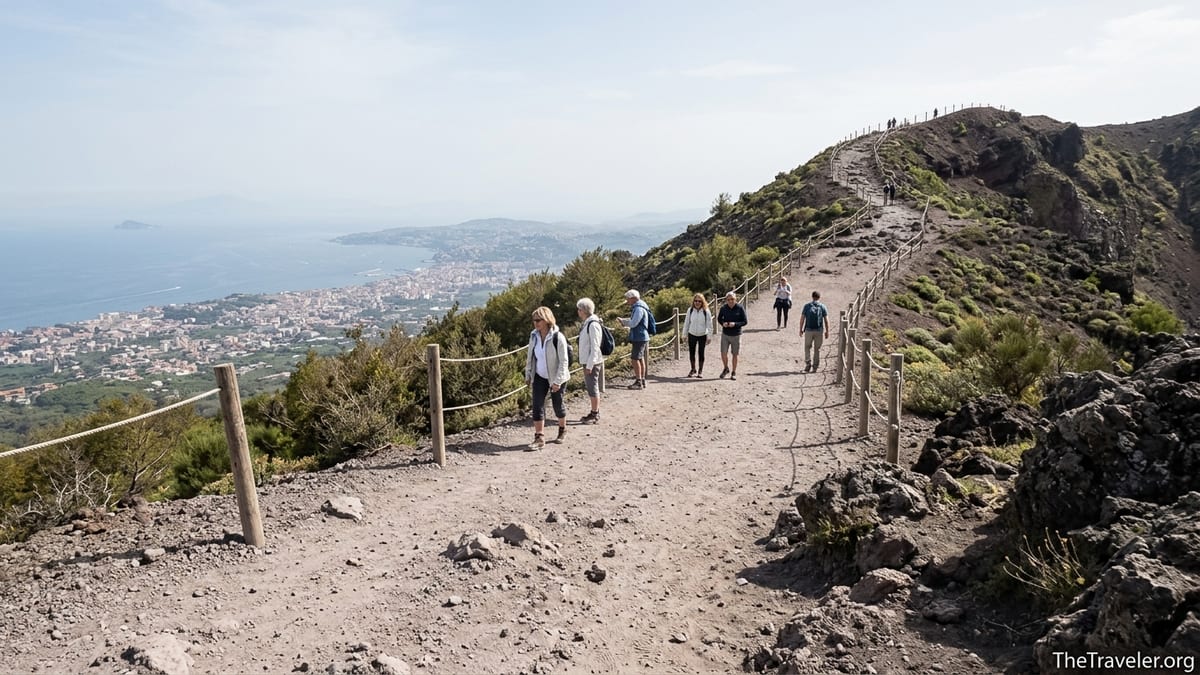
The main tourist route on Mount Vesuvius is the Gran Cono trail, also known as Path No. 5 in Vesuvius National Park. It starts around 1,000 meters above sea level at the upper parking area and climbs to the crater rim at roughly 1,200 meters. The walk is around 1.5 to 1.7 kilometers uphill, with about 200 meters of elevation gain, followed by the same distance back down. For most reasonably active travelers, this is considered an easy to moderate hike rather than a hard climb.
In practice, most visitors reach the crater rim in about 30 to 45 minutes, stopping occasionally for photos and to catch their breath. Travel writers and recent hikers consistently describe it as a “short but quite steep” walk on gravel, where the main challenge is not the length but the constant uphill gradient. Many people in their 60s and 70s manage the path at a slow pace, as do school groups and casual visitors who rarely hike at home.
The surface underfoot is loose volcanic material, similar to small marbles or coarse sand, so your feet can slip slightly backward on each step. That can make the effort feel a bit greater than a paved city hill of the same incline. The descent feels easier on your lungs but can be tiring for your knees, especially if you are not used to walking downhill on gravel. Good footwear and taking your time are more important here than athletic fitness.
If you are used to city walking but not to hiking up hills, you should still be able to reach the crater as long as you allow enough time, take short breaks, and avoid the hottest part of the day in summer. Travelers who struggle the most are usually those with heart or respiratory conditions, serious knee problems, or very low fitness attempting the climb in peak heat with no shade or water.
Trail Conditions, Footwear and Weather Challenges
The path itself is wide and clearly defined, with wooden fences and rope barriers along many sections, so there is no risk of getting lost. The main danger is slipping on the gravel, particularly on the way down. The surface is made up of small, light volcanic stones that roll under your shoes. Sneakers with decent tread are usually sufficient, but smooth-soled fashion trainers or sandals make the walk unnecessarily tricky and increase your risk of falling.
Because of the loose surface, walking poles can help if you have trouble with balance or bad knees, though most visitors manage without them. Many guided tours in high season report seeing people struggle in flimsy shoes or flip-flops, especially after a brief shower that turns the dust into a thin layer of mud. If you only invest in one thing before you go, make it closed shoes with a good grip, such as lightweight hiking shoes or sturdy running shoes.
Weather plays a major role in how hard Vesuvius feels. The mountain is noticeably cooler than Naples, especially at the crater rim, but you are very exposed to wind and sun. On a sunny July afternoon, temperatures on the trail can still feel intense, as there is almost no natural shade. In contrast, on a cool spring or autumn day you might start in a T-shirt at the car park and put on a jacket at the top, where cold winds and low clouds sometimes move in quickly.
Conditions can also change during the day. On some spring mornings, travelers report starting the climb under overcast skies and walking into cloud near the top, reducing visibility but making the effort feel easier in cooler air. In winter and early spring, strong winds or heavy rain sometimes lead to temporary closures of the Gran Cono trail for safety, particularly if there is a risk of falling rocks or small landslides. Check the situation locally the day before, as weather-related closures are not always widely publicized in English.
Getting There From Naples and How Long the Visit Really Takes
Although the climb itself only takes around 1.5 to 2 hours round-trip including time at the top, the overall visit from Naples usually fills at least half a day once you factor in transport and waiting times. The most common independent route is to ride the Circumvesuviana train from Napoli Garibaldi station to Ercolano Scavi, a ride of about 20 minutes. From there, local shuttle buses or private minivans run up the twisting road to the upper parking area near the trailhead.
Return shuttle tickets from Ercolano Scavi typically cost in the region of 10 to 15 euros per person, sometimes including or paired with the crater entry ticket depending on the company. Operators advertise fixed departure times, but in practice buses often wait to fill up before leaving, so allow some flexibility. Another option is to join an organized tour from central Naples or Sorrento, often combining Vesuvius with Pompeii in a single day; these usually cost significantly more but simplify logistics and include transport and a guide.
If you are driving, you can follow the Strada Provinciale Ercolano–Vesuvio up to the higher parking area around 1,000 meters, paying a parking fee on arrival. From there you still need a separate ticket to enter the national park trail leading to the crater. Driving allows you to arrive early in the morning or late in the afternoon, when the trail can be quieter and temperatures more comfortable, but the narrow road and hairpin bends require confidence behind the wheel.
In practical terms, many travelers who set out from Naples around 8:30 in the morning find themselves back in the city between 1:30 and 3:00 in the afternoon, depending on how long they linger at the top and how efficient their connections are. If you combine Vesuvius with Pompeii in the same day using public transport, expect a full and fairly tiring day.
Tickets, Entry Rules and Closures You Should Know About
Access to the Gran Cono crater trail is controlled, and you must have a ticket for a specific time slot. Tickets are sold online through official channels and partner platforms, and recent visitors report paying around 10 euros per adult for the crater entry alone. You cannot generally buy tickets at the top, and mobile phone signal at the upper parking area is unreliable, so it is safer to book in advance for a defined entry time rather than relying on same-day availability.
Time slots are spaced throughout the day, typically from around 9:00 in the morning to mid-afternoon, with the last entry in peak summer usually in the late afternoon and earlier in winter. The park rules allow a bit of flexibility if you arrive slightly earlier or later than your slot, but you must enter early enough to complete the round trip and leave the trail before closing time. Guards and staff at the entrance check ticket barcodes and will usually turn away people who arrive after the last entry window.
Temporary closures are not uncommon. Heavy rainstorms, strong winds, or minor rockfalls can lead authorities to shut the Gran Cono trail, sometimes at short notice. After intense bad weather in recent years, local news outlets have reported the trail closing for days or weeks at a time while debris was cleared and safety checks were completed. Even when the park itself is open, sections of the upper loop that once circled more of the crater rim have been restricted for safety, meaning visitors now typically follow an out-and-back route along one side rather than a complete circuit.
Because situations change, it is wise to double-check the latest information once you are in the Naples area. Your hotel, a local tourism office in Naples, or the shuttle companies operating from Ercolano Scavi can usually confirm whether the crater path is open on a given day and whether weather is likely to cause problems. For travelers on tight schedules, this advance check can prevent disappointment.
What You Actually See and Experience at the Crater
From the moment you step onto the trail, the view over the Bay of Naples opens up quickly. As you climb, you see the sprawl of Naples, the island outlines of Capri and Ischia on clear days, and the older Monte Somma ridge that forms the remnants of Vesuvius’s ancient caldera. The path winds upwards in a series of broad switchbacks, and within 15 to 20 minutes you can usually look down over the coastline and nearby towns clustered around the slopes.
At the crater rim, the feel is very different: the roar of traffic from below fades, replaced by wind and the crunch of gravel. The crater itself is a huge, steep-walled bowl lined with layers of dark rock and lighter ash. On cool days you may notice small fumaroles, vents releasing faint white steam or gas from the inner walls, a visible reminder that Vesuvius remains an active volcano even though it has not erupted since the mid-twentieth century.
Along the rim, simple wooden railings and ropes mark the viewpoints. There are usually a few small kiosks or stands selling espresso, bottled water, postcards and volcanic rock souvenirs. Many recent visitors mention grabbing a quick coffee at the bar near the highest viewpoint while looking down into the crater. On busy days, groups cluster around guides explaining the AD 79 eruption that buried Pompeii, with visual aids or photographs to illustrate how the landscape once looked.
The mood can change rapidly with the weather. On some clear spring mornings, the sky and sea are bright blue and visibility along the coast is exceptional, making the hike feel almost leisurely despite the gradient. On hazy August afternoons, the horizon can disappear into a white blur, and the heat and crowds make the same path feel more demanding. In colder seasons, gusty winds and low cloud can limit views but add an atmospheric, almost otherworldly feel to the crater.
Who Finds Vesuvius Hard, and How to Prepare Physically
Mount Vesuvius is within reach of most visitors who are comfortable walking up a city hill or climbing several flights of stairs at a slow pace. Travelers who already hike occasionally will likely find it straightforward. However, a number of groups tend to struggle more: people with limited mobility, chronic knee or ankle problems, asthma or other respiratory conditions, or a very sedentary lifestyle trying to rush in hot weather.
If you know you are not in good shape, consider preparing for the trip by adding regular brisk walks in the weeks before you travel. Even 30 minutes of walking uphill or on stairs a few times a week can make a difference. Plan to take the trail slowly, stopping as often as needed, and do not be shy about turning around early if you feel dizzy or overly breathless. Guides and staff see people at many fitness levels every day, so there is no shame in setting your own pace.
Hydration is critical, especially in late spring and summer. There is often a kiosk near the parking area, but it is safer and cheaper to bring at least one full bottle of water per person from Naples or Ercolano. A light snack, such as a sandwich or energy bar, helps keep your energy up, particularly if you are combining Vesuvius with an early start at Pompeii the same day. Sun protection matters too: a hat, sunglasses and sunscreen are strongly recommended, as the ash and gravel reflect sunlight and many sections of the path have no shade.
Clothing should be layered. Even on warm days in Naples, it can be windy and cool on the crater rim, and standing still at the viewpoint can quickly chill you after a sweaty climb. A light windproof jacket or fleece that you can stuff in a small backpack is ideal. In shoulder seasons, long trousers rather than shorts can help with temperature swings and protect your legs if you slip on the gravel.
Safety, Volcanic Risk and Environmental Considerations
Despite its dramatic history, visiting Vesuvius today is generally considered safe from a volcanic activity standpoint. The volcano is under continuous scientific monitoring, and authorities maintain emergency plans for the surrounding region. Any signs of significant unrest would trigger closures and evacuations long before casual tourist visits became dangerous. In normal conditions, the main risks for visitors are mundane: tripping, slipping, sunburn, heat exhaustion or dehydration.
The park rules are designed to minimize accidents. Visitors are required to stay on the marked trail and behind barriers where indicated. Climbing over fences to get closer to the crater edge, a behavior still seen in some social media photos, is strictly forbidden and risky given the steep drop and unstable rock. Stone throwing into the crater, another occasional misbehavior, is prohibited both for safety and to protect the fragile environment.
Environmental protection is an increasing focus for the park. The slopes of Vesuvius support distinctive Mediterranean vegetation and wildlife, and trails are occasionally closed or rerouted due to erosion or landslide risk. Littering remains a problem in some sections, so carrying your rubbish back down and using bins at the parking area helps preserve the landscape. Smoking on the trail is discouraged because of fire risk in dry months.
Insurance is a personal decision but worth considering if you have any concerns about health or mobility. Some travel insurance policies include coverage for injuries sustained during hiking up to a certain altitude, which would typically include Vesuvius. Check the small print if you are planning more demanding outdoor activities elsewhere in Italy.
The Takeaway
From Naples, Mount Vesuvius can look intimidating, but for most travelers the reality is a manageable, moderately steep walk with a big payoff: panoramic views of the Bay of Naples and a close-up look into one of the world’s most famous volcanic craters. The Gran Cono trail is relatively short, well marked and busy with other visitors, which means it feels safe but can be crowded at peak times.
The factors that most affect how difficult the experience feels are not technical climbing skills but basic preparation and timing. Sensible shoes, water, layers for wind and sun, and booking your crater ticket in advance matter far more than athletic training. Choosing a cooler part of the day, especially in summer, can make the difference between a pleasant hike and an exhausting slog.
If you have health issues or are unused to any uphill walking, plan extra time, communicate with your companions, and be honest with yourself about how you feel on the day. It is perfectly acceptable to take the trail slowly or to turn back before the top if necessary. Even partial climbs offer impressive views over the bay and surrounding countryside.
For many visitors, standing on the rim of Vesuvius and looking down into its vast crater is one of the most memorable moments of a trip to southern Italy. With realistic expectations about the difficulty, a cautious eye on the weather, and a bit of logistical planning from Naples, you can experience the mountain in comfort and safety.
FAQ
Q1. Is the Mount Vesuvius hike suitable for beginners?
The main Gran Cono trail is generally suitable for beginners who are comfortable walking uphill at a slow pace, though the loose gravel and steady gradient make it more demanding than a flat city walk.
Q2. How long does it take to hike up and down Mount Vesuvius?
Most visitors take around 30 to 45 minutes to walk from the trailhead to the crater rim and 20 to 30 minutes to come back down, plus time spent at the top for views and photos.
Q3. Do I need hiking boots, or are sneakers enough?
Sturdy sneakers or running shoes with good tread are usually enough. Full hiking boots are helpful but not essential, while sandals or smooth-soled fashion shoes are not recommended.
Q4. Can I visit Mount Vesuvius from Naples without a tour?
Yes. You can take the Circumvesuviana train from Napoli Garibaldi to Ercolano Scavi and then use shuttle buses or taxis to reach the upper parking area near the trailhead, as long as you have pre-booked a crater entry ticket.
Q5. Is the trail safe for children and older travelers?
Healthy children and older adults often complete the hike without problems, provided they go slowly, wear appropriate shoes and stay behind the safety barriers. Those with serious heart, lung or mobility issues should consult a doctor before attempting it.
Q6. What is the best time of day to climb Vesuvius?
Mornings and late afternoons are usually best, offering cooler temperatures and, often, clearer views. Midday in summer can be uncomfortably hot and crowded on the exposed trail.
Q7. Are there toilets or food stalls on the trail?
Basic facilities, such as toilets and small kiosks selling snacks, coffee and drinks, are usually available near the parking area and close to the crater viewpoints, but it is still wise to bring your own water and a light snack.
Q8. Can I combine a visit to Pompeii and Vesuvius in one day?
Yes, many travelers do both in one busy day, often visiting Pompeii in the morning and Vesuvius in the afternoon, or joining an organized tour that includes transport and guiding for both sites.
Q9. What happens if the weather is bad on the day of my visit?
In case of strong wind, heavy rain or landslide risk, the park authorities may close the crater trail for safety. In that situation you might need to reschedule or accept a refund or partial refund depending on how you booked.
Q10. Is Mount Vesuvius still an active volcano, and is it dangerous to visit?
Vesuvius is considered an active volcano but is in a quiet phase and is closely monitored by scientists. Tourist visits are allowed only when conditions are deemed safe, so under normal circumstances the main risks are from hiking conditions rather than volcanic activity.