


If you have spent any time researching Shenandoah National Park, you have almost certainly seen Whiteoak Canyon described as a trail with “six waterfalls.” It sounds straightforward, but once you are on the trail, cascades, slides, and side streams blur together and it quickly becomes less obvious what actually counts as a waterfall. For trip planning, safety, and expectations, it helps to understand how many waterfalls Whiteoak Canyon really has, how they are arranged, and which ones most hikers actually see.
Get the latest updates straight to your inbox!
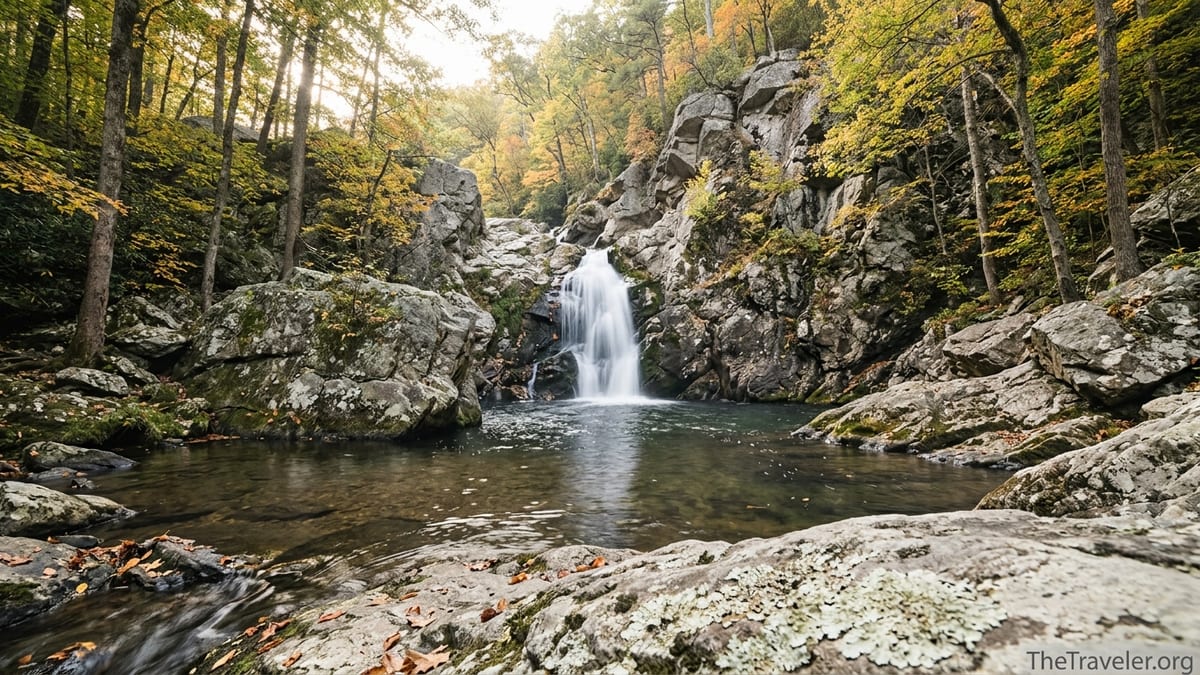
So, How Many Waterfalls Are in Whiteoak Canyon?
The most widely accepted answer is that Whiteoak Canyon contains six major waterfalls along Whiteoak Run inside Shenandoah National Park. This “series of six waterfalls” description appears in park materials, guidebooks, and trail guides, and has become the standard way hikers talk about the canyon. The falls range from roughly 35 feet to about 86 feet in height, with many more small cascades and chutes in between that do not get counted as separate falls.
When hikers or the National Park Service talk about “six waterfalls,” they are referring to six distinct drops big enough and separated enough to feel like individual falls rather than part of a single staircase. These are strung out over just a few miles of steep, rocky gorge. The highest and best known of the group is usually called Upper Whiteoak Falls, an impressive plunge of about 86 feet, making it one of the tallest waterfalls in Shenandoah.
Beyond those six major drops, the stream is almost continuous whitewater for long stretches, with ledges, slides, and pools that could easily be called “waterfalls” in a looser sense. Some hikers, especially on social media, will casually refer to “dozens” of waterfalls in the canyon, because they are counting every small tumble. For navigation, though, and for understanding what guidebooks mean, it is safest to think in terms of six primary named falls plus many smaller cascades.
It is also important to distinguish Whiteoak Canyon from neighboring Cedar Run. Many loop hikes, including the popular Whiteoak Canyon – Cedar Run circuit, combine both drainages in one strenuous day. Cedar Run has its own impressive drops and a famous natural rock slide, but those are on a separate stream. When someone on the trail says they saw “ten waterfalls,” they may be lumping Cedar Run and Whiteoak Canyon together.
How the Six Whiteoak Canyon Waterfalls Are Arranged
The six main waterfalls sit in a steep, narrow gorge carved by Whiteoak Run as it drops off the Blue Ridge crest toward the foothills near the town of Syria, Virginia. Depending on where you start, you either descend past them from Skyline Drive or climb up from the boundary parking area off Weakley Hollow Road. Either way, the falls are stacked like steps on a tilted staircase, with shorter cascades and pools between each major drop.
At the top of the series is Upper Whiteoak Falls, the highest single drop, usually reached via a 4.6-mile out-and-back from Skyline Drive if you follow the Whiteoak Canyon Trail from the Limberlost / Skyland area. Below that, the stream tumbles through a mix of narrower chutes and short ledges before plunging again in successive major falls. Hikers often refer to them informally as First through Sixth Falls, counting from the bottom up, although these names are descriptive rather than official.
If you start from the lower, boundary trailhead near Syria, you will encounter the lowest waterfall first after a couple of miles of steady climbing. As you keep ascending, you pass each successive major drop until you reach the top of the canyon and, if you continue, the junctions that allow you to connect with the Cedar Run Trail or loop back via fire roads to Skyline Drive. The vertical spacing means that even though the map distance between falls might be short, the elevation gain between them can feel punishing, especially in summer heat.
In practice, most casual day hikers only see two or three of the six waterfalls. Families coming from the lower trailhead often aim for one of the middle falls that has a spacious pool and slabs of bedrock for picnicking. Stronger hikers or trail runners doing the full Whiteoak Canyon – Cedar Run loop may pass all six in a single long day, but they are focused as much on the demanding terrain as on pausing at each individual drop.
What Counts as a Waterfall Here, and What Does Not
The “six waterfalls” figure reflects a judgment call about what qualifies as a separate waterfall in a steep mountain stream. In Whiteoak Canyon, the major falls are separated by enough distance and topography that each feels like its own destination, usually with a plunge pool or clear viewing area. They are also tall enough that you can see them as discrete drops even from a distance, rather than just a series of ripples.
Between these bigger drops, Whiteoak Run rarely flows flat. You will see countless smaller ledges where the water tilts over a three- or four-foot step, twisting chutes where the stream squeezes between boulders, and mini waterfalls tumbling into potholes carved in the bedrock. In spring, when the flow is high and the moss is bright, these lesser features can be as photogenic as the headline falls, but they are not what the trail descriptions are counting when they say “six waterfalls.”
Real-world confusion usually arises near the natural swimming holes and rock slides, because they sit at the edges of larger drops. A popular example is the deep pool on Cedar Run used for cliff jumping and sliding, which appears in many online trip photos. Visitors sometimes assume that pool is part of Whiteoak Canyon because they encounter it on the combined loop or because guidebooks market the entire area as one big “waterfall hike.” In reality, the pool and slide belong to Cedar Run, not Whiteoak Run.
Another source of ambiguity is seasonal flow. In a wet April or after heavy summer thunderstorms, side streams that are dry for much of the year can turn into impressive temporary waterfalls of their own. Hikers might come home with photos of a roaring tributary cascade and recall seeing “more than six waterfalls” in the canyon. That experience is not wrong, but those ephemeral flows are not the six primary falls that appear on park maps and in formal trail descriptions.
Upper Whiteoak Falls and the Other Major Drops
The easiest individual waterfall to single out in Whiteoak Canyon is Upper Whiteoak Falls. Dropping roughly 86 feet, it is often cited as the second-tallest waterfall in Shenandoah National Park and is a marquee destination on its own. The water fans out over a broad rock face before plunging into a deep, aerated pool. In high water, the roar is loud enough that you hear it well before the overlook comes into view.
Most visitors reach Upper Whiteoak Falls from the Skyline Drive side of the park. A common outing is to park at one of the central district lots near the Whiteoak Canyon or Limberlost trailheads and follow the Whiteoak Canyon Trail downhill to the falls, then turn around and climb back. This keeps the steep uphill for the return leg, which many hikers find easier on the joints than descending endless stone steps at the end of the day.
Below Upper Whiteoak Falls, the remaining five major waterfalls are somewhat shorter but no less scenic. Several feature large, sloping slabs where the water slides in a silky sheet before dropping into rounded pools. These are the spots where you are most likely to see hikers sunbathing on warm days or carefully wading into the shallows to cool off. Because the canyon walls rise steeply, viewpoints can be tight, and you often need to move around to see the full height of a drop.
From the lower boundary trailhead, hikers tackle these falls in the opposite order, starting with the lower drops that feel more intimate, hemmed in by lush foliage. As you work your way up, the gorge opens slightly, and the rock faces grow taller and more dramatic. By the time you reach the vicinity of the upper falls, you are high on the flank of the Blue Ridge, with brief glimpses across the Shenandoah foothills appearing through gaps in the trees.
Looping in Cedar Run: More Waterfalls, Different Stream
Many guidebooks and hiking websites recommend combining Whiteoak Canyon with neighboring Cedar Run in a single loop of about 7 to 9 miles, depending on the exact route. This circuit is frequently described as one of the most spectacular day hikes in Shenandoah, partly because it strings together the six Whiteoak waterfalls with Cedar Run’s own cascades, slides, and pools. On paper, it may sound like a single “waterfall hike,” but in reality you are visiting two adjacent drainages that share a trail junction.
Cedar Run is smaller and steeper than Whiteoak Run and has its own character. The stream drops through narrow rock chutes, over bouldery ledges, and into a sequence of deep pools. One of the most popular spots on Cedar Run is a natural rock slide where hikers in summer take turns sitting down in the flow and letting the current carry them into a pool below. Nearby, a cliffside pool with enough depth for short jumps has become an unofficial swimming hole, although the Park Service does not promote cliff jumping because of the injury risk.
When you hike the full Whiteoak Canyon – Cedar Run loop from Skyline Drive, you usually descend one drainage and climb back up the other. Either way, you will be crossing water repeatedly, navigating slick rocks, and paying close attention to trail junctions where the Cedar Run and Whiteoak Canyon Trails splice together via connector paths and fire roads. It is a big day, often taking six to eight hours for fit hikers, and it significantly increases the total number of waterfalls and cascades you see compared with hiking just one side.
Because this loop includes waterfalls on two different streams, it can skew people’s mental count. Someone might come back and say they saw “more than ten waterfalls” on the Whiteoak hike. In their lived experience that is true, but if you focus strictly on Whiteoak Run inside the canyon itself, the widely agreed figure remains six major falls.
Planning a Trip: What Most Hikers Actually See
From a practical standpoint, the number of waterfalls that exist on paper matters less than how many you can realistically visit in a day. Whiteoak Canyon is steep, rocky, and popular, and Shenandoah National Park’s central district can be very busy on spring and fall weekends. Parking lots at both the Skyline Drive access points and the lower Weakley Hollow Road boundary trailhead often fill by mid-morning, especially when leaf color is at its peak.
First-time visitors who want a moderate outing often choose an out-and-back hike from the lower boundary lot to one of the middle falls or to a favorite swimming spot. That kind of trip might yield views of two or three major waterfalls plus many smaller cascades along the way. Allowing four to five hours, including snack breaks and photo stops, is realistic for many families or casual hikers, particularly in warm weather when stream crossings and rest breaks take longer.
More ambitious hikers, trail runners, or backpackers who tackle the full Whiteoak Canyon – Cedar Run loop can expect to see all six major falls on Whiteoak Run plus multiple notable drops on Cedar Run. Plan for a full day on the trail, carry extra water or water treatment gear, and be prepared for almost continuous climbing or descending. In wet or icy conditions, sections of the trail can feel closer to scrambling than walking, and it is not unusual for people to underestimate the effort required.
Whatever itinerary you choose, remember that the waterfalls are only part of the experience. The canyon is lush with ferns, rhododendron, and mountain laurel, and the sound of rushing water is a nearly constant soundtrack. In spring, wildflowers crowd the banks; in fall, the hardwoods along the gorge blaze yellow and orange. Many hikers find that the smaller, unnamed cascades framed by mossy boulders linger in memory just as much as the headline falls.
Staying Safe Around the Waterfalls
Waterfalls in Whiteoak Canyon are beautiful, but they are also inherently hazardous places. Every year, rangers respond to injuries caused by slips on wet rocks, falls from viewpoints, and accidents involving swimming or jumping into pools. The combination of slick bedrock, strong current, and steep canyon walls means that a minor misstep can have serious consequences, especially far from the nearest road access.
On the ground, this means treating every wet rock as potentially slippery, even if it looks rough or grippy. Many of the approach paths to the waterfall viewpoints involve stepping onto angled slabs, and it can be tempting to inch closer to the edge to get a better photo. Giving yourself a wider margin than feels necessary is the safer choice, particularly if you are wearing running shoes with worn tread or hiking after recent rain.
Swimming also carries risks. Pools below several of the waterfalls look inviting on a hot July afternoon, but water temperatures can still be shockingly cold, current can be stronger than expected near the inlets, and underwater rocks or logs may be hidden by turbulence. The Park Service does not install lifeguards or safety ropes here, and rescues in the canyon are logistically complex. If you choose to swim, do it cautiously, avoid alcohol, and be especially careful with children or anyone not fully comfortable in moving water.
Weather awareness is equally important. Summer thunderstorms in the Blue Ridge can build quickly, and a heavy downpour upstream can raise water levels and make crossings more difficult within minutes. If the forecast calls for intense storms, it may be smarter to choose a less canyon-like hike where exit routes are less constrained. In colder months, ice forms on spray-soaked rocks around the falls, turning familiar viewpoints into treacherous skating rinks. Traction devices and trekking poles can make the difference between a scenic winter outing and a dangerous fall.
The Takeaway
When hikers debate how many waterfalls are actually in Whiteoak Canyon, they are often talking past one another. The canyon’s core is a series of six widely recognized major waterfalls along Whiteoak Run, led by the standout 86-foot Upper Whiteoak Falls. Around those headline drops swirl countless smaller cascades, slides, and chutes that blur the line between “rapid” and “waterfall,” especially in high water or after storms.
Understanding that distinction helps set realistic expectations. If you plan a short out-and-back from the lower trailhead, you might see two or three of the big falls and many lesser drops. Commit to the strenuous Whiteoak Canyon – Cedar Run loop, and you can add Cedar Run’s own waterfalls and swimming holes to the tally. In either case, the experience is less about ticking off an exact number and more about immersing yourself in one of Shenandoah’s most dramatic mountain gorges.
Approach the canyon with respect. Start early to avoid parking stress and crowds, carry enough water and food for a longer day than you think you need, and take your time around slick rock and fast-moving water. Whether you come home saying you saw six waterfalls, ten, or “too many to count,” Whiteoak Canyon is likely to become one of those hikes you recommend to every friend who asks where to go in Shenandoah National Park.
FAQ
Q1. How many main waterfalls are officially recognized in Whiteoak Canyon?
Most trail descriptions and park materials describe Whiteoak Canyon as having six major waterfalls along Whiteoak Run, plus many smaller cascades and rapids between them.
Q2. Is Upper Whiteoak Falls the tallest waterfall in the canyon?
Yes. Upper Whiteoak Falls is generally cited as the tallest drop in Whiteoak Canyon at roughly 86 feet, making it one of the highest waterfalls in Shenandoah National Park.
Q3. Why do some people say there are more than six waterfalls in Whiteoak Canyon?
Hikers sometimes count every small drop, slide, and side stream, or they include nearby Cedar Run’s waterfalls when doing the combined loop, which increases the number they report seeing.
Q4. Are Cedar Run’s waterfalls part of Whiteoak Canyon’s six falls count?
No. Cedar Run is a separate stream with its own waterfalls and swimming holes. The commonly cited six waterfalls belong specifically to Whiteoak Run in Whiteoak Canyon.
Q5. Can I see all six Whiteoak Canyon waterfalls on a single day hike?
Yes, fit hikers can see all six in one day, especially by doing the full Whiteoak Canyon – Cedar Run loop, but it is a strenuous outing that often takes six to eight hours.
Q6. What is the easiest way to see at least one big waterfall in Whiteoak Canyon?
Many visitors hike from the lower boundary trailhead to one of the middle waterfalls, turning around at a large pool or scenic drop, which provides classic canyon views without tackling the entire loop.
Q7. Are there good swimming spots at the Whiteoak Canyon waterfalls?
There are pools below several falls that people use for wading or swimming in warm weather, but conditions can be cold, currents strong, and rocks slippery, so caution is essential.
Q8. Is Whiteoak Canyon suitable for children or less experienced hikers?
Sections of the trail can work for active families, but the terrain is steep and rocky. A shorter out-and-back to a lower waterfall is usually better than committing to the full canyon loop.
Q9. When is the best season to see the waterfalls at their strongest?
Spring, especially after snowmelt and seasonal rains, typically offers the highest and most dramatic flow, though early summer after storms can also produce powerful waterfalls.
Q10. Do I need special gear to hike to the waterfalls in Whiteoak Canyon?
Sturdy footwear with good traction is highly recommended, and many hikers find trekking poles helpful on steep, rocky sections and stream crossings, especially when trails are wet or icy.