


Japan is expecting another busy year for tourism in 2027, and that is already showing up in airfares and hotel rates. While the weak yen still makes many on-the-ground costs feel reasonable for visitors from the United States, prices for flights and popular city hotels are significantly higher than they were just a few years ago. Planning a realistic budget now is the best way to avoid sticker shock later.
Get the latest updates straight to your inbox!
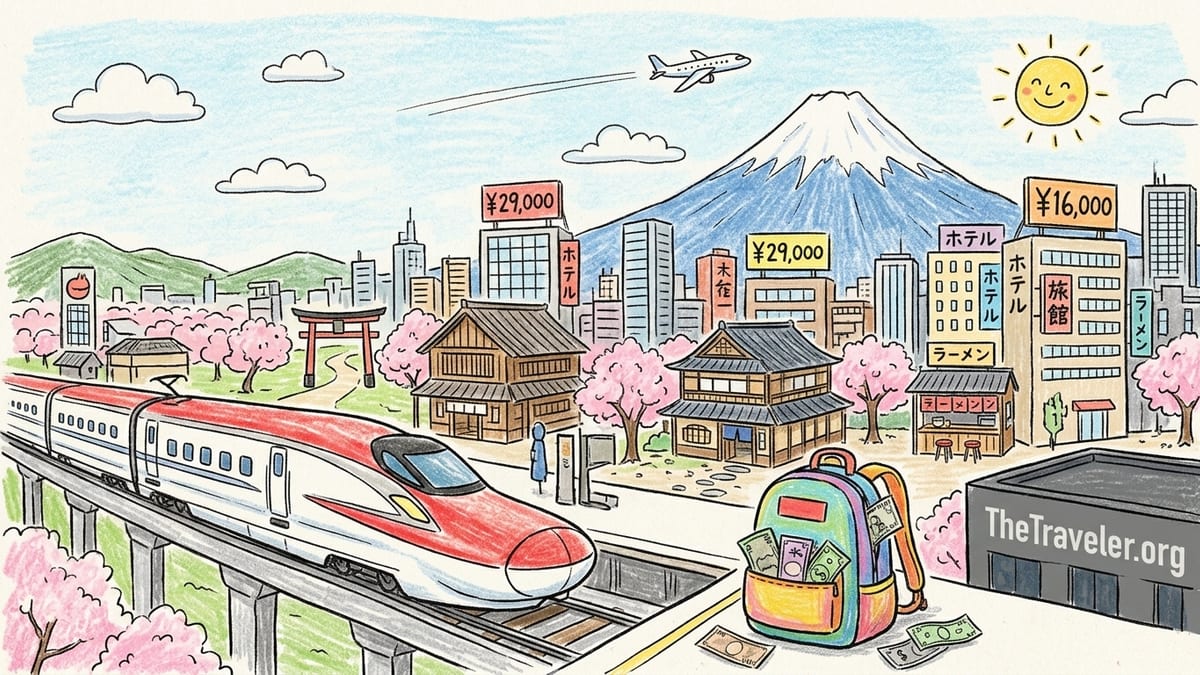
Key price trends shaping Japan travel in 2027
Japan’s tourism rebound has pushed spending by international visitors to record levels in 2024, and average per-person trip spending has climbed accordingly. Surveys compiled by Japanese and international tourism bodies suggest that an average visitor spends the equivalent of around 225,000 to 250,000 yen per trip on the ground, excluding flights, with lodging the single largest category. This spending pattern, combined with high demand in Tokyo, Osaka and Kyoto, has kept hotel rates high even where the local currency is relatively weak.
Hotel market data for 2025 and 2026 show average nightly rates in major Japanese cities rising into the mid- to high-20,000 yen range for standard "city" hotels, with business hotels sitting lower but still well above pre-pandemic norms. In Tokyo, for example, analysis of listed rates across dozens of properties in 2026 shows an average of roughly 28,000 to 29,000 yen per night for midrange city hotels, while business hotels often settle around 14,000 to 16,000 yen per night for a double room. These averages vary by season, but they give a realistic starting point for 2027 planning.
Transport passes have also become more expensive. The nationwide Japan Rail Pass saw a sharp price increase in 2023 and subsequent tweaks announced by the JR companies for 2025 and 2026. Regional passes such as the Hokkaido Rail Pass and certain JR East area passes have been repriced upward as well. While there is no official 2027 price list yet, the clear trend over recent years is that wide-ranging rail passes are no longer the automatic bargain they once were and need to be compared carefully against individual ticket prices.
On the other hand, everyday expenses like meals and local transit still feel relatively good value for many US visitors. Data from budgeting sites that aggregate real traveler spending suggests an average food spend in Japan of roughly 7,500 to 8,000 yen per person per day, with many travelers who rely more on convenience stores and casual restaurants spending less than that. For 2027, most visitors who are not seeking fine dining can still expect to eat well on about 4,000 to 6,000 yen per day.
Flights from the US to Japan in 2027
By late 2026, trans-Pacific fares to Japan have settled into a higher range than before the pandemic. Data compilations based on current fare searches in 2026 show that average one-way prices from major US gateways to Tokyo typically fall somewhere in the 700 to 1,000 US dollar range in economy when booked a few months ahead, depending on the departure city and season. Round-trip economy fares from the US to Japan commonly land between about 1,200 and 1,800 dollars for standard dates, with peak holidays and last-minute bookings going higher.
For example, in recent fare snapshots, West Coast cities such as Los Angeles and San Francisco often show some of the lowest baseline prices to Tokyo, with off-peak round trips occasionally dropping into the 1,000 to 1,200 dollar range on carriers like ANA, Japan Airlines, United or American when purchased well in advance. From Chicago or Dallas, similar searches frequently produce return fares in the 1,300 to 1,700 dollar band. From East Coast cities such as New York or Boston, it is common to see economy round-trip prices in the 1,500 to 1,900 dollar range when demand is high.
Fuel costs and limited capacity on some routes are keeping fares elevated. Domestic airfare statistics inside the United States, compiled by transportation agencies, show double-digit year-on-year increases through 2026, and that same price pressure appears in long-haul international tickets. For 2027 planning, a conservative baseline for a US-based traveler is to assume about 1,400 to 1,800 dollars for a round-trip economy ticket to Tokyo or Osaka, and to treat anything below 1,200 dollars from a major hub as a good deal worth booking quickly.
Business class and premium economy have climbed even more. Long-haul business class fares from the United States to Japan routinely exceed 4,000 dollars round trip and can easily reach 6,000 dollars or more during peak seasons, especially on flagship nonstops operated by Japanese and US legacy carriers. Premium economy, where available, usually adds 40 to 70 percent on top of an economy ticket. Travelers targeting 2027 should start tracking prices early, sign up for fare alerts, and remain flexible with dates and departure airports to keep flight costs under control.
What trains, passes and local transport really cost
Japan’s rail network remains one of the easiest ways to get around, but price increases in nationwide and regional passes mean it is essential to run the numbers. Official Japan Rail Pass price tables list the ordinary class 7-day pass in the mid-50,000 yen range, the 14-day pass in the low 80,000s and the 21-day pass higher still. These figures are roughly double the pre-2023 levels. Additional notices from JR companies indicate that, from late 2026, buying the pass through some overseas channels became more expensive than purchasing directly online, which matters for travelers who relied on foreign travel agents.
Regional passes, such as the JR East and JR Hokkaido offerings, have also seen specific revisions. For instance, the Hokkaido Rail Pass 5-day option, which once cost about 21,000 yen, was increased to approximately 23,000 yen in 2025 according to announcements shared by JR Hokkaido. JR East issued a similar notice in early 2025, revising prices for passes such as the JR East-South Hokkaido Rail Pass and the JR Tohoku-South Hokkaido Rail Pass from April of that year. While these examples are from 2025, they show the direction of travel: incremental increases that are likely to persist into 2027.
For point-to-point tickets, shinkansen fares remain straightforward. A reserved ordinary-class seat on the Tokaido Shinkansen between Tokyo and Kyoto typically runs in the neighborhood of 14,000 yen one way, depending on train category and seat type. Tokyo to Osaka is similar. Tokyo to Hiroshima can reach around 18,000 to 20,000 yen. If your 10-day trip includes only one or two such long hops, buying individual tickets rather than a nationwide pass often costs less than the current 7-day pass price. Travelers focusing on just one region, such as Kansai, may be well served by local passes or city-specific day tickets instead of national products.
Within cities, IC cards such as Suica and Pasmo in Tokyo or Icoca in Kansai remain the default option for tapping in and out of trains, subways and buses. Data from detailed trip reports shows typical single rides in Tokyo’s subway system costing roughly 150 to 250 yen, with an occasional longer suburban hop reaching 1,000 yen or more. Travelers who tracked every transaction during multi-week itineraries often reported average local transit spending in the range of 2,000 to 3,000 yen per day when they were moving between multiple neighborhoods, and less on slower-paced days.
Accommodation costs: hotels, business hotels and ryokan
Japanese accommodation is where many 2027 travelers will feel the sharpest increase. Industry research for 2026 shows that across major destinations like Tokyo, Osaka, Kyoto, Fukuoka and Hokkaido, average listed prices in October 2026 clustered around 16,000 yen per night for a business hotel double room, roughly 29,000 yen for a standard "city" hotel and about 34,000 yen for ryokan stays with meals included, with Tokyo and Kyoto typically at the higher end of these ranges. These figures represent per-room prices, usually before city accommodation taxes.
Zooming in on Tokyo, market analyses covering 2025 and 2026 indicate that the average transacted rate for midrange city hotels sits around 28,000 yen per night, while nine major business hotel brands show typical double-room prices in the mid-14,000 yen range nationwide and slightly higher in the capital. A separate look at visitor-facing guides for 2026 summarises Tokyo rates more simply: capsule and budget hostels often fall between 2,500 and 6,000 yen per night per person, standard business hotels around 8,000 to 15,000 yen per room, three-star hotels around 18,000 yen, four-star properties around 30,000 to 35,000 yen and luxury five-star hotels closer to 45,000 yen and up.
Kyoto and Osaka show similar patterns, though Kyoto’s limited central inventory keeps its rates especially high during peak periods like cherry blossom and autumn foliage. In these seasons, an otherwise midrange city hotel can easily approach or exceed 35,000 yen per night, and traditional ryokan with kaiseki dinners may charge 40,000 to 60,000 yen per person, especially in famous hot spring areas. Even outside peak, a comfortable, modern three-star business hotel in central Osaka or Kyoto will often cost 12,000 to 18,000 yen per night for a room in 2026, a range that planners can reasonably extend into 2027.
Travelers on tighter budgets still have options. Chains like APA, Toyoko Inn and Super Hotel continue to offer compact but clean rooms near major train stations, frequently in the 8,000 to 13,000 yen range per night if booked early or outside peak weekends. Capsule hotels and guesthouses in Tokyo neighborhoods such as Asakusa and Ikebukuro or in Osaka’s Namba and Shin-Osaka districts may present beds for as low as 3,000 to 5,000 yen per night. Booking further in advance, staying slightly away from major stations, and avoiding holiday weekends remain reliable tactics for reducing accommodation costs in 2027.
Food and daily expenses: what you will spend in Japan
Food budgeting in Japan has become one of the bright spots for US travelers. Aggregated spending data suggests visitors often allocate around 7,500 to 8,000 yen per day to meals but do not always use all of it. Travel budgeting sites that collect real expenditure from thousands of trips estimate average food spending in Japan at roughly 48 US dollars per person per day, which corresponds to around 7,500 yen at recent exchange rates. However, many recent trip reports indicate that travelers who favor convenience-store meals, ramen counters and inexpensive set menus are comfortable on 4,000 to 6,000 yen daily.
Concrete examples from real itineraries help illustrate this range. One autumn 2024 two-week trip report that carefully logged expenses showed food costs of about 62,000 yen over 14 days for one traveler, around 4,400 yen per day, despite including occasional sit-down restaurant meals. Another 2024 report for a 12-day trip for two adults listed roughly 830 US dollars spent on food, which converts to about 9,000 to 10,000 yen per day for the pair, or 4,500 to 5,000 yen per person. These numbers align with the idea that moderate eaters who mix konbini meals, casual restaurants and some treats can dine comfortably within that band.
In everyday terms, a bowl of ramen at a neighborhood shop might cost 900 to 1,300 yen, a conveyor-belt sushi lunch around 1,200 to 2,000 yen, and a fast-casual curry or donburi set 600 to 1,000 yen. Department store food halls and chain restaurants around Shinjuku or Umeda frequently advertise set meals in the 1,000 to 2,000 yen range. Coffee in a chain cafe often runs 350 to 500 yen, while a canned drink from a vending machine is usually about 120 to 160 yen. Travelers who cook occasionally in an apartment-style stay or rely on supermarket bento can cut daily food costs even further.
Daily spending also includes attractions and incidentals. Guides that outline sample budgets for Japan often suggest that basic sightseeing costs 1,000 to 3,000 yen per day in entry fees if you visit a couple of temples, museums or viewpoints. Many shrines remain free, but prominent attractions, such as famous castles, observation decks or specialty museums, may charge anywhere from 500 to 3,000 yen. Theme parks like Tokyo Disney Resort and Universal Studios Japan are significantly more expensive, with single-day tickets often priced around the equivalent of 10,000 yen or more per adult and considerable extra costs for food and souvenirs inside the parks.
Sample budgets for 7, 10 and 14 day trips
Putting these individual components together, it is possible to outline realistic 2027 budgets for different trip lengths, assuming a traveler from the United States visiting a mix of Tokyo, Kyoto and Osaka. The examples below separate the international flight cost from on-the-ground expenses so that readers can plug in their own airfare. All amounts are approximate and based on late-2026 price levels projected into 2027.
For a 7-day budget trip staying mostly in business hotels and using individual shinkansen tickets, you might assume 9,000 yen per night for accommodation in Tokyo and Osaka, giving about 63,000 yen for seven nights if you find good deals or mix in one or two capsule nights. Food at 4,500 yen per day would total roughly 31,500 yen. Local transit and the occasional intercity ticket could add another 25,000 to 30,000 yen, especially if you take one Tokyo to Kyoto or Osaka shinkansen ride and then return to your departure airport by a cheaper route. Add perhaps 10,000 to 15,000 yen for attractions and incidentals. In total, this yields a ground budget in the region of 130,000 to 140,000 yen for one week, not counting shopping.
A 10-day midrange trip with nicer city hotels and at least two long-distance bullet train rides might look different. If you target three-star hotels averaging 16,000 yen per night across Tokyo, Kyoto and Osaka, 10 nights will cost about 160,000 yen. Assuming you buy individual shinkansen tickets from Tokyo to Kyoto and Kyoto to Osaka, plus airport trains, you might spend another 40,000 to 50,000 yen on intercity and local transport. Food at 5,500 yen per day would reach about 55,000 yen, reflecting a mix of casual meals and a few higher-end dinners. Entry fees and occasional experiences, such as a tea ceremony or observation deck, might add 20,000 yen. This places the total on-the-ground budget near 275,000 to 285,000 yen.
For a 14-day trip with more cities, such as including Hiroshima or Kanazawa, a traveler could either buy a longer regional pass or rely on multiple shinkansen tickets. Suppose you choose mostly business and midrange hotels averaging 14,000 yen per night, for a total of around 196,000 yen for 14 nights. Food at 5,000 yen per day for two weeks totals 70,000 yen. If you add three or four major intercity train segments at 14,000 to 18,000 yen each, plus local transit, a reasonable transport total is 80,000 to 90,000 yen. Attractions over two weeks might cost 25,000 to 30,000 yen. Altogether, that points to a baseline ground budget in the 370,000 to 390,000 yen range, again excluding major shopping or luxury splurges.
It is worth comparing these totals with recent reports from real travelers. Multiple 2024 trip breakdowns for two-week itineraries across Japan, excluding flights, tend to land between about 300,000 and 450,000 yen per person once accommodation, food, rail and sightseeing are combined. Those numbers encompass a range of comfort levels, from budget-conscious guests in business hotels to pairs who occasionally stayed in higher-end properties. For a first-time visitor in 2027 seeking a comfortable but not extravagant experience, aiming for the middle of that band remains a sensible approach.
Tips to keep your 2027 Japan budget under control
With flights and hotels now the biggest drivers of total trip cost, early planning and flexibility are the most powerful tools for keeping a Japan trip affordable in 2027. For airfares, start monitoring prices at least six months ahead for peak seasons and three to four months ahead for shoulder periods. Being willing to depart midweek, fly from a secondary US airport or accept a one-stop itinerary instead of a nonstop can shave several hundred dollars off the price of a trans-Pacific ticket.
On the ground, choose your travel pattern to minimize unnecessary long-distance journeys. If you know you will only travel between Tokyo and the Kansai region, compare a regional pass or discounted advance shinkansen tickets with the current nationwide pass prices rather than defaulting to the biggest pass available. When planning city days, cluster sights by neighborhood so you are not zigzagging across Tokyo and Osaka on repeated paid journeys. Many travelers who originally budgeted 7,000 to 10,000 yen per day for food and transport later reported spending significantly less once they took advantage of city passes and neighborhood-focused days.
Accommodation strategies can also yield substantial savings. Booking nonrefundable rates well in advance, especially for travel outside peak cherry blossom and autumn foliage weeks, often secures more favorable prices at reliable chains. Consider staying one or two train stops away from marquee districts like Shinjuku or Shibuya if that simplifies your budget; central business hotels one step back from the main station can be materially cheaper than flagship city hotels with similar room sizes. Mixing in one or two nights at capsule hotels or hostels in cities like Osaka, where they are plentiful, can trim the average nightly cost without sacrificing the overall experience.
Finally, be honest about what you want from the trip. Travelers who emphasize food, for example, may wish to allocate more to restaurant spending but save by sticking to a smaller number of cities and cheaper accommodations. Others primarily interested in scenery and temples can select less expensive dining options and invest more in rail passes to reach rural areas or multiple regions. By combining current price data with a clear sense of priorities, you can build a 2027 Japan itinerary that feels rich in experiences without overrunning your budget.
Conclusion: planning ahead for a realistic 2027 Japan budget
Japan in 2027 will likely remain both enticing and, in some categories, more expensive than past visitors remember. Airfares from the United States are elevated compared with pre-pandemic norms, and hotel rates in major cities reflect sustained demand from domestic and international guests alike. At the same time, the overall cost structure on the ground, with reasonable local transport fares and a wide spectrum of dining options, still allows for a rewarding trip across a wide range of budgets.
By examining current flight prices, updated rail pass structures, real hotel market data and actual spending by recent travelers, would-be visitors can move beyond generic advice and put concrete yen figures into their plans. Whether you are sketching out a lean 7-day city break or a more ambitious two-week circuit, using late-2026 price benchmarks and building in a small buffer for 2027 inflation will help ensure you arrive in Japan prepared rather than surprised. With that groundwork in place, you can focus less on exchange rates and more on savoring ramen in Osaka, wandering Kyoto’s backstreets and watching bullet trains glide into Tokyo Station on time, every time.