


Travel in the Caucasus has often been sold as a romantic mix of wild mountains, generous hospitality, and Soviet nostalgia. For years I moved through Armenia, Georgia, and Azerbaijan on those terms, treating border lines as practical inconveniences rather than moral fault lines. Learning what happened in Nagorno Karabakh, and then seeing the region again after 2023 when almost all of its Armenian population fled, changed that. It altered how I read landscapes, how I talked to people, and what it meant to move freely through a region where so many others had lost that right.
Get the latest updates straight to your inbox!
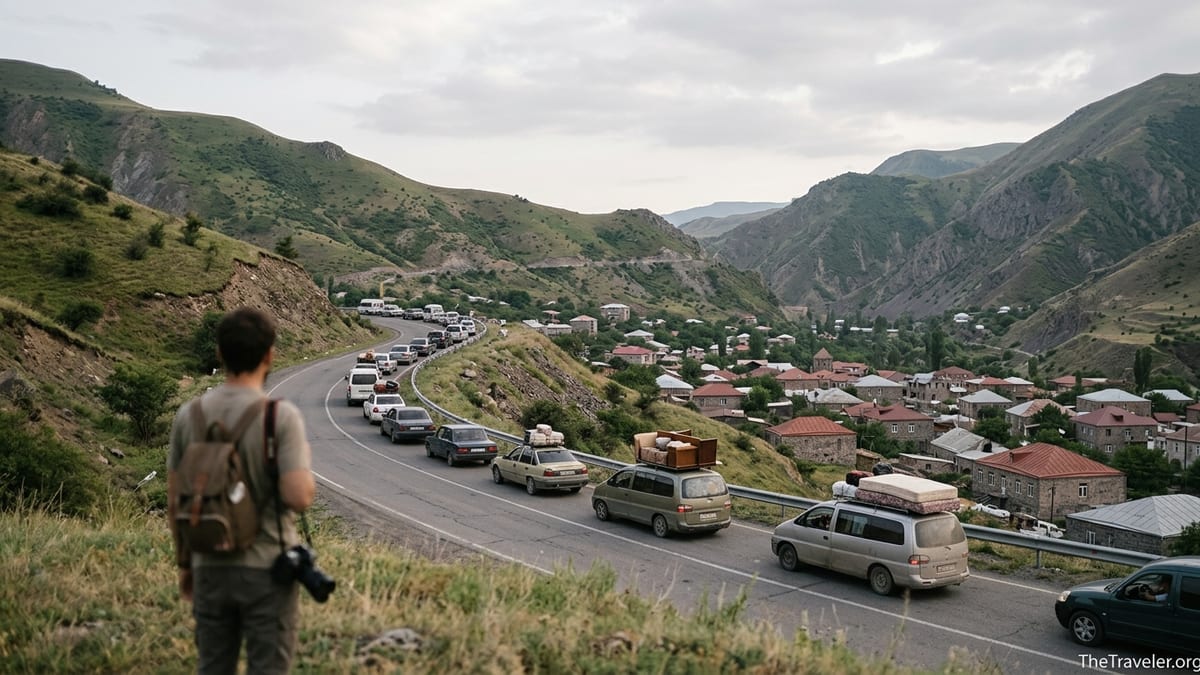
From Blank Spot on the Map to Vanished Place
When I first traveled through the South Caucasus a decade ago, Nagorno Karabakh was literally a blank gray patch on most tourist maps. Guidebooks mentioned “ongoing tensions” and advised travelers to avoid the area, but on the ground in Yerevan and Tbilisi it felt distant, something for diplomats and analysts, not backpackers on overnight marshrutkas. The region existed largely as a caution in visa fine print: if you had an Artsakh entry stamp, you would not be allowed into Azerbaijan. That was often the extent of the story.
That changed abruptly after September 2020, when a six-week war returned swathes of territory around Nagorno Karabakh to Azerbaijan and cost thousands of lives on both sides. Then, in late 2022 and 2023, reports filtered out that the Lachin corridor, the only road linking the Armenian-populated enclave to Armenia, was blocked for months at a time. A short, decisive Azerbaijani offensive on 19 and 20 September 2023 was followed by an exodus of more than 100,000 ethnic Armenians within days, emptying the region of nearly all its Armenian residents. Overnight, the “blank spot” was not just contested. It was effectively emptied.
For a traveler, those numbers are not abstract. I had stood in Stepanakert’s main square years earlier, drinking coffee at a basic café that served thick Armenian sand-brewed coffee for less than a dollar. To imagine that square today, with Armenian institutions dissolved and shops shuttered or changed, is to feel how quickly places can disappear from lived memory even while remaining on the map. Nagorno Karabakh forced me to confront that travel is always happening in the aftermath of something, even if guidebooks gloss over it.
Relearning the Geography of the South Caucasus
Nagorno Karabakh also rewired how I saw the geography of the wider Caucasus. On a map, Armenia looks landlocked but compact, Georgia like a thin bridge between the Black Sea and the Caucasus Range, Azerbaijan stretching from the Caspian to its exclave of Nakhchivan. After diving into the history of Nagorno Karabakh, those shapes turned into stories of corridors, choke points, and enclaves that shape daily life and travel choices.
Take the drive from Yerevan to Goris in southern Armenia, for instance, a route many travelers now know because it became the path for Armenian refugees leaving Nagorno Karabakh. Shared taxis do the roughly 250 kilometer journey in about five to six hours, passing roadside honey sellers and Soviet-era factories. On older maps the road seemed like any other provincial route. After 2023, I could not see it that way. It was the same asphalt that carried nearly the entire Armenian population of Nagorno Karabakh toward the border, cars piled with mattresses and crates of chickens.
Even places far from the conflict zone felt different once I understood that context. In Kutaisi, Georgia’s laid-back second city, budget airlines bring in weekenders with little sense that a few hundred kilometers away lies territory that recently saw a mass displacement. In Baku, the gleaming Flame Towers, luxury malls, and carefully restored Old City can make it easy to forget that many Azerbaijani families still speak about the 1990s, when hundreds of thousands were displaced from areas then held by Armenian forces. Geography in the Caucasus is not neutral. It is layered with unresolved journeys.
Listening Differently in Armenia, Azerbaijan, and Georgia
Understanding Nagorno Karabakh changed not only what I saw but how I listened. Before, I might have casually asked an Armenian taxi driver about “the situation” or an Azerbaijani hostel owner about “the conflict,” assuming they would offer a succinct summary. After reading accounts of sieges, of months-long shortages in Stepanakert during the Lachin blockade, and of Azerbaijani families who had been displaced for decades, I realized that for most people this was not a neat topic. It was a wound.
In Yerevan, conversations about Nagorno Karabakh often start with practical worries. A guesthouse owner near Republic Square talked less about geopolitics than about the sudden arrival of relatives from Stepanakert, and what it meant to double up families in cramped apartments. Food prices in local supermarkets had already been rising; adding more mouths to feed on the same income was a daily arithmetic, not an abstract humanitarian concern.
In Baku, the tone is different but just as personal. When Azerbaijan regained territories during the 2020 war and then asserted full control over Nagorno Karabakh in 2023, many Azerbaijanis framed it as the end of a long national trauma. Some spoke with pride about visiting cities such as Shusha or Aghdam again, places they had only known from stories or old family photos. For them, the landscape was full of ghosts of villages lost in the early 1990s and a sense of return, not simply victory.
Georgia, which has its own unresolved conflicts in Abkhazia and South Ossetia, is where narratives collide most openly. In Tbilisi cafés, Armenian and Azerbaijani students share tables, and it is possible, if you listen more than you speak, to hear how young people on both sides are exhausted by inherited grievances. Travel here became less about checking off monasteries and more about hearing how people live with a past that never quite passes.
Rethinking Safety, Ethics, and “Off the Beaten Path” Travel
Nagorno Karabakh also forced me to confront some travel instincts I had rarely questioned. The urge to go “before it changes,” to seek out contested or little-visited areas, is common among overland travelers in the Caucasus. When Nagorno Karabakh still functioned as the de facto Republic of Artsakh, you could arrange a visit through tour agencies in Yerevan, pay modest guesthouse rates, and come home with stories of crumbling Soviet factories and mountain vistas “few outsiders see.” Today, with the Armenian population gone and the political situation sensitive, that desire looks different.
Conflict research and human rights reporting showed clearly that the months before the September 2023 offensive were marked by a severe humanitarian crisis. The blockage of the Lachin corridor left residents facing shortages of essential goods, from fuel to medicine. Learning that, I had to ask what it would have meant if I had visited during that period, camera in hand, knowing that my ability to leave was guaranteed while residents worried about basic supplies and security.
This shift spills into other travel decisions in the Caucasus. Choosing whether to visit border regions in Tavush or Syunik in Armenia, or newly accessible towns on the Azerbaijani side, is no longer just a question of scenery or cost. It raises questions like: Is my presence welcome or intrusive right now. Am I contributing economically in a way local people value, or simply treating their trauma as backdrop. When a guesthouse in Goris charges a bit more than a hostel in central Tbilisi, I find myself thinking less about budget comparisons and more about how many new residents that guesthouse might be quietly supporting.
For travel writers, there is an added ethical layer. To describe Nagorno Karabakh purely as a “former breakaway region” or to avoid mentioning the recent exodus of Armenians would produce a lighter, easier text. It would also be dishonest. The challenge is to connect readers with the lived reality of those affected without using suffering as color for an otherwise carefree narrative.
Seeing History in Everyday Details
Once you know the outlines of the Nagorno Karabakh story, history starts appearing in mundane details across the Caucasus. In Yerevan’s Vernissage market, among the carved chess sets and pomegranate-themed souvenirs, you will see stallholders selling medals, patches, and flags relating to Artsakh. A casual visitor might read them as generic patriotic trinkets. Someone who has followed recent events will recognize them as fragments of a political entity that officially dissolved itself at the end of 2023, after its leaders announced they would disband the self-proclaimed republic’s institutions.
In Baku, history is present in the absence of people, as much as in monuments. When you stand on the Bulvar, the city’s seaside promenade, and look toward the downtown skyline, it is easy to be absorbed by the polished surface of modern Azerbaijan. Yet just a few hours away by road, areas that were under Armenian control for decades are now undergoing rapid reconstruction by the Azerbaijani state. New highways, airports, and planned smart villages are being built in districts where entire Armenian communities once lived and where Azerbaijani families had previously been displaced. The speed of that transformation, and who benefits from it, will shape how future travelers experience these landscapes.
Georgia offers quieter clues. In Tbilisi’s courtyards and cheap eateries, it is common to meet people from across the region: Armenians from Gyumri looking for work, Azerbaijanis from Ganja, Russians who left Moscow or Saint Petersburg after 2022. After Nagorno Karabakh, these encounters feel less random. Each person carries a story about why they left and what it means to navigate new borders, whether physical or bureaucratic. Hotel reception desks groaning under stacks of passports, or budget hostels full of long-term residents, become reminders that mobility in the Caucasus is rarely simple.
Traveling with More Questions and Fewer Certainties
Learning about Nagorno Karabakh did not hand me a clear political position that neatly explains the Caucasus. If anything, it stripped away some certainties. It is possible to acknowledge, at the same time, the long history of Armenian presence in Nagorno Karabakh, the suffering of Azerbaijanis displaced in the early 1990s, and the horror of seeing more than four-fifths of the enclave’s Armenian population flee in a matter of days after the 2023 offensive. For a traveler, holding those truths together is uncomfortable but necessary.
On a practical level, it means asking better questions. Instead of “Is it safe,” I now ask “Safe for whom, and under what conditions.” A road that is open and secure for a foreigner with a passport from the European Union or North America may feel very different to a local resident from a minority community. Instead of “Is this border open,” I ask “To which passports, and since when.” In the Caucasus, regulations on crossings between Armenia, Azerbaijan, Georgia, and nearby regions can change with little notice, and they often reflect deeper political shifts.
It also means accepting that some places are not accessible, not because of a lack of courage or curiosity, but because the people who lived there have been uprooted or because the security situation is too volatile. Nagorno Karabakh today is not a destination in any normal tourist sense. It is a region where an Armenian population that once numbered well over a hundred thousand has, according to international observers, almost entirely left. To treat it as a frontier attraction would miss the point.
The Takeaway
Nagorno Karabakh changed how I saw the Caucasus by exposing the gap between the way travel often flattens regions into attractions and the way people actually experience history. It turned border crossings from a logistical puzzle into a reminder of who gets to move and who does not. It shifted my focus from scenic viewpoints to bus stations, city squares, and roadside cafés filled with people who had to start over, sometimes multiple times in one lifetime.
For travelers heading to Armenia, Azerbaijan, or Georgia now, the lesson is not to avoid the region. It is to arrive with eyes open. Ask hosts in Yerevan how the influx of people from Nagorno Karabakh has affected their communities. Listen in Baku when people talk about finally visiting ancestral towns. Pay attention in Tbilisi to how people from across the former Soviet space are renegotiating their lives. The Caucasus remains one of the most beautiful and hospitable regions on earth, but beauty here is inseparable from complexity.
Ultimately, learning about Nagorno Karabakh pushes us to move through the Caucasus with more humility. That might mean choosing locally owned guesthouses over anonymous chains, taking time to hear personal histories, or being willing to adjust itineraries if tensions rise. It certainly means resisting the urge to treat contested spaces as trophies to be collected. Travel, at its best, is not about conquering distances. It is about encountering other people’s realities, and letting those realities change how we see the map itself.
FAQ
Q1. Is it possible for tourists to visit Nagorno Karabakh now?
As of mid 2026, there is no standard tourist access comparable to pre-2020 trips arranged from Armenia, and conditions on the ground are highly sensitive and subject to change. Travelers should treat the area as off-limits unless they have a specific, officially approved reason to be there and up to date guidance from relevant authorities.
Q2. How did the 2023 events in Nagorno Karabakh change travel in Armenia?
The arrival of more than one hundred thousand people from Nagorno Karabakh placed pressure on housing and services, especially in southern Armenia and Yerevan, while also increasing the importance of local guesthouses, small hotels, and restaurants that now serve mixed local and displaced communities.
Q3. Can I travel to both Armenia and Azerbaijan on the same trip?
Many travelers do visit both countries in one journey, usually by routing through Georgia in between, but political relations are tense and border crossings between Armenia and Azerbaijan remain closed, so itineraries need to be planned carefully and checked against the latest entry policies.
Q4. Will an Armenian visa stamp cause problems entering Azerbaijan, or vice versa?
Having visited Armenia itself is not usually an issue in Azerbaijan, but older entry stamps from the former de facto authorities in Nagorno Karabakh were considered problematic, and travelers should assume that any documentation suggesting unauthorized visits to sensitive areas may lead to questioning or refusal of entry.
Q5. Is it safe to travel in the South Caucasus after the Nagorno Karabakh conflict?
Most popular destinations in Armenia, Georgia, and Azerbaijan remain calm and receive foreign visitors, but occasional clashes along border areas and rapid political shifts mean travelers should monitor reliable news sources, stay in touch with local hosts, and avoid military zones or restricted roads.
Q6. How can travelers be respectful when discussing Nagorno Karabakh with locals?
It is best to let local people raise the subject first, listen more than you speak, avoid taking sides or repeating social media narratives, and remember that nearly everyone you meet will know someone directly affected by conflict or displacement.
Q7. Are there ways for travelers to support communities affected by displacement?
Booking locally owned guesthouses, eating in family run restaurants, buying crafts directly from artisans, and using community based tour operators are practical ways to put money into the hands of people rebuilding their lives after upheaval.
Q8. Has tourism in Georgia been affected by the Nagorno Karabakh situation?
Georgia remains the main overland bridge of the region and continues to attract large numbers of visitors, but the wider climate of regional uncertainty and the presence of people displaced from various conflicts have made Tbilisi and other cities feel more like crossroads than ever.
Q9. What should travelers know about photographing sensitive sites in the Caucasus?
It is wise to avoid photographing military checkpoints, border installations, or people in obviously vulnerable situations, to ask before taking close ups of individuals, and to be especially cautious in areas close to contested front lines.
Q10. Where can I learn more about the history behind Nagorno Karabakh before visiting the region?
Reading recent reporting by established news organizations, consulting books by regional historians, and comparing perspectives from Armenian, Azerbaijani, and international authors will provide a more balanced understanding than relying on a single source or social media feed.