


High, forested ridges, stone villages clinging to steep valleys and churches carved into the mountainside once made Nagorno Karabakh one of the most atmospheric corners of the South Caucasus. For decades, though, the region was better known for checkpoints and ceasefire lines than for hiking trails or monasteries. In 2023 Azerbaijan reasserted full control over Nagorno Karabakh, the self‑proclaimed Republic of Artsakh dissolved, and almost all of the local Armenian population fled. To understand why this small pocket of land has shaped regional politics for more than a century, you need to trace a story that runs from the final years of the Russian Empire to today’s newly drawn maps and nervous border crossings.
Get the latest updates straight to your inbox!
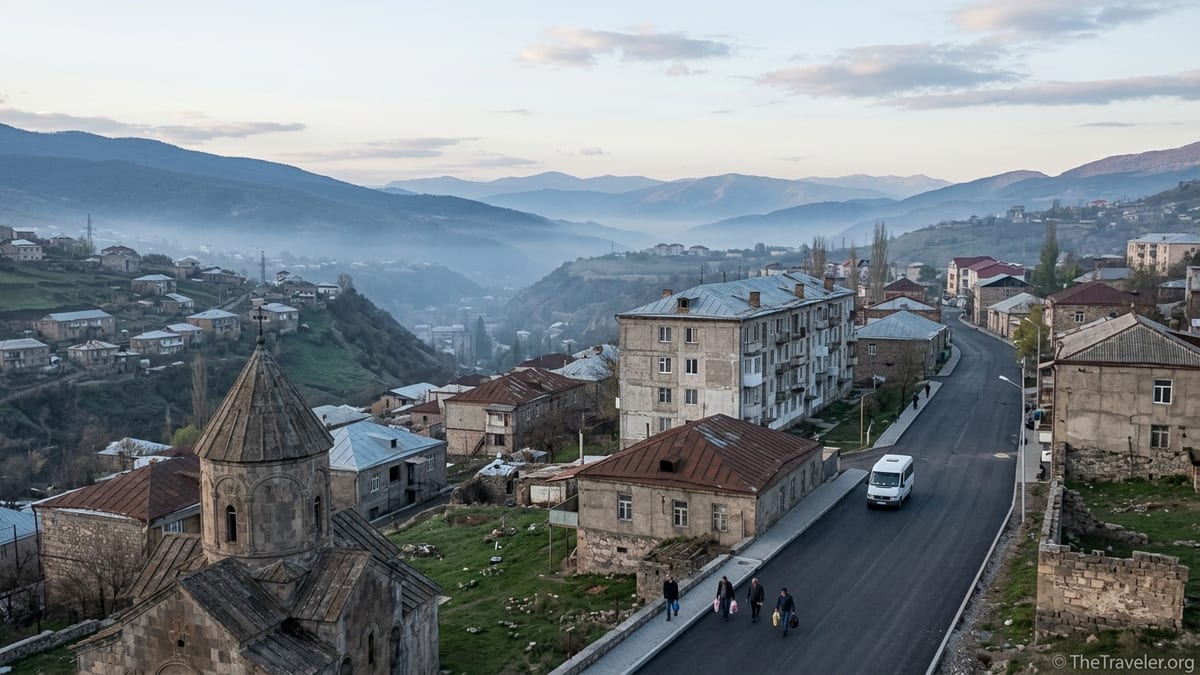
Where and What Is Nagorno Karabakh?
Nagorno Karabakh is a mountainous plateau in the South Caucasus, roughly the size of a small European province, wedged inside the internationally recognized borders of Azerbaijan but historically populated largely by ethnic Armenians. In Armenian it is often called Artsakh, a name that appears in medieval chronicles and church inscriptions; in Azerbaijani, the wider area is known as Qarabağ, or Karabakh, a term that also covers the surrounding lowlands. For decades, visitors who made it into the region would hear both names used side by side in local conversations, a reminder that competing identities have always overlapped here.
Geographically, Nagorno Karabakh sits between Armenia to the west and Azerbaijan’s lowland cities of Ganja and Barda to the east. The drive from Yerevan to the former de facto capital Stepanakert, known as Khankendi in Azerbaijani, used to take around five to six hours along twisting roads that climbed over the Lachin corridor, the main land route that once linked Armenia to the enclave. Those same roads are now firmly under Azerbaijani control, patrolled by police and military units instead of the Armenian forces and Russian peacekeepers that manned them until 2023 and 2024 respectively.
For travelers, the region is no longer an accessible “breakaway republic” with its own border control and license plates, as it was between the early 1990s and late 2020. Today it functions as part of Azerbaijan, administered from Baku, and off‑limits in practice to foreign tourists except through tightly controlled, special‑purpose trips. Most visitors wanting to understand the story of Nagorno Karabakh now base themselves in Yerevan or Baku and explore museum exhibitions, memorials and border‑adjacent towns instead of entering the territory itself.
The land, however, still bears the marks of earlier decades. Once, hikers could follow footpaths from Stepanakert to nearby villages such as Shushi and Togh and stumble upon abandoned Soviet‑era cable cars, half‑ruined caravanserais and terraced vineyards. Many of those settlements were heavily damaged in the wars of 1992 to 1994 and 2020, and again during the September 2023 offensive. The new authorities have begun clearance and reconstruction, but remnants of trenches and burned‑out houses remain, and large areas are closed because of landmines.
From Empire to Soviet Republics: How the Dispute Began
The roots of the Nagorno Karabakh dispute lie in the last years of the Russian Empire and the chaotic period that followed its collapse. In the late 19th and early 20th centuries, Armenians formed a majority in much of the highland part of Karabakh, while Turkic‑speaking Muslims, the ancestors of today’s Azerbaijanis, were concentrated in nearby cities and lowland areas. Both communities had deep historical ties to the region, from medieval Armenian monasteries such as Gandzasar to the palaces of the Karabakh khans.
When the Russian Empire fell apart during World War I, short‑lived independent republics of Armenia and Azerbaijan emerged. Between 1918 and 1920 clashes, massacres and population movements scarred Karabakh and neighboring provinces. Local Armenian militias and Azerbaijani forces each tried to establish control. British troops, briefly present in the region after the war, sided at one point with Azerbaijani claims, but their decisions were provisional and soon overtaken by events as the Red Army advanced south.
Once the Bolsheviks consolidated power in the South Caucasus in the early 1920s, Moscow had to decide where to draw internal borders between the new Soviet republics. After several reversals, Soviet authorities placed Nagorno Karabakh as an autonomous oblast within the Azerbaijan Soviet Socialist Republic, rather than attaching it to Soviet Armenia. Armenian historians point to the region’s Armenian majority and cultural heritage to argue this was an injustice; Azerbaijani narratives emphasize earlier Azerbaijani political entities and question whether Armenians were always dominant in the highlands. The decision, made by distant party officials, planted a long‑term contradiction inside the Soviet system.
For much of the Soviet era, that contradiction was contained. Armenians in Nagorno Karabakh had their own schools and cultural institutions and could travel relatively easily to Armenia, while Azeris lived and worked across the union. But complaints simmered about underinvestment, discrimination and demographic shifts, with Armenians claiming that Baku encouraged Azeri settlement and Azerbaijanis insisting that Armenians had privileged access to Moscow. The conflict was latent, but not forgotten, in the quiet streets of Stepanakert’s Soviet apartment blocks and the tea houses of nearby Azeri towns.
War, Ceasefires and the Rise of the De Facto Republic
The lid blew off in the late 1980s, as Mikhail Gorbachev’s reforms loosened political controls. In 1988, Nagorno Karabakh’s regional Soviet formally requested to transfer from the Azerbaijani to the Armenian republic. The move triggered mass protests in Yerevan, counter‑demonstrations in Baku and a wave of interethnic violence. Pogroms in the Azerbaijani cities of Sumgait and Baku targeted Armenians; anti‑Azerbaijani attacks and expulsions took place in parts of Armenia and Nagorno Karabakh. Trains were stopped, families were expelled from villages, and mixed neighborhoods across the South Caucasus were rapidly emptied.
By the time the Soviet Union collapsed in 1991, full‑scale war had broken out. Armenian forces and local Karabakh Armenian fighters, supported in varying ways by Armenia proper, gradually gained the upper hand. Azerbaijani troops and civilians were pushed out of Nagorno Karabakh and seven surrounding districts, including Kelbajar, Agdam and Fizuli. One of the war’s darkest moments was the 1992 killing of hundreds of Azerbaijani civilians fleeing the town of Khojaly, an event Azerbaijan commemorates as a massacre and Armenians dispute in scale and interpretation but acknowledge as a tragedy.
A Russia‑brokered ceasefire in 1994 left Armenian forces in control of almost all of Nagorno Karabakh and those adjacent districts. The self‑proclaimed Nagorno Karabakh Republic, later often called the Republic of Artsakh, established its own institutions: a president and parliament in Stepanakert, separate license plates, border checkpoints and a small international airport that never opened for regular civilian traffic because of security concerns. Hotels such as the Armenia Hotel in Stepanakert and guesthouses in Shushi began to cater to a trickle of foreign visitors, mainly diaspora Armenians, journalists and adventurous backpackers.
For Azerbaijanis, meanwhile, the ceasefire era meant a long wait to return to homes and lands they had fled. Hundreds of thousands of internally displaced people ended up in temporary housing around Baku, Ganja and other cities. In some settlements close to the line of contact, travelers could see rows of prefabricated houses or converted railway carriages that had been used as emergency accommodation in the 1990s and later replaced by purpose‑built villages funded by oil revenues. The memory of lost villages and graveyards remained a powerful force in Azerbaijani politics and identity.
The 2020 War and the 2023 Offensive
For more than two decades, international mediators under the OSCE Minsk Group tried to broker a final settlement, but front lines hardly moved. Skirmishes along the contact line and the Armenia–Azerbaijan border flared periodically, including serious clashes in 2016. A combination of factors then produced a decisive shift in 2020: Azerbaijan’s increased military spending, new weaponry such as armed drones obtained from Turkey and Israel, and a regional environment shaped by Russia’s focus on other priorities.
In late September 2020, Azerbaijan launched a large‑scale offensive that turned into a 44‑day war. Fighting devastated parts of Nagorno Karabakh and the surrounding districts. Towns like Shushi, perched on a bluff above Stepanakert, changed hands after intense street battles; videos circulated of trenches, artillery strikes and drone footage hitting Armenian armor and artillery. Armenia, with fewer resources and weaker air defenses, struggled to hold the lines. Civilians sheltered in basements and metro stations in Stepanakert as explosions shook the city.
The war ended with a Russia‑brokered ceasefire on 10 November 2020. Under its terms, Azerbaijan regained control of the occupied districts around Nagorno Karabakh and parts of the enclave itself, including Shusha/Shushi. Russian peacekeepers deployed along key roads and around remaining Armenian‑populated areas, while a narrow version of the Lachin corridor remained open as a lifeline between Nagorno Karabakh and Armenia. Travelers who came to the region in 2021 or 2022 would have noticed Russian armored vehicles and observation posts along the route, alongside new Azerbaijani checkpoints and flags in retaken lowland towns.
Tensions never fully subsided. In late 2022 and 2023, a blockade of the Lachin corridor severely restricted the flow of goods and people, creating shortages for the Armenians still living in Nagorno Karabakh. On 19 September 2023, Azerbaijan launched a new, rapid offensive against the remaining Armenian forces in the enclave. After about a day of fighting, local authorities accepted a ceasefire mediated by the Russian peacekeeping command. Within days, an almost complete Armenian exodus began: buses and private cars formed long queues heading toward Armenia, a scene captured by international news crews stationed on the road into the border town of Goris.
Exodus, Dissolution and New Realities on the Ground
The September 2023 offensive not only redrew military lines; it also transformed the human geography of Nagorno Karabakh. Before the 2020 war, estimates suggested roughly 150,000 Armenians lived in the region. After the 44‑day war and the loss of several districts, that number dropped. Following the 2023 offensive, Armenian officials stated that almost all remaining Armenians had left within a matter of days, with over 100,000 people recorded crossing into Armenia in the weeks that followed. Aid groups set up registration points in Goris and nearby towns, while schools and hotels in cities such as Yerevan and Vanadzor opened their doors to displaced families.
On 28 September 2023, the de facto authorities in Nagorno Karabakh announced that the self‑proclaimed Republic of Artsakh would dissolve by 1 January 2024. Its institutions, from the presidency to local courts, effectively ceased functioning in the territory. For Armenians, the decision felt like the end of a political project that had begun in the late Soviet period. For Azerbaijan, it marked the restoration of full sovereignty over lands recognized internationally as part of its territory. Public celebrations in Baku contrasted with mourning services in Armenian churches and commemorations in diaspora communities abroad.
In 2024, another key element of the post‑2020 order disappeared. Russian peacekeepers, who had been deployed under the 2020 ceasefire agreement with a mandate initially expected to last until 2025, began to withdraw in April. By June, Azerbaijani authorities announced that the withdrawal was complete and Azerbaijani forces alone controlled the territory. The blue helmets and armored personnel carriers that travelers once saw near Shusha and along the Lachin road vanished, leaving new Azerbaijani checkpoints and police stations in their place.
For people on the move, this means Nagorno Karabakh today is no longer a semi‑autonomous enclave or a peacekeeper‑patrolled gray zone. It is integrated into Azerbaijan’s administrative system, with access controlled from Baku. International visitors cannot simply turn up in Stepanakert as some adventurous backpackers did a decade ago. Instead, they encounter layers of visa rules and security restrictions, and in Armenia they will meet families from Nagorno Karabakh who are rebuilding their lives in cities and villages far from the mountains where they grew up.
What This Means for Travelers to Armenia and Azerbaijan
Even though Nagorno Karabakh itself is effectively closed to tourism, the conflict that shaped it is impossible to ignore when traveling in Armenia or Azerbaijan. In Armenia, many taxi drivers in Yerevan or Gyumri have relatives from Stepanakert, Hadrut or Martakert. Strike up a conversation on the way from Zvartnots International Airport into the capital and you may hear first‑hand stories of the 2020 shelling or the 2023 exodus. Guesthouse owners in border‑adjacent communities like Goris or Kapan sometimes supplement their income by hosting aid workers or journalists covering the displaced families, a reminder that the line between tourism and crisis response can be thin.
On the Azerbaijani side, Baku’s broad boulevards and seaside promenade feel far from the front lines, but displays in the Military Trophies Park and exhibits in newer museums reference the “Patriotic War” of 2020 and the return of territories. Road trips into regions such as Fuzuli, Jabrayil or Zangilan pass through areas that were for years inaccessible and are now dotted with demining crews, new highways and construction camps. Tour agencies in Baku sometimes advertise tightly controlled day trips for journalists or foreign delegations to see rebuilding projects in these districts, although access is not comparable to standard tourist excursions.
From a safety standpoint, both Armenia and Azerbaijan are sensitive to border incidents. Travel advisories from foreign governments periodically warn against approaching certain stretches of the Armenia–Azerbaijan frontier or attempting to visit areas near the former line of contact because of landmines and sporadic shooting. A traveler driving from Yerevan to the Armenian resort town of Jermuk, for instance, may pass military positions and damaged infrastructure from the 2022 clashes. In Azerbaijan, drives toward the Iranian border or into the recaptured districts often involve passing multiple police checks where passports and vehicle documents are scrutinized.
For many visitors, the most meaningful engagement with the story of Nagorno Karabakh now comes through cultural sites and conversations rather than direct access to the territory. In Yerevan, museums and memorials discuss the wars of the 1990s and 2020s and the displacement of Armenians from the enclave. In Baku and Ganja, exhibitions highlight Azerbaijani villages destroyed or abandoned in the 1990s and now slated for reconstruction. Joining a walking tour, visiting a local history museum, or simply taking time to talk with hosts and guides provides a more grounded understanding of how ordinary people on both sides experienced a conflict that shaped the map.
The Takeaway
The story of Nagorno Karabakh is not just about maps and ceasefire lines. It is about how a rugged piece of mountain territory became a symbol of identity and loss for both Armenians and Azerbaijanis, and how decisions made in distant capitals during the Soviet era reverberated decades later as wars and mass displacement. From the early 20th century power struggles to the formation of a de facto republic in the 1990s, the 44‑day war in 2020, the brief but decisive offensive of 2023 and the withdrawal of Russian peacekeepers in 2024, the region has sat at the crossroads of empire, nationalism and geopolitics.
For travelers, Nagorno Karabakh today is less a destination than a lens through which to understand the South Caucasus. You may not be able to walk the streets of Stepanakert or visit the hilltop citadel of Shusha as independent tourists, but you will encounter the echoes of those places in the stories of drivers, hosts and guides from Armenia and Azerbaijan. The checkpoints, new roads and reconstruction projects you see from a distance all trace back to this unresolved history.
Approaching the region with curiosity, empathy and awareness of recent events will change how you experience everything from a cup of coffee in Yerevan’s Cascade district to a stroll along Baku’s Caspian seafront. Behind the modern facades are families whose lives were uprooted from towns and villages most foreigners will never see. Understanding Nagorno Karabakh’s story will not solve its tragedies, but it can help visitors move beyond headlines and appreciate the human dimensions of a conflict that reshaped a corner of the Caucasus and continues to influence how people live, travel and imagine their futures there.
FAQ
Q1. Can foreign tourists currently visit Nagorno Karabakh itself?
In practice, no. The territory is under Azerbaijani control, heavily militarized and subject to strict access rules. Ordinary tourists cannot freely enter and move around as they once did.
Q2. Who controls Nagorno Karabakh today?
As of mid‑2026, Nagorno Karabakh is administered by Azerbaijan, following the September 2023 offensive, the exodus of its Armenian population and the dissolution of the self‑proclaimed Republic of Artsakh.
Q3. Is it safe to travel to Armenia after the 2020 and 2023 fighting?
Most of Armenia, including Yerevan, Gyumri, Dilijan and Lake Sevan, is considered relatively safe for visitors, though travelers should check up‑to‑date advisories and avoid sensitive border areas where tensions can flare.
Q4. Is it safe to travel to Azerbaijan given the conflict?
Major cities like Baku and Ganja and established tourist areas along the Caspian Sea are generally calm, but some border regions and newly retaken districts have security and landmine risks, so travelers should follow official guidance.
Q5. Why did almost all Armenians leave Nagorno Karabakh in 2023?
After Azerbaijan’s September 2023 offensive and the subsequent ceasefire, Armenian residents feared for their safety and future status. Within days, most chose to leave for Armenia rather than remain under new control.
Q6. What happened to the Russian peacekeepers?
Russian peacekeepers deployed after the 2020 war began withdrawing in April 2024. By June 2024 Azerbaijani officials announced that the withdrawal was complete and that their own forces fully controlled the territory.
Q7. How does the conflict affect everyday travel in the South Caucasus?
Travelers may encounter extra checkpoints on some roads, closed or restricted border areas, visible damage from past fighting and many local people who have been displaced or lost relatives in the wars.
Q8. Can I visit sites connected to the Nagorno Karabakh story without entering the territory?
Yes. In Armenia, towns like Goris and museums in Yerevan tell the story of displaced Armenians. In Azerbaijan, exhibitions in Baku and trips toward rebuilt districts show how the conflict is remembered there.
Q9. Why is Nagorno Karabakh so important to both Armenians and Azerbaijanis?
For Armenians, it is tied to centuries‑old churches, villages and memories of self‑rule. For Azerbaijanis, it represents historically significant territory and towns they consider part of their national heritage.
Q10. What should travelers keep in mind when discussing Nagorno Karabakh with locals?
The subject is deeply emotional on all sides. Approach it with sensitivity, avoid taking political positions and focus on listening to people’s personal experiences rather than debating history.